Original | Odaily Planet Daily(@OdailyChina)
Author | Asher(@Asher_ 0210)

Over the past six months, the two hottest trading sectors, prediction markets and Perp DEX, have been infiltrating each other's core territories.
In April, Polymarket announced the launch of Perps, covering cryptocurrencies, US stocks, and commodities; at the end of May, Kalshi officially launched CFTC-regulated cryptocurrency perpetual contracts. On the other side, the Perp DEX leader Hyperliquid entered the prediction market arena in reverse through HIP-4, hoping to extend its already mature order book, account system, and liquidity advantages to real-world event trading.
Prediction markets have gathered a group of users keen on trading sports, esports, politics, and trending events, while Hyperliquid has accumulated a cohort of crypto-native traders more inclined towards high-frequency and leveraged trading. The cross-sector moves by both sides are essentially attempts to bring their respective advantages in core user bases and trading scenarios into the other's home turf.
However, several months later, the results have not been ideal. The accumulated user habits and liquidity in the original sectors did not naturally migrate with the expansion of product boundaries.
Hyperliquid: Active Prediction Markets Dropped from 125 to Less Than 20
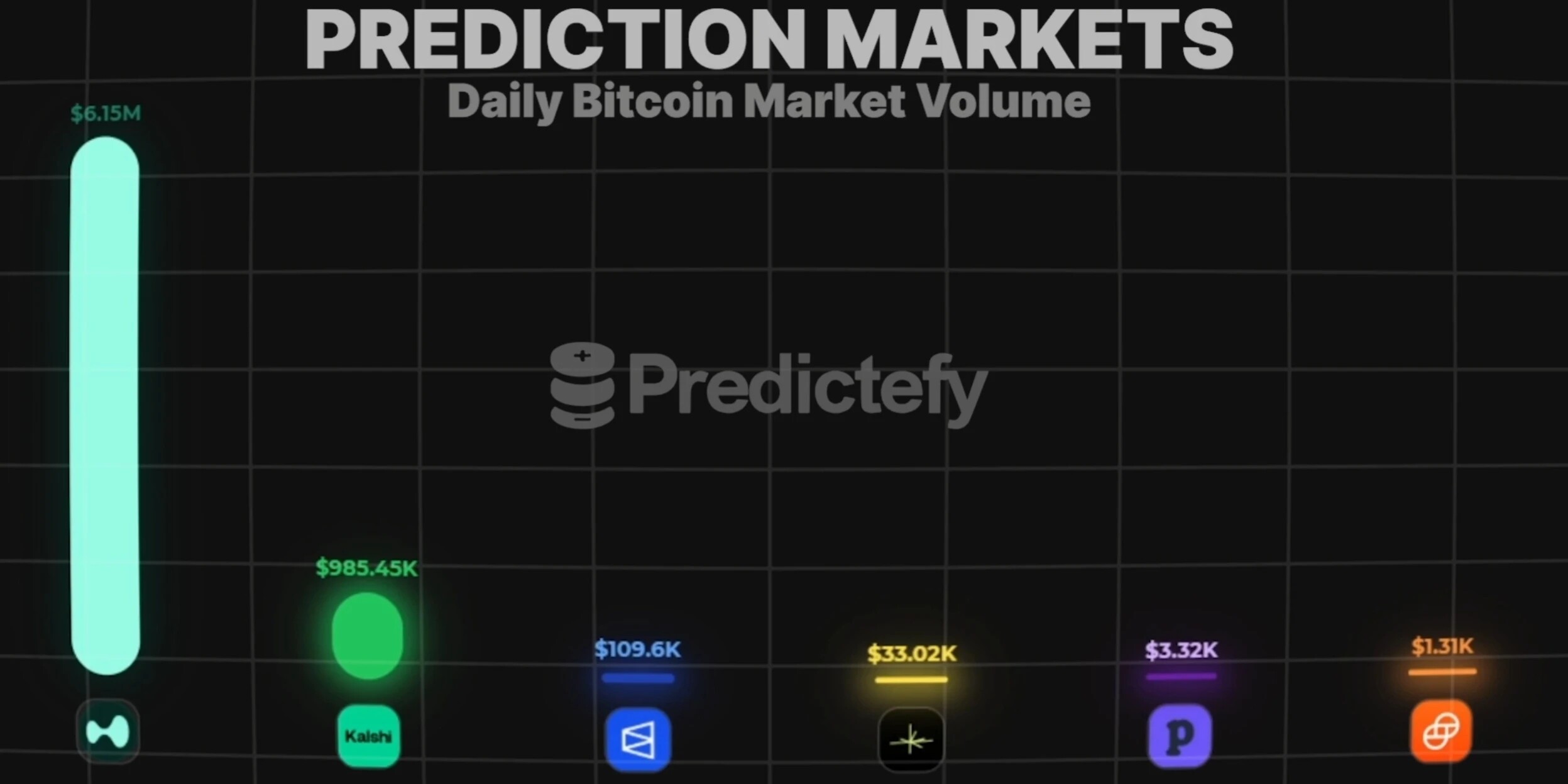
On May 2nd, Hyperliquid launched HIP-4 Outcome Markets on its mainnet, formally introducing outcome markets into its on-chain trading system. The first batch launched was intraday BTC binary outcome contracts, with first-day trading volume reaching $6.15 million, far exceeding similar prediction events on Kalshi and Polymarket. Additionally, over 54,000 trades were completed that day, involving more than 3,000 traders.
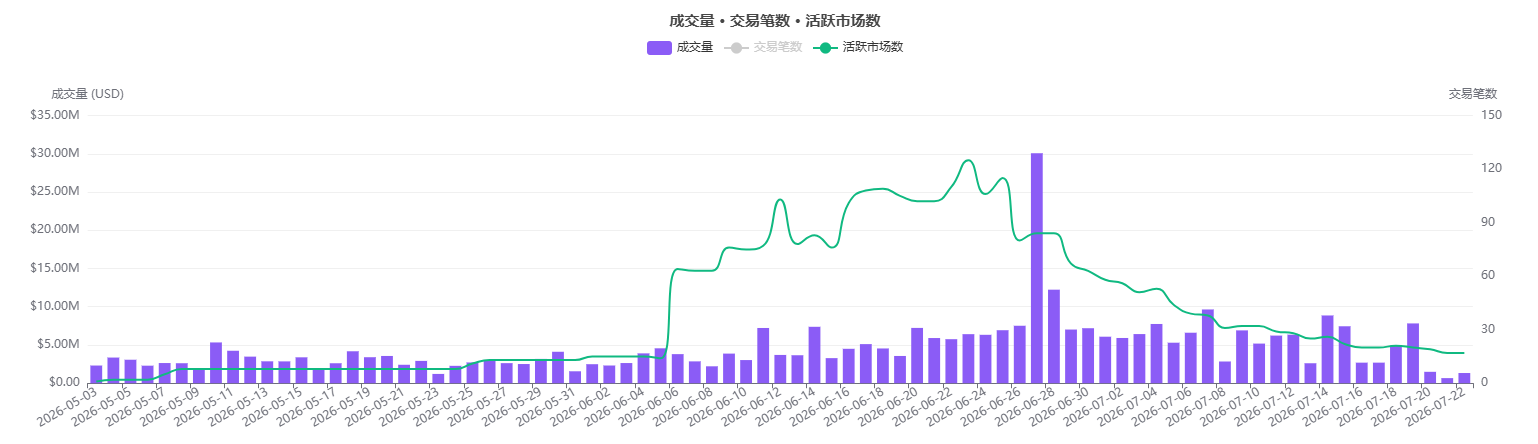
The World Cup further amplified this growth wave. In early June, HIP-4 had only dozens of active markets, which quickly rose to over 100, peaking at over 120. Trading volume also increased correspondingly, nearing $30 million on June 27th and remaining at the tens of millions level the next day. With the addition of sports events, macro data, and crypto price events, HIP-4 initially moved beyond its early state dominated by short-term BTC contracts and began expanding towards a more comprehensive event trading platform.
But the rapid increase in the number of markets did not translate into sustained trading demand. As the World Cup entered its later stages, the number of active HIP-4 markets began to decline continuously, dropping from a high of 125 to around 50, further decreasing to just over 20 by mid-July, and recently falling below 20, a contraction of over 85% from the peak. Trading volume also weakened in tandem, mostly returning to the millions of dollars range on most days, and recently even dropping below $1 million at times.
Behind this lies the completely different liquidity structures of Perps and event contracts. Perpetual contract trading has long revolved around core assets like BTC and ETH, allowing market makers, capital, and traders to continuously accumulate in the same set of markets. Event contracts, however, are settled continuously as matches end, data is released, or political events conclude, often requiring new markets to re-gather liquidity and trading interest. While Hyperliquid can reuse its matching system, accounts, and capital infrastructure, it cannot directly copy the liquidity and user trading frequency formed in Perps to HIP-4.
Polymarket: Perpetual Contract Daily Trading Volume Below $20 Million
Polymarket announced its foray into the perpetual contract market in April and began rolling out its Perps product to more users in July, supporting up to 20x leverage. Access currently still requires an invitation code activation or joining a waitlist. The product covers crypto assets like BTC, ETH, SOL, and has also extended to some stocks and commodities.
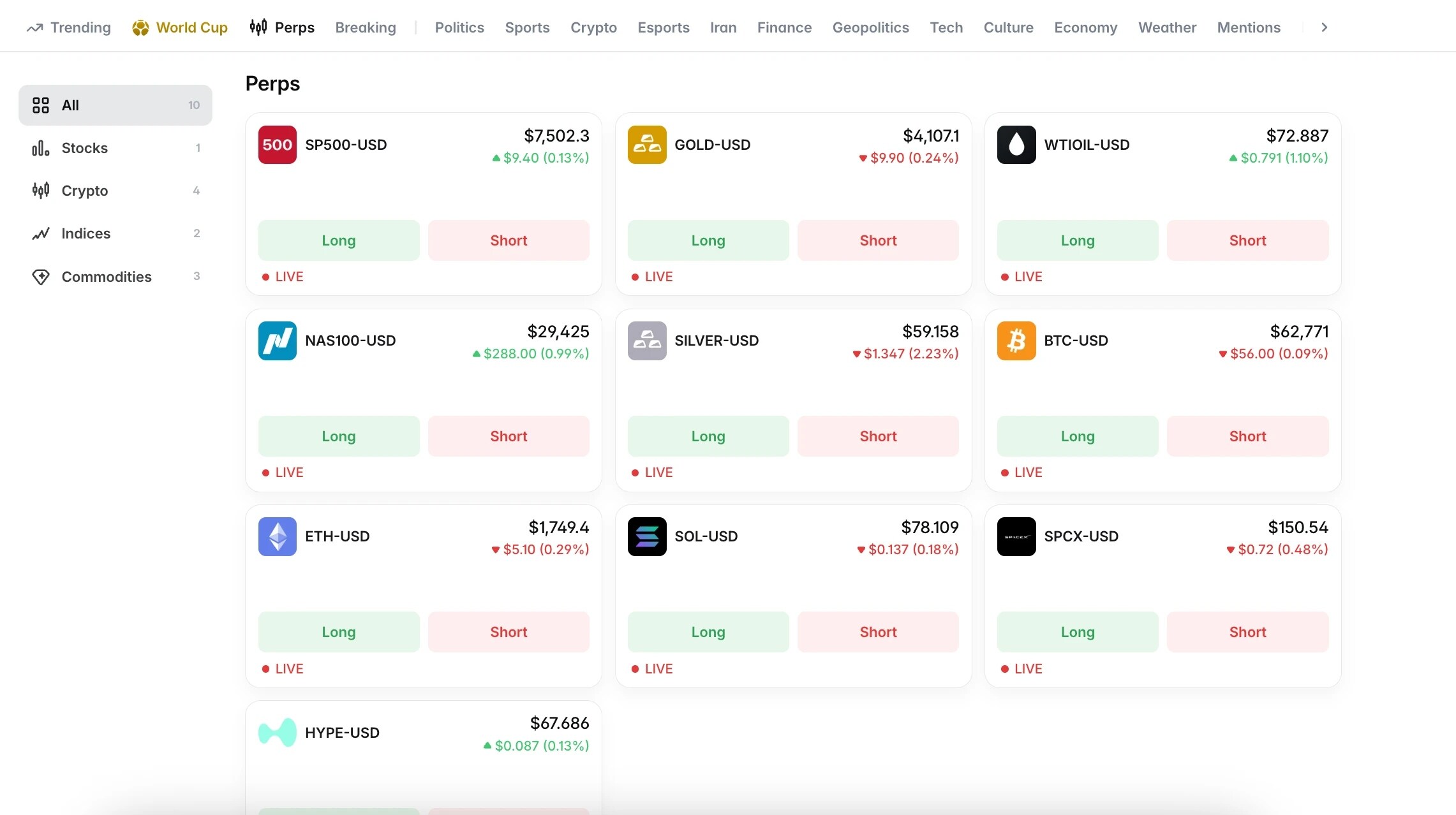
In its initial launch phase, Polymarket Perps saw 24-hour trading volume reach approximately $48 million, but this level was not sustained. By late July, daily trading volume had fallen to around $18.2 million, with open interest (OI) at approximately $26.4 million. The OI for core pairs like BTC and ETH also remained in the single-digit millions. Compared to the initial launch, trading activity for Polymarket Perps has noticeably cooled.
However, it's not entirely fair to directly compare Polymarket Perps with mature Perp platforms at this stage, as it remains in an early phase requiring invitation codes for trading. But even considering this, the gap in scale remains stark. During the same period, Hyperliquid's open interest was approximately $7.7 billion, with a 24-hour trading volume of about $1.58 billion. In contrast, Polymarket Perps' OI was only about $26.4 million, roughly 0.3% of the former; its daily trading volume was also only about 1% of Hyperliquid's.
Currently, the trading volume on Polymarket Perps resembles early user experimentation with a new product, not yet forming stable trading habits or sustained discussion heat. At least based on current data, the user base and brand advantages Polymarket accumulated in the prediction market have not smoothly transferred to the Perp sector. This cross-sector move cannot yet be called a success.
Kalshi Perps: $16.1 Billion in Trading Volume Over Six Weeks, but Recent Cooling
Compared to Polymarket, Kalshi's Perps had a faster start. At the end of May, Kalshi officially launched CFTC-regulated cryptocurrency perpetual contracts, initially covering BTC, ETH, SOL, XRP, and other assets. By July 9th, approximately six weeks after launch, the cumulative trading volume for Kalshi Perps had reached $16.1 billion.
However, compared to the rapid surge in volume at launch, Kalshi Perps' current trading heat has noticeably cooled. Data from Loris Tools shows that the daily trading volume for the Perps section on Kalshi was still $448 million on July 20th, but in the past two days, it has dropped to around $80 million—a plunge of over 80% in daily volume within just a few days.
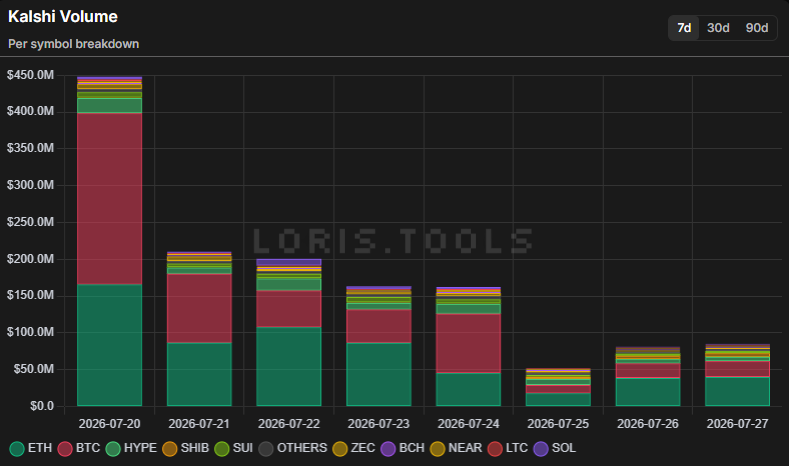
Meanwhile, Hyperliquid's Perp daily trading volume remains at the billions of dollars level. Even using Kalshi's recent high of $448 million on July 20th for comparison, there is still a significant gap in trading scale compared to Hyperliquid. With Kalshi's recent daily volume falling to around $80 million, the gap has widened further.
The disparity in open interest is even more pronounced. The OI for the Perps section on Kalshi remains in the tens of millions of dollars range, while Hyperliquid's is approximately $7.5 billion. Kalshi's cumulative $16.1 billion over six weeks indicates its Perps had a decent cold start, but the recent rapid decline in trading volume and persistently low OI also means it remains noticeably distant from the competitive range of mainstream Perp platforms.
Kalshi's "U.S. Compliant Gateway" remains its most distinct differentiator. But currently, this advantage primarily addresses the issue of "whether U.S. users can trade Perps," not yet solving "why professional Perp traders would stay on Kalshi long-term."
Crossing Boundaries is Difficult; Fortifying the Home Turf Might Be More Important Than the "Everything Exchange" Slogan
The cross-sector attempts by Hyperliquid, Polymarket, and Kalshi highlight the difficulty in replicating the long-accumulated user habits and liquidity of their original sectors. Hyperliquid's core users are more accustomed to high-frequency, leveraged, and on-chain derivatives trading, while Polymarket and Kalshi's users primarily focus on judging sports, politics, and trending events. Platforms can quickly add new categories but find it hard to make users simultaneously change their original trading styles.
For Hyperliquid, further deepening its Perp and on-chain asset trading might be more important than proving it can trade anything. For Polymarket and Kalshi, what remains truly scarce is event supply, user mindshare, and prediction market liquidity. Crossing boundaries can bring new growth imagination, but if new categories cannot form independent demand, they might also dilute the resources where the platform originally held the strongest advantage.
The so-called Everything Exchange, in the end, may not compete on who covers the most categories, but rather on who can continuously accumulate users, liquidity, and market depth in their core sector. For platforms that already possess clear advantages, deepening their home turf might be more crucial than constantly expanding their boundaries.