Blackrock Contributes to Bitcoin ETF Recovery of $32 Million After 4-Day Slump

cryptonews.ruPubblicato 2026-07-30Pubblicato ultima volta 2026-07-30

Introduzione

The cryptocurrency ETF market saw a reversal on July 29th. Bitcoin ETFs ended a four-day outflow streak, posting a net inflow of $32.11 million, largely driven by BlackRock's IBIT fund which attracted $89.83 million. This offset outflows from other major Bitcoin ETFs. Meanwhile, Solana ETFs rebounded with a $19.06 million inflow, primarily into Morgan Stanley's new staking-supported MSOL ETF, after significant outflows the previous day. Ethereum ETFs faced renewed pressure, however, with a net outflow of $18.65 million despite some inflows to new staking products. XRP ETFs saw a modest recovery. Conversely, $HYPE ETFs extended their losing streak to five days with further outflows. The data suggests a selective market: Bitcoin regaining support, Solana rebounding, and staking products attracting interest, while Ethereum and $HYPE faced continued selling pressure.

The cryptocurrency exchange-traded fund (ETF) market shifted direction again on Wednesday, July 29. Bitcoin found buyers after four consecutive sessions characterized by outflows, while Solana offset significant losses from the previous day with nearly equal inflows.

Ether funds were less fortunate. After two sessions of growth, they returned to outflows, and $HYPE ETF funds extended their losing streak to five days.

Blackrock Supported Bitcoin Amid Ether Fund Pullback

Blackrock's IBIT ETF became the driving force behind the Bitcoin ETF recovery, attracting an inflow of $89.83 million. This increase offset outflows of $43.08 million from Fidelity's FBTC and $14.64 million from ARK 21Shares' ARKB. As a result, the category ended the period with a net inflow of $32.11 million.

The total trading volume for Bitcoin ETFs reached $1.88 billion, and the aggregate net assets at the day's close stood at $77.46 billion.
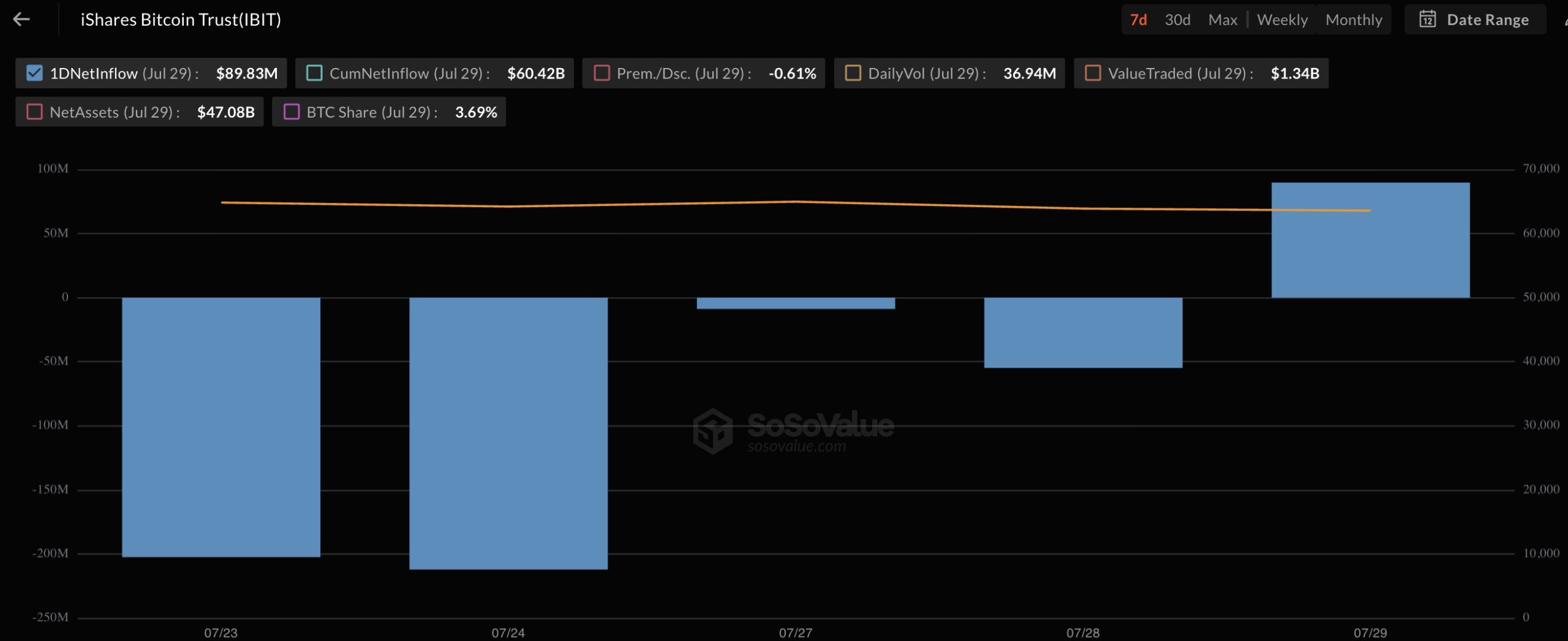
Bitcoin ETF fund flows appear to be largely dictated by Blackrock's IBIT fund, with Bitcoin ETFs' net gains/losses mirroring IBIT's flow dynamics. Source: Sosovalue

Ether ETFs displayed more mixed dynamics. The recently launched Morgan Stanley staking fund, MSSE, attracted $14.30 million, and Blackrock's ETHA ETF attracted $5.16 million.

These inflows were outweighed by outflows from five products. Fidelity's FETH fund lost $16.07 million. Grayscale's ETHE and Ether Mini Trust funds recorded outflows of $9.74 million and $8.09 million, respectively.

The 21Shares TETH fund lost $2.85 million, and Bitwise's ETHW lost $1.36 million. For the period, the net outflow for this category amounted to $18.65 million. Ether ETF trading volume was $563.79 million, with net assets at closing at $10.37 billion.

Solana Recovers Amid Accelerated Selling on Hype Wave

Solana ETFs attracted $19.06 million, offsetting the outflow of $18.07 million recorded during the previous session.

All new capital flowed into the recently launched Morgan Stanley MSOL ETF—a Solana ETF with staking support. The total trading volume reached $60.21 million, and net assets rose to $862.98 million.

Demand for new Morgan Stanley products related to staking was noticeable. The MSSE fund attracted $19.45 million over two days, and MSOL attracted $19 million on its first day of inflows, indicating that investors are responding positively to products that combine token investments with staking yield.

$XRP ETFs also returned to positive territory, though the growth was modest. Franklin Templeton's XRPZ attracted $584,710, bringing the total assets for the category to $988.70 million. Trading volume reached $10.35 million.

$HYPE ETF funds remained under pressure. Bitwise's BHYP fund recorded an outflow of $8.78 million, marking the fifth consecutive day of decline for this category. The trading volume for $HYPE ETF funds was $6.92 million, and net assets decreased to $252.38 million.

The latest fund flow data indicates that the market remains willing to take on cryptocurrency risk but is becoming increasingly selective. Bitcoin regained support, Solana bounced back, and staking products attracted interest. Ether and $HYPE, however, faced another wave of selling.

end-content


Crypto di tendenza

Domande pertinenti

QWhat was the main reason for the Bitcoin ETF market reversing its four-day outflow streak on July 29?

AThe main reason was a significant influx of $89.83 million into BlackRock's IBIT ETF, which offset outflows from other major Bitcoin ETFs, resulting in a net inflow of $32.11 million for the category.

QWhich newly launched product categories from Morgan Stanley attracted significant investor interest and capital?

AMorgan Stanley's newly launched staking-enabled ETFs attracted significant interest. The Ethereum staking fund (MSSE) attracted $14.30 million, and the Solana staking fund (MSOL) attracted $19.06 million, indicating positive investor reception for products combining token exposure with staking yield.

QHow did the performance of Ethereum ETFs compare to Bitcoin ETFs on the reported day?

AEthereum ETFs underperformed compared to Bitcoin ETFs. While Bitcoin ETFs saw a net inflow of $32.11 million, Ethereum ETFs experienced a net outflow of $18.65 million, with outflows from products like Fidelity's FETH and Grayscale's ETHE outweighing inflows.

QWhat happened to the $HYPE ETF funds during the reported period?

AThe $HYPE ETF funds continued to face selling pressure, with Bitwise's BHYP fund experiencing an $8.78 million outflow. This marked the fifth consecutive day of losses for the category, reducing its total net assets to $252.38 million.

QWhat does the latest fund flow data suggest about the overall sentiment in the cryptocurrency ETF market?

AThe data suggests the market is still willing to take on crypto risk but is becoming increasingly selective. Support returned for Bitcoin, Solana rebounded, and staking products attracted interest, while Ethereum and $HYPE faced continued selling pressure.

Letture associate

Qualcomm Chip Price Hike Deals a Blow to Android Phones

Qualcomm has officially announced a new round of price increases for its entire chip portfolio, effective September 1. The hikes, reaching up to 18% for the flagship Snapdragon 8 Elite Gen 6 Pro, follow similar moves by MediaTek, intensifying cost pressures on the already strained smartphone industry. CEO Cristiano Amon confirmed the plan, citing the need to offset rising industry-wide costs and restore declining profit margins. Qualcomm's Q3 FY2026 results showed a 25% drop in net profit, with mobile revenue plunging 20% year-over-year, hitting its lowest level since 2021. The surge in AI computing demand has led memory manufacturers to prioritize HBM production, creating a shortage in general-purpose DRAM and NAND Flash chips. Their prices soared by 93%-98% and 55%-60% respectively in Q1 2026, causing the memory cost share in smartphones to jump from 10%-15% to over 30%. Coupled with the soaring cost of advanced nodes like TSMC's 2nm and packaging, overall chip costs have reached historic highs. These upstream pressures are forcing downstream smartphone brands like Xiaomi, OPPO, and vivo to cut orders for mid-to-low-end models by up to 20% and use cost-saving measures like older chipsets. Reportedly, the Snapdragon 8E5 will be repurposed as a "long-lasting" chip for sub-brand phones in H2 2026. Amid this cost crisis, the Android market remains sluggish. Q2 2026 smartphone shipments in China fell 4.3% year-over-year, marking five consecutive quarters of decline. Major Android brands saw market share drop, while Huawei and Apple, with their in-house chip advantages, gained share. Qualcomm is diversifying into automotive and IoT sectors to reduce reliance on smartphones, but these new segments cannot yet fill the mobile revenue gap. Industry observers warn that the full impact of component cost hikes will hit in the second half of 2026, likely leading to higher-than-expected price increases for Android flagships and a further contraction in the Chinese smartphone market.

marsbit51 min fa

Qualcomm Chip Price Hike Deals a Blow to Android Phones

marsbit51 min fa

Breaking: GPT-5.6 Prices Slashed Effective Today

OpenAI has announced significant price cuts for its GPT-5.6 model API, effective immediately. The entry-level **GPT-5.6 Luna** sees the most drastic reduction, with input prices dropping 80% to $0.20 per million tokens and output prices falling to $1.20 per million tokens. The mid-tier **GPT-5.6 Terra** is reduced by 20%, now costing $2.00 (input) and $12.00 (output) per million tokens. The flagship **GPT-5.6 Sol** maintains its original price but introduces a new **Fast mode**, offering speeds up to 2.5 times faster for double the cost. The company attributes these price reductions to efficiency gains achieved through **GPT-5.6 Sol's own involvement in optimizing its production systems**. The model assisted in rewriting GPU kernels and improving speculative decoding, leading to a 20% reduction in end-to-end service costs and over 15% improvement in token generation efficiency. OpenAI emphasizes this process remained human-led. A key focus of the降价 is to lower the barrier for running **AI agent workflows**. By making the capable, tool-calling Luna model significantly cheaper, OpenAI aims to enable more frequent use in cost-sensitive, high-volume tasks like code review and monitoring. This creates a potential feedback loop: model-assisted efficiency gains lead to lower costs, which enables broader agent deployment, which in turn drives further optimization. The new pricing and features will also apply to Codex and ChatGPT Work subscriptions. The changes intensify competition in the large language model market, with OpenAI directly challenging rivals like Anthropic to respond.

marsbit1 h fa

Breaking: GPT-5.6 Prices Slashed Effective Today

marsbit1 h fa

Trading

Spot

Articoli Popolari

Come comprare 4

Benvenuto in HTX.com! Abbiamo reso l'acquisto di 4 (4) semplice e conveniente. Segui la nostra guida passo passo per intraprendere il tuo viaggio nel mondo delle criptovalute.Step 1: Crea il tuo Account HTXUsa la tua email o numero di telefono per registrarti il tuo account gratuito su HTX. Vivi un'esperienza facile e sblocca tutte le funzionalità,Crea il mio accountStep 2: Vai in Acquista crypto e seleziona il tuo metodo di pagamentoCarta di credito/debito: utilizza la tua Visa o Mastercard per acquistare immediatamente 44.Bilancio: Usa i fondi dal bilancio del tuo account HTX per fare trading senza problemi.Terze parti: abbiamo aggiunto metodi di pagamento molto utilizzati come Google Pay e Apple Pay per maggiore comodità.P2P: Fai trading direttamente con altri utenti HTX.Over-the-Counter (OTC): Offriamo servizi su misura e tassi di cambio competitivi per i trader.Step 3: Conserva 4 (4)Dopo aver acquistato 4 (4), conserva nel tuo account HTX. In alternativa, puoi inviare tramite trasferimento blockchain o scambiare per altre criptovalute.Step 4: Scambia 4 (4)Scambia facilmente 4 (4) nel mercato spot di HTX. Accedi al tuo account, seleziona la tua coppia di trading, esegui le tue operazioni e monitora in tempo reale. Offriamo un'esperienza user-friendly sia per chi ha appena iniziato che per i trader più esperti.

426 Totale visualizzazioniPubblicato il 2025.10.20Aggiornato il 2026.06.02

Come comprare 4

Discussioni

Benvenuto nella Community HTX. Qui puoi rimanere informato sugli ultimi sviluppi della piattaforma e accedere ad approfondimenti esperti sul mercato. Le opinioni degli utenti sul prezzo di 4 4 sono presentate come di seguito.

活动图片