New Protocol Tacit: The ZEC of the Bitcoin Ecosystem

marsbitPubblicato 2026-05-14Pubblicato ultima volta 2026-05-14

Introduzione

The article discusses Tacit, a new privacy-focused Bitcoin asset protocol emerging after a period of relative quiet in the Bitcoin ecosystem. Unlike BRC-20 or Runes, Tacit is a "meta-protocol" where the indexer runs directly in the user's browser, removing the need for centralized servers. Its key innovation is enabling privacy for token amounts on the Bitcoin mainnet. Tacit employs cryptographic techniques like Pedersen Commitments and Bulletproofs to conceal transaction amounts while proving conservation of funds. It uses Mimblewimble-style signatures to prevent inflation and ECDH encryption to ensure only senders and receivers can decrypt real amounts. This makes it a native "privacy coin" for Bitcoin, albeit one that hides amounts but not the direction of fund flows between addresses. The protocol, developed by ross.wei (known for Ethereum's ZAMM), has rapidly evolved since its May 7 launch. It now supports fair launches, a marketplace, token swaps, and a novel mixer similar to Tornado Cash but without relying on smart contracts. However, this privacy comes at a cost, with transaction fees estimated to be about 10 times higher than Runes. Future plans include privacy-wrapping native Bitcoin (cBTC), implementing silent receipts, and hiding the token type in transfers. The main token, $TAC, has gained traction with a market cap around $4 million. Positioned between simpler token standards and complex solutions like RGB, Tacit represents a significant and innovative step ...

The Bitcoin ecosystem had been forgotten for a long time. Especially after Magic Eden, once the largest Bitcoin ecosystem marketplace, stopped supporting the Bitcoin ecosystem and discontinued its Magic Eden Wallet service, it gave players who hadn't paid attention to the Bitcoin ecosystem for a while a feeling that "the Bitcoin ecosystem is over."

However, not only are veteran Bitcoin infrastructure projects like UniSat and Xverse still working hard, but after Magic Eden, marketplaces like SatFlow and ord.net have also filled the gap. Recently, the emergence of a new Bitcoin asset protocol has brought the Bitcoin ecosystem back into the spotlight.

This new protocol is called Tacit.

What is Tacit?

First, we need to classify Tacit into the "meta-protocol" category like BRC-20 and Runes, which rely on indexers to handle asset confirmation. If there's any difference, it's that Tacit's indexer runs directly in the user's browser, eliminating the need to trust any centralized server (indexer). As long as two computers run the same code and view the same Bitcoin blockchain data, they will arrive at the same balance results.

Tacit's unique aspect is that it is a new Bitcoin asset protocol focused on "privacy." Many players promoting this new protocol directly use analogies like "ZEC on Bitcoin." This has some merit but isn't entirely accurate, because Tacit's hiding capability only applies to the *amount* of tokens (including the total supply amount specified during new token deployment and the specific amount of each transfer), not to the on-chain address graph.

In other words, Tacit hides the *amount* of fund flow, but not the *direction* of fund flow.

Nevertheless, it is still a native privacy asset protocol on the Bitcoin mainnet. Let's use a simple analogy to explain how it achieves this on the Bitcoin mainnet.

An ordinary Bitcoin transaction is like a transparent ledger; everyone can see a transaction and how much money is involved. Tacit, on the other hand, is like putting the transaction into a "black box" (a Pedersen commitment).

People can still see that this transaction occurred. Although they cannot see the amount, you can prove to everyone that "the money I put in plus the money I take out balances the books."

Pedersen commitments and Bulletproofs are used to hide the transaction amount while proving to the entire network that you haven't fabricated tokens out of thin air (e.g., proving the transferred amount is not negative and the total is conserved).

Mimblewimble-style signatures prove that the outgoing amount equals the incoming amount, ensuring tokens cannot be maliciously inflated.

When the sender transfers tokens to the receiver, the amount information is encrypted using ECDH and written onto the blockchain. Only the sender and receiver can decrypt and see the real amount using their private keys; to others, this data is just gibberish.

Finally, the indexer built into the dApp (the user's browser) reads the data on the Bitcoin chain, independently verifies the aforementioned cryptographic proofs, and thereby calculates your real balance.

Since its launch on May 7th, developer ross.wei (@z0r0zzz) has been updating quickly. Currently, Tacit already supports fair launches, has a marketplace, supports token swaps, and even has a mixer.
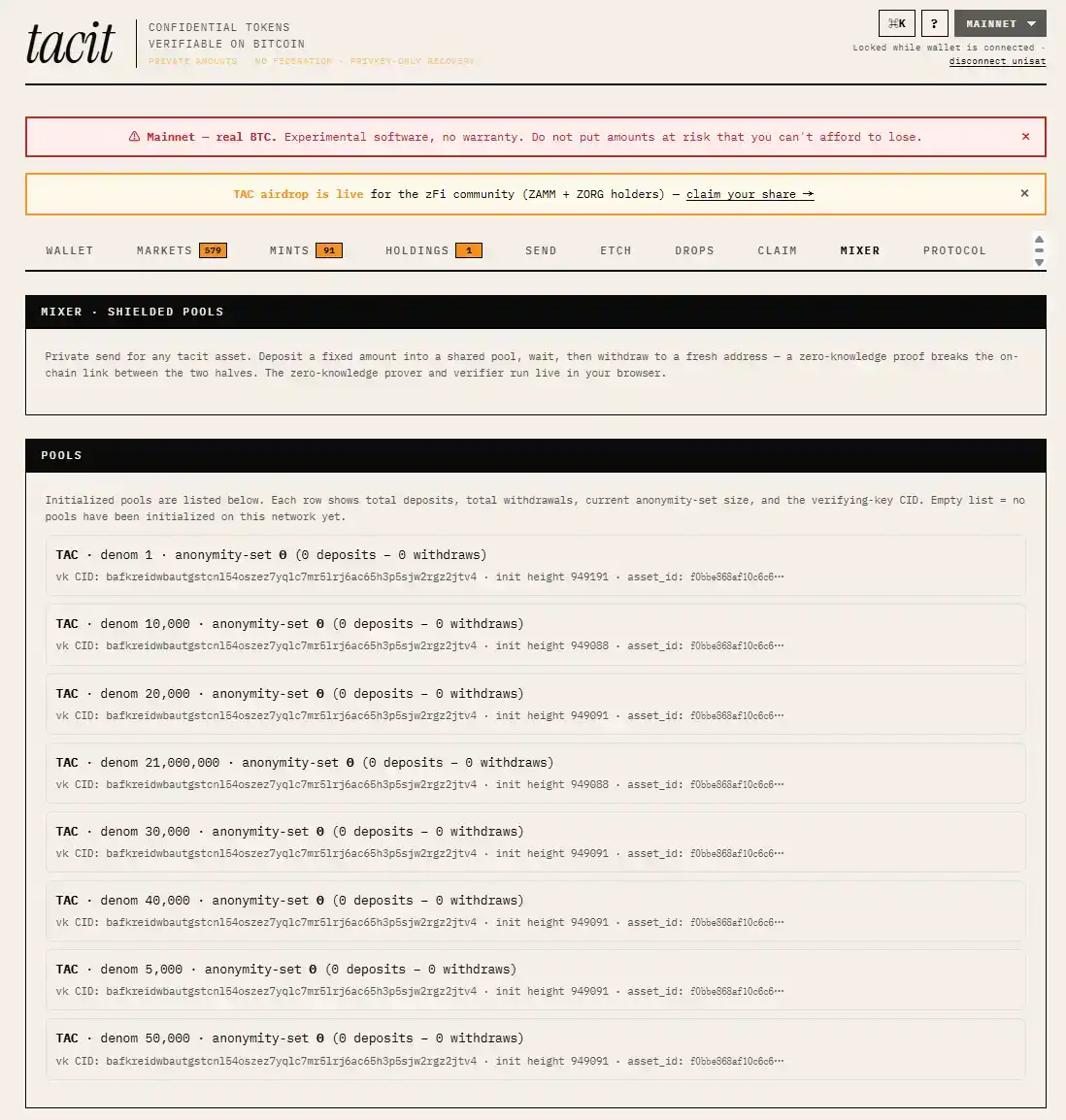
This mixer is somewhat similar to Tornado Cash—the more people deposit, the higher the privacy (harder to identify which addresses in the pool correspond). However, Tacit's mixer does not rely on smart contracts. It embeds the deposit proof in the Taproot transaction note, and the zero-knowledge proof for withdrawals is handled by the indexer in the browser.

It's even slightly stronger than Tornado Cash in some aspects because Tornado Cash cannot hide the amount being mixed. However, Tacit's mixer cannot mix native Bitcoin because hiding the mixing amount itself requires first wrapping the Bitcoin.

Of course, privacy comes at a cost. According to the GitHub documentation, due to the larger witness data required for hiding, the transfer cost corresponds to a mainnet fee rate of approximately 10 sat/vB, meaning each transfer costs about 25,000-30,000 sat, roughly 10 times the cost of a Runes transfer.

Who Built Tacit?

Developer ross.wei (@z0r0zzz) is a relatively well-known developer in the Ethereum ecosystem. He previously developed ZAMM, which uses a single contract for creating new tokens, managing LPs, farming, and swaps, significantly improving gas efficiency and user experience.

$ZAMM was also a notable project on Ethereum in the past, reaching a market cap in the tens of millions of dollars and receiving a retweet from crypto KOL Ansem.

Tacit isn't something he suddenly created on a whim; he has been interested in Bitcoin technology for a while. This new protocol has also garnered attention from Messari Enterprise Research Manager @AvgJoesCrypto.
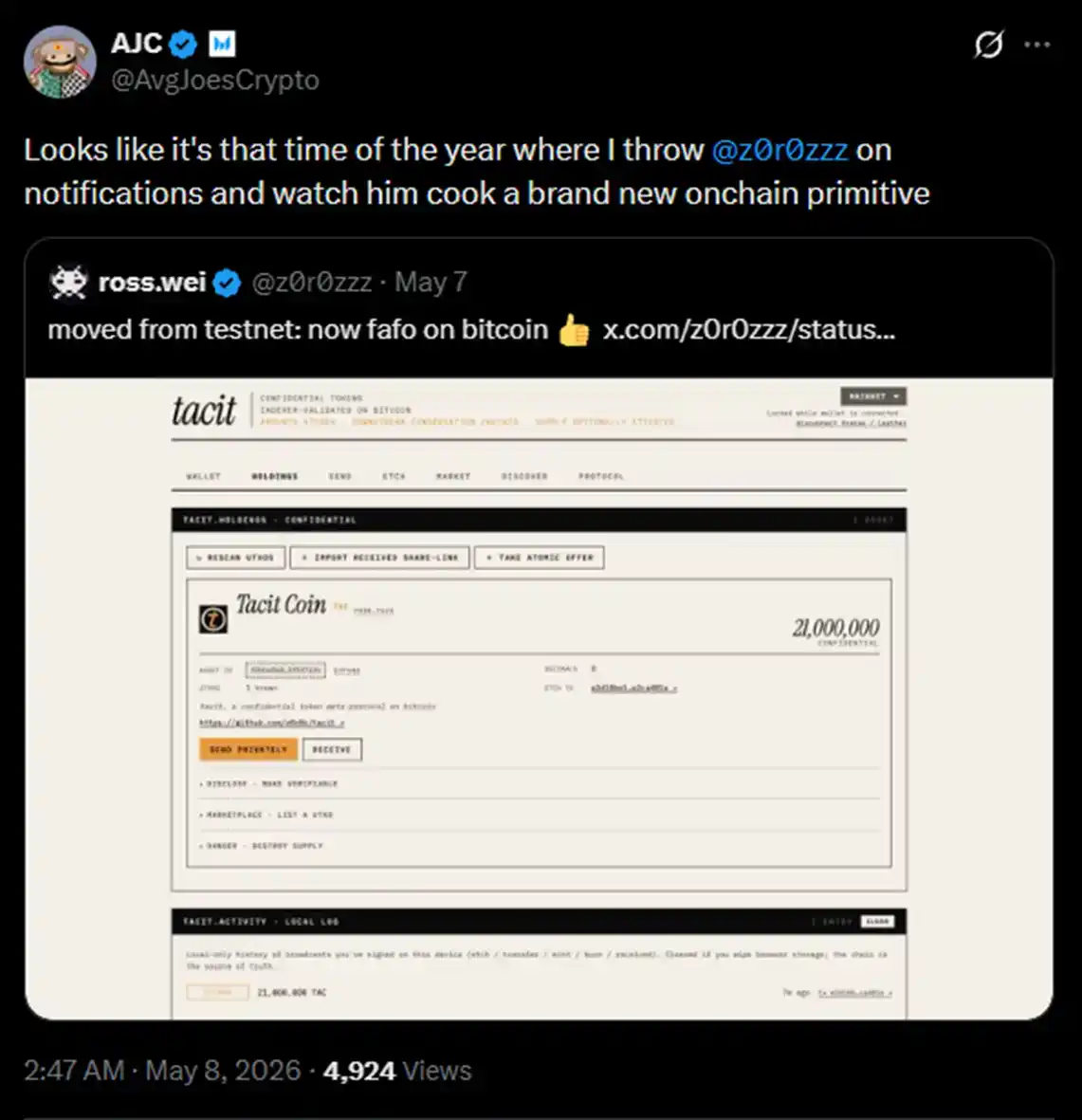
In the future, the author also plans to implement privacy-wrapped native Bitcoin (cBTC), silent receiving (generating a new one-time address for each receiving transaction), and hiding the type of currency being transferred.

Relevant Assets

Currently, the token with the highest trading volume is $TAC. This token was deployed by the protocol author himself and was airdropped not long ago based on holdings of the $ZORG staking token from the Ethereum-based $ZAMM. Its current market cap is approximately $4 million, making it the undisputed leader.

The first token launched via fair launch is $FAIR, though trading for this token is not yet available on the marketplace.

Conclusion

This is indeed an innovative Bitcoin asset protocol. Compared to BRC-20 and Runes, it has already implemented amount privacy and plans to achieve more. Compared to RGB, Taproot Assets, and Liquid CT, it doesn't rely on off-chain client-side proofs or exist as a sidechain; it operates entirely using on-chain data.

After repurposing its own protocol components to create a mixer, it has also addressed the hiding of the on-chain address graph.

Although the usage cost is relatively high, this is truly a refreshing and eye-catching innovation not seen in the Bitcoin ecosystem for a long time.


Domande pertinenti

QWhat is the main characteristic that differentiates the new Bitcoin asset protocol Tacit from protocols like BRC-20 and Runes?

ATacit is a privacy-focused Bitcoin asset protocol. Its primary differentiating characteristic is that it can hide the amount of tokens in transactions (including the total supply defined at deployment and the specific amount in each transfer), while protocols like BRC-20 and Runes have transparent ledgers. However, Tacit does not hide the direction of fund flows (i.e., the address graph).

QHow does Tacit achieve transaction amount privacy on the Bitcoin mainnet according to the article?

ATacit uses a combination of cryptographic techniques: Pedersen commitments and Bulletproofs to hide the transaction amount while proving to the network that no tokens are fraudulently created (e.g., proving amounts are non-negative and conserved). Mimblewimble-style signatures prove that the output amount equals the input amount, preventing malicious inflation. The actual amount information is encrypted using ECDH and written on-chain, decryptable only by the sender and receiver with their private keys.

QWho is the developer behind the Tacit protocol, and what is their background mentioned in the article?

AThe developer behind Tacit is ross.wei (@z0r0zzz). He is a well-known Ethereum developer who previously created ZAMM, a project that reached a multi-million dollar market cap and gained attention from crypto KOLs like Ansem. His interest in Bitcoin technology led to the development of Tacit.

QWhat is the current primary token associated with the Tacit protocol, and how was it distributed?

AThe primary token is $TAC. It was deployed by the protocol author and recently airdropped to holders of $ZORG, the staking token of the Ethereum-based $ZAMM project. Its current market capitalization is approximately $4 million.

QWhat are some of the planned future features for the Tacit protocol as mentioned in the article?

APlanned future features for Tacit include: privacy encapsulation for native Bitcoin (cBTC), silent receiving (generating a new one-time address for each incoming transaction), and hiding the type of token being transferred.

Letture associate

Google Cracks Down on 'AI Poisoning'

Google has taken a strong stance against "AI poisoning," a new form of manipulation where advertisers subtly feed information to influence AI-generated answers like those in Google's AI Overview. Unlike traditional SEO, which aims for higher website rankings, Generative Engine Optimization (GEO) seeks to have a brand or product recommended within the AI's response itself. This is particularly valuable as AI summaries, often perceived as neutral and comprehensive, can shorten the consumer decision path and directly influence purchases. The article illustrates the issue with a "hot dog experiment," where fabricated content was quickly picked up and presented as fact by AI. GEO exploitation is potent because AI models aggregate information from various sources—reviews, articles, forums—and can mistake coordinated marketing campaigns for genuine consensus. This threatens the core credibility of search engines. While Google's updated spam policy now explicitly covers attempts to manipulate AI-generated content, enforcement faces challenges. Google can leverage its long experience fighting SEO spam, using penalties like ranking demotion. However, sophisticated "gray area" tactics, such as sponsored third-party reviews or industry reports, are harder to distinguish from legitimate promotion. Other AI players, like Microsoft, have taken a more open approach to GEO, viewing it as a new channel for brands. Ultimately, as AI becomes a primary information source, maintaining the trustworthiness of its answers is a critical challenge for all platforms.

marsbit17 min fa

Google Cracks Down on 'AI Poisoning'

marsbit17 min fa

When Futu Turns into a Matchmaking Corner: Overseas Identity Becomes the Hard Currency for the Middle Class

When Futu Becomes a Matchmaking Corner: Overseas Status as the New Hard Currency for China's Middle Class Following a severe penalty announcement from Chinese regulators on May 22nd targeting offshore brokerages like Futu, its app community unexpectedly transformed into an impromptu matchmaking platform. Users posted相亲 (matchmaking) requests, explicitly seeking partners with overseas residency or citizenship, revealing a stark new reality: for China's middle class, an overseas identity has become a crucial asset. The regulatory crackdown, which restricts mainland Chinese residents from opening new accounts to buy overseas securities like US stocks, has sharply escalated the value of a foreign passport or permanent residency. This status now acts as a gateway to global asset allocation—including US equities, offshore property, and foreign currency deposits—effectively becoming a new form of "hard currency." Its scarcity, non-transferability (except through marriage, inheritance, etc.), and role as a hedge against domestic uncertainty have driven its premium. The article traces the evolution of how China's middle class views overseas resources: from an investment for opportunity (2000s), to risk diversification (2010s), and now to a mandatory "insurance policy" for financial access. With the regulatory window closing for many, the demand is shifting towards securing such status for the next generation through international education. The surreal scene of high-performing investors posting dating resumes underscores a 2026 where financial talent can be secondary to the right passport.

marsbit1 h fa

When Futu Turns into a Matchmaking Corner: Overseas Identity Becomes the Hard Currency for the Middle Class

marsbit1 h fa

Understanding Bound in One Article: The "Multi-signature + Timelock" Escape Mechanism and the Off-Chain Matching Black Box

**Title**: Understanding Bound: The Escape Mechanism of "Multi-Sig + Time Lock" and the Off-Chain Matching Black Box **Summary**: Bound Exchange, evolved from the earlier radFi platform, introduces a novel approach to Bitcoin trading by combining self-custody security with exchange-like speed. Its core mechanism relies on a 2-of-2 multi-signature (multi-sig) address for user deposits. One private key is held by the user via a passkey, and the other is held by Bound. This setup requires both keys to sign any transaction, preventing Bound from unilaterally accessing user funds (non-custodial). To address the risk of Bound becoming unavailable, a 3-month timelock is integrated into the Bitcoin script. After this period, users can withdraw their assets with just their single signature, ensuring an escape hatch. For trading, Bound operates a concentrated liquidity AMM. However, as Bitcoin L1 lacks smart contracts, the AMM curve, liquidity management, and trade price calculations occur off-chain in Bound's backend database. On-chain Bitcoin transactions serve only as final settlement receipts for pre-determined amounts. This creates a centralization point: the critical sequence of trade execution—which determines the exact price along the curve for each order—is managed off-chain by Bound in a non-transparent "black box." While the 2-of-2 setup protects user本金 (principal), the pricing and ordering of trades introduce potential operational MEV risks, as the order processing is invisible and unverifiable on-chain. In practice, users can also connect external wallets (like Unisat) for fully self-custodied trading, but this requires manually signing every transaction. The platform currently supports deposits of BTC and Runes only.

marsbit1 h fa

Understanding Bound in One Article: The "Multi-signature + Timelock" Escape Mechanism and the Off-Chain Matching Black Box

marsbit1 h fa

Technology Has No Barriers, 24/7 Trading is the Key to Hyperliquid's Success

The article argues that Hyperliquid's competitive edge lies not in technological superiority but in its 24/7 trading model, which fundamentally challenges traditional finance's fixed market hours. Based in Singapore with an 11-person team, Hyperliquid has generated significant revenue and trading volume. Its core advantage is the ability to facilitate trading continuously, including during weekends when major exchanges like the CME are closed. This was demonstrated when Hyperliquid listed a SpaceX pre-IPO perpetual contract on a Sunday, allowing the market to price the company hours before traditional institutions opened. This disruption has drawn regulatory scrutiny from traditional giants like CME and ICE, who cite risks like lack of KYC and market manipulation. However, the article suggests their concern stems from Hyperliquid eroding the "time monopoly" of established markets. The piece contrasts Hyperliquid's synthetic derivatives—pure price-betting contracts with no underlying asset or centralized issuer—with other models like PreStocks (dependent on real股权) and Ondo (licensed but targetable). Hyperliquid's code-based, decentralized structure makes it resilient to takedowns, even if founders face legal action. Ultimately, the author concludes that while it raises legitimate regulatory questions, Hyperliquid's "unforgeable" competitive barrier is the time advantage of non-stop trading, a feature legacy systems cannot replicate.

marsbit1 h fa

Technology Has No Barriers, 24/7 Trading is the Key to Hyperliquid's Success

marsbit1 h fa

Trading

Spot
Futures

Articoli Popolari

Come comprare ZEC

Benvenuto in HTX.com! Abbiamo reso l'acquisto di Zcash (ZEC) semplice e conveniente. Segui la nostra guida passo passo per intraprendere il tuo viaggio nel mondo delle criptovalute.Step 1: Crea il tuo Account HTXUsa la tua email o numero di telefono per registrarti il tuo account gratuito su HTX. Vivi un'esperienza facile e sblocca tutte le funzionalità,Crea il mio accountStep 2: Vai in Acquista crypto e seleziona il tuo metodo di pagamentoCarta di credito/debito: utilizza la tua Visa o Mastercard per acquistare immediatamente ZcashZEC.Bilancio: Usa i fondi dal bilancio del tuo account HTX per fare trading senza problemi.Terze parti: abbiamo aggiunto metodi di pagamento molto utilizzati come Google Pay e Apple Pay per maggiore comodità.P2P: Fai trading direttamente con altri utenti HTX.Over-the-Counter (OTC): Offriamo servizi su misura e tassi di cambio competitivi per i trader.Step 3: Conserva Zcash (ZEC)Dopo aver acquistato Zcash (ZEC), conserva nel tuo account HTX. In alternativa, puoi inviare tramite trasferimento blockchain o scambiare per altre criptovalute.Step 4: Scambia Zcash (ZEC)Scambia facilmente Zcash (ZEC) nel mercato spot di HTX. Accedi al tuo account, seleziona la tua coppia di trading, esegui le tue operazioni e monitora in tempo reale. Offriamo un'esperienza user-friendly sia per chi ha appena iniziato che per i trader più esperti.

251 Totale visualizzazioniPubblicato il 2024.12.12Aggiornato il 2025.03.21

Come comprare ZEC

Discussioni

Benvenuto nella Community HTX. Qui puoi rimanere informato sugli ultimi sviluppi della piattaforma e accedere ad approfondimenti esperti sul mercato. Le opinioni degli utenti sul prezzo di ZEC ZEC sono presentate come di seguito.

活动图片