The Bitcoin Playbook To Know: Step 4 Says A Crash Is Coming, But Where’s The Bottom?

bitcoinistPubblicato 2026-05-21Pubblicato ultima volta 2026-05-21

Introduzione

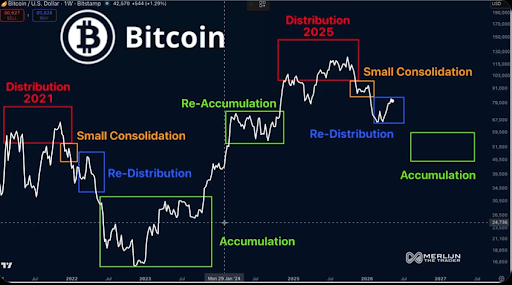
A crypto analyst's six-step framework, based on the 2021 market cycle, suggests Bitcoin is approaching a critical phase. According to Merlijn The Trader, BTC has already completed the distribution, small consolidation, and redistribution phases. The next projected step is a significant price crash into an accumulation range between $45,000 and $59,000, representing a potential decline of 24% to 42% from current levels near $77,500. However, a key condition exists: if Bitcoin can maintain a weekly close above the $78,000 level, this deeper correction phase could be skipped entirely, allowing the cycle to advance directly toward re-accumulation and a potential future rally.

Bitcoin has followed its current script before. According to one crypto analyst, it may be doing so again, and if history holds, the next move is not upward.

Crypto analyst Merlijn The Trader has outlined a six-step framework on X that places BTC’s current price action directly onto the structure of the 2021 market cycle. Three steps have already been completed. The fourth, he says, is next, and it involves another Bitcoin price crash.

Bitcoin Is Now At The Most Important Stage Of The Playbook

Merlijn’s weekly candlestick timeframe chart divides Bitcoin’s previous cycle into six phases: distribution, small consolidation, redistribution, accumulation, re-accumulation, and then the final rally. In the 2021 section of the chart, BTC first formed a distribution range near the cycle top before entering a smaller consolidation, then a redistribution phase, and finally a deeper accumulation zone after the major bear market breakdown.

The analyst is of the notion that the same structure is now playing out again. Distribution, he said, has already occurred. Bitcoin reached an all-time high of $126,060 in October 2025 before turning lower. Since that peak, Bitcoin’s price has been declining in bear market price action.
Source: Chart from Merlijn The Trader on X

The small consolidation phase that followed the distribution top has also been completed, and Bitcoin’s price action since late January is all in the redistribution phase. This caveat is why BTC is currently in the most important part of the technical setup. The next projection based on the setup is not another immediate rally phase, but a crash to an accumulation range much lower than current prices.

The $78,000 Line That Changes Everything

Merlijn placed that possible accumulation zone between $45,000 and $59,000. This would imply that Bitcoin still has one major downside leg left if the 2021-style structure continues to play out.

However, Merlijn’s analysis carries an interesting condition. If BTC holds $78,000, Step 4 is skipped entirely, and the cycle advances directly to re-accumulation and eventually the major run. If $78,000 breaks, the $45,000 to $59,000 accumulation range becomes the next destination before any real bounce. Therefore, the strongest version of the bullish case would be Bitcoin closing multiple weeks above $78,000 and forcing the Bitcoin price to skip the deeper accumulation phase.

That level is now under direct pressure. BTC broke below the $77,000 price level on May 18, but it is now back to trading around $77,500 at the time of writing. This means a drop to $59,000 would represent a decline of about 23.8%, while a fall to $45,000 would mark a deeper correction of 42% from the current price.

BTC trading at $77,632 on the 1D chart | Source: BTCUSDT on Tradingview.com

Domande pertinenti

QAccording to the analyst's framework, what are the six phases of Bitcoin's market cycle?

AAccording to the analyst, the six phases are: distribution, small consolidation, redistribution, accumulation, re-accumulation, and the final rally.

QWhat is the key price level that determines whether Bitcoin will skip the deeper crash phase (Step 4)?

AThe key price level is $78,000. If Bitcoin holds above $78,000, it could skip the deeper crash/accumulation phase and move directly to re-accumulation.

QIf the $78,000 support level breaks, what is the analyst's projected price range for the next accumulation zone?

AIf the $78,000 support breaks, the analyst projects the next accumulation zone to be between $45,000 and $59,000.

QWhat historical market cycle is the analyst comparing the current Bitcoin price action to?

AThe analyst is comparing the current Bitcoin price action to the structure of the 2021 market cycle.

QAccording to the article, which phase of the analyst's framework is Bitcoin currently in, and why is it considered the most important part of the setup?

ABitcoin is currently in the redistribution phase. It is considered the most important part because the next projection from this phase is not an immediate rally, but a potential crash to a much lower accumulation range if the 2021 pattern repeats.

Letture associate

The First Large-Scale Strike in the AI Era Comes from the Factories That Build AI

The article describes a potential large-scale strike at Samsung Electronics, narrowly averted in May 2026 after a temporary agreement. The strike, planned by the company's union, would have been the first major labor action in the AI era targeting a core AI supply chain player. Samsung, alongside SK Hynix, produces roughly two-thirds of the world's memory chips, critical components for AI training and data centers like HBM. An 18-day strike could have disrupted global supply, affecting prices and production for tech companies and cloud providers. For South Korea, where semiconductors constitute about 35% of exports and Samsung represents a quarter of the stock market's value, such an action threatens national economic stability. The union's demands include a 7% base wage increase and, crucially, a clear, substantial profit-sharing model. They want 15% of annual operating profit as an employee bonus pool and the removal of the existing cap (about 50% of annual salary). This frustration is amplified by seeing rival SK Hynix successfully negotiate a deal granting employees 10% of operating profit as bonuses, with reports suggesting some workers could receive bonuses equivalent to hundreds of thousands of dollars. The conflict stems from deeper issues in South Korea's chaebol (conglomerate) system, where rapid national industrialization often prioritized corporate growth over labor rights. Samsung long maintained a "no union" policy until a 2020 apology from its leader. The article argues this strike highlights a fundamental tension in the AI age: as technology advances and corporate profits soar—often driven by AI—the workers who build the infrastructure are demanding a fair share and dignity, rejecting the notion that they are mere expendable components in a machine that "must not stop." The piece concludes that the true test of the AI era isn't just computational power, but whether the people who build the future can secure a stable and valued place within it.

marsbit27 min fa

The First Large-Scale Strike in the AI Era Comes from the Factories That Build AI

marsbit27 min fa

Ripple’s Fed Master Account Bid Gains Momentum After Trump Order

President Donald Trump has signed an executive order directing financial regulators and the Federal Reserve to review expanding fintech and crypto firms' access to core payment infrastructure. This order significantly advances the industry's push for direct Fed connectivity, a central issue for Ripple. The company has been seeking a Federal Reserve master account as part of its strategy for its RLUSD stablecoin, which would allow it to hold reserves directly with the central bank and access its payment rails. The order, titled "Integrating Financial Technology Innovation into Regulatory Frameworks," mandates a Fed review within 120 days on allowing access for entities like uninsured depository institutions and non-bank financial companies, including those in digital assets. This creates a formal policy timeline for resolving whether crypto payment firms must rely on traditional bank intermediaries. Ripple's application for a national bank charter and a master account is part of this broader landscape. The issue gained precedent when Kraken Financial received a limited-purpose master account, while Custodia Bank's application was denied after a legal battle. The Fed has also proposed a more restricted "payment account" option. Trump's order does not guarantee approval for Ripple but forces a high-level examination of the regulatory barriers, bringing the company's long-running effort to the forefront of Washington's financial policy agenda.

bitcoinist41 min fa

Ripple’s Fed Master Account Bid Gains Momentum After Trump Order

bitcoinist41 min fa

Google's 2026 Roadmap is Hidden in This Keynote Speech

Google I/O 2026 was not merely a product launch, but a strategic unveiling of the company's decade-long roadmap. The core signal is that Google is evolving its AI, Gemini, from a feature within products into a foundational operating layer that integrates and reshapes its entire ecosystem—Search, Android, Chrome, YouTube, Workspace, XR, and developer tools. The traditional paradigms of digital interaction are being redefined. Search is shifting from finding links to understanding intent and completing tasks. Android is transforming from an app-centric OS into an AI-native platform that orchestrates workflows across services. Chrome is becoming an AI reasoning layer over the web, while YouTube is evolving into a conversational knowledge engine. Google is heavily investing in Agentic AI, aiming for AI to act as a digital operator that executes tasks autonomously. Underlying this vision is the integration of Gemini across all products, making it the central nervous system. Key developments include Gemini Omni for multimodal generation, deeper product integrations, and a push into XR glasses for contextual, ambient computing. Google is positioning AI not as an optional feature but as essential infrastructure, akin to electricity. The broader implication is a competition for the next computing interface. Google's goal is not just to win in chatbots or models, but to become the operating system for the AI era by controlling the primary entry points—search, assistant, OS, and browser—and weaving them into a unified, intelligent layer. This represents a fundamental shift in computing paradigms that will impact creators, developers, businesses, and how all users interact with technology.

marsbit1 h fa

Google's 2026 Roadmap is Hidden in This Keynote Speech

marsbit1 h fa

‘Withdraw Insurance to Buy Stocks’: South Koreans Over 60 Are Borrowing to Bet on Samsung

South Korea's stock market has seen a frenzy, with the KOSPI nearly doubling in six months. This boom is fueled by a surge in retail investors borrowing to buy stocks, with outstanding margin loans hitting a record high. A significant portion of this debt is held by people over 50, with the 60+ age group seeing the fastest growth. Many are reportedly cashing out savings-type life insurance policies—even at a loss—to fund their stock investments. They are heavily concentrated in major semiconductor stocks like Samsung Electronics and SK Hynix, which have driven most of the market's gains. This trend is particularly risky for older investors, who are leveraging their limited retirement savings. While a market correction in March caused significant losses for leveraged accounts, the swift recovery and continued rally have reinforced risky behavior. Stories of quick profits on platforms like Blind further fuel the speculative rush. The phenomenon is partly driven by economic anxiety. With South Korea having a high elderly poverty rate and a low public pension replacement rate, some seniors see the booming market as a last chance to improve their finances. This "FOMO" (fear of missing out) sentiment is palpable, even in public parks where retirees gather and now discuss stock tips alongside their usual activities. Despite regulatory warnings and the inherent risks of leverage—especially for those with little time to recover from losses—the borrowing binge continues. The market's heavy reliance on a few tech stocks and its cyclical nature pose a substantial threat to these elderly investors, for whom a downturn could be catastrophic.

marsbit1 h fa

‘Withdraw Insurance to Buy Stocks’: South Koreans Over 60 Are Borrowing to Bet on Samsung

marsbit1 h fa

Trading

Spot
Futures

Articoli Popolari

Come comprare 4

Benvenuto in HTX.com! Abbiamo reso l'acquisto di 4 (4) semplice e conveniente. Segui la nostra guida passo passo per intraprendere il tuo viaggio nel mondo delle criptovalute.Step 1: Crea il tuo Account HTXUsa la tua email o numero di telefono per registrarti il tuo account gratuito su HTX. Vivi un'esperienza facile e sblocca tutte le funzionalità,Crea il mio accountStep 2: Vai in Acquista crypto e seleziona il tuo metodo di pagamentoCarta di credito/debito: utilizza la tua Visa o Mastercard per acquistare immediatamente 44.Bilancio: Usa i fondi dal bilancio del tuo account HTX per fare trading senza problemi.Terze parti: abbiamo aggiunto metodi di pagamento molto utilizzati come Google Pay e Apple Pay per maggiore comodità.P2P: Fai trading direttamente con altri utenti HTX.Over-the-Counter (OTC): Offriamo servizi su misura e tassi di cambio competitivi per i trader.Step 3: Conserva 4 (4)Dopo aver acquistato 4 (4), conserva nel tuo account HTX. In alternativa, puoi inviare tramite trasferimento blockchain o scambiare per altre criptovalute.Step 4: Scambia 4 (4)Scambia facilmente 4 (4) nel mercato spot di HTX. Accedi al tuo account, seleziona la tua coppia di trading, esegui le tue operazioni e monitora in tempo reale. Offriamo un'esperienza user-friendly sia per chi ha appena iniziato che per i trader più esperti.

334 Totale visualizzazioniPubblicato il 2025.10.20Aggiornato il 2025.10.20

Come comprare 4

Discussioni

Benvenuto nella Community HTX. Qui puoi rimanere informato sugli ultimi sviluppi della piattaforma e accedere ad approfondimenti esperti sul mercato. Le opinioni degli utenti sul prezzo di 4 4 sono presentate come di seguito.

活动图片