Trading firm QCP Capital has released its latest market report, analyzing the dynamics of the stock and cryptocurrency markets ahead of the upcoming Federal Reserve meeting.
Trading on Friday, July 24th, on U.S. exchanges concluded with mixed results. The S&P 500 edged up 0.05% to 7,412 points, while the Nasdaq Composite lost 0.64%, dropping to 24,976 points — pressure on the index came from weakness in major technology companies. The Dow Jones Industrial Average, in contrast, gained 0.46%, closing at 51,947 points. The subdued Friday session continued the heavier trading from Thursday, when disappointing earnings reports from several tech giants dampened broader market sentiment.
Analysts at QCP Capital pay particular attention to the debt market. The yield on the 10-year U.S. Treasury note fell to approximately 4.67% on Friday — earlier in the week, it had reached its highest level since January 2025. The retreat in yields was partly facilitated by a drop in oil prices. The U.S. Dollar Index (DXY) remained stable, hovering around the 101.4 mark.
As QCP notes, market focus is now shifting to the Federal Open Market Committee (FOMC) meeting on Wednesday, July 29th. Most market participants still anticipate the federal funds rate will remain unchanged. However, investors will be closely watching the accompanying statement and comments from Fed Chairman Kevin Warsh — these could provide clues about how the regulator assesses the current dynamics of inflation and economic growth.
Crypto Market Holding Up Better Than Stocks
According to the QCP Capital report, digital assets have generally outperformed the stock market in July, despite the more complex macroeconomic backdrop. Since the beginning of the month, Bitcoin has risen approximately 11.6%, and Ethereum has gained 24.6%, even as rising Treasury yields and waves of risk aversion have periodically pressured markets overall.
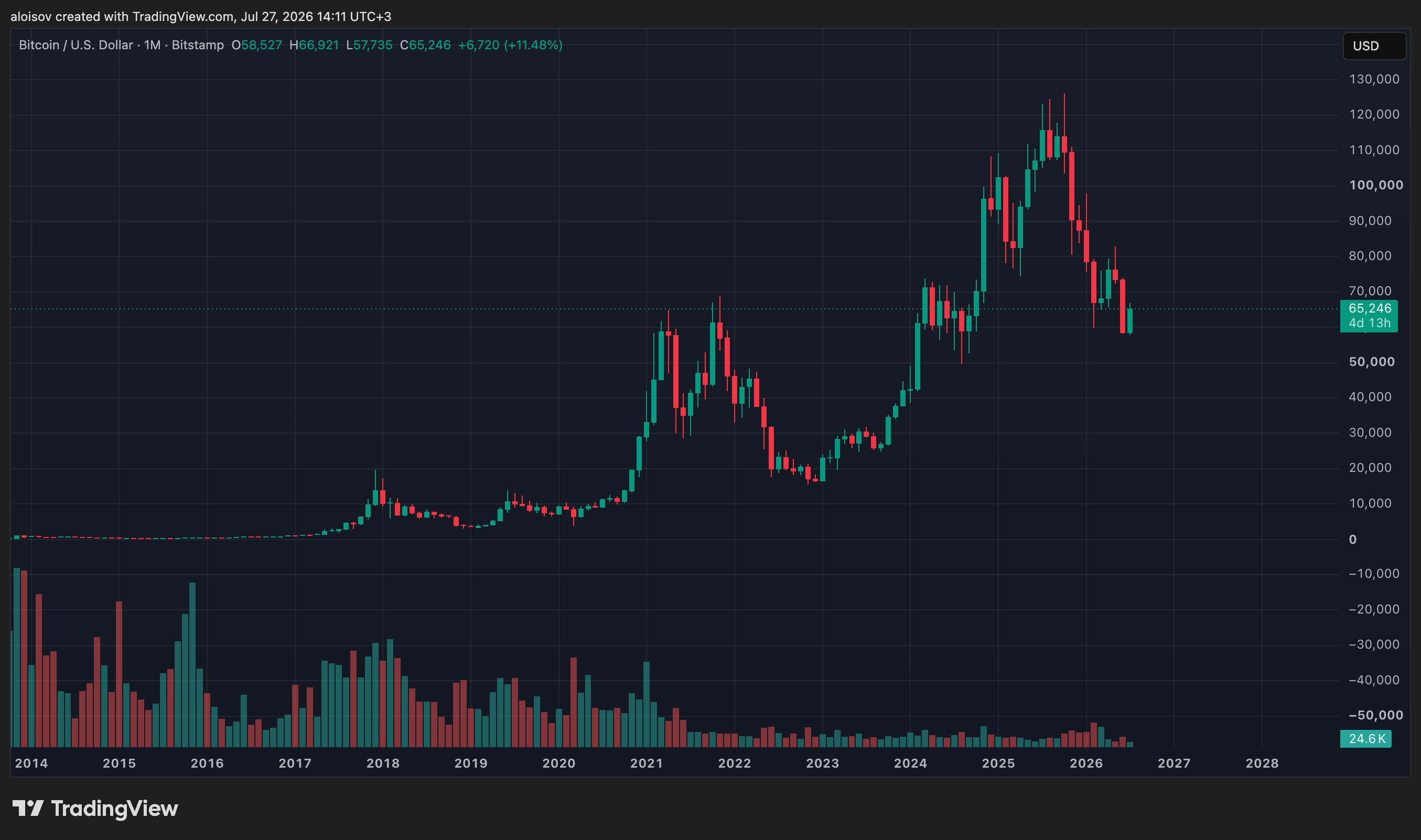
Meanwhile, capital flows into spot ETFs weakened at the end of last week. According to QCP, U.S. spot Bitcoin and Ethereum ETFs recorded a combined net outflow of approximately $311 million on July 24th, interrupting a seven-day streak of capital inflows. While weekly flows have repeatedly reversed throughout the year, ETF dynamics remain a key indicator of institutional interest and overall market sentiment.
Market participants are also focused on the fate of the CLARITY Act bill — its further progress continues to be closely monitored by the crypto community due to its potential implications for the U.S. regulatory framework.
Positioning in the Options Market
A separate section of the QCP Capital report is dedicated to the options market, where a cautious mood persists. Recent data points to increased demand for downside protection — a reaction to the broader deterioration in market sentiment that has partially offset the improvement in short-term risk-reversal indicators observed earlier in July.
A risk-reversal is an options strategy that shows how traders assess the probability of an asset's price rising relative to the probability of it falling. It works by comparing the price of call options (giving the right to buy an asset at a certain price) and put options (giving the right to sell an asset at a certain price) with the same expiration date. If put options are more expensive, it means market participants are willing to pay more for protection against a price decline, indicating cautious or pessimistic sentiment. If calls are more expensive, the market is pricing in greater upside potential.
The advantage of this indicator is that it provides insight into the balance of fears and hopes among market participants without the need to directly analyze spot prices. The disadvantage is that a risk-reversal only reflects current market expectations and can change quickly with new data, so it is not suitable as a standalone signal for decision-making.
According to QCP, implied volatility on the front-end of the curve for Ethereum continues to trade at a premium to the comparable metric for Bitcoin. At the same time, funding rates in the perpetual futures market remain positive, despite weaker spot price dynamics. Collectively, these indicators, as noted by QCP, suggest that overall market positioning remains constructive, although participants continue to hedge against short-term macroeconomic uncertainty.
What to Watch This Week
The calendar for this week is packed with macroeconomic events that could influence sentiment across several asset classes. QCP highlights the following key points:
July 29th — FOMC rate decision and press conference by Fed Chairman Warsh
U.S. Treasury yields — investors will continue to watch movements across the entire yield curve after its rise at the long end last week
ETF capital flows — whether last week's outflow becomes a temporary phenomenon or develops into a more sustained trend
Digital asset regulation in the U.S. — the market continues to monitor the fate of the CLARITY Act bill and its review schedule
The market is currently balancing two opposing signals — the resilience of the crypto market and growing caution in the options market. The outcome of the Fed meeting on Wednesday could tip these scales in either direction.
AI Opinion
Analysis shows that the current Fed pause in the easing cycle is not the first time the market has tried to guess what the regulator will do next. Researchers at PANews compare the rate-cutting cycle that began in September 2024 to three historical scenarios — the "preemptive" cycle of 1995, the "rescue" cycle of 2007, and the "panic" cycle of 2020, each of which impacted risk assets like Bitcoin differently. After several cuts in 2024-2025, the Fed shifted to holding rates steady in 2026, and the current caution in the options market is largely a reaction to this pause, not to a new wave of easing.
The macroeconomic link between Treasury yields and the value of digital assets is not limited to the current episode — the industry has long demonstrated an inverse correlation between interest rates and capital flowing into risky instruments. The situation with the CLARITY Act adds a separate layer of uncertainty that is not purely about monetary policy. Will the crypto market remain resilient if the Fed pause extends into the fall, or will macro-caution ultimately prevail over institutional demand?
end-content