Written by: Liam Akiba Wright
Compiled by: Chopper, Foresight News
TL;DR
- Bitdeer mined 921 bitcoins in May 2026, but held only 171 bitcoins by month-end.
- Behind this data discrepancy, Bitdeer is simultaneously developing its AI cloud business, which in theory could reduce the need to sell bitcoin for liquidity.
- However, May's operational data shows that Bitdeer's bitcoin holdings remain low. Whether AI business revenue can support corporate expansion and reduce bitcoin selling remains uncertain.
The latest operational data from Bitdeer reveals the realistic contradiction behind the collective pivot of bitcoin mining companies to the AI track: while mining output has soared, the total bitcoin holdings at month-end have shrunk significantly compared to the same period last year.
Bitdeer disclosed that it mined a cumulative 921 bitcoins in May 2026, a 370% year-on-year surge; yet its month-end bitcoin holdings were only 171. In contrast, the company's financial report for May 2025 showed mining output of 196 bitcoins and holdings as high as 1,351.
The stark contrast between output and holdings points directly to the selling pressure in the context of mining companies' transition to AI. The valuation logic Bitdeer conveys to investors is that a complete business map will be formed by its computing power mining farms, self-developed mining machines, power sites, AI cloud computing resources, and future data center colocation revenue. However, the bitcoin holding data on the balance sheet indicates that this transformation strategy still heavily relies on selling newly mined bitcoins to maintain operational cash flow.
The current situation presents both encouraging and concerning aspects. In theory, AI business revenue could create a cash buffer, alleviating the pressure for companies to sell tokens during downturns in the mining industry. A combined look at May and Q1 disclosure data shows: Bitdeer's mining output continues to rise, but its book bitcoin inventory has plummeted; simultaneously, the newly developing AI infrastructure business introduces a new dimension of risk.
The Discrepancy Between Bitcoin Production and Holdings is the Clearest Signal
Comparing the May data from the two years, the two core metrics show completely opposite trends. Mining output increased from 196 to 921 bitcoins, while bitcoin holdings plunged from 1,351 to 171.
Supplementary note: The May 2026 mining statistics include both proprietary and pooled mining output, while the May 2025 period only counted proprietary mining. Even after adjusting for this statistical difference, the vast disparity in holding size remains highly pronounced.
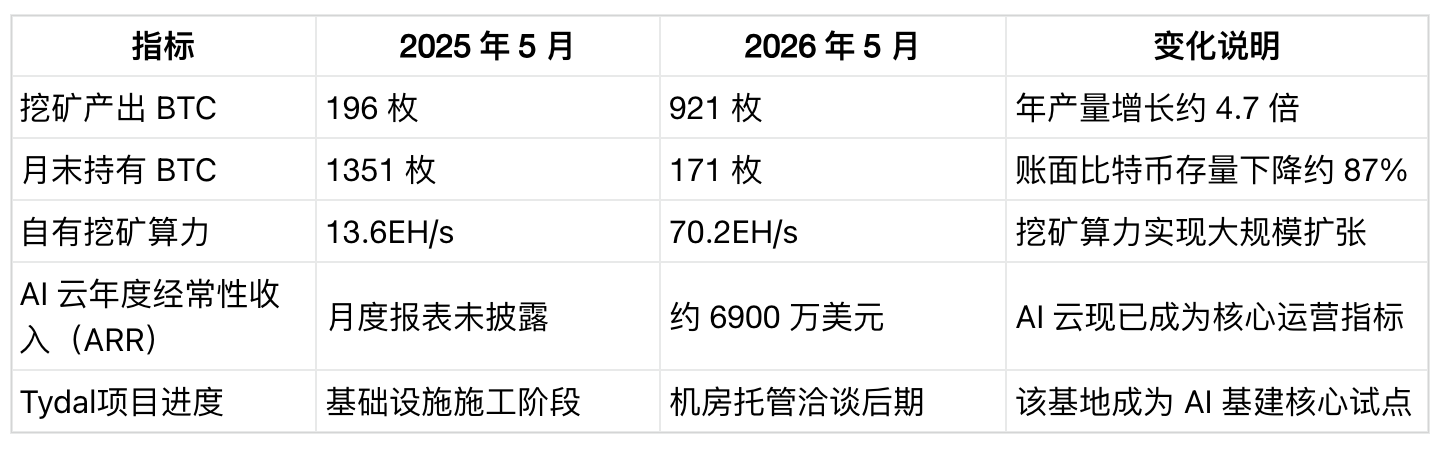
A rough estimate based on Bitcoin's price range of approximately $62,700 to $62,900 on June 19th: the total value of Bitdeer's May mining output was about $57.9 million, while the market value of its month-end bitcoin holdings was only $10.7 million.
This is merely an estimation based on spot prices and not official financial data disclosed by the company, yet it sufficiently illustrates the scale difference. While the monthly mining output volume is substantial, the retained bitcoin size on the books is severely mismatched with the company's overall operational scale.
Monthly holdings are a static point-in-time data point, unable to fully depict the entire flow of funds or precisely calculate how much of the month's output was sold, pledged, retained, or used for other purposes. However, this data is enough to prove that expanding computing power and increasing mining output have not translated into bitcoin treasury reserves for the company.
For a bitcoin miner transitioning to AI infrastructure, this data gap alters the investment logic: new AI revenue should either help the company retain more bitcoin or be used to fund capital-intensive infrastructure expansion.
Bitdeer's Q1 2026 financial report further confirms the trend seen in the May data. In Q1, Bitdeer mined 2,033 BTC, compared to only 350 BTC in the same period of 2025; quarter-end bitcoin holdings were a mere 31 BTC, compared to 1,156 BTC a year earlier. The company also disclosed the disposal of digital assets, realizing a total of $206.8 million.
As mining farm scale expands, Bitdeer's mining revenue has grown significantly, while bitcoin holdings on the balance sheet continue to decline, indicating the company is consistently converting mined bitcoins into funds needed for operations and expansion.
The company reported a net cash outflow of $346.9 million from operating activities in Q1; capital expenditures were $93.7 million, used for data center infrastructure, GPU procurement, tariff payments, and mining machine deployment; total corporate liabilities reached $1.9 billion. Total Q1 revenue was $188.9 million, with adjusted EBITDA at $14.4 million, and cash, cash equivalents, and restricted cash combined amounted to $297.7 million.
The company is progressing with a large-scale capital investment plan, where bitcoin reserves, debt financing, and infrastructure investment are interlinked, forming a unified development strategy.
Can AI Business Cash Flow Alleviate Bitcoin Selling Pressure?
Bitdeer's AI cloud business data is the core argument supporting market optimism. In May, the company disclosed that its AI Cloud Annual Recurring Revenue (ARR) remained stable at $69 million, with GPU utilization at 90%. It had deployed 4,248 GPUs, with an additional 3,305 GPUs under external lease agreements; two Nvidia GB300 NVL72 computing clusters were launched, and its Model Studio had been adapted for the Nvidia Nemotron 3 large language model.
AI cloud revenue had seen rapid growth prior to May. March monthly data showed ARR at about $43 million, rising to $69 million in April and maintaining that level in May. The growth rhythm shifted from high-speed expansion to steady operation, testing the business's sustainability.
Annual Recurring Revenue is merely an annualized projection metric. In Q1, the company's recognized AI cloud revenue booked into the income statement was only $3.7 million. There is a clear gap between the two: annualized revenue represents potential future revenue space, while recognized revenue is actual cash flow recorded in the profit and loss statement. A $69 million ARR figure might seem to reduce reliance on bitcoin sales, but the cash flow must still cover electricity costs, interest, capital expenditures, and costs associated with the cyclical volatility of the mining industry.
This monthly data from Bitdeer also raises an industry-wide debate about miners transitioning to AI. As CryptoSlate previously reported, even though most AI computing facilities are not yet operational, Wall Street is willing to assign higher valuations to bitcoin miners laying out AI and High-Performance Computing (HPC) plans. Bitdeer's May operational report localizes this industry question onto a single company: when AI business scale has reached a level warranting separate disclosure, yet the company's bitcoin treasury remains meager, how should this be interpreted?
The benefits for bitcoin miners venturing into AI cloud and data center colocation are apparent: long-term computing power lease contracts can smooth cash flow, reduce the need to sell bitcoin during market downturns, and allow proprietary power resources to generate additional value beyond the simple pricing system of mining.
However, the transition path also presents challenges: building AI infrastructure requires substantial capital, stable clients, mature delivery capabilities, and sufficient time. During this transition period, the bitcoin treasury likely serves more as a liquidity reserve rather than a long-term value asset.
The Tydal Project: Hidden Implementation Risks
The Tydal data center is the most tangible project illustrating Bitdeer's business model transformation. In March, the company disclosed that its Tydal data center subsidiary had partnered with a third-party institution to convert the campus into a 180-megawatt AI computing center, primarily to host Nvidia Vera Rubin equipment in a colocation model, with the project expected to be completed as early as December 2026.
The latest update in May indicated that the Tydal site had entered advanced negotiations with potential colocation clients. This project also serves as the company's core evidence: power sites originally serving bitcoin mining can be transformed to host client computing power leases, generating long-term contract revenue, no longer relying solely on bitcoin mining profits.
The bitcoin mining business exposes Bitdeer to risks related to computing power unit price, mining difficulty, transaction fees, energy costs, mining machine performance, and bitcoin price. The AI data center colocation business, however, introduces new risks: client creditworthiness, delivery milestones, GPU supply, construction timelines, power allocation, contract terms, and financing costs. Overall risk volatility might be reduced, but the sources of risk have shifted.
Therefore, Bitdeer's May operational report is less of a stellar report card and more akin to an ongoing stress test of its operations. CryptoSlate's report in February about Bitdeer's large-scale reduction in bitcoin reserves also addressed the market's core question: even as miners continuously produce bitcoin, they will still sell tokens to raise funds to support operational expansion.
Currently, Bitdeer's mining computing power continues to expand, bitcoin holdings saw a slight recovery after the March low, AI ARR stabilized at $69 million, and the AI data center colocation business continues to advance. However, the critical gap remains unfilled: AI annualized revenue cannot stably translate into sustained cash flow, and mining output hasn't accumulated as corporate bitcoin reserves.
If this profitability link is successfully established in the future, the AI business will become a safety cushion buffering the company's routine bitcoin selling operations. If this link fails to materialize, the transformation merely changes the form of risk: book bitcoin continues to dwindle, the company becomes highly dependent on computing power leasing business, while simultaneously bearing pressure from power parks, client development, and capital markets.
This is precisely the core question Bitdeer's May operational data leaves for the market: while mining 921 BTC in a month is certainly noteworthy, the mere 171 BTC held by month-end is the number that warrants deeper reflection.