StarDynamics Secures 2.5 Billion in Two Months, State-Owned Capital Consortium Joins In

marsbitPubblicato 2026-07-06Pubblicato ultima volta 2026-07-06

Introduzione

Star Era Raises 25 Billion Yuan in Two Months with State Capital Leading the Charge. Chinese humanoid robotics leader Star Era has secured a new 10-billion-yuan funding round led by state-owned capital, including funds like Chengtong Fund under the SASAC, marking 25 billion yuan raised within two months. The company, a spin-off from Tsinghua University, has built a comprehensive capital matrix combining state guidance, top-tier financial backers, and industrial partners. Founded in 2023 by Dr. Chen Jianyu, one of Tsinghua's youngest doctoral supervisors, Star Era stands out for its early and pioneering work on "world models" for embodied AI, notably releasing its PAD world action model ahead of major global players. The company follows an AI-native, full-stack R&D strategy from data and AI brain to control, dexterous hands (XHAND series), and robot bodies (bipedal L7, wheeled Q5). A core innovation is its fully direct-drive dexterous hands, which act as high-fidelity data collectors for training its AI models like the ERA-42 and VLAW, creating a virtuous cycle of data and intelligence. Star Era claims to possess one of the world's largest real-world dexterous hand datasets. Commercially, Star Era has achieved product-market fit, most notably in logistics, with robots operating 24/7 in distribution centers for partners like SF Express and China Post, handling over 1,200 parcels per hour. It is also expanding into high-end manufacturing (Samsung, Geely) and commercial servi...

China's top embodied intelligence companies are engaged in a battle of titans—

Investment community learned that today (July 6), StarDynamics completed a new round of 1 billion yuan financing. This round was led by the State-owned Assets Supervision and Administration Commission's (SASAC) state-owned capital operation company, Chengtong Fund. Other major state-owned capital participants included Jiangxi State-owned Capital Operation Holding Group, Guoyuan Equity, Yufu Zhongxin Fund, Hangzhou Capital, and others. Additionally, CICC Renault, Jiukun Venture Capital, Hony Capital, Juntai Capital, and Shenghe Capital followed on; existing shareholders Houxue Capital, Tsinghua Unigroup Tiancheng, and Qianshan Capital continued to invest.

With this, StarDynamics has raised 2.5 billion yuan in intensive financing over two months, constructing a triple capital matrix of "National-Level Capital Leadership + Top-Tier Financial Empowerment + Industrial Ecosystem Synergy," which assembles the industry's most extensive industrial capital injections, totaling over 20 entities.

In past communications with investors, StarDynamics left a deep impression on us: it is Tsinghua University's only equity-held embodied company, one of the earliest to propose world models in embodied AI, and despite being only three years old, it has already achieved scaled deployment in logistics scenarios. China's embodied intelligence landscape is filled with various schools, yet StarDynamics has quietly broken through.

Tsinghua's Direct Robotics Lineage

2.5 Billion in Financing in Two Months

The outside world may not know that StarDynamics is the proponent of the world model concept in embodied intelligence.

Rewind to 2024, VLA (Vision-Language-Action) was still the industry mainstream, but StarDynamics had already begun exploring research on world models. Not only did StarDynamics first propose the "world model" approach, it also released its world model achievement earlier than most globally—the PAD model released in September 2024 was the world's first World Action Model (WAM), integrating video prediction and action prediction, released nearly a year before similar solutions from NVIDIA (like DreamZero).

At the time, this was a pioneering, "minority" voice, somewhat esoteric.

It wasn't until the second half of 2025 that discussions about world models began frequently appearing in the embodied field. In October that year, StarDynamics collaborated with the Stanford University team led by Chelsea Finn to introduce Ctrl-World, using world models as data simulators to generate training data approximating real-world physics, improving performance by 45% over Pi0.5. Subsequently, we witnessed a global explosion of world models, with the entire industry converging towards this direction.

Being able to move slightly ahead of the industry is inseparable from the unique academic background of its helmsman, Chen Jianyu.

Born in 1992, he was admitted to Tsinghua University's Department of Precision Instruments in 2011—one of China's earliest institutions engaged in bipedal humanoid robotics research. During his undergraduate studies, Chen Jianyu began researching gait planning for bipedal robots. He later went to the University of California, Berkeley, for a direct Ph.D., studying under Professor Masayoshi Tomizuka, a member of the U.S. National Academy of Engineering and a pioneer in mechatronic control, delving deeply into robot reinforcement learning and motion control algorithms.

After earning his Ph.D. in 2020, upon invitation from Turing Award laureate and Chinese Academy of Sciences academician Yao Qizhi, Chen Jianyu returned to China and joined Tsinghua University's Institute for Interdisciplinary Information Sciences, serving as an assistant professor. At 28, he became one of the youngest doctoral supervisors at Tsinghua at the time.

These academic and research experiences made Chen Jianyu a rare talent in the industry with both hardware + brain capabilities, leading to very forward-thinking and keen choices in technical roadmaps and model iterations. In August 2023, leveraging Tsinghua's technology transfer policies, Beijing StarDynamics was officially established. It is the only embodied intelligence enterprise with direct equity held by Tsinghua University, with Chen Jianyu as its founder.

His core judgment is: to achieve true general intelligence, robots must simultaneously possess a smart "brain" and a dexterous "body"—a robot without a brain easily becomes scrap metal, and a brain without a body can hardly be called a robot.

Therefore, from day one, StarDynamics has been driven by AI Native principles, constructing the industry's only full-stack self-developed barrier encompassing "data-brain-motion control-dexterous hand-body." The core logic is "algorithm requirements first, data value first," starting from the actual needs of brain model training and deployment, and reverse-defining hardware design. To date, it possesses three major product lines: the full-size bipedal humanoid robot Star-L7, the wheeled humanoid service robot Star-Q5, and the full direct-drive five-finger dexterous hand Star-XHAND series.
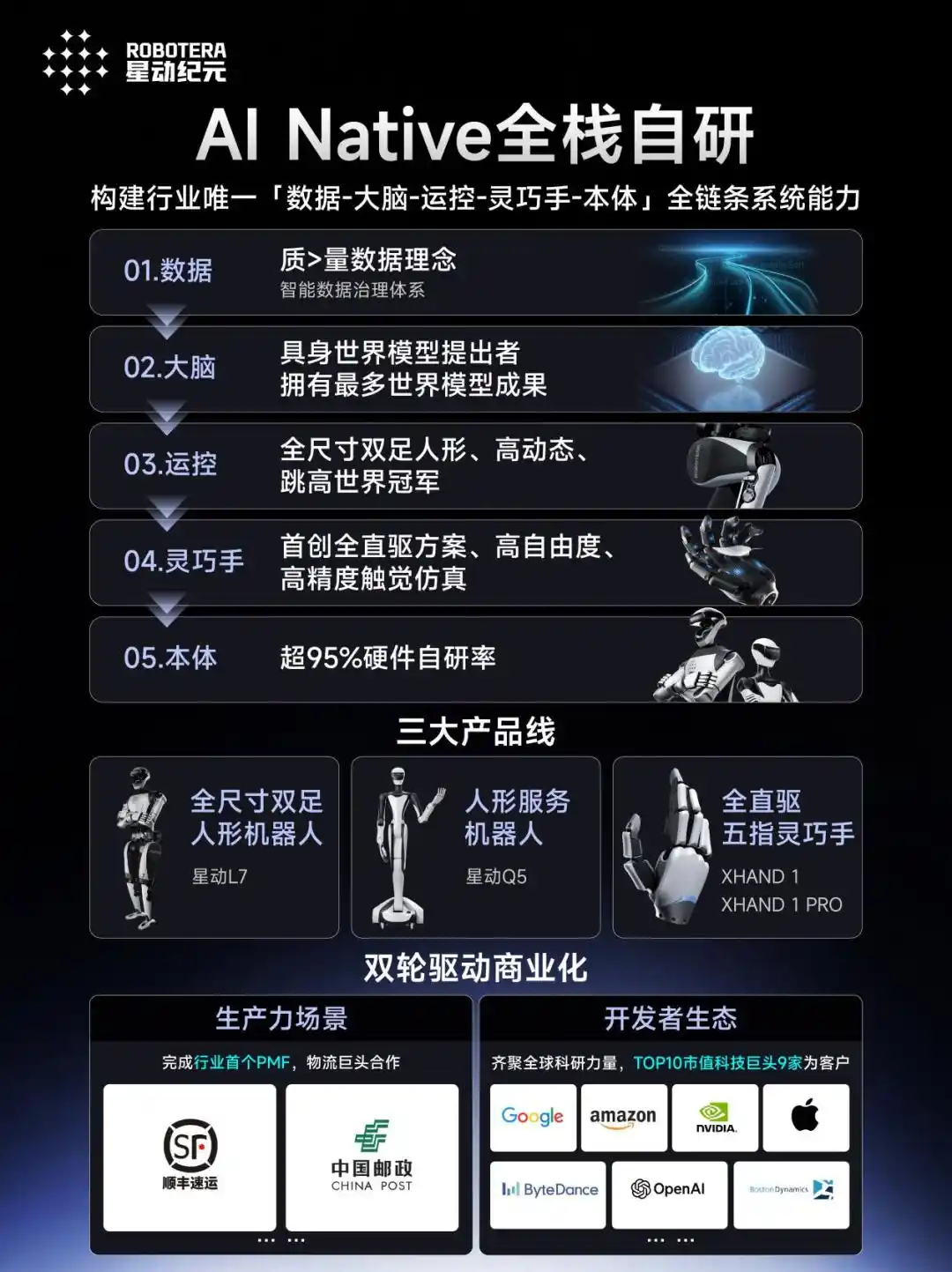
In less than three years, a long queue of investors has lined up behind Chen Jianyu. From early backers like Tsinghua University and Alibaba, to top-tier financial institutions like CDH VGC, Sequoia Capital China, IDG Capital, Qingliu Capital, CICC Capital, to industry giants like SF Express, Samsung, Geely Capital, Haier, Lenovo, Singtel, BAIC Capital, Dongfeng Capital, CICC Porsche, CICC Renault, and funds under China Unicom, as well as local state-owned capital like the Beijing Artificial Intelligence Industry Investment Fund—StarDynamics' shareholder list almost covers the most complete capital spectrum in the embodied intelligence sector.

Entering 2026, the financing pace accelerated dramatically: In March, it completed a 1 billion yuan strategic financing round, with valuation breaking through the 10 billion yuan mark. South Korea's Samsung and Singapore's Singtel appeared among its shareholders as overseas industrial capital for the first time. Just a month later, $200 million in financing arrived, led by SF Express, with leading institutions like Sequoia Capital China and IDG Capital jointly following on, while the industrial investor lineup expanded simultaneously. And today, with national-level state-owned capital platforms like Chengtong Fund collectively joining, a new 1 billion yuan financing round was announced. Securing three consecutive large-scale financings within three months, it set one of the fastest financing speeds in the embodied sector this year.

Thus, StarDynamics has constructed a triple capital matrix of "National-Level Capital Leadership + Top-Tier Financial Empowerment + Industrial Ecosystem Synergy," with over 20 industrial capital entities assembled behind it—a lineup not commonly seen in the industry.

Strengthening the Brain Through the Hand, Forging a New Path in Embodiment

At this juncture, for embodied intelligence to deliver industrial value, the competition is no longer about individual strengths, but the systemic capability integrating software and hardware—the brain (model and data) determines the upper limit of value, while the body (whole machine and end-effectors) constrains the lower limit of capability.

But within this system, there is a core hub often overlooked: the dexterous hand.

StarDynamics adheres to the AI Native principle of full-stack self-development across the entire embodied chain of "data-brain-motion control-dexterous hand-body," meaning hardware design does not start from mechanical structures but is reverse-defined from "what kind of data is most valuable for the brain." The five-finger dexterous hand is precisely the richest and most precise data collection entry point for physical world interaction—whether a grasp is successful, how force feedback changes, if an object slips, these high-dimensional data points directly determine what the model can learn.

Over the past two years, StarDynamics' models have continuously evolved:

In the first half of 2024, the team first proposed the robot fast-slow system VLA architecture (frequency-separated VLA), achieving the unity of "acting in real-time" and "deep thinking"; in the second half, they combined world models with VLA, releasing the VLA algorithm framework PAD and VPP integrating world models, and consolidating them to launch the end-to-end native robot brain model ERA-42.

ERA-42 is one of StarDynamics' core models, integrating vision, understanding, prediction, and action into one, enabling control of whole-body dexterous operations through a single end-to-end VLA model.

In February this year, building upon Ctrl-World, StarDynamics launched VLAW, pioneering the world's first VLA reinforcement learning framework based on world models, achieving synergistic iteration of policy and simulator, making world models not only "look right" but also "be physically correct." To date, StarDynamics is one of the embodied companies with the most world model achievements.

Breakthroughs in brain capability depend on high-quality data. On this front, relying on its self-developed dexterous hand and deployment applications, StarDynamics possesses the world's largest dataset from real dexterous hand hardware.

Simply put, StarDynamics uses dexterous hand hardware to obtain high-quality dexterous manipulation data, then uses this data to train smarter "brain" models, and finally feeds the evolved models back to the dexterous hands, forming a virtuous cycle of "the more used, the smarter; the smarter, the more capable." Therefore, the "dexterous hand" business is not merely a single-point component on the robot body but a core hub connecting the entire full-stack capability, the central entry point for collecting physical world interaction data.

Having long anticipated that end-effectors would become a bottleneck for embodied intelligence deployment, StarDynamics' dexterous hand adopted a brain-friendly, pioneering full direct-drive technical route—joint module output directly acts on joints, with no transmission backlash, elasticity, or friction loss. The generated data inherently possesses high precision, low latency, and reproducibility, and can be directly used for model training, fundamentally solving the quality issue of physical interaction data.

Currently, StarDynamics employs a "dual-hand strategy" with two differently positioned dexterous hand products:

1. Star-XHAND 1 PRO (Brain Hand), emphasizing high performance, core positioning as a data collection and algorithm validation platform, anchoring the upper limit of model capability;
2. Star-XHAND 1 (Work Hand), achieving precise force control and flexible operation through a full direct-drive technical architecture, adaptable to various humanoid robot platforms, solidifying the lower limit for scaled deployment.

It is reported that Star-XHAND 1 is now widely adopted to meet diverse needs in scenarios like industrial sorting and routine operations, becoming a shared choice for global robot manufacturers—American embodied intelligence unicorn Skild AI, South Korea's Rainbow Robotics, UK's Extend Robotics and Discover Robotics, as well as the new-generation humanoid robot HMND 01 from UK's Humanoid AI, among others, have all adopted Star-XHAND 1 as a core end-effector.

When the valuation of a single dexterous hand within the industry can even exceed that of the entire robot body, StarDynamics' narrative of "strengthening the brain through the hand" gains more substance. But ultimately, "strengthening the brain through the hand" is not the goal, but a means—obtaining high-quality data through the hand, training a stronger brain through the data, driving more intelligent robots through the brain, ultimately running through the full-stack system capability of "data-brain-motion control-dexterous hand-body," becoming real productivity in industrial scenarios—that is StarDynamics' true moat.

Relying on its self-developed dexterous hand and deployment applications, StarDynamics has accumulated a leading-scale dataset from real dexterous hand hardware within the industry. Based on this, the company has built a triple-gradient data source system:

Core Value Layer: Long-duration real hardware interaction data from real scenarios like logistics and industry, with 100% physical authenticity, forming the core foundation for models to align with industrial needs;
Precision Training Layer: High-precision teleoperation data, providing standardized action reference paradigms; currently has over 12 million clips of real hardware teleoperation data, including over 1.5 million clips of dexterous hand real hardware teleoperation data, one of the largest datasets of its kind in the industry;
Breadth Expansion Layer: First-person human behavior data and large-scale internet video data, enabling million-hour scaling, cost-effectively covering vast daily behaviors and scenarios.

Among these, long-duration real hardware interaction data from real scenarios and large-scale human video data simultaneously satisfy authenticity and diversity, constituting the dual core engines of the data system.

Currently, StarDynamics' overall dataset covers 100+ real scenarios and 1000+ dexterous manipulation tasks, sufficiently ensuring scene richness and behavioral diversity, laying a high-quality data foundation for the continuous iteration of the general embodied brain.

On this foundation, StarDynamics begins to answer the next question: Can this data support the brain in achieving commercial closed loops in real industrial scenarios?

Robots Begin Stable Deployment

The Watershed Moment

The answer lies on the industrial front lines where robots can stably deploy and work continuously.

StarDynamics adheres to a "B2B first, then B2C" commercialization path, gradually deploying in logistics, high-end manufacturing, and commercial service scenarios.

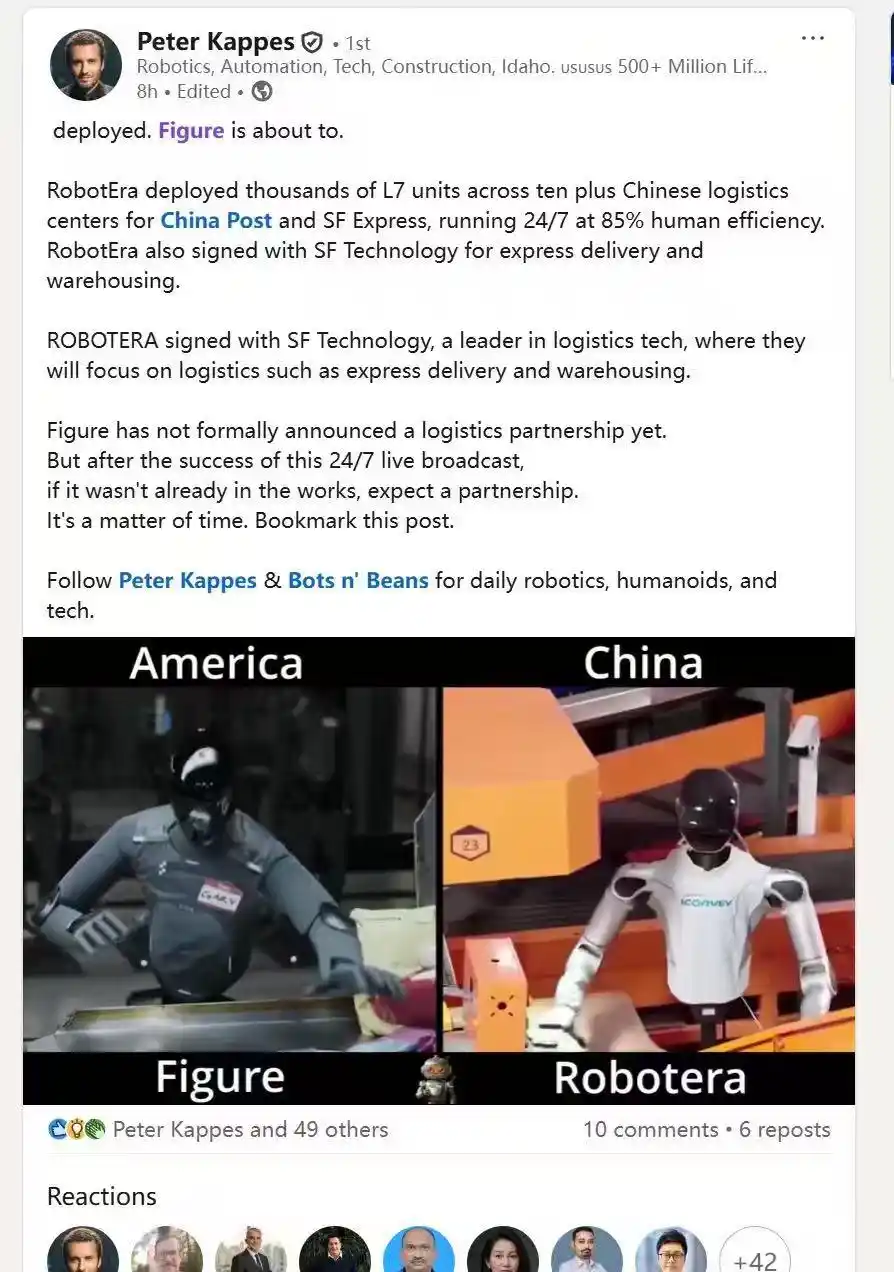
As we have seen, StarDynamics first achieved the industry's first PMF (Product-Market Fit) in logistics scenarios, deeply cooperating with leading clients like SF Express and China Post, batch-deploying to over 10 logistics centers across 5 provinces/municipalities in North, East, and South China, with some achieving normal 7×24 hour operations.

Here, embodied robots can flexibly handle various parcel sorting tasks involving packages of different shapes, materials, and sizes—grasping, turning parcel labels face-up, placing, etc. It's reported that efficiency in some scenarios even surpasses human levels, with processing speeds reaching over 1200 pieces per hour.

There's an interesting anecdote here—when the overseas embodied leader Figure conducted a live stream from its testing room, it was called out by foreign media: "StarDynamics' robots in China are already working at SF Express and China Post. When will Figure step out of the testing room and truly deploy?"
It is revealed that in the future, StarDynamics will continue to expand logistics scenarios, building a full-process embodied logistics service system covering inbound logistics, in-plant logistics, sales logistics, after-sales logistics, and extended express logistics links.

Meanwhile, high-end manufacturing and commercial service scenarios are also being rolled out. In high-end manufacturing for 3C electronics and automotive, StarDynamics has partnered with industry leaders like Samsung, Lenovo, Haier, and Geely. The real hardware data flowing back from these industrial sites continuously provides iterative nourishment for the embodied brain. Additionally, the Star-Q5 super-realistic service robot has been deployed in scenarios like Haier, Lenovo, and Century Golden Resources, providing services like store attraction, guided tours, explanation, and product delivery, exploring B2C entry points.

The underlying body capabilities supporting these deployments are also being validated by global top-tier institutions. StarDynamics' dexterous hands, universal body base, and development kits are not only used internally but have also been shipped globally, serving 9 out of the world's top 10 tech companies by market capitalization, becoming the shared choice of top tech firms and research institutions including OpenAI, Boston Dynamics, NVIDIA, Apple, Google, Amazon, ByteDance, as well as MIT, UC Berkeley, Stanford University, Tsinghua University, and Shanghai Qizhi Research Institute. Feedback from top-tier research clients further drives continuous upgrades to StarDynamics' hardware base.

As robots begin stable deployment, the prelude to the era of embodied intelligence leaders opens. As more robots enter the real world to perform tasks, those who can first establish data moats and evolution barriers for the next-generation robot brain that others find difficult to replicate will occupy key positions in the new round of competition.

As widely believed, 2026 is a watershed year for embodied models: in the first half, model capabilities diverge; in the second half, commercialization closed loops diverge. Capital markets no longer pay for stories, only recognizing one thing—whether technology can deploy, whether deployment can scale, and whether scale can feed back into technology.

The watershed moment has emerged—not under the spotlight of the laboratory, but on the logistics sorting lines at 3 a.m.

This article is from the WeChat public account "Investment Community" (ID: pedaily2012), author: Yang Jiyun


Crypto di tendenza

Domande pertinenti

QWhat is the significance of Xingdong Jiyuan's recent financing round, and which type of investors led it?

AXingdong Jiyuan recently completed a new 10 billion RMB financing round. It is significant because it was led by the State-owned Assets Supervision and Administration Commission (SASAC) state-owned capital operation company, Chengtong Fund, and involved participation from other major state-owned entities. This builds a 'three-fold capital matrix' of national capital leadership, top-tier financial empowerment, and industrial ecosystem collaboration. The company has raised 25 billion RMB in just two months.

QAccording to the article, what core technical concept did Xingdong Jiyuan pioneer in the field of embodied intelligence?

AXingdong Jiyuan was the proposer of the World Model concept in the field of embodied intelligence. It was an early pioneer, releasing its PAD model (a World Action Model) in September 2024, nearly a year before similar solutions like NVIDIA's DreamZero were announced.

QHow does Xingdong Jiyuan's 'AI Native' approach and its focus on dexterous hands (XHAND) create a competitive advantage?

AXingdong Jiyuan's 'AI Native' approach reverses the traditional hardware-first design. It starts by asking 'what data is most valuable for the AI brain?' and uses its self-developed, fully direct-drive dexterous hands (XHAND) as the primary sensor to collect high-quality, high-precision physical interaction data. This data is then used to train smarter brain models. This creates a virtuous cycle where better hands gather better data, which trains a better brain, enabling more capable robots, forming a core barrier through its full-stack 'data-brain-control-hand-body' capability.

QIn which industrial sector has Xingdong Jiyuan first achieved Product-Market Fit (PMF) with its robots?

AXingdong Jiyuan has first achieved Product-Market Fit (PMF) in the logistics sector. Its robots are deployed in-depth with leading clients like SF Express and China Post, operating 24/7 in over 10 logistics centers across China. They perform tasks like parcel sorting, handling items of various shapes and materials, with reported efficiency exceeding human levels in some scenarios.

QWhat does the article suggest is the key factor for success in the embodied intelligence field as of 2026?

AThe article suggests that 2026 is a watershed year where success is no longer about stories or isolated technologies. The key factors are whether the technology can be implemented, whether that implementation can be scaled, and whether the scale can, in turn, feed back to improve the technology. The 'dividing line' is now drawn in real-world industrial settings, like late-night logistics sorting lines, rather than in research labs.

Letture associate

China Added 67 New Unicorns in Half a Year, with AI and Robotics Accounting for Over Half

China added 67 new unicorn companies in the first half of 2026, reaching a total of 517 unicorns with a combined valuation of approximately $2.39 trillion. This surge marks a significant rebound after a post-2022 slowdown and sets a new semi-annual record. The growth is primarily driven by Artificial Intelligence (AI) and Robotics, which together account for over 53% of the new entrants. Specifically, 19 new unicorns are in robotics and 17 in AI. Notable companies include DeepSeek ($615.38B) and Kling AI ($18B). The trend indicates a decisive shift from internet consumer models to hard tech innovation. Geographically, new unicorns are highly concentrated in four cities: Beijing (19), Shanghai (18), Shenzhen (9), and Hangzhou (5), which together host 76.1% of the new companies. Hangzhou's overall valuation is boosted significantly by DeepSeek. Valuation distribution among new unicorns is pyramidal: 77.6% are valued between $1B and $2B, indicating early-stage status, while only two exceed $10B. There is a notable "speed divide": many AI/robotics startups achieved unicorn status in under three years, often via corporate spin-offs or led by star founders, while hard tech companies in semiconductors or biotech typically took over eight years. The report concludes that this wave reflects China's accelerating transition into an AI and robotics-powered innovation cycle, characterized by faster company formation, heightened geographic concentration, and a clear focus on foundational technologies.

marsbit32 min fa

China Added 67 New Unicorns in Half a Year, with AI and Robotics Accounting for Over Half

marsbit32 min fa

Trading

Spot

Articoli Popolari

Cosa è $S$

Comprendere SPERO: Una Panoramica Completa Introduzione a SPERO Mentre il panorama dell'innovazione continua a evolversi, l'emergere delle tecnologie web3 e dei progetti di criptovaluta gioca un ruolo fondamentale nel plasmare il futuro digitale. Un progetto che ha attirato l'attenzione in questo campo dinamico è SPERO, denotato come SPERO,$$s$. Questo articolo mira a raccogliere e presentare informazioni dettagliate su SPERO, per aiutare gli appassionati e gli investitori a comprendere le sue basi, obiettivi e innovazioni nei domini web3 e crypto. Che cos'è SPERO,$$s$? SPERO,$$s$ è un progetto unico all'interno dello spazio crypto che cerca di sfruttare i principi della decentralizzazione e della tecnologia blockchain per creare un ecosistema che promuove l'impegno, l'utilità e l'inclusione finanziaria. Il progetto è progettato per facilitare interazioni peer-to-peer in modi nuovi, fornendo agli utenti soluzioni e servizi finanziari innovativi. Al suo interno, SPERO,$$s$ mira a responsabilizzare gli individui fornendo strumenti e piattaforme che migliorano l'esperienza dell'utente nello spazio delle criptovalute. Questo include la possibilità di metodi di transazione più flessibili, la promozione di iniziative guidate dalla comunità e la creazione di percorsi per opportunità finanziarie attraverso applicazioni decentralizzate (dApps). La visione sottostante di SPERO,$$s$ ruota attorno all'inclusività, cercando di colmare le lacune all'interno della finanza tradizionale mentre sfrutta i vantaggi della tecnologia blockchain. Chi è il Creatore di SPERO,$$s$? L'identità del creatore di SPERO,$$s$ rimane piuttosto oscura, poiché ci sono risorse pubblicamente disponibili limitate che forniscono informazioni dettagliate sul suo fondatore o fondatori. Questa mancanza di trasparenza può derivare dall'impegno del progetto per la decentralizzazione—un ethos che molti progetti web3 condividono, dando priorità ai contributi collettivi rispetto al riconoscimento individuale. Centrando le discussioni attorno alla comunità e ai suoi obiettivi collettivi, SPERO,$$s$ incarna l'essenza dell'empowerment senza mettere in evidenza individui specifici. Pertanto, comprendere l'etica e la missione di SPERO rimane più importante che identificare un creatore singolo. Chi sono gli Investitori di SPERO,$$s$? SPERO,$$s$ è supportato da una varietà di investitori che vanno dai capitalisti di rischio agli investitori angelici dedicati a promuovere l'innovazione nel settore crypto. Il focus di questi investitori generalmente si allinea con la missione di SPERO—dando priorità a progetti che promettono avanzamenti tecnologici sociali, inclusività finanziaria e governance decentralizzata. Queste fondazioni di investitori sono tipicamente interessate a progetti che non solo offrono prodotti innovativi, ma contribuiscono anche positivamente alla comunità blockchain e ai suoi ecosistemi. Il supporto di questi investitori rafforza SPERO,$$s$ come un concorrente degno di nota nel dominio in rapida evoluzione dei progetti crypto. Come Funziona SPERO,$$s$? SPERO,$$s$ impiega un framework multifunzionale che lo distingue dai progetti di criptovaluta convenzionali. Ecco alcune delle caratteristiche chiave che sottolineano la sua unicità e innovazione: Governance Decentralizzata: SPERO,$$s$ integra modelli di governance decentralizzati, responsabilizzando gli utenti a partecipare attivamente ai processi decisionali riguardanti il futuro del progetto. Questo approccio favorisce un senso di proprietà e responsabilità tra i membri della comunità. Utilità del Token: SPERO,$$s$ utilizza il proprio token di criptovaluta, progettato per servire varie funzioni all'interno dell'ecosistema. Questi token abilitano transazioni, premi e la facilitazione dei servizi offerti sulla piattaforma, migliorando l'impegno e l'utilità complessivi. Architettura Stratificata: L'architettura tecnica di SPERO,$$s$ supporta la modularità e la scalabilità, consentendo un'integrazione fluida di funzionalità e applicazioni aggiuntive man mano che il progetto evolve. Questa adattabilità è fondamentale per mantenere la rilevanza nel panorama crypto in continua evoluzione. Coinvolgimento della Comunità: Il progetto enfatizza iniziative guidate dalla comunità, impiegando meccanismi che incentivano la collaborazione e il feedback. Nutrendo una comunità forte, SPERO,$$s$ può affrontare meglio le esigenze degli utenti e adattarsi alle tendenze di mercato. Focus sull'Inclusione: Offrendo basse commissioni di transazione e interfacce user-friendly, SPERO,$$s$ mira ad attrarre una base utenti diversificata, inclusi individui che potrebbero non aver precedentemente interagito nello spazio crypto. Questo impegno per l'inclusione si allinea con la sua missione generale di empowerment attraverso l'accessibilità. Cronologia di SPERO,$$s$ Comprendere la storia di un progetto fornisce preziose intuizioni sulla sua traiettoria di sviluppo e sui traguardi. Di seguito è riportata una cronologia suggerita che mappa eventi significativi nell'evoluzione di SPERO,$$s$: Fase di Concettualizzazione e Ideazione: Le idee iniziali che formano la base di SPERO,$$s$ sono state concepite, allineandosi strettamente con i principi di decentralizzazione e focus sulla comunità all'interno dell'industria blockchain. Lancio del Whitepaper del Progetto: Dopo la fase concettuale, è stato rilasciato un whitepaper completo che dettaglia la visione, gli obiettivi e l'infrastruttura tecnologica di SPERO,$$s$ per suscitare interesse e feedback dalla comunità. Costruzione della Comunità e Prime Interazioni: Sono stati effettuati sforzi attivi di outreach per costruire una comunità di early adopters e potenziali investitori, facilitando discussioni attorno agli obiettivi del progetto e ottenendo supporto. Evento di Generazione del Token: SPERO,$$s$ ha condotto un evento di generazione del token (TGE) per distribuire i propri token nativi ai primi sostenitori e stabilire una liquidità iniziale all'interno dell'ecosistema. Lancio della Prima dApp: La prima applicazione decentralizzata (dApp) associata a SPERO,$$s$ è stata attivata, consentendo agli utenti di interagire con le funzionalità principali della piattaforma. Sviluppo Continuo e Partnership: Aggiornamenti e miglioramenti continui alle offerte del progetto, inclusi partnership strategiche con altri attori nello spazio blockchain, hanno plasmato SPERO,$$s$ in un concorrente competitivo e in evoluzione nel mercato crypto. Conclusione SPERO,$$s$ rappresenta una testimonianza del potenziale del web3 e delle criptovalute di rivoluzionare i sistemi finanziari e responsabilizzare gli individui. Con un impegno per la governance decentralizzata, il coinvolgimento della comunità e funzionalità progettate in modo innovativo, apre la strada verso un panorama finanziario più inclusivo. Come per qualsiasi investimento nello spazio crypto in rapida evoluzione, si incoraggiano potenziali investitori e utenti a ricercare approfonditamente e a impegnarsi in modo riflessivo con gli sviluppi in corso all'interno di SPERO,$$s$. Il progetto mostra lo spirito innovativo dell'industria crypto, invitando a ulteriori esplorazioni delle sue innumerevoli possibilità. Mentre il percorso di SPERO,$$s$ è ancora in fase di sviluppo, i suoi principi fondamentali potrebbero effettivamente influenzare il futuro di come interagiamo con la tecnologia, la finanza e tra di noi in ecosistemi digitali interconnessi.

110 Totale visualizzazioniPubblicato il 2024.12.17Aggiornato il 2024.12.17

Cosa è $S$

Cosa è AGENT S

Agent S: Il Futuro dell'Interazione Autonoma in Web3 Introduzione Nel panorama in continua evoluzione di Web3 e criptovalute, le innovazioni stanno costantemente ridefinendo il modo in cui gli individui interagiscono con le piattaforme digitali. Uno di questi progetti pionieristici, Agent S, promette di rivoluzionare l'interazione uomo-computer attraverso il suo framework agentico aperto. Aprendo la strada a interazioni autonome, Agent S mira a semplificare compiti complessi, offrendo applicazioni trasformative nell'intelligenza artificiale (AI). Questa esplorazione dettagliata approfondirà le complessità del progetto, le sue caratteristiche uniche e le implicazioni per il dominio delle criptovalute. Cos'è Agent S? Agent S si presenta come un innovativo framework agentico aperto, progettato specificamente per affrontare tre sfide fondamentali nell'automazione dei compiti informatici: Acquisizione di Conoscenze Specifiche del Dominio: Il framework apprende in modo intelligente da varie fonti di conoscenza esterne ed esperienze interne. Questo approccio duale gli consente di costruire un ricco repository di conoscenze specifiche del dominio, migliorando le sue prestazioni nell'esecuzione dei compiti. Pianificazione su Lungo Orizzonte di Compiti: Agent S impiega una pianificazione gerarchica potenziata dall'esperienza, un approccio strategico che facilita la suddivisione e l'esecuzione efficiente di compiti complessi. Questa caratteristica migliora significativamente la sua capacità di gestire più sottocompiti in modo efficiente ed efficace. Gestione di Interfacce Dinamiche e Non Uniformi: Il progetto introduce l'Interfaccia Agente-Computer (ACI), una soluzione innovativa che migliora l'interazione tra agenti e utenti. Utilizzando Modelli Linguistici Multimodali di Grandi Dimensioni (MLLM), Agent S può navigare e manipolare senza sforzo diverse interfacce grafiche utente. Attraverso queste caratteristiche pionieristiche, Agent S fornisce un framework robusto che affronta le complessità coinvolte nell'automazione dell'interazione umana con le macchine, preparando il terreno per innumerevoli applicazioni nell'AI e oltre. Chi è il Creatore di Agent S? Sebbene il concetto di Agent S sia fondamentalmente innovativo, informazioni specifiche sul suo creatore rimangono elusive. Il creatore è attualmente sconosciuto, il che evidenzia sia la fase embrionale del progetto sia la scelta strategica di mantenere i membri fondatori sotto anonimato. Indipendentemente dall'anonimato, l'attenzione rimane sulle capacità e sul potenziale del framework. Chi sono gli Investitori di Agent S? Poiché Agent S è relativamente nuovo nell'ecosistema crittografico, informazioni dettagliate riguardanti i suoi investitori e sostenitori finanziari non sono documentate esplicitamente. La mancanza di approfondimenti pubblicamente disponibili sulle fondazioni di investimento o sulle organizzazioni che supportano il progetto solleva interrogativi sulla sua struttura di finanziamento e sulla roadmap di sviluppo. Comprendere il supporto è cruciale per valutare la sostenibilità del progetto e il suo potenziale impatto sul mercato. Come Funziona Agent S? Al centro di Agent S si trova una tecnologia all'avanguardia che gli consente di funzionare efficacemente in contesti diversi. Il suo modello operativo è costruito attorno a diverse caratteristiche chiave: Interazione Uomo-Computer Simile a Quella Umana: Il framework offre una pianificazione AI avanzata, cercando di rendere le interazioni con i computer più intuitive. Mimando il comportamento umano nell'esecuzione dei compiti, promette di elevare le esperienze degli utenti. Memoria Narrativa: Utilizzata per sfruttare esperienze di alto livello, Agent S utilizza la memoria narrativa per tenere traccia delle storie dei compiti, migliorando così i suoi processi decisionali. Memoria Episodica: Questa caratteristica fornisce agli utenti una guida passo-passo, consentendo al framework di offrire supporto contestuale mentre i compiti si sviluppano. Supporto per OpenACI: Con la capacità di funzionare localmente, Agent S consente agli utenti di mantenere il controllo sulle proprie interazioni e flussi di lavoro, allineandosi con l'etica decentralizzata di Web3. Facile Integrazione con API Esterne: La sua versatilità e compatibilità con varie piattaforme AI garantiscono che Agent S possa adattarsi senza problemi agli ecosistemi tecnologici esistenti, rendendolo una scelta attraente per sviluppatori e organizzazioni. Queste funzionalità contribuiscono collettivamente alla posizione unica di Agent S all'interno dello spazio crittografico, poiché automatizza compiti complessi e multi-fase con un intervento umano minimo. Man mano che il progetto evolve, le sue potenziali applicazioni in Web3 potrebbero ridefinire il modo in cui si svolgono le interazioni digitali. Cronologia di Agent S Lo sviluppo e le tappe di Agent S possono essere riassunti in una cronologia che evidenzia i suoi eventi significativi: 27 Settembre 2024: Il concetto di Agent S è stato lanciato in un documento di ricerca completo intitolato “Un Framework Agentico Aperto che Usa i Computer Come un Umano”, mostrando le basi per il progetto. 10 Ottobre 2024: Il documento di ricerca è stato reso pubblicamente disponibile su arXiv, offrendo un'esplorazione approfondita del framework e della sua valutazione delle prestazioni basata sul benchmark OSWorld. 12 Ottobre 2024: È stata rilasciata una presentazione video, fornendo un'idea visiva delle capacità e delle caratteristiche di Agent S, coinvolgendo ulteriormente potenziali utenti e investitori. Questi indicatori nella cronologia non solo illustrano i progressi di Agent S, ma indicano anche il suo impegno per la trasparenza e il coinvolgimento della comunità. Punti Chiave su Agent S Man mano che il framework Agent S continua a evolversi, diversi attributi chiave si distinguono, sottolineando la sua natura innovativa e il potenziale: Framework Innovativo: Progettato per fornire un uso intuitivo dei computer simile all'interazione umana, Agent S porta un approccio nuovo all'automazione dei compiti. Interazione Autonoma: La capacità di interagire autonomamente con i computer attraverso GUI segna un passo avanti verso soluzioni informatiche più intelligenti ed efficienti. Automazione di Compiti Complessi: Con la sua metodologia robusta, può automatizzare compiti complessi e multi-fase, rendendo i processi più veloci e meno soggetti a errori. Miglioramento Continuo: I meccanismi di apprendimento consentono ad Agent S di migliorare dalle esperienze passate, migliorando continuamente le sue prestazioni e la sua efficacia. Versatilità: La sua adattabilità attraverso diversi ambienti operativi come OSWorld e WindowsAgentArena garantisce che possa servire un'ampia gamma di applicazioni. Man mano che Agent S si posiziona nel panorama di Web3 e delle criptovalute, il suo potenziale per migliorare le capacità di interazione e automatizzare i processi segna un significativo avanzamento nelle tecnologie AI. Attraverso il suo framework innovativo, Agent S esemplifica il futuro delle interazioni digitali, promettendo un'esperienza più fluida ed efficiente per gli utenti in vari settori. Conclusione Agent S rappresenta un audace passo avanti nell'unione tra AI e Web3, con la capacità di ridefinire il modo in cui interagiamo con la tecnologia. Sebbene sia ancora nelle sue fasi iniziali, le possibilità per la sua applicazione sono vaste e coinvolgenti. Attraverso il suo framework completo che affronta sfide critiche, Agent S mira a portare le interazioni autonome al centro dell'esperienza digitale. Man mano che ci addentriamo nei regni delle criptovalute e della decentralizzazione, progetti come Agent S giocheranno senza dubbio un ruolo cruciale nel plasmare il futuro della tecnologia e della collaborazione uomo-computer.

568 Totale visualizzazioniPubblicato il 2025.01.14Aggiornato il 2025.01.14

Cosa è AGENT S

Come comprare S

Benvenuto in HTX.com! Abbiamo reso l'acquisto di Sonic (S) semplice e conveniente. Segui la nostra guida passo passo per intraprendere il tuo viaggio nel mondo delle criptovalute.Step 1: Crea il tuo Account HTXUsa la tua email o numero di telefono per registrarti il tuo account gratuito su HTX. Vivi un'esperienza facile e sblocca tutte le funzionalità,Crea il mio accountStep 2: Vai in Acquista crypto e seleziona il tuo metodo di pagamentoCarta di credito/debito: utilizza la tua Visa o Mastercard per acquistare immediatamente SonicS.Bilancio: Usa i fondi dal bilancio del tuo account HTX per fare trading senza problemi.Terze parti: abbiamo aggiunto metodi di pagamento molto utilizzati come Google Pay e Apple Pay per maggiore comodità.P2P: Fai trading direttamente con altri utenti HTX.Over-the-Counter (OTC): Offriamo servizi su misura e tassi di cambio competitivi per i trader.Step 3: Conserva Sonic (S)Dopo aver acquistato Sonic (S), conserva nel tuo account HTX. In alternativa, puoi inviare tramite trasferimento blockchain o scambiare per altre criptovalute.Step 4: Scambia Sonic (S)Scambia facilmente Sonic (S) nel mercato spot di HTX. Accedi al tuo account, seleziona la tua coppia di trading, esegui le tue operazioni e monitora in tempo reale. Offriamo un'esperienza user-friendly sia per chi ha appena iniziato che per i trader più esperti.

1.1k Totale visualizzazioniPubblicato il 2025.01.15Aggiornato il 2026.06.02

Come comprare S

Discussioni

Benvenuto nella Community HTX. Qui puoi rimanere informato sugli ultimi sviluppi della piattaforma e accedere ad approfondimenti esperti sul mercato. Le opinioni degli utenti sul prezzo di S S sono presentate come di seguito.

活动图片