The Black Swan Was This: The Real Reason Behind This Bitcoin Crash

Odaily星球日报Pubblicato 2026-02-08Pubblicato ultima volta 2026-02-08

Introduzione

Bitcoin experienced a sharp sell-off on February 5th, with prices briefly crashing to $60,000 and over $2.6 billion in liquidations. The primary catalyst was likely a broad-based de-leveraging event within multi-strategy hedge funds, triggered by extreme underperformance in software stocks and correlated risk assets. This forced liquidation included delta-neutral positions like basis trades (selling spot Bitcoin while buying futures), exacerbating the downturn. Despite the severe price drop, Bitcoin ETFs, including IBIT, saw net inflows of over $300 million, contradicting expectations of significant outflows. The sell-off was amplified by negative gamma dynamics in the options market, where dealers were short puts and forced to aggressively hedge by selling underlying assets as volatility spiked. The event highlighted Bitcoin's integration into traditional finance, with the initial selling pressure originating from non-crypto systemic de-risking rather than directional bearishness. The rapid rebound on February 6th suggested the sell-off was primarily technical and hedging-driven, not fundamental. The resilience of ETF inflows indicates underlying institutional demand, potentially setting the stage for a sharp upward move once market conditions stabilize.

Author | Jeff Park (CIO, Bitwise)

Compiled by | Odaily Planet Daily (@OdailyChina)

Translator | DingDang (@XiaMiPP)

Editor's Note: On February 5th, the crypto market experienced another sharp decline, with over $2.6 billion in liquidations within 24 hours. Bitcoin briefly crashed to $60,000, yet the market seemed to lack a clear consensus on the cause of this drop. Bitwise CIO Jeff Park offers a new analytical framework from the perspective of options and hedging mechanisms.
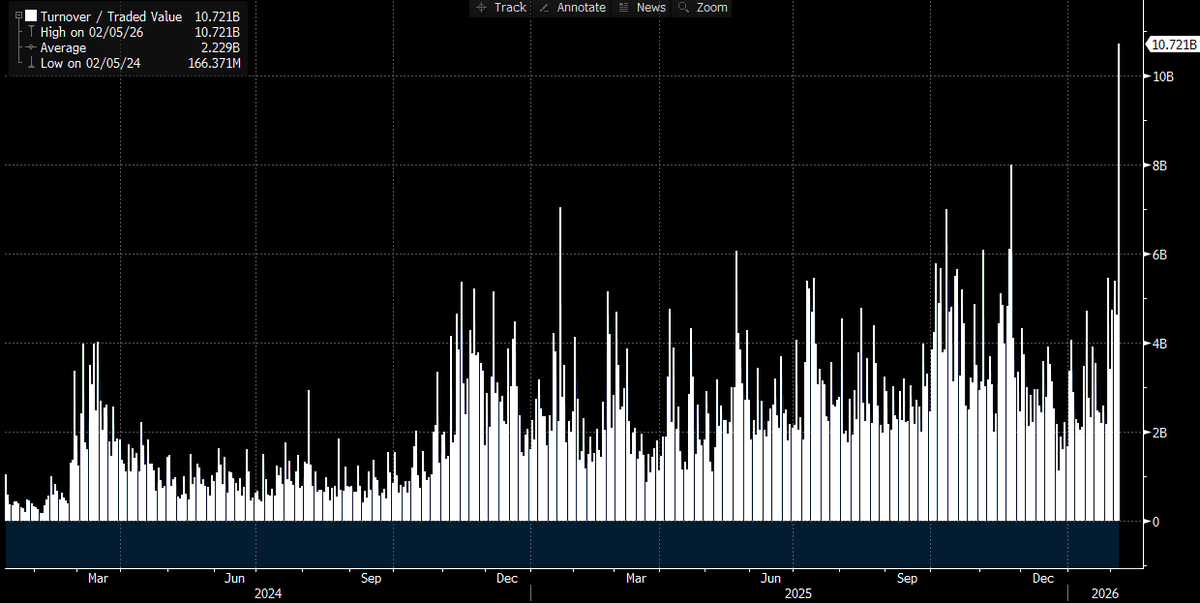
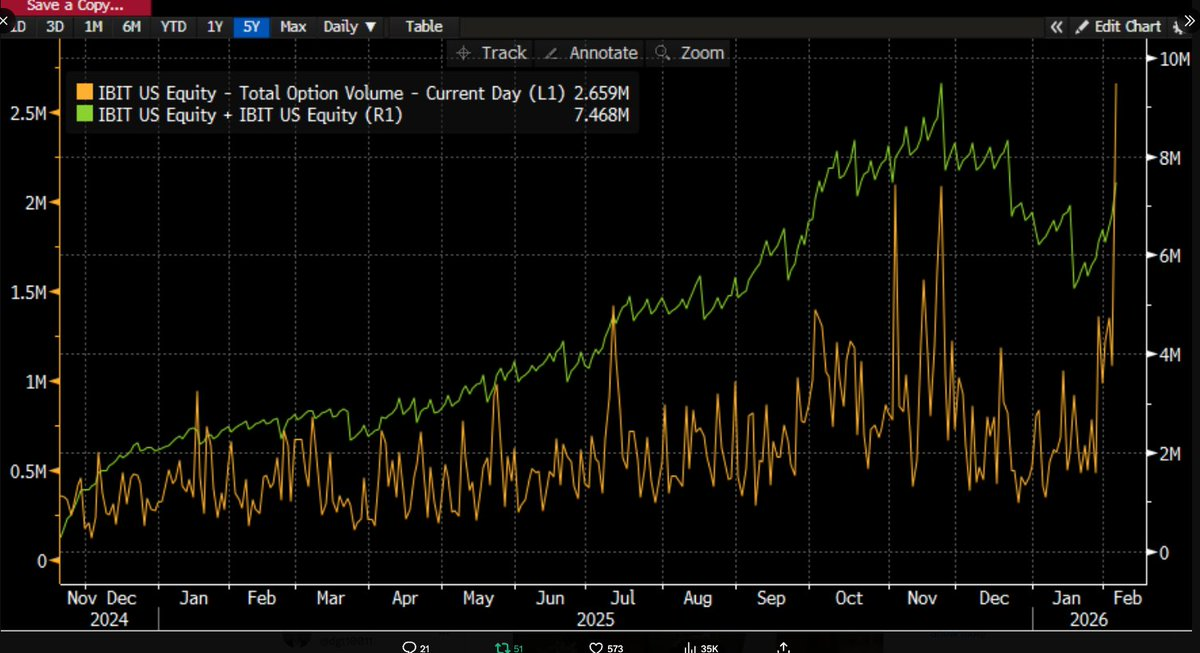
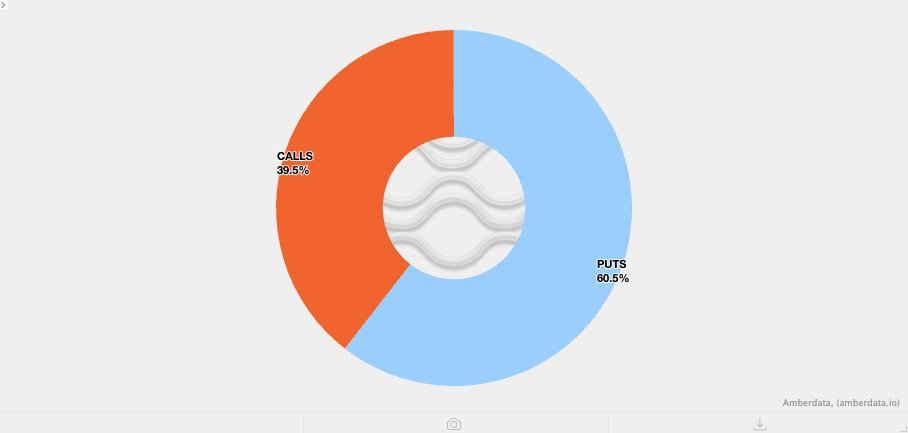
As time passes and more data becomes available, the picture is becoming clearer: this severe sell-off is likely related to the Bitcoin ETF, and the day itself was one of the most turbulent trading days in recent capital market history. We can draw this conclusion because IBIT's trading volume hit a record high that day—exceeding $10 billion, double the previous record (a truly staggering number), while options volume also set a new record (see chart below, showing the highest number of contracts since the ETF's launch). Somewhat unusually compared to the past, the volume structure showed that options trading was clearly dominated by puts, not calls (we will elaborate on this later).
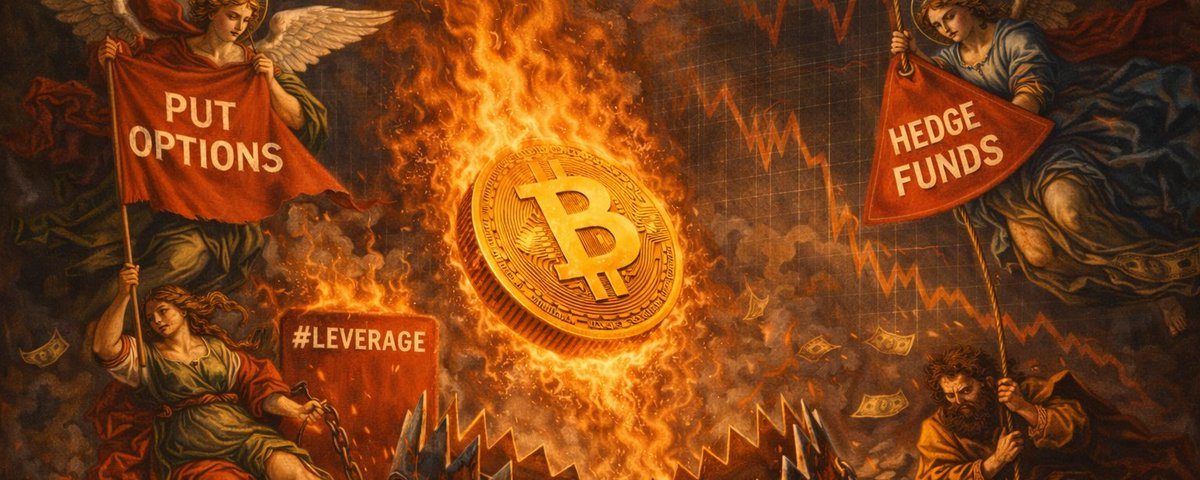
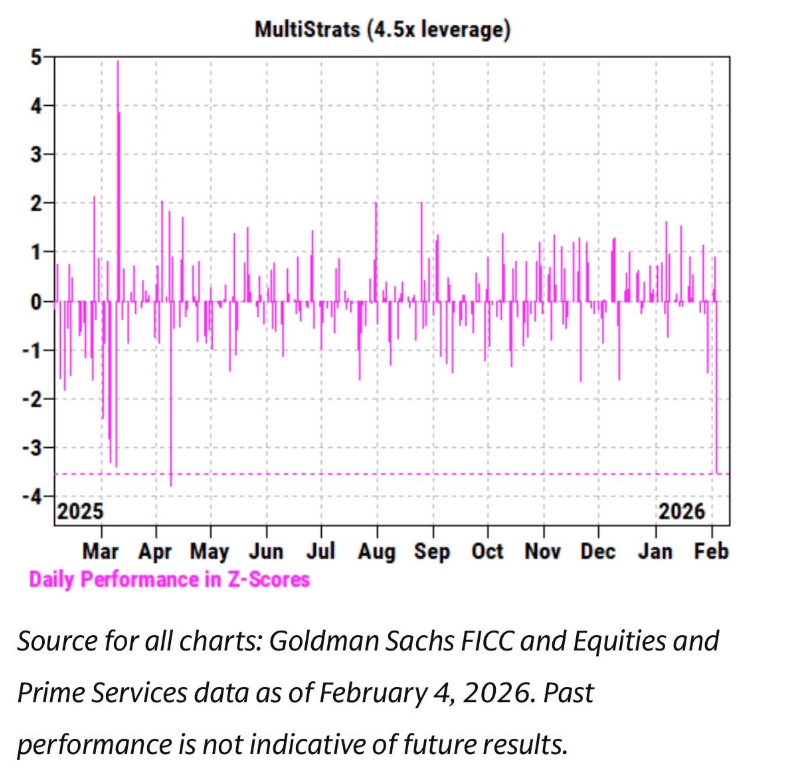
Simultaneously, over the past few weeks, we have observed an extremely tight correlation between IBIT's price movements and software stocks, as well as other risk assets. Goldman Sachs' Prime Brokerage (PB) team also reported that February 4th was one of the worst single days on record for multi-strategy funds, with a Z-score as high as 3.5. This means it was an extreme event with a probability of only 0.05%, ten times rarer than a 3-sigma event (the classic "black swan" threshold, probability ~0.27%). It was, by all accounts, a catastrophic shock. Typically, it is after such events that risk managers at multi-strategy funds (pod shops) quickly intervene, demanding all trading teams immediately, indiscriminately, and urgently deleverage. This explains why February 5th also turned into a bloodbath.
With so many records broken and a clear downward price direction (a 13.2% single-day drop), we originally expected a high likelihood of seeing net outflows from the ETF. This judgment isn't far-fetched based on historical data: for example, on January 30th, IBIT saw a record $530 million outflow after a 5.8% drop the previous day; or on February 4th, IBIT saw about $370 million in outflows amid consecutive declines. Therefore, expecting at least $500 million to $1 billion in outflows in the market environment of February 5th was entirely reasonable.

But the opposite happened—we saw widespread net inflows. IBIT added approximately 6 million shares that day, corresponding to an increase in Assets Under Management (AUM) of over $230 million. Meanwhile, other Bitcoin ETFs also recorded inflows, with the entire ETF system attracting over $300 million in net inflows.

This outcome is somewhat puzzling. Theoretically, one could勉强conceive that the strong price rebound on February 6th somewhat alleviated redemption pressure, but transitioning from "potentially reduced outflows" to "net inflows" is a completely different matter. This suggests that multiple factors were likely at play simultaneously, but these factors don't form a single, linear narrative framework. Based on the information we currently have, several reasonable preliminary assumptions can be made, and on these assumptions, I will present my overall inference.

First, this round of Bitcoin selling likely affected a type of multi-asset portfolio or strategy that is not purely crypto-native. This could be the multi-strategy hedge funds mentioned earlier, or it could be funds like BlackRock's model portfolio business, which allocates between IBIT and IGV (a software ETF) and were forced into automatic rebalancing during the sharp volatility.

Second, the acceleration of the Bitcoin sell-off was likely related to the options market, particularly structures related to the downside.

Third, this selling did not ultimately translate into outflows at the Bitcoin asset level, meaning the main driving force behind the price action came from the "paper money system," i.e., position adjustment behavior dominated by dealers and market makers, overall in a hedged state.

Based on the above facts, my core hypothesis is as follows.

  1. The direct catalyst for this sell-off was a broad deleveraging triggered by multi-asset funds and portfolios after the downside correlation of risk assets reached a statistically anomalous level.
  2. This process then triggered an extremely violent deleveraging, which also included Bitcoin exposure, but a significant portion of this risk was actually in "Delta neutral" hedged positions, such as basis trades, relative value trades (e.g., Bitcoin vs. crypto stocks), and other structures where the residual Delta risk is typically "boxed" by the dealer system.
  3. This deleveraging then triggered a negative Gamma effect, further amplifying the downward pressure, thus forcing dealers to sell IBIT. However, because the selling was so fiercely, market makers had to go net short Bitcoin regardless of their own inventory. This process, in turn, created new ETF inventory, thereby reducing the market's original expectation of large-scale outflows.

Subsequently, on February 6th, we observed positive inflows into IBIT, as some IBIT buyers (the question is, what type of buyers were these chose to allocate on the dip after the decline, further offsetting what might have been a small net outflow.

First, I personally lean towards the view that the initial catalyst for this event came from the sell-off in software stocks, especially considering the high correlation Bitcoin showed with software stocks, even higher than its correlation with gold. Please refer to the two charts below.
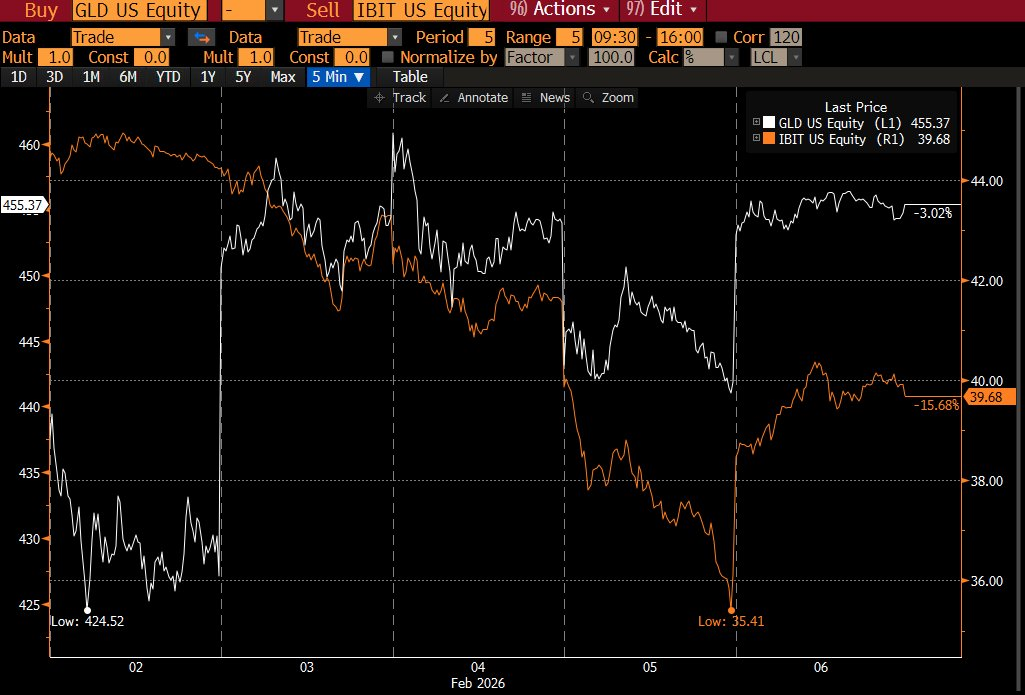
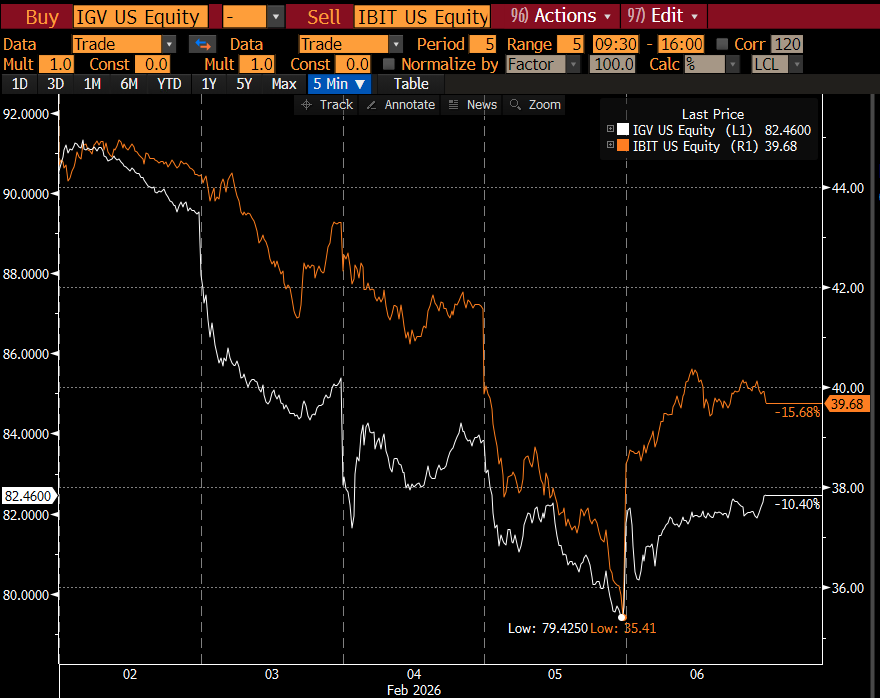
This is logically sound because gold is typically not an asset held in large quantities by multi-strategy funds engaged in financing trades, although it might appear in RIA model portfolios (pre-designed asset allocation schemes). Therefore, in my view, this further supports the judgment that: the epicenter of this turmoil is more likely located within the multi-strategy fund system.

This makes the second judgment seem more reasonable, namely that this violent deleveraging process did indeed include hedged Bitcoin risk. Take the CME Bitcoin basis trade as an example, a strategy long favored by multi-strategy funds.

Looking at the complete data from January 26th to yesterday, covering the CME Bitcoin basis movements for 30, 60, 90, and 120-day tenors (thanks to top-tier industry researcher @dlawant for the data), one can clearly see the near-month basis jumping from 3.3% to as high as 9% on February 5th. This is one of the largest jumps we have personally observed in the market since the ETF launch, which almost unequivocally points to one conclusion: basis trades were forcibly liquidated on a large scale under指令.

Imagine institutions like Millennium, Citadel, being forced to liquidate basis trade positions (selling spot, buying futures). Considering their volume within the Bitcoin ETF system, it's easy to understand why this operation would cause剧烈impact on the overall market structure. I have previously written down my own reasoning on this point.

Odaily Planet Daily adds: Currently, a significant portion of this undifferentiated US-based selling is likely coming from multi-strategy hedge funds. These funds often employ delta hedging strategies, or run some form of relative value (RV) or factor-neutral trades, and these trades are currently widening spreads, possibly accompanied by spillover from growth stock equity correlations.

A rough estimate: About 1/3 of Bitcoin ETF holdings are of the institutional type, and roughly 50% (possibly more) of that is believed to be held by hedge funds. This is a considerable amount of fast money flow, which can easily capitulate and liquidate once financing costs or margin requirements rise in the current high-volatility environment and risk managers intervene, especially when the basis yield no longer justifies the risk premium. It's worth noting that MSTR's USD trading volume today is among the highest in its history.

This is why the biggest factor最容易causing hedge fund failures is the notorious "common holder risk": multiple seemingly independent funds hold highly similar exposures, and when the market turns down, everyone rushes for the same narrow exit, causing all downside correlations to tend towards 1. Selling in such poor liquidity conditions is typical "risk-off" behavior, which we are seeing today. This will eventually be reflected in the ETF flow data. If this hypothesis holds, I suspect prices will reprice quickly once this all clears, though rebuilding confidence will still take some time afterwards.

This leads to the third clue. Now that we understand why IBIT was sold amid broad deleveraging, the question becomes: What was accelerating the decline? A possible "accelerant" is structured products. Although I don't believe the structured products market is large enough to trigger this sell-off on its own, when all factors align异常ly and perfectly simultaneously in a way beyond any VaR (Value at Risk) model's expectations, they can certainly act as an acute event triggering连锁liquidation behavior.

This immediately reminds me of my time at Morgan Stanley. There, structured products with knock-in put barriers (options that only "activate" into effective put options if the underlying asset price touches/crosses a specific barrier level) often had highly destructive consequences. In some cases, the change in option Delta could even exceed 1, a phenomenon not even considered in the standard Black-Scholes model—because in the standard Black-Scholes framework, for plain vanilla options (the most basic European call/put options), the delta can never exceed 1.

Take a note priced by JPMorgan last November as an example; its knock-in barrier was set exactly at 43.6. If these notes continued to be issued in December, and the Bitcoin price fell another 10%, one can imagine a large accumulation of knock-in barriers in the 38–39 range, the so-called "eye of the storm".
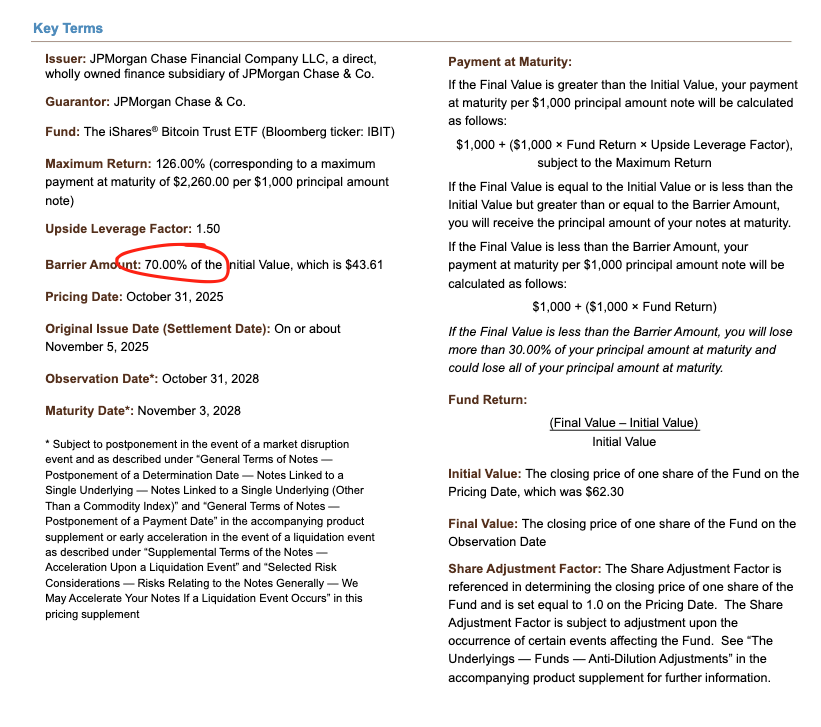
In the event these barriers are breached, if the dealer hedged the knock-in risk by, say, selling puts, then under negative Vanna dynamics, the rate of change of Gamma can be extremely rapid. At this point, as a dealer, the only viable response is to aggressively sell the underlying asset as the market weakens. This is precisely what we observed: implied volatility (IV) collapsed to near 90%, a historical extreme, almost reaching a catastrophic squeeze level. In such a situation, dealers were forced to expand their IBIT short positions to the extent that they ultimately created net new ETF shares. This part确实requires some degree of inference and is difficult to fully confirm without more detailed spread data, but given the record volume that day and the deep involvement of Authorized Participants (APs), this scenario is entirely plausible.

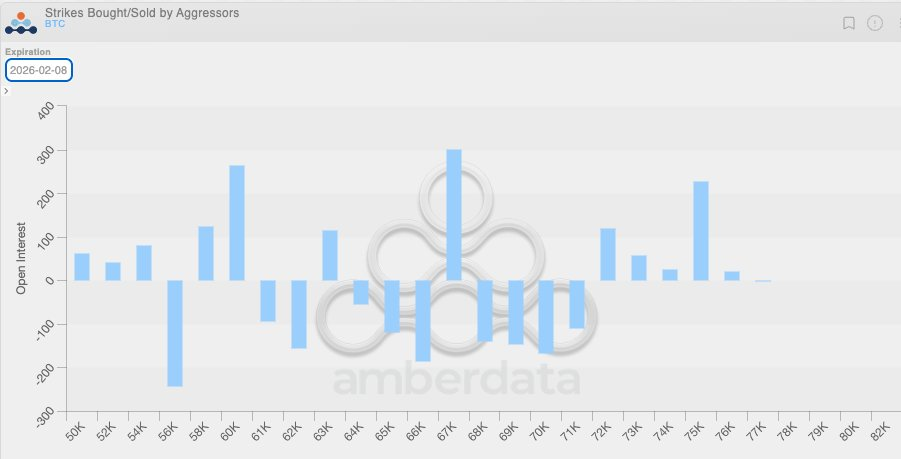
Combining this negative Vanna dynamic with another fact makes the logic even clearer. Due to the overall low volatility in the previous period, crypto-native market clients had generally been inclined to buy puts over the past few weeks. This means crypto dealers were naturally in a short Gamma state and had underpriced the potential for outsized moves. When the big move finally arrived, this structural imbalance further amplified the downward pressure. The position distribution chart below also clearly shows this, with dealers heavily positioned short Gamma on puts in the $64k to $71k range.
This brings us back to February 6th, when Bitcoin staged a strong rebound of over 10%. A notable phenomenon here is that the CME's open interest (OI) expanded明显faster than Binance's (again, thanks to @dlawant for aligning the hourly data to 4 PM ET). From February 4th to 5th, a clear collapse in CME OI can be seen, again confirming the judgment that basis trades were massively unwound on February 5th; on February 6th, these positions were likely re-established to take advantage of the higher basis levels, thereby offsetting the impact of outflows.
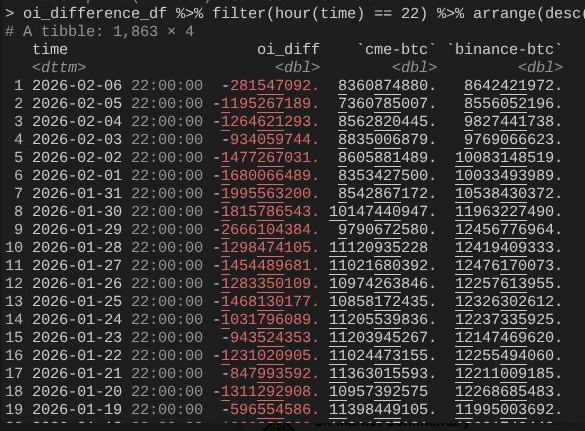
At this point, the entire logical chain closes: IBIT was roughly flat in terms of creations and redemptions because CME basis trades had recovered; but prices remained偏低because Binance's OI showed a clear collapse, meaning a significant portion of the deleveraging pressure came from short Gamma positions and liquidations within the crypto-native market.

The above is my best explanation for the market performance on February 5th and subsequently on February 6th. This reasoning is built on several assumptions and is not entirely satisfying because it lacks a clear "culprit" to blame (like the FTX incident). But the core conclusion is this: The trigger for this sell-off came from de-risking behavior in traditional finance outside crypto, and this process恰好pushed the Bitcoin price into a range where short Gamma hedging behavior would accelerate the decline. This drop was not driven by directional bearishness but triggered by hedging needs, and ultimately reversed quickly on February 6th (unfortunately, this reversal primarily benefited market-neutral capital in traditional finance, not directional strategies in crypto-native markets). While this conclusion may not be exciting, it is at least somewhat reassuring that: the previous day's sell-off likely has nothing to do with a 10/10 event.

Yes, I don't believe what happened last week is a continuation of the 10/10 deleveraging process. I read an article suggesting this turmoil might originate from a non-US, Hong Kong-based fund involved in a failed JPY carry trade. But this theory has two obvious flaws. First, I don't believe a non-crypto prime broker would be willing to service such a complex multi-asset trade while also providing a 90-day margin buffer, without falling into insolvency first when the risk framework tightened. Second, if the carry trade money was "bailed out" by buying IBIT options, then the Bitcoin price drop itself wouldn't accelerate the risk release—these options would just go out-of-the-money, their Greeks rapidly to zero. This means the trade itself must have contained real downside risk. If someone was long USD/JPY carry and simultaneously selling IBIT puts, then that prime broker, frankly, doesn't deserve to exist.

The next few days will be crucial, as we will get more data to judge whether investors are using this dip to build new demand; if so, that would be a very bullish signal. For now, I am quite encouraged by the potential for ETF inflows. I still firmly believe that true RIA-style ETF buyers (not relative value hedge funds) are savvy investors, and at the institutional level, we are seeing substantial, real, and profound progress, evident throughout the industry's advancement and among my friends at Bitwise. For this reason, I am focusing on net inflows that are not accompanied by an expansion in basis trading.

Finally, all this also shows once again that Bitcoin has integrated into the global financial capital markets in an extremely complex and mature way. This also means that when the market finds itself on the other side of a squeeze in the future, the upside move will be steeper than ever before.

The fragility of traditional finance's margin rules is Bitcoin's antifragility. Once the rebound comes—which I see as inevitable, especially after Nasdaq raised the options open interest cap—it will be a spectacular sight to behold.

Domande pertinenti

QAccording to the article, what was the primary catalyst for the author believes initiated the Bitcoin sell-off?

AThe author believes the initial catalyst was a broad de-leveraging event from multi-strategy hedge funds, triggered by a statistically anomalous level of downside correlation in risk assets, particularly software stocks.

QWhy was the significant net inflow into Bitcoin ETFs on February 5th considered counterintuitive?

AIt was counterintuitive because, given the record-breaking sell-off and price drop, a net outflow of at least $5-10 billion was expected based on historical precedent, but the ETFs instead saw net inflows of over $300 million.

QWhat specific trading strategy, popular with multi-strategy funds, does the author point to as being unwound during the sell-off?

AThe author points to the CME Bitcoin basis trade (selling spot Bitcoin and buying futures) as a key strategy that was forcibly unwound during the de-leveraging event.

QWhat market dynamic, related to options, acted as an 'accelerant' and amplified the downward pressure on Bitcoin's price?

AA negative Vanna dynamic, where dealers were forced to aggressively sell the underlying asset (Bitcoin) as price fell due to their short Gamma position and the hedging of structured products with knock-in put barriers.

QWhat is the author's overall conclusion about the fundamental nature of the sell-off?

AThe author concludes the sell-off was not driven by directional bearishness but was a hedging-driven event catalyzed by traditional finance de-risking, which pushed Bitcoin's price into a zone where short-Gamma hedging accelerated the decline.

Letture associate

Trading

Spot
Futures

Articoli Popolari

Cosa è BITCOIN

Comprendere HarryPotterObamaSonic10Inu (ERC-20) e la sua posizione nel mondo delle criptovalute Negli ultimi anni, il mercato delle criptovalute ha assistito a un aumento della popolarità delle meme coin, catturando l'interesse non solo dei trader, ma anche di coloro che cercano coinvolgimento comunitario e valore di intrattenimento. Tra questi token unici c'è HarryPotterObamaSonic10Inu (ERC-20), un progetto intrigante che mescola riferimenti culturali nel tessuto delle criptovalute. Questo articolo esplora gli aspetti chiave di HarryPotterObamaSonic10Inu, analizzando i suoi meccanismi, l'etica guidata dalla comunità e il suo coinvolgimento con il panorama crittografico più ampio. Che cos'è HarryPotterObamaSonic10Inu (ERC-20)? Come suggerisce il suo nome, HarryPotterObamaSonic10Inu è una meme coin costruita sulla blockchain di Ethereum, classificata secondo lo standard ERC-20. A differenza delle criptovalute tradizionali che possono enfatizzare l'utilità pratica o il potenziale investimento, questo token prospera grazie al valore di intrattenimento e alla forza della sua comunità. Il progetto mira a creare un ambiente in cui gli utenti coinvolti possono riunirsi, condividere idee e partecipare ad attività ispirate a diversi fenomeni culturali. Una caratteristica notevole di HarryPotterObamaSonic10Inu è la zero tassa sulle transazioni. Questo elemento allettante tende a incoraggiare il trading e il coinvolgimento della comunità, privo di costi aggiuntivi che possono scoraggiare i trader di piccole dimensioni. L'offerta totale della moneta è fissata a un miliardo di token, un numero che segna la sua intenzione di mantenere una circolazione sostanziale all'interno della comunità. Creatore di HarryPotterObamaSonic10Inu (ERC-20) Le origini di HarryPotterObamaSonic10Inu sono avvolte in un certo mistero; i dettagli sul creatore rimangono sconosciuti. Lo sviluppo di questo token non presenta un team identificabile o un piano esplicito, cosa non rara nel settore delle meme coin. Invece, il progetto è emerso organicamente, con il suo progresso fortemente dipendente dall'entusiasmo e dalla partecipazione della sua comunità. Investitori di HarryPotterObamaSonic10Inu (ERC-20) Per quanto riguarda investimenti esterni e finanziamenti, HarryPotterObamaSonic10Inu rimane ambiguo. Il token non elenca alcuna fondazione di investimento conosciuta o un sostegno organizzativo significativo. Invece, la linfa vitale del progetto è la sua comunità di base, che informa la sua crescita e sostenibilità attraverso azioni collettive e coinvolgimento nello spazio crittografico. Come funziona HarryPotterObamaSonic10Inu (ERC-20)? In quanto meme coin, HarryPotterObamaSonic10Inu opera principalmente al di fuori delle strutture tradizionali che governano spesso il valore degli asset. Ci sono diversi aspetti distintivi che definiscono il funzionamento del progetto: Transazioni senza tasse: Senza costi fiscali sulle transazioni, gli utenti possono comprare e vendere liberamente il token senza preoccuparsi di costi nascosti. Coinvolgimento della comunità: Il progetto prospera sull'interazione della comunità, sfruttando le piattaforme social per creare entusiasmo e facilitare il coinvolgimento. Discussioni, condivisione di contenuti e coinvolgimento sono elementi cruciali che aiutano ad espandere la sua portata e a favorire la lealtà tra i sostenitori. Nessuna utilità pratica: Va notato che HarryPotterObamaSonic10Inu non offre un'utilità concreta all'interno dell'ecosistema finanziario. Piuttosto, è classificato come un token principalmente per attività di intrattenimento e comunitarie. Riferimento culturale: Il token incorpora astutamente elementi della cultura pop per attirare interesse, collegandosi a appassionati di meme e seguaci delle criptovalute. HarryPotterObamaSonic10Inu esemplifica come le meme coin operino in modo diverso rispetto ai progetti di criptovalute più tradizionali, entrando nel mercato come costrutti sociali innovativi piuttosto che come asset utilitari. Cronologia di HarryPotterObamaSonic10Inu (ERC-20) La storia di HarryPotterObamaSonic10Inu è segnata da diversi traguardi notevoli: Creazione: Il token è emerso da un meme virale, catturando l'immaginazione di molti appassionati di criptovalute. Le date di creazione specifiche non sono disponibili, sottolineando la sua crescita organica. Inserimento negli scambi: HarryPotterObamaSonic10Inu ha fatto il suo ingresso in vari scambi, consentendo un accesso e un trading più facili da parte della comunità. Iniziative di coinvolgimento della comunità: Attività in corso volte a migliorare l'interazione della comunità, comprese gare, campagne sui social media e generazione di contenuti da parte di fan e sostenitori. Piani di espansione futura: La tabella di marcia del progetto include il lancio di una collezione NFT, merchandising e un sito di eCommerce relativo ai suoi temi culturali, coinvolgendo ulteriormente la comunità e cercando di aggiungere più dimensioni al suo ecosistema. Punti chiave su HarryPotterObamaSonic10Inu (ERC-20) Natura guidata dalla comunità: Il progetto dà priorità al contributo collettivo e alla creatività, garantendo che il coinvolgimento degli utenti sia al centro del suo sviluppo. Classificazione come meme coin: Rappresenta l'epitome delle criptovalute basate sull'intrattenimento, distinguendosi dai veicoli d'investimento tradizionali. Nessuna affiliazione diretta con Bitcoin: Nonostante la somiglianza nel nome del ticker, HarryPotterObamaSonic10Inu è distintivo e non ha alcuna relazione con Bitcoin o altre criptovalute consolidate. Focus sulla collaborazione: HarryPotterObamaSonic10Inu è progettato per creare uno spazio per la collaborazione e la condivisione di storie tra i suoi detentori, fornendo un canale per la creatività e il legame comunitario. Prospettive future: L'ambizione di espandersi oltre il suo presupposto iniziale verso NFT e merchandising delinea un percorso per il progetto per potenzialmente entrare in strade più mainstream all'interno della cultura digitale. Poiché le meme coin continuano a catturare l'immaginazione della comunità crittografica, HarryPotterObamaSonic10Inu (ERC-20) si distingue per i suoi legami culturali e il suo approccio centrato sulla comunità. Anche se potrebbe non adattarsi al modello tipico di un token orientato all'utilità, la sua essenza risiede nella gioia e nella camaraderia coltivate tra i suoi sostenitori, evidenziando la natura in evoluzione delle criptovalute in un'epoca sempre più digitale. Con la continuazione dello sviluppo del progetto, sarà importante osservare come le dinamiche della comunità influenzano la sua traiettoria nel panorama in continuo cambiamento della tecnologia blockchain.

510 Totale visualizzazioniPubblicato il 2024.04.01Aggiornato il 2024.12.03

Come comprare BTC

Benvenuto in HTX.com! Abbiamo reso l'acquisto di Bitcoin (BTC) semplice e conveniente. Segui la nostra guida passo passo per intraprendere il tuo viaggio nel mondo delle criptovalute.Step 1: Crea il tuo Account HTXUsa la tua email o numero di telefono per registrarti il tuo account gratuito su HTX. Vivi un'esperienza facile e sblocca tutte le funzionalità,Crea il mio accountStep 2: Vai in Acquista crypto e seleziona il tuo metodo di pagamentoCarta di credito/debito: utilizza la tua Visa o Mastercard per acquistare immediatamente BitcoinBTC.Bilancio: Usa i fondi dal bilancio del tuo account HTX per fare trading senza problemi.Terze parti: abbiamo aggiunto metodi di pagamento molto utilizzati come Google Pay e Apple Pay per maggiore comodità.P2P: Fai trading direttamente con altri utenti HTX.Over-the-Counter (OTC): Offriamo servizi su misura e tassi di cambio competitivi per i trader.Step 3: Conserva Bitcoin (BTC)Dopo aver acquistato Bitcoin (BTC), conserva nel tuo account HTX. In alternativa, puoi inviare tramite trasferimento blockchain o scambiare per altre criptovalute.Step 4: Scambia Bitcoin (BTC)Scambia facilmente Bitcoin (BTC) nel mercato spot di HTX. Accedi al tuo account, seleziona la tua coppia di trading, esegui le tue operazioni e monitora in tempo reale. Offriamo un'esperienza user-friendly sia per chi ha appena iniziato che per i trader più esperti.

2.7k Totale visualizzazioniPubblicato il 2024.12.12Aggiornato il 2025.03.21

Cosa è $BITCOIN

ORO DIGITALE ($BITCOIN): Un'Analisi Completa Introduzione all'ORO DIGITALE ($BITCOIN) L'ORO DIGITALE ($BITCOIN) è un progetto basato su blockchain che opera sulla rete Solana, con l'obiettivo di combinare le caratteristiche dei metalli preziosi tradizionali con l'innovazione delle tecnologie decentralizzate. Sebbene condivida un nome con Bitcoin, spesso definito “oro digitale” a causa della sua percezione come riserva di valore, l'ORO DIGITALE è un token separato progettato per creare un ecosistema unico all'interno del panorama Web3. Il suo obiettivo è posizionarsi come un asset digitale alternativo valido, anche se i dettagli riguardanti le sue applicazioni e funzionalità sono ancora in fase di sviluppo. Cos'è l'ORO DIGITALE ($BITCOIN)? L'ORO DIGITALE ($BITCOIN) è un token di criptovaluta esplicitamente progettato per l'uso sulla blockchain di Solana. A differenza di Bitcoin, che fornisce un ruolo di stoccaggio di valore ampiamente riconosciuto, questo token sembra concentrarsi su applicazioni e caratteristiche più ampie. Aspetti notevoli includono: Infrastruttura Blockchain: Il token è costruito sulla blockchain di Solana, nota per la sua capacità di gestire transazioni ad alta velocità e a basso costo. Dinamiche di Offerta: L'ORO DIGITALE ha un'offerta massima fissata a 100 quadrilioni di token (100P $BITCOIN), sebbene i dettagli riguardanti la sua offerta circolante siano attualmente non divulgati. Utilità: Sebbene le funzionalità precise non siano esplicitamente delineate, ci sono indicazioni che il token potrebbe essere utilizzato per varie applicazioni, potenzialmente coinvolgendo applicazioni decentralizzate (dApp) o strategie di tokenizzazione degli asset. Chi è il Creatore dell'ORO DIGITALE ($BITCOIN)? Attualmente, l'identità dei creatori e del team di sviluppo dietro l'ORO DIGITALE ($BITCOIN) rimane sconosciuta. Questa situazione è tipica tra molti progetti innovativi nel settore blockchain, in particolare quelli allineati con la finanza decentralizzata e i fenomeni delle meme coin. Sebbene tale anonimato possa favorire una cultura guidata dalla comunità, intensifica le preoccupazioni riguardo alla governance e alla responsabilità. Chi sono gli Investitori dell'ORO DIGITALE ($BITCOIN)? Le informazioni disponibili indicano che l'ORO DIGITALE ($BITCOIN) non ha alcun sostenitore istituzionale noto o investimenti di venture capital prominenti. Il progetto sembra operare su un modello peer-to-peer incentrato sul supporto e sull'adozione della comunità piuttosto che su percorsi di finanziamento tradizionali. La sua attività e liquidità si trovano principalmente su exchange decentralizzati (DEX), come PumpSwap, piuttosto che su piattaforme di trading centralizzate consolidate, evidenziando ulteriormente il suo approccio di base. Come Funziona l'ORO DIGITALE ($BITCOIN) Le meccaniche operative dell'ORO DIGITALE ($BITCOIN) possono essere elaborate in base al suo design blockchain e alle caratteristiche della rete: Meccanismo di Consenso: Sfruttando il proof-of-history (PoH) unico di Solana combinato con un modello di proof-of-stake (PoS), il progetto garantisce una validazione efficiente delle transazioni contribuendo all'alta performance della rete. Tokenomics: Sebbene meccanismi deflazionistici specifici non siano stati dettagliati ampiamente, l'ampia offerta massima di token implica che potrebbe soddisfare microtransazioni o casi d'uso di nicchia che devono ancora essere definiti. Interoperabilità: Esiste il potenziale per l'integrazione con l'ecosistema più ampio di Solana, inclusi vari piattaforme di finanza decentralizzata (DeFi). Tuttavia, i dettagli riguardanti integrazioni specifiche rimangono non specificati. Cronologia degli Eventi Chiave Ecco una cronologia che evidenzia traguardi significativi riguardanti l'ORO DIGITALE ($BITCOIN): 2023: Il dispiegamento iniziale del token avviene sulla blockchain di Solana, contrassegnato dal suo indirizzo di contratto. 2024: L'ORO DIGITALE guadagna visibilità poiché diventa disponibile per il trading su exchange decentralizzati come PumpSwap, consentendo agli utenti di scambiarlo contro SOL. 2025: Il progetto assiste a un'attività di trading sporadica e a un potenziale interesse per impegni guidati dalla comunità, sebbene non siano state documentate partnership significative o avanzamenti tecnici fino ad ora. Analisi Critica Punti di Forza Scalabilità: L'infrastruttura sottostante di Solana supporta alti volumi di transazioni, il che potrebbe migliorare l'utilità di $BITCOIN in vari scenari di transazione. Accessibilità: Il potenziale basso prezzo di trading per token potrebbe attrarre investitori al dettaglio, facilitando una partecipazione più ampia grazie a opportunità di proprietà frazionata. Rischi Mancanza di Trasparenza: L'assenza di sostenitori, sviluppatori o di un processo di audit pubblicamente noti potrebbe generare scetticismo riguardo alla sostenibilità e all'affidabilità del progetto. Volatilità del Mercato: L'attività di trading è fortemente dipendente dal comportamento speculativo, il che può comportare una significativa volatilità dei prezzi e incertezze per gli investitori. Conclusione L'ORO DIGITALE ($BITCOIN) emerge come un progetto intrigante ma ambiguo all'interno dell'evolvente ecosistema di Solana. Sebbene tenti di sfruttare la narrativa dell'“oro digitale”, la sua partenza dal ruolo consolidato di Bitcoin come riserva di valore sottolinea la necessità di una chiara differenziazione della sua utilità e struttura di governance. L'accettazione e l'adozione future dipenderanno probabilmente dall'affrontare l'attuale opacità e dalla definizione più esplicita delle sue strategie operative ed economiche. Nota: Questo rapporto comprende informazioni sintetizzate disponibili a ottobre 2023, e potrebbero essersi verificati sviluppi oltre il periodo di ricerca.

99 Totale visualizzazioniPubblicato il 2025.05.13Aggiornato il 2025.05.13

Discussioni

Benvenuto nella Community HTX. Qui puoi rimanere informato sugli ultimi sviluppi della piattaforma e accedere ad approfondimenti esperti sul mercato. Le opinioni degli utenti sul prezzo di BTC BTC sono presentate come di seguito.

活动图片