Satoshi Nakamoto Sued? $83.7 Billion Worth of BTC Up for 'Legal Claim'

marsbitPubblicato 2026-06-01Pubblicato ultima volta 2026-06-01

Introduzione

An anonymous individual known as Noah Doe, along with two Wyoming LLCs, has filed a lawsuit in the New York Supreme Court. They are attempting to use New York's "lost and found" laws to claim legal ownership of approximately 837 billion USD worth of Bitcoin held in 39,069 dormant addresses. Crucially, this list includes addresses believed to belong to Bitcoin's creator, Satoshi Nakamoto (holding around 837 billion USD), alongside other long-inactive addresses from Mt. Gox and early Bitcoin holders. The plaintiff's legal strategy hinges on classifying these public Bitcoin addresses as "lost property." They submitted a USB drive containing only the public addresses to the New York Police Department, sent OP_RETURN notifications on the Bitcoin blockchain, and issued press releases. Their argument is that after these efforts and a waiting period, they should be granted ownership. A key, and highly controversial, claim is an unnamed "independent expert" valuing each address at under 10 USD, allowing for a faster legal process. Analysts from Galaxy point out major flaws in the case. The plaintiff never physically possessed the Bitcoin or private keys. The "under 10 USD" valuation is considered unrealistic, and allowing anonymous companies to claim such vast assets is highly unusual. Even if the plaintiff wins, they would only receive a court declaration of ownership, not the actual private keys to move the Bitcoin. The real danger lies in this court document acting as a "cloud o...

Originally fromGalaxy

Compiled by / Odaily Planet Daily Golem(@web 3_golem)
Who would have thought that Bitcoin founder Satoshi Nakamoto would one day get sued, potentially having the 'ownership' of wallet addresses taken away. And you, the reader of this article, might also be one of the 'defendants', as long as you have dormant Bitcoin addresses.

This past March, the New York State Supreme Court accepted a lawsuit: the plaintiff seeks to confirm ownership of over 3.7 million bitcoins (approximately $274 billion) associated with 39,069 Bitcoin addresses. The plaintiff goes by the pseudonym Noah Doe and two unnamed Wyoming limited liability companies (pseudonyms 'ABC Company' and 'XYZ Company').

The plaintiff asks the New York State Supreme Court, through a declaratory judgment action based on New York's lost property law, to confirm their ownership of these dormant assets. More importantly, these 39,069 addresses also include addresses suspected to belong to Bitcoin founder Satoshi Nakamoto (a total of 21,744 addresses, holding approximately 1.09 million bitcoins, valued at around $83.7 billion at current prices).

In simple terms, an anonymous individual and his companies registered in Wyoming are trying to get a New York court to rule that Satoshi Nakamoto's bitcoins (and many other cryptocurrencies) are lost property, and that they rightfully own them for 'finding' these bitcoins. Galaxy analyzed the plaintiff's potential motives and identity, the impact on Bitcoin, and the likelihood of the plaintiff's success.

Odaily Planet Daily has compiled and condensed the full article below, enjoy~

Case Overview and Deconstructing the Plaintiff's Tactics

The plaintiff has filed an application with the New York State Supreme Court requesting the court to declare that they own 39,069 dormant Bitcoin addresses and all assets within them. The legal basis is a declaratory judgment confirming ownership under Rule 3001 of the New York Civil Practice Law and Rules, grounded in New York's lost property law, specifically Article 7-B of the Personal Property Law. This provision states that a finder of lost property who turns it over to the police and does not face a denial of ownership from the rightful owner within a specified waiting period may ultimately acquire ownership. The plaintiff is attempting to apply this old framework to Bitcoin.

The specific tactic is: Noah Doe, as the finder, delivers a USB drive containing the addresses (not private keys or proof of address ownership, merely the public addresses) to the New York City Police Department's 17th Precinct, substituting this for handing over the lost property to the police; then initiates OP_RETURN notifications on the Bitcoin blockchain and issues a press release, substituting for contacting the owner; finally, has an expert appraise each address as being worth less than $10, allowing the entire case to proceed under the fastest process stipulated by this provision.

It is necessary to clarify that, even if the plaintiff wins completely, they will only receive a piece of paper—a court declaration—and nothing more. They will not receive any private keys and cannot transfer any bitcoins.

The real value of a New York judgment lies elsewhere. It would act as a 'cloud on title': if these bitcoins ever appear in any regulated venue in the future, the plaintiff could present this document to challenge an exchange or custodian. This is the potential risk this case poses to Bitcoin holders and why this seemingly absurd lawsuit is still worth careful examination.

Case Timeline

The following timeline consists of two parts: one is the factual narrative of discovering the addresses as told by the plaintiff, and the other is the procedural history of the case in court.

  • October 2024: Noah Doe claims he discovered 'security issues' with certain addresses and developed an 'algorithm' to flag abandoned addresses. (In reality, these addresses do not have 'security issues');
  • December 26, 2024: Noah Doe first 'finds' approximately 1,625 addresses. A USB drive containing the addresses is delivered to the NYPD's 17th Precinct on January 1, 2025;
  • February 2025: Noah Doe hires Solomon Brothers Strategic Advisors as consultants;
  • March 31 and April 14, 2025: Noah Doe 'finds' 546 addresses and 39,911 addresses respectively, delivering a USB drive with the addresses to the police precinct after each 'discovery';
  • June 30 to July 10, 2025: Noah Doe sends 'abandonment notices' to each address via OP_RETURN;
  • August 7, 2025: Issues a press release to global media. Reported by CoinDesk, Bitcoinist, Yahoo Finance, Investing.com, and Galaxy Digital's research report;
  • August 2025 to February 2026: Solomon Brothers receives threatening emails, including over 50 emails containing only "4 8 15 16 23 42," demanding $1.5 million and 50 bitcoins;
  • October 10, 2025: The 90-day owner claim period ends;
  • December 2025: Noah Doe transfers these addresses to ABC Company and places 98% of its interest into an irrevocable trust; ABC Company transfers 17.7% of its interest to XYZ Company;
  • March 11, 2026: Original summons and complaint filed. Judge Arlene P. Bruce annotates the original order to show cause;
  • March 23, 2026: Judge Emily Morales-Minerva recuses herself from the case;
  • March 25 to April 17, 2026: Judge Carlos J. Voltron signs the order to show cause (allowing use of pseudonyms) and an order authorizing alternative service via OP_RETURN (without notifying opposing parties);
  • May 1, 2026: First amended complaint expands the defendant list to defendants 1 through 39,069, attaching a full list of addresses;
  • May 21-22, 2026: On-chain service of process: 98 batch transactions in Bitcoin blocks 950,446 to 950,576;
  • May 22, 2026: Carlos J. Voltron files affidavits of service containing verification reports for each batch and 39,069 lines of verification details (Documents 27-29).

Legal Basis and Tactics Proposed by Plaintiff

Article 7-B of the New York Personal Property Law (Sections 251-258) establishes a short-form lost property regime. It provides two distinct paths for a finder to acquire ownership, both of which are invoked by the plaintiff in this case.

  • Path A: Custody (Sections 252, 253/254, 257(1)). Section 252 requires a person finding lost property valued at $20 or more to return it to the owner or deliver it to police custody within 10 days. Sections 253(7) and 254 stipulate varying police custody periods based on the property's value: less than $100 for 3 months, $100-$500 for 6 months, $500-$5,000 for 1 year, and $5,000 or more for 3 years.
  • Path B: The Sub-$10 Shortcut (Section 257(2)). For lost property valued under $10, ownership vests in the finder one year after finding if the finder "has made reasonable efforts to find the owner and return the property, but has been unsuccessful," without requiring police delivery.

The complaint's (unnamed) 'independent expert' appraised the 'present' value of each address at under $10, citing the unlikelihood of recovery. This valuation determines the procedural path for the entire case, as it places each address under the uniform one-year vesting period of Section 257(2). It also makes the Path A process shorter, with police custody for items under $100 being only three months pursuant to Section 254.

Plaintiff's Arguments

The complaint lists several arguments by the plaintiff, each of which must hold for the next to succeed, forming an interlinked chain.

  • These addresses constitute lost property. Addresses are treated as property, akin to bank accounts. Under this view, losing a private key does not destroy the property; its contents are merely 'lost,' and a finder can claim them.
  • Noah Doe is the finder, and NYPD custody complies with relevant regulations. Section 252 of Article 7-B requires the finder to deliver the property to the police. The plaintiff argues that delivering a USB drive with address information to the 17th Precinct satisfies this requirement.
  • Ownership has vested in the finder. For property valued under $10, Section 257(2) states ownership vests in the finder one year after finding if the finder has made reasonable efforts to locate the owner but failed. The OP_RETURN notices, press release, and 90-day claim period are all presented as constituting reasonable efforts.
  • These addresses have been abandoned. Noah Doe's 'algorithm' flags addresses held by himself, unused for at least five years, and inactive during significant price increases. Approximately 424 owners who reacted by moving tokens were removed from the list, leaving the 39,069 non-responsive owners as defendants.
  • Service via OP_RETURN notification is lawful. Because the owners are allegedly unknown and cannot be located, the court authorized alternative service under CPLR § 308(5) by sending an on-chain notice pointing to the complaint to each address.
  • The plaintiff can proceed anonymously. Given the known risks of kidnapping for large Bitcoin holders, the plaintiff was permitted to proceed using pseudonyms.

Who Are the Owners?

Galaxy analyzed the addresses claimed to be 'found' by plaintiff Noah Doe using their Bitcoin full node and internal research database.

As of May 25, 2026, the 39,069 'Noah Doe addresses' hold 3,799,629 bitcoins, valued at approximately $293.5 billion at $77,245 per bitcoin. This value is not evenly distributed but concentrated in several distinct clusters, each telling a different story.
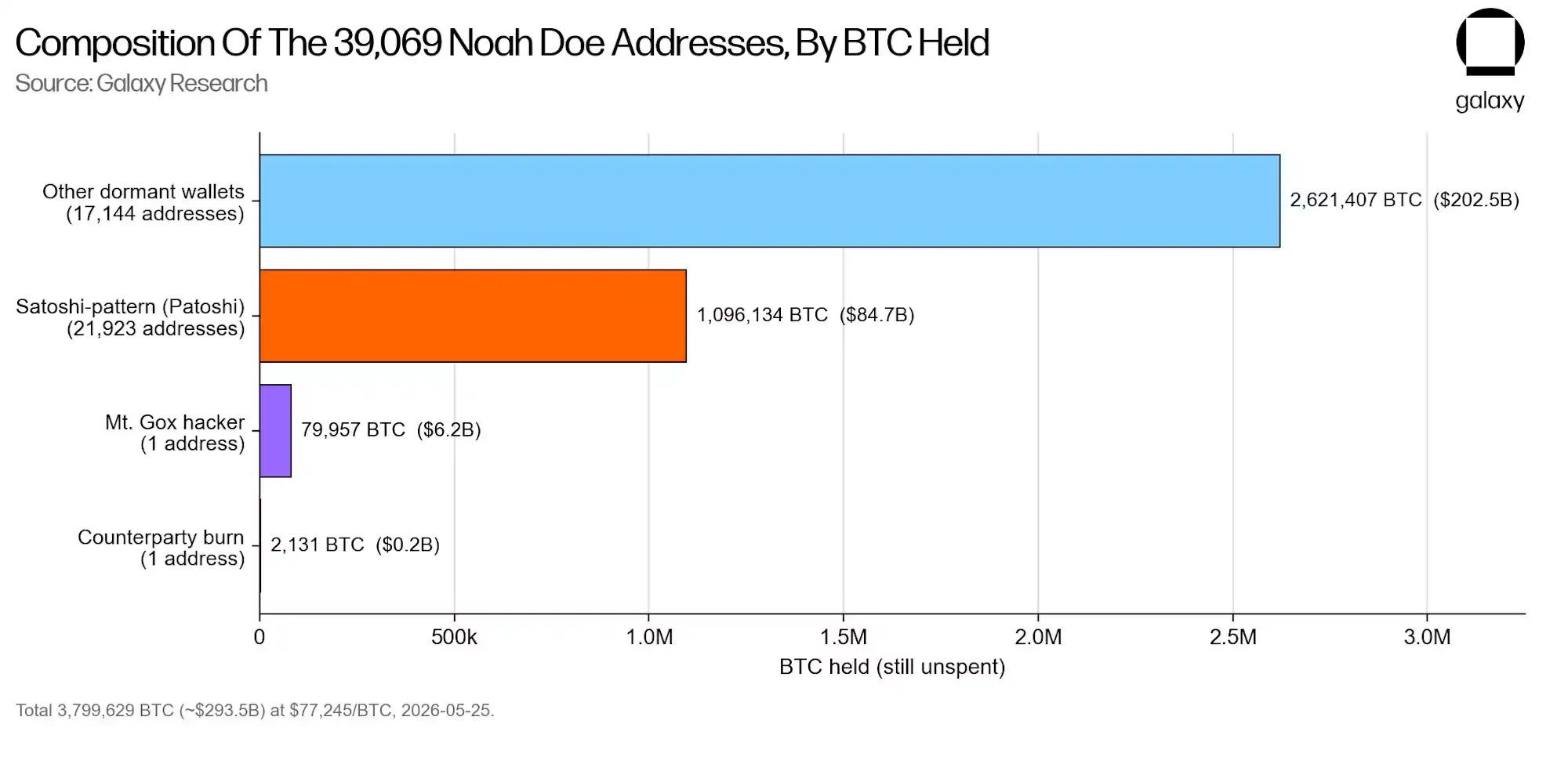
Composition of addresses found by Noah Doe

Satoshi (Patoshi) Addresses

Comprise 21,923 addresses, ~1,096,134 BTC (~$84.7 billion). These are early-mined bitcoins linked to Bitcoin's creator via the 'Patoshi' nonce pattern and have never moved.

Mt. Gox Hacker Address

Only 1 address, ~79,957 BTC (~$6.2 billion). This is John Doe #1. These bitcoins were stolen from the early Bitcoin exchange Mt. Gox and have lain dormant since 2011. They are contested property that investigators have tracked for years.

Counterparty Burn Address

Only 1 address, ~2,131 BTC (~$160 million). This is John Doe #104, a provably unspendable 'burn' address. No one has ever held its key because, by design, none exists.

Other Dormant Addresses

7,144 addresses, ~2,621,407 BTC (~$202.5 billion). These addresses contain significant holdings from early adopters and the exchange era, unmoved for many years.

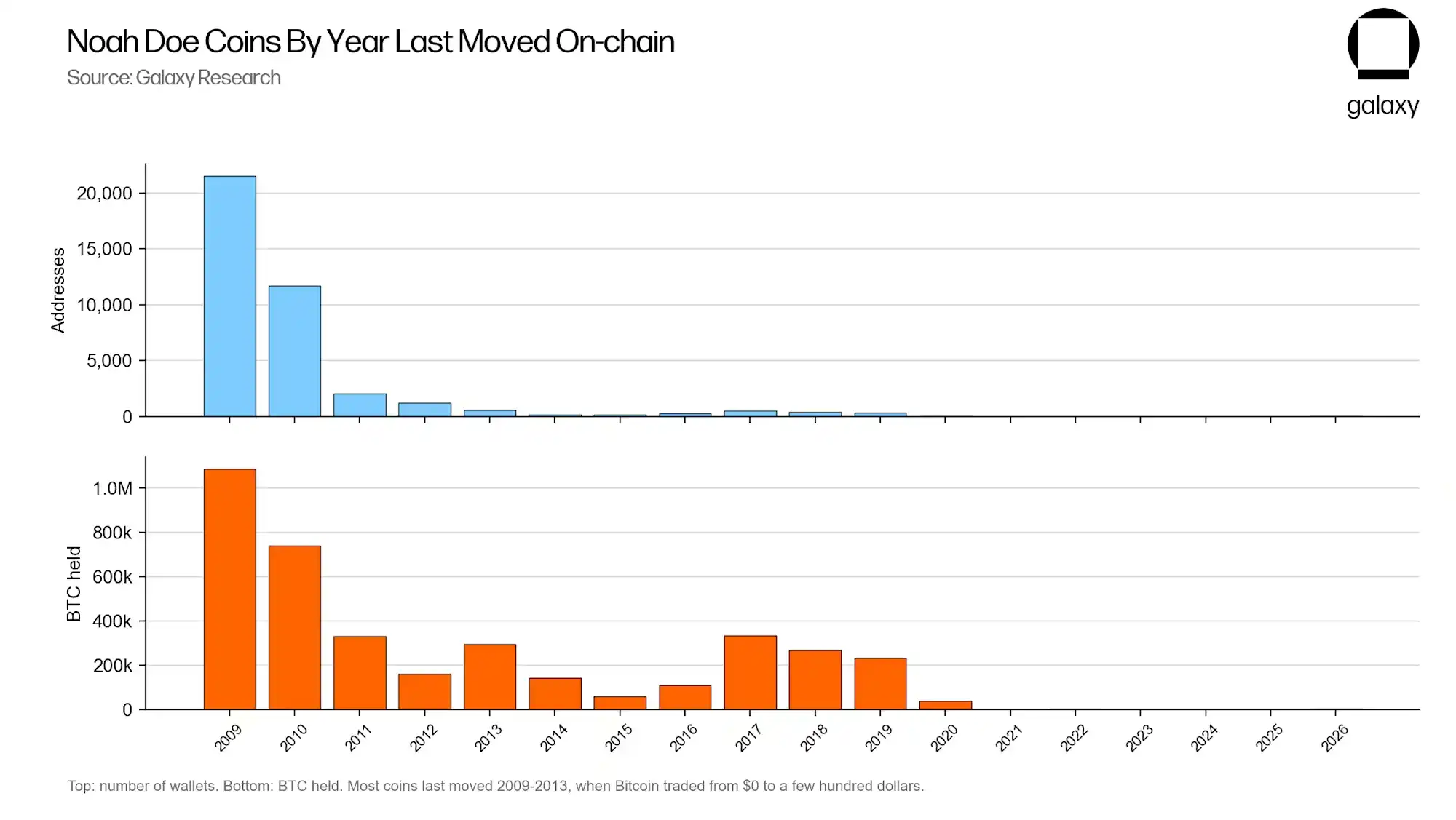
This dormancy has a long history. If we sort each address by the last year its bitcoin moved on-chain, we find the majority of movement concentrated in Bitcoin's early days. The vast majority of these bitcoins last moved between 2009 and 2013, a period when Bitcoin's price surged from nearly zero to several hundred dollars.
But many of these addresses have been claimed before. In the Kleiman v. Wright case (S.D. Fla., 2018), Australian businessman Craig Wright submitted a list of 16,404 early-block addresses he claimed to own as part of his later-dismissed assertion of being 'Satoshi Nakamoto.'

We compared the Bitcoin addresses Wright claimed in the Kleiman litigation with Noah Doe's addresses to see their overlap.
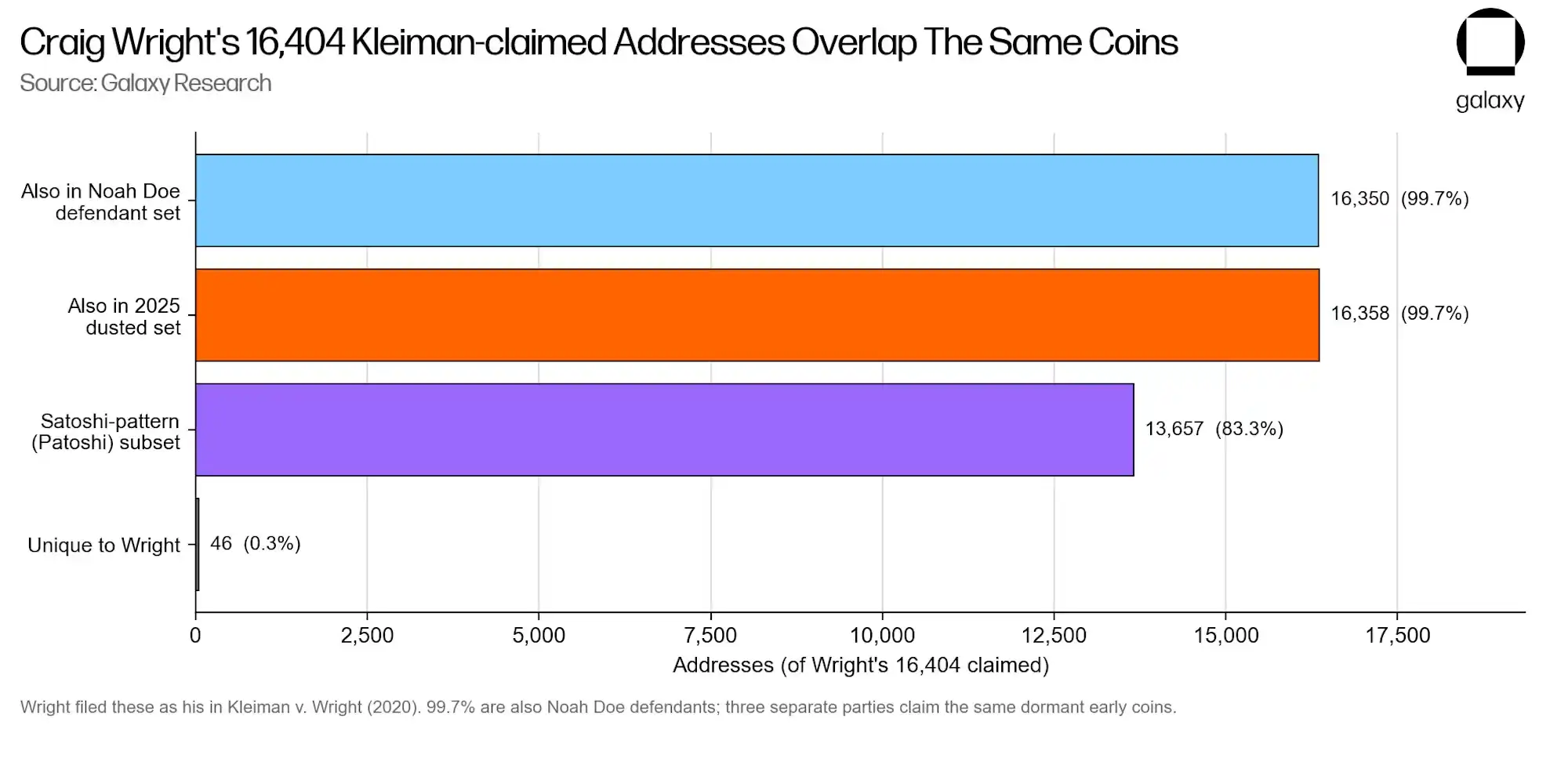
Overlap between Noah Doe and Craig Wright addresses

The overlap is nearly identical. Of the 16,404 addresses Wright claimed, 16,350 (99.7%) are also claimed by Noah Doe's defendants, holding ~817,513 bitcoins. We cannot determine if Craig Wright has any connection to the Noah Doe case, but the overlap is notable. Craig Wright has spent years trying to claim these bitcoins through litigation but was found in contempt of court by a UK court in 2024.

Suspicious Aspects of the Case

While we are not lawyers, merely examining the case record and relevant laws reveals numerous questionable points.

Does Lost Property Law Apply?

Before any valuation or service issues, there's a more fundamental question. The lost property law was designed for physical objects that a finder picks up, holds, and delivers to the police. Noah Doe never held these coins or keys. He merely looked at public addresses on a ledger that anyone can read. Viewing a public address is far from holding lost property. Delivering a USB drive listing addresses to the police is also different from actually surrendering the lost item.

The statute envisions a finder who can return the item if the owner shows up. But here, the finder never held the coins and could never hand them over—not to the police allegedly holding them, nor to an owner coming to claim them. The core issue goes beyond ownership; losing a private key does not strip the true owner of any rights. The Bitcoin remains on-chain, and the true key holder can move it at any time, as hundreds of owners of lost bitcoins have done.

It seems obvious that ownership cannot effectively transfer to a finder who can never touch the asset.

Valuation is Unreliable

The average holding of a Noah Doe address is 97.25 BTC, worth ~$7.5 million; the median is 50.00 BTC, worth ~$3.86 million. Compared to these figures, the claim that each address is worth under $10 is untenable. It appears to be a tactic to push these assets through the legal process at the fastest possible speed.

Two further details undermine this valuation. The expert presenting the 'under $10' figure is unnamed in the documents, so this single number dictating the entire timeline cannot be scrutinized or challenged. If the logic of 'recoverable as-is' were applied universally, then nearly all self-custodied bitcoins would be valued near zero, which starkly contradicts how any user, especially a plaintiff going to such lengths to sue, treats these assets.

Anonymity of the Parties

Noah Doe's use of anonymity in this case is also suspicious. He requests anonymity to avoid being targeted as a large holder, yet the relief he seeks would force the actual address holders to reveal their identities to defend their cryptocurrency. The protection the plaintiff seeks for himself is precisely what he aims to deprive all defendants of.

Even if an individual could present a genuine personal safety theory, that theory exists to protect natural persons. ABC Company and XYZ Company are shell LLCs. A corporation has no physical entity to be threatened and no privacy to expose, so the logic of fearing extortion doesn't apply. Allowing two companies to claim trillions in property under shell names is extraordinary.

Furthermore, New York State disfavors anonymous entities. New York courts rarely permit pseudonyms. While New York historically allowed anonymous LLC ownership, the state's LLC Transparency Act now mandates disclosure of beneficial ownership, although federal regulation has narrowed its scope to foreign-formed LLCs.

Potential Directions for Subsequent Litigation

Even setting aside these details, the 'audacity' of this lawsuit becomes apparent. It is extraordinary that a New York court would award legal ownership of approximately $293 billion worth of Bitcoin (including some belonging to Satoshi Nakamoto) to anonymous parties based on a dubious 'lost property' theory with a suspect sub-$10 valuation. Courts are generally reluctant to entertain such novel and far-reaching cases, especially where property is contested and a judgment could have broad implications.

Since this is a declaratory action about property ownership, under CPLR § 1012(a)(3), the true owners of the addresses have the right to intervene directly in the suit; interested non-owners may seek permission to intervene under § 1013. However, while the principle allows intervention, a significant practical obstacle exists. To intervene, an owner must come forward and prove control over the listed address, which is precisely the deanonymization that cautious Bitcoin whales spend their lives avoiding.

The defendant addresses are all pseudonymous and deliberately not publicly listed. Therefore, by late June 2026, roughly 30 days after service, a technical default judgment is almost certain to occur. A motion for default judgment will likely be filed during the summer. However, for many reasons, the court is unlikely to swiftly enter a default judgment granting all the relief the plaintiff seeks.

First, a declaration of ownership is not a clerk's default for a sum certain; it requires an application to the court, which retains discretion to require a hearing and demand actual evidence. Second, the novelty and high stakes of the theory often prompt judicial skepticism, not 'rubber-stamp' approval. Moreover, the validity of OP_RETURN service itself is debatable, and questionable affidavits of service give the court reason to proceed cautiously. Finally, any actual holder who intervenes could turn a largely uncontested case into a genuine contest.

Galaxy estimates the likelihood of the court issuing a full ownership declaration in a default judgment is low, and any such ruling is more likely to be narrower in scope and issued after a hearing.

What if the Plaintiff Wins?

Even with a complete victory, the plaintiff still cannot seize any Bitcoin. What they hold is a New York declaration, not a set of private keys. The principle 'Not your keys, not your coins' applies to them as well.

Therefore, the danger is not that the plaintiff could seize Satoshi's bitcoins or any other bitcoins mentioned in the Noah Doe defendant addresses. The danger is that if any of these bitcoins are transferred to a centralized exchange or custodian, the plaintiff could present their New York judgment to that institution and attempt to place a lien on those bitcoins. Such action could freeze assets, trigger years of litigation, and force the holder who moved bitcoins decades later to prove ownership, jeopardizing their own anonymity.

The paper title certificate is leverage against regulated intermediaries and those who rely on them. This almost certainly explains why, even though a judgment could never directly affect the Bitcoin itself, it is still worth pursuing for whoever is behind this case.


Domande pertinenti

QWhat is the core legal strategy used by the anonymous plaintiff (Noah Doe) in the New York case to claim ownership of dormant Bitcoin addresses?

AThe plaintiff is attempting to apply New York's lost property law (specifically Article 7-B of the Personal Property Law) to Bitcoin addresses. The strategy involves: 1) Claiming the dormant addresses are 'lost property'. 2) 'Delivering' this property to the police by submitting a USB drive with the public addresses (not private keys) to a New York City police precinct. 3) Using OP_RETURN transactions and press releases as 'reasonable efforts' to locate the owners. 4) Having an unnamed expert value each address's 'recoverable' worth at under $10, which qualifies them for a faster, one-year vesting period under the law, bypassing longer custody requirements for high-value items.

QAccording to the article's analysis, what are the main categories of Bitcoin addresses included in the lawsuit, and which is the most significant?

AThe 39,069 addresses are categorized into four main groups: 1) Satoshi (Patoshi) addresses: 21,923 addresses holding ~1.09 million BTC (~$84.7B), linked to Bitcoin's creator. This is the most significant group by cultural and symbolic value. 2) Mt. Gox hacker address: 1 address holding ~79,957 BTC (~$6.2B), from the 2011 exchange hack. 3) Counterparty burn address: 1 provably unspendable address holding ~2,131 BTC (~$160M). 4) Other dormant addresses: 7,144 addresses holding ~2.62 million BTC (~$202.5B), comprising early holders and exchange-era Bitcoin.

QWhy would a New York court judgment granting ownership to the plaintiff not allow them to actually seize or move the Bitcoin?

ABecause the plaintiff would only receive a declaratory judgment—a piece of paper stating their legal ownership under New York law. They do not possess and cannot obtain the private keys required to cryptographically sign transactions and move the Bitcoin on the blockchain. The fundamental Bitcoin principle 'not your keys, not your coins' still applies. The judgment's power lies in creating a 'cloud on title' that could be used against regulated intermediaries like exchanges in the future.

QWhat is the primary risk to actual Bitcoin holders if the plaintiff were to win this lawsuit?

AThe primary risk is not direct seizure of coins, but future legal entanglement. If any Bitcoin from the listed addresses is later transferred to a regulated exchange or custodian, the plaintiff could present the New York judgment to that institution, claiming a legal interest and potentially freezing the assets. This could force the long-dormant holder into a lengthy legal battle to prove ownership, compromising their anonymity and creating significant hassle and cost.

QWhat are some of the key weaknesses or 'suspicious points' in the plaintiff's case as highlighted by the Galaxy analysis?

AKey weaknesses include: 1) Applicability of Law: The lost property law is designed for physical items one can pick up and hand over. The plaintiff never held the Bitcoin/keys, only viewed public addresses. 2) Valuation: Deeming each multi-million dollar address worth '<$10' based on 'recoverability' is highly questionable and appears to be a procedural tactic. The unnamed expert's valuation is unverifiable. 3) Anonymity: The plaintiff (Noah Doe and shell companies) seeks anonymity for safety while suing to force actual holders to de-anonymize themselves to defend their property—a contradictory standard. 4) Novelty & Scale: The court is likely to be skeptical of applying an old law in this novel, unprecedented way to claim nearly $3 trillion in assets.

Letture associate

Trading

Spot
Futures

Articoli Popolari

Cosa è BITCOIN

Comprendere HarryPotterObamaSonic10Inu (ERC-20) e la sua posizione nel mondo delle criptovalute Negli ultimi anni, il mercato delle criptovalute ha assistito a un aumento della popolarità delle meme coin, catturando l'interesse non solo dei trader, ma anche di coloro che cercano coinvolgimento comunitario e valore di intrattenimento. Tra questi token unici c'è HarryPotterObamaSonic10Inu (ERC-20), un progetto intrigante che mescola riferimenti culturali nel tessuto delle criptovalute. Questo articolo esplora gli aspetti chiave di HarryPotterObamaSonic10Inu, analizzando i suoi meccanismi, l'etica guidata dalla comunità e il suo coinvolgimento con il panorama crittografico più ampio. Che cos'è HarryPotterObamaSonic10Inu (ERC-20)? Come suggerisce il suo nome, HarryPotterObamaSonic10Inu è una meme coin costruita sulla blockchain di Ethereum, classificata secondo lo standard ERC-20. A differenza delle criptovalute tradizionali che possono enfatizzare l'utilità pratica o il potenziale investimento, questo token prospera grazie al valore di intrattenimento e alla forza della sua comunità. Il progetto mira a creare un ambiente in cui gli utenti coinvolti possono riunirsi, condividere idee e partecipare ad attività ispirate a diversi fenomeni culturali. Una caratteristica notevole di HarryPotterObamaSonic10Inu è la zero tassa sulle transazioni. Questo elemento allettante tende a incoraggiare il trading e il coinvolgimento della comunità, privo di costi aggiuntivi che possono scoraggiare i trader di piccole dimensioni. L'offerta totale della moneta è fissata a un miliardo di token, un numero che segna la sua intenzione di mantenere una circolazione sostanziale all'interno della comunità. Creatore di HarryPotterObamaSonic10Inu (ERC-20) Le origini di HarryPotterObamaSonic10Inu sono avvolte in un certo mistero; i dettagli sul creatore rimangono sconosciuti. Lo sviluppo di questo token non presenta un team identificabile o un piano esplicito, cosa non rara nel settore delle meme coin. Invece, il progetto è emerso organicamente, con il suo progresso fortemente dipendente dall'entusiasmo e dalla partecipazione della sua comunità. Investitori di HarryPotterObamaSonic10Inu (ERC-20) Per quanto riguarda investimenti esterni e finanziamenti, HarryPotterObamaSonic10Inu rimane ambiguo. Il token non elenca alcuna fondazione di investimento conosciuta o un sostegno organizzativo significativo. Invece, la linfa vitale del progetto è la sua comunità di base, che informa la sua crescita e sostenibilità attraverso azioni collettive e coinvolgimento nello spazio crittografico. Come funziona HarryPotterObamaSonic10Inu (ERC-20)? In quanto meme coin, HarryPotterObamaSonic10Inu opera principalmente al di fuori delle strutture tradizionali che governano spesso il valore degli asset. Ci sono diversi aspetti distintivi che definiscono il funzionamento del progetto: Transazioni senza tasse: Senza costi fiscali sulle transazioni, gli utenti possono comprare e vendere liberamente il token senza preoccuparsi di costi nascosti. Coinvolgimento della comunità: Il progetto prospera sull'interazione della comunità, sfruttando le piattaforme social per creare entusiasmo e facilitare il coinvolgimento. Discussioni, condivisione di contenuti e coinvolgimento sono elementi cruciali che aiutano ad espandere la sua portata e a favorire la lealtà tra i sostenitori. Nessuna utilità pratica: Va notato che HarryPotterObamaSonic10Inu non offre un'utilità concreta all'interno dell'ecosistema finanziario. Piuttosto, è classificato come un token principalmente per attività di intrattenimento e comunitarie. Riferimento culturale: Il token incorpora astutamente elementi della cultura pop per attirare interesse, collegandosi a appassionati di meme e seguaci delle criptovalute. HarryPotterObamaSonic10Inu esemplifica come le meme coin operino in modo diverso rispetto ai progetti di criptovalute più tradizionali, entrando nel mercato come costrutti sociali innovativi piuttosto che come asset utilitari. Cronologia di HarryPotterObamaSonic10Inu (ERC-20) La storia di HarryPotterObamaSonic10Inu è segnata da diversi traguardi notevoli: Creazione: Il token è emerso da un meme virale, catturando l'immaginazione di molti appassionati di criptovalute. Le date di creazione specifiche non sono disponibili, sottolineando la sua crescita organica. Inserimento negli scambi: HarryPotterObamaSonic10Inu ha fatto il suo ingresso in vari scambi, consentendo un accesso e un trading più facili da parte della comunità. Iniziative di coinvolgimento della comunità: Attività in corso volte a migliorare l'interazione della comunità, comprese gare, campagne sui social media e generazione di contenuti da parte di fan e sostenitori. Piani di espansione futura: La tabella di marcia del progetto include il lancio di una collezione NFT, merchandising e un sito di eCommerce relativo ai suoi temi culturali, coinvolgendo ulteriormente la comunità e cercando di aggiungere più dimensioni al suo ecosistema. Punti chiave su HarryPotterObamaSonic10Inu (ERC-20) Natura guidata dalla comunità: Il progetto dà priorità al contributo collettivo e alla creatività, garantendo che il coinvolgimento degli utenti sia al centro del suo sviluppo. Classificazione come meme coin: Rappresenta l'epitome delle criptovalute basate sull'intrattenimento, distinguendosi dai veicoli d'investimento tradizionali. Nessuna affiliazione diretta con Bitcoin: Nonostante la somiglianza nel nome del ticker, HarryPotterObamaSonic10Inu è distintivo e non ha alcuna relazione con Bitcoin o altre criptovalute consolidate. Focus sulla collaborazione: HarryPotterObamaSonic10Inu è progettato per creare uno spazio per la collaborazione e la condivisione di storie tra i suoi detentori, fornendo un canale per la creatività e il legame comunitario. Prospettive future: L'ambizione di espandersi oltre il suo presupposto iniziale verso NFT e merchandising delinea un percorso per il progetto per potenzialmente entrare in strade più mainstream all'interno della cultura digitale. Poiché le meme coin continuano a catturare l'immaginazione della comunità crittografica, HarryPotterObamaSonic10Inu (ERC-20) si distingue per i suoi legami culturali e il suo approccio centrato sulla comunità. Anche se potrebbe non adattarsi al modello tipico di un token orientato all'utilità, la sua essenza risiede nella gioia e nella camaraderia coltivate tra i suoi sostenitori, evidenziando la natura in evoluzione delle criptovalute in un'epoca sempre più digitale. Con la continuazione dello sviluppo del progetto, sarà importante osservare come le dinamiche della comunità influenzano la sua traiettoria nel panorama in continuo cambiamento della tecnologia blockchain.

1.5k Totale visualizzazioniPubblicato il 2024.04.01Aggiornato il 2024.12.03

Cosa è BITCOIN

Come comprare BTC

Benvenuto in HTX.com! Abbiamo reso l'acquisto di Bitcoin (BTC) semplice e conveniente. Segui la nostra guida passo passo per intraprendere il tuo viaggio nel mondo delle criptovalute.Step 1: Crea il tuo Account HTXUsa la tua email o numero di telefono per registrarti il tuo account gratuito su HTX. Vivi un'esperienza facile e sblocca tutte le funzionalità,Crea il mio accountStep 2: Vai in Acquista crypto e seleziona il tuo metodo di pagamentoCarta di credito/debito: utilizza la tua Visa o Mastercard per acquistare immediatamente BitcoinBTC.Bilancio: Usa i fondi dal bilancio del tuo account HTX per fare trading senza problemi.Terze parti: abbiamo aggiunto metodi di pagamento molto utilizzati come Google Pay e Apple Pay per maggiore comodità.P2P: Fai trading direttamente con altri utenti HTX.Over-the-Counter (OTC): Offriamo servizi su misura e tassi di cambio competitivi per i trader.Step 3: Conserva Bitcoin (BTC)Dopo aver acquistato Bitcoin (BTC), conserva nel tuo account HTX. In alternativa, puoi inviare tramite trasferimento blockchain o scambiare per altre criptovalute.Step 4: Scambia Bitcoin (BTC)Scambia facilmente Bitcoin (BTC) nel mercato spot di HTX. Accedi al tuo account, seleziona la tua coppia di trading, esegui le tue operazioni e monitora in tempo reale. Offriamo un'esperienza user-friendly sia per chi ha appena iniziato che per i trader più esperti.

3.9k Totale visualizzazioniPubblicato il 2024.12.12Aggiornato il 2026.06.01

Come comprare BTC

Cosa è $BITCOIN

ORO DIGITALE ($BITCOIN): Un'Analisi Completa Introduzione all'ORO DIGITALE ($BITCOIN) L'ORO DIGITALE ($BITCOIN) è un progetto basato su blockchain che opera sulla rete Solana, con l'obiettivo di combinare le caratteristiche dei metalli preziosi tradizionali con l'innovazione delle tecnologie decentralizzate. Sebbene condivida un nome con Bitcoin, spesso definito “oro digitale” a causa della sua percezione come riserva di valore, l'ORO DIGITALE è un token separato progettato per creare un ecosistema unico all'interno del panorama Web3. Il suo obiettivo è posizionarsi come un asset digitale alternativo valido, anche se i dettagli riguardanti le sue applicazioni e funzionalità sono ancora in fase di sviluppo. Cos'è l'ORO DIGITALE ($BITCOIN)? L'ORO DIGITALE ($BITCOIN) è un token di criptovaluta esplicitamente progettato per l'uso sulla blockchain di Solana. A differenza di Bitcoin, che fornisce un ruolo di stoccaggio di valore ampiamente riconosciuto, questo token sembra concentrarsi su applicazioni e caratteristiche più ampie. Aspetti notevoli includono: Infrastruttura Blockchain: Il token è costruito sulla blockchain di Solana, nota per la sua capacità di gestire transazioni ad alta velocità e a basso costo. Dinamiche di Offerta: L'ORO DIGITALE ha un'offerta massima fissata a 100 quadrilioni di token (100P $BITCOIN), sebbene i dettagli riguardanti la sua offerta circolante siano attualmente non divulgati. Utilità: Sebbene le funzionalità precise non siano esplicitamente delineate, ci sono indicazioni che il token potrebbe essere utilizzato per varie applicazioni, potenzialmente coinvolgendo applicazioni decentralizzate (dApp) o strategie di tokenizzazione degli asset. Chi è il Creatore dell'ORO DIGITALE ($BITCOIN)? Attualmente, l'identità dei creatori e del team di sviluppo dietro l'ORO DIGITALE ($BITCOIN) rimane sconosciuta. Questa situazione è tipica tra molti progetti innovativi nel settore blockchain, in particolare quelli allineati con la finanza decentralizzata e i fenomeni delle meme coin. Sebbene tale anonimato possa favorire una cultura guidata dalla comunità, intensifica le preoccupazioni riguardo alla governance e alla responsabilità. Chi sono gli Investitori dell'ORO DIGITALE ($BITCOIN)? Le informazioni disponibili indicano che l'ORO DIGITALE ($BITCOIN) non ha alcun sostenitore istituzionale noto o investimenti di venture capital prominenti. Il progetto sembra operare su un modello peer-to-peer incentrato sul supporto e sull'adozione della comunità piuttosto che su percorsi di finanziamento tradizionali. La sua attività e liquidità si trovano principalmente su exchange decentralizzati (DEX), come PumpSwap, piuttosto che su piattaforme di trading centralizzate consolidate, evidenziando ulteriormente il suo approccio di base. Come Funziona l'ORO DIGITALE ($BITCOIN) Le meccaniche operative dell'ORO DIGITALE ($BITCOIN) possono essere elaborate in base al suo design blockchain e alle caratteristiche della rete: Meccanismo di Consenso: Sfruttando il proof-of-history (PoH) unico di Solana combinato con un modello di proof-of-stake (PoS), il progetto garantisce una validazione efficiente delle transazioni contribuendo all'alta performance della rete. Tokenomics: Sebbene meccanismi deflazionistici specifici non siano stati dettagliati ampiamente, l'ampia offerta massima di token implica che potrebbe soddisfare microtransazioni o casi d'uso di nicchia che devono ancora essere definiti. Interoperabilità: Esiste il potenziale per l'integrazione con l'ecosistema più ampio di Solana, inclusi vari piattaforme di finanza decentralizzata (DeFi). Tuttavia, i dettagli riguardanti integrazioni specifiche rimangono non specificati. Cronologia degli Eventi Chiave Ecco una cronologia che evidenzia traguardi significativi riguardanti l'ORO DIGITALE ($BITCOIN): 2023: Il dispiegamento iniziale del token avviene sulla blockchain di Solana, contrassegnato dal suo indirizzo di contratto. 2024: L'ORO DIGITALE guadagna visibilità poiché diventa disponibile per il trading su exchange decentralizzati come PumpSwap, consentendo agli utenti di scambiarlo contro SOL. 2025: Il progetto assiste a un'attività di trading sporadica e a un potenziale interesse per impegni guidati dalla comunità, sebbene non siano state documentate partnership significative o avanzamenti tecnici fino ad ora. Analisi Critica Punti di Forza Scalabilità: L'infrastruttura sottostante di Solana supporta alti volumi di transazioni, il che potrebbe migliorare l'utilità di $BITCOIN in vari scenari di transazione. Accessibilità: Il potenziale basso prezzo di trading per token potrebbe attrarre investitori al dettaglio, facilitando una partecipazione più ampia grazie a opportunità di proprietà frazionata. Rischi Mancanza di Trasparenza: L'assenza di sostenitori, sviluppatori o di un processo di audit pubblicamente noti potrebbe generare scetticismo riguardo alla sostenibilità e all'affidabilità del progetto. Volatilità del Mercato: L'attività di trading è fortemente dipendente dal comportamento speculativo, il che può comportare una significativa volatilità dei prezzi e incertezze per gli investitori. Conclusione L'ORO DIGITALE ($BITCOIN) emerge come un progetto intrigante ma ambiguo all'interno dell'evolvente ecosistema di Solana. Sebbene tenti di sfruttare la narrativa dell'“oro digitale”, la sua partenza dal ruolo consolidato di Bitcoin come riserva di valore sottolinea la necessità di una chiara differenziazione della sua utilità e struttura di governance. L'accettazione e l'adozione future dipenderanno probabilmente dall'affrontare l'attuale opacità e dalla definizione più esplicita delle sue strategie operative ed economiche. Nota: Questo rapporto comprende informazioni sintetizzate disponibili a ottobre 2023, e potrebbero essersi verificati sviluppi oltre il periodo di ricerca.

99 Totale visualizzazioniPubblicato il 2025.05.13Aggiornato il 2025.05.13

Cosa è $BITCOIN

Discussioni

Benvenuto nella Community HTX. Qui puoi rimanere informato sugli ultimi sviluppi della piattaforma e accedere ad approfondimenti esperti sul mercato. Le opinioni degli utenti sul prezzo di BTC BTC sono presentate come di seguito.

活动图片