Japan to Test Blockchain for Settling Stocks and Government Bonds

cryptonews.ruPubblicato 2026-08-26Pubblicato ultima volta 2026-08-26

Introduzione

Japan is preparing to launch a real-time settlement system for stock and government bond transactions based on blockchain technology. According to Nikkei, the authorities aim to have a project plan ready by early 2027. A working group including the FSA, the Ministry of Finance, the Bank of Japan, and financial sector representatives will be formed this summer to define the system's architecture and responsibilities. If approved, the infrastructure could become operational in the early 2030s. Currently, stock settlements in Japan occur two days after a trade, and government bond settlements the next day. Blockchain aims to virtually eliminate this delay, allowing sellers to receive funds and reinvest almost immediately. This initiative builds on existing experiments. In February, the FSA supported a demonstration project registering bonds, funds, and stock rights on a blockchain with settlements in stablecoins. The Bank of Japan is also testing the use of tokenized central bank reserves for blockchain settlements, including for securities. The new project could elevate these tests to a national infrastructure level, with potential future use for international transfers. Nikkei noted that the US and Europe lead in real-world asset tokenization, and there is a risk that foreign investors might shy away from Japanese markets if the technology lags. The global RWA segment (excluding stablecoins) is valued at $38.3 billion, with $15.6 billion in US government bonds.

Japan is preparing a real-time settlement system for stock and government bond transactions based on blockchain. The authorities aim to have a project plan ready by the beginning of 2027, writes Nikkei.

Settlements Without Delay

The project will involve the FSA, the Ministry of Finance, the Bank of Japan, and representatives from the financial sector. As early as this summer, they plan to establish a working group to determine the blockchain system's architecture, the responsibilities among participants, and the further development plan.

If the project receives final approval, the infrastructure could become operational in the early 2030s.

Currently, stock settlements in Japan occur two days after a trade is executed, and Japanese government bond settlements take place the next day. Blockchain is expected to virtually eliminate this delay: the seller will be able to receive funds and reinvest them almost immediately after the transaction.

Blockchain Already Under Testing

This is not the first experiment with the technology for the Japanese financial market. In February, the FSA reported supporting a demonstration project where rights to government and corporate bonds, investment funds, and stocks will be recorded on a blockchain, and settlements will be conducted using stablecoins.

The Bank of Japan is also conducting its own experiment on using tokenized central bank reserves for blockchain settlements. The regulator is considering scenarios including securities settlements.

The new initiative could elevate these experiments to the level of national infrastructure. In the future, Japanese authorities are also considering the possibility of using the system for international transfers.

Nikkei noted: The US and Europe are leading in the tokenization of real-world assets, and there is a risk that foreign investors and funds may abandon Japanese securities markets if the technology in the country lags behind.

The total volume of the RWA segment (excluding stablecoins) is $38.3 billion, of which $15.6 billion is accounted for by United States government bonds.
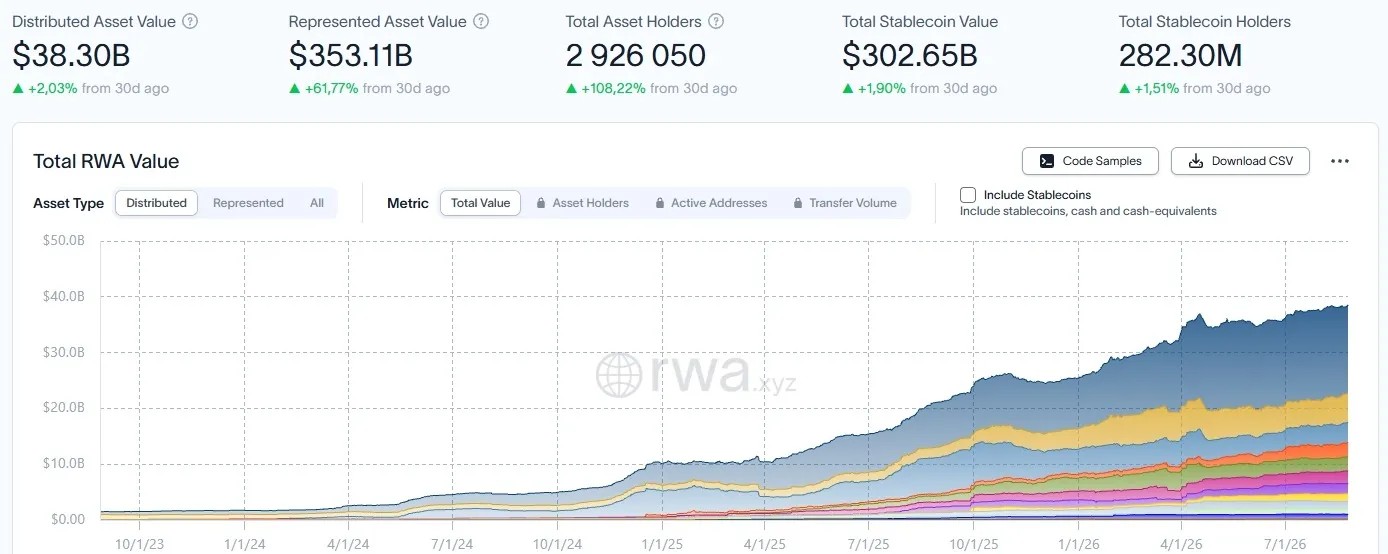
Source: RWA.xyz.

Recall that in the UK, it was forecasted that tokenization could add up to £33 billion per year to the economy over a 10-year horizon.

end-content
Domande pertinenti

QWhat is Japan preparing to test for stock and government bond settlement?

AJapan is preparing a system for real-time settlement of stock and government bond transactions using blockchain technology.

QWhich organizations are involved in the project to develop Japan's blockchain settlement system?

AThe organizations involved include the Financial Services Agency (FSA), the Ministry of Finance, the Bank of Japan, and representatives from the financial sector.

QWhat is the main benefit that blockchain technology is expected to provide for settlements in Japan's financial market?

AThe main benefit is that it should virtually eliminate the current settlement delays. Currently, stock settlements take two days, and government bond settlements take one day. With blockchain, sellers could receive and reinvest funds almost immediately after a transaction.

QAccording to the Nikkei, what risk is Japan trying to avoid by advancing its blockchain infrastructure?

AJapan is trying to avoid the risk that foreign investors and funds may avoid Japanese securities markets if the country's technology lags behind, as the U.S. and Europe are leading in the tokenization of real-world assets.

QWhat specific prior blockchain experiments in Japan are mentioned in the article?

AThe article mentions two prior experiments: 1) An FSA-supported demonstration project where rights to bonds, funds, and stocks would be recorded on a blockchain and settled using stablecoins. 2) The Bank of Japan's experiment using tokenized central bank reserves for blockchain-based settlements, potentially including securities settlements.

Letture associate

HBM is Being Redefined

HBM is being redefined as AI-driven demand for computing power shifts the performance bottleneck from processing units to memory bandwidth, making High Bandwidth Memory the critical component for advanced AI hardware. At HotChips 2026, Samsung and SK Hynix unveiled new technical roadmaps for HBM4, moving away from the traditional approach of simply increasing DRAM speed and stacking layers. The focus for HBM4 has shifted from DRAM optimization to a comprehensive system-level redesign of the Base Die. Key innovations include upgrading the Base Die to advanced logic processes (e.g., Samsung's 4nm), adopting hybrid bonding for 3D stacking, and exploring heterogeneous packaging solutions like Intel's EMIB alongside the established CoWoS. This marks HBM's evolution from a simple memory component into an integrated system involving "memory + logic + packaging + IP + EDA." This transition brings benefits like better signal integrity, higher I/O bandwidth (up to 2048-bit), and potential for in-memory computing. However, it also introduces significant complexity. DRAM manufacturers now must deeply collaborate with logic foundries, extending design cycles and increasing supply chain challenges. Furthermore, the industry is moving towards multiple advanced packaging paths, with EMIB emerging as an alternative to CoWoS to alleviate capacity constraints, while hybrid bonding is being developed for future ultra-high (16+ layer) stacks. New core barriers have emerged beyond manufacturing. High-speed PHY/SERDES IP, crucial for HBM4's higher data rates, is concentrated among a few established players, creating an entry barrier for smaller firms. Similarly, the industry lacks mature 3D heterogeneous EDA toolchains capable of co-simulating the coupled electrical, thermal, and mechanical effects across the logic base, memory stacks, and interposer. These "soft" capabilities in IP and EDA are now critical determinants of HBM4's performance and yield. In summary, the HBM industry is entering a new era of systemic competition. The standardized approach is giving way to divergent vendor roadmaps, with multiple technologies coexisting. Success will depend on integrated architecture, packaging, process, and ecosystem capabilities, fundamentally reshaping the competitive landscape for AI memory.

marsbit4 min fa

HBM is Being Redefined

marsbit4 min fa

The Era of Earning 200,000 from a 3,000 Investment Is Over; AI Comic Dramas Are Not a Get-Rich-Quick Trend

The era of turning 3,000 yuan into 200,000 yuan is over. AI-generated comic dramas are no longer a low-barrier gold rush. A wave of sudden account suspensions has hit creators in AI comic dramas, AI art, and AI tutorials, primarily triggered by new content and copyright compliance rules implemented by Tomato Novel on August 17. This "last straw" exposed the underlying issues: tightening platform rules, rising copyright requirements, increasing costs, and severe content homogenization. The business model was fundamentally unsustainable for most creators. One creator detailed the math: producing five minutes of content daily cost around 510 yuan in AI computing and editing, while a video with 60,000 views might only earn 45 yuan. While a few early viral hits like "Huo Qubing" and "Zombie Cleaner" achieved high returns with minimal investment, they were exceptions. The reality for most solo creators was barely covering costs or operating at a loss. The new regulations mandate formal authorization from original authors for adaptations, limit video length and the amount of原著 content used, and ban terms like "Episode 1" in titles. This directly dismantled the previous "produce first, authorize later" model. Faced with the inability to afford版权 costs and the threat of penalty, many creators chose to halt updates. While some fans expressed frustration, the rules protect original authors who often faced侵权 with little recourse. The shutdowns signal not the failure of AI technology, but an inevitable industry shift from wild growth to regulated refinement. The previous model prioritized quick cash over quality content, leading to formulaic, "AI-face" saturated dramas that audiences grew tired of. The future belongs to creators who use AI as a tool to serve solid storytelling, not replace it. Some are now seeking formal licenses, a slower but necessary process. Upcoming national regulations further underscore this move towards standardization, weeding out those seeking only fast money and making space for genuine creators.

marsbit4 min fa

The Era of Earning 200,000 from a 3,000 Investment Is Over; AI Comic Dramas Are Not a Get-Rich-Quick Trend

marsbit4 min fa

Circle CEO: Stablecoins Are at the Internet's 2002 Stage, Will Reach Trillions of Dollars in the Future

Circle CEO Jeremy Allaire, in a Q2 2026 earnings AMA, discussed the current state and future of stablecoins and Circle's strategy. He compared stablecoins today to the internet in 2002, predicting they will grow from hundreds of billions to trillions of dollars. Key points include: * **Current Use Cases**: Stablecoins have achieved product-market fit in digital asset markets (for trading/settlement), as a digital dollar store of value in emerging markets, and for cross-border payments and settlement. * **Future Growth Areas**: Allaire highlighted opportunities in the AI agent economy, merchant payments (especially via QR codes and stablecoin cards), and the convergence of traditional and on-chain finance. * **Circle's Strategy**: Circle aims to grow USDC through global partnerships. Its economic engines will include reserve income, transaction fees from its on-chain payment network (CPN), and its upcoming "economic operating system," Arc. * **Arc's Vision**: Arc, launching its mainnet on September 16, is a stablecoin-native blockchain designed for seamless user and developer experience. It aims to power the future "on-chain" economy where businesses and AI agents operate. * **Global Adoption**: Allaire emphasized that stablecoin adoption is a global phenomenon, driven by regulatory clarity in regions like Europe (MiCA) and the US (GENIUS Act), and will continue regardless of specific US legislation like the CLARITY Act. * **EURC Growth**: Circle's euro stablecoin, EURC, has surpassed €400 million in circulation, benefiting from early preparation for European regulations and existing distribution networks. Allaire expressed confidence in Circle's execution, citing strong team cohesion and the adoption of AI tools, while identifying cybersecurity and global local operations as key areas for continued strengthening.

marsbit58 min fa

Circle CEO: Stablecoins Are at the Internet's 2002 Stage, Will Reach Trillions of Dollars in the Future

marsbit58 min fa

Trading

Spot
活动图片