Original Author: Xu Chao
Original Source: Wall Street News
The U.S. Treasury market is sending increasingly strong signals of stress to other asset classes, with stocks being the first to feel the impact.
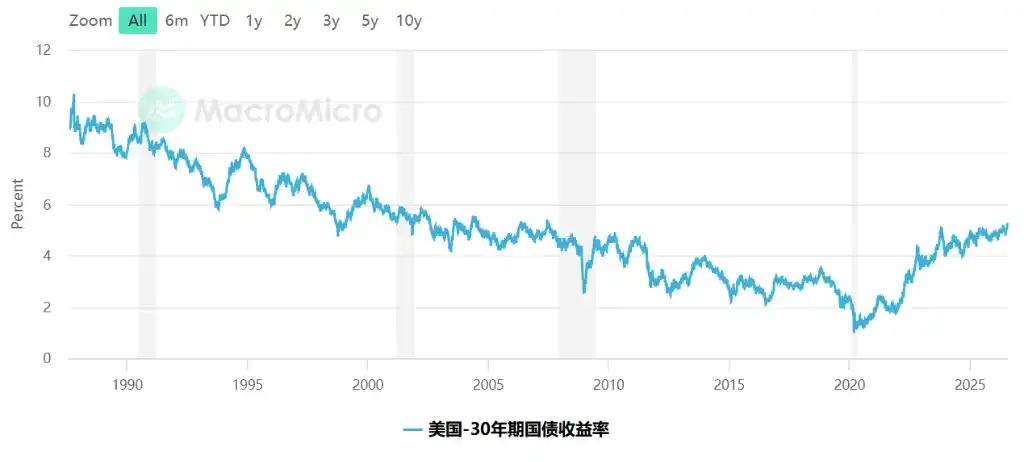
Long-term U.S. Treasury yields surged sharply last week, with the 30-year yield hitting its highest level since 2007, and the 10-year yield breaking out of the trading range it had maintained since late 2023.
Meanwhile, the ICE BofA MOVE Index, which measures expected volatility in the Treasury market, rose to its highest level since May, while demand for put options betting on falling bond prices surged. Data from the Chicago Board Options Exchange shows that the one-month put skew for options linked to the iShares 20+ Year Treasury Bond ETF soared to its highest level since the 2008 financial crisis.
In the coming week, the release of details from the U.S. Treasury's financing plans and the July non-farm payroll report could further intensify the volatility in the bond market.
Bob Elliott of Unlimited Funds recently wrote in a commentary: "It's difficult to gauge how much longer other asset markets, like equities, can withstand current interest rate levels without being dragged down." Gennadiy Goldberg, head of U.S. rates strategy at TD Securities, also warned that uncertainty surrounding the Federal Reserve's policy guidance, combined with geopolitical and other market noise, has created a precarious environment.
Fed Credibility Questioned, Long-Term Yields Break Out
The core driver of this recent surge in U.S. Treasury yields stems from market doubts about the Federal Reserve's policy credibility.
Since Federal Reserve Chair Kevin Warsh took the helm, he has adopted a tough stance on fighting inflation, yet the inflation rate has remained above the Fed's 2% target for five consecutive years. Investors are beginning to question whether the Fed truly has the will to raise interest rates again.
Last Wednesday, a rare divergence emerged within the Fed's rate-setting committee—three regional Fed presidents voted in favor of a rate hike, opposing the majority's position. As Warsh concluded his press conference last week, long-term yields jumped suddenly while short-term yields fell, sharply narrowing the spread between them. Analysis by Dow Jones Market Data shows this was the most significant compression of the yield curve on a 'Fed decision day' since 2023.
TD Securities' Goldberg stated: "The market is questioning just how determined the Fed is on controlling inflation." He also noted that while the base case remains no rate hikes this year or next, the probability of a hike has "increased significantly."
Bond Market Volatility Rises, Hedging Demand Expands Sharply
The unusual movement in yields quickly spread to the derivatives market, causing a sharp rise in hedging demand.
The ICE BofA MOVE Index reached its highest level since May, indicating traders are actively hedging against the risk of further rate increases.
At the same time, the ratio of trading volume in put options to call options linked to the iShares 20+ Year Treasury Bond ETF (TLT) has noticeably increased. Analysts at the Chicago Board Options Exchange pointed out that the one-month put skew for TLT options has surged to its highest level since the 2008 financial crisis.
Particularly noteworthy is that this rise in long-end yields has diverged from oil price movements—oil prices are falling, not rising in tandem with yields. This has further weakened the correlation between yields and oil prices, adding to market uncertainty.
Spillover Effects Emerge, Pressure on Stocks Rises
Turmoil in the U.S. Treasury market has historically been a precursor to stock market risks, and the current situation similarly has equity investors on edge.
Bob Elliott noted in his commentary that whenever Treasury yields reach or approach current levels, stress tends to begin spreading to other markets, with stocks being the first to be dragged down. Currently, the 30-year yield is at 5.239% and the 10-year yield is at 4.693%, both in historically high ranges.
Goldberg also admitted that geopolitical uncertainty stemming from the situation with Iran, ambiguity in the Fed's policy guidance, and a combination of other market noise are all contributing to the fragile environment. "All these uncertainties are intertwined," he said.
Multiple Event Windows Approach, A Critical Week of Testing Lies Ahead
The coming week will be a critical window to determine whether the stress in the Treasury market can spread further.
Later this week, the U.S. Treasury will release details of its latest government financing plans, and anything unexpected could trigger a new wave of volatility in the bond market. Several important economic data points will also be released throughout the week, culminating in Friday's July non-farm payroll report, which will significantly influence market expectations regarding the Fed's policy direction.
At the same time, last week, the U.S. Treasury and the Federal Reserve jointly conducted a historic coordinated intervention with Japanese authorities to stabilize the persistently weakening yen. Analysts believe the U.S. side's participation in the intervention was partly motivated by a desire to prevent renewed volatility in the U.S. Treasury market.
The $30 trillion U.S. Treasury market is the cornerstone of the global financial system, serving both as the core collateral for short-term institutional liquidity and as the benchmark pricing anchor for trillions of dollars in global debt. If this "sleeping giant" continues to stir, its tremors will extend far beyond the bond market itself.