Hong Kong Consensus Binance Voice: In the Era of Regulation-Friendly, Why Are Institutions Increasing Their Bitcoin Holdings?

marsbitPubblicato 2026-02-15Pubblicato ultima volta 2026-02-15

Introduzione

Hong Kong Consensus: Binance's Voice - Why Institutions Are Accumulating Bitcoin in a Regulation-Friendly Era At the 2026 Hong Kong Consensus conference, Binance Co-CEO Richard Teng highlighted key market shifts. Regulatory clarity is now a foundation for innovation, not a barrier, with recent U.S. legislative progress boosting stablecoin adoption. The line between Web2 and Web3 is blurring, evidenced by Binance's collaboration with Franklin Templeton on tokenized money market funds, integrating traditional finance into crypto. While retail investors remain cautious, institutions are accumulating—buying ~43,000 BTC in January alone. Binance's strategic move to convert $1 billion of its SAFU fund from stablecoins to Bitcoin signals strong long-term confidence, reducing circulating supply and providing market support. Institutional buying is driven by Bitcoin's role as a strategic asset, with spot ETFs, corporate treasuries, and even governments like El Salvador increasing holdings. Unlike MicroStrategy's corporate asset allocation or passive ETF inflows, Binance's SAFU conversion is a risk management move, using a dynamic purchasing mechanism to ensure fund security. This action, while having a modest direct price impact (estimated 2-5% upside), reinforces Bitcoin's credibility and sets a psychological support level. For retail investors, survival in the bear market means focusing on defensive strategies, such as low-risk earning opportunities like Binance's booster program...

Author: Viee | Biteye Content Team

In early February 2026, the winter in Hong Kong's Victoria Harbour was livelier than usual, as the Hong Kong Consensus Conference, a focal point of Asia's crypto narrative, was held once again.

Recently, the price of Bitcoin once fell below the $70,000 mark, trading volume was sluggish, and investors were panicked. In this bear market, what choices will these behemoth exchanges make to cope with the cold wave? For ordinary retail investors, perhaps the question is not when the bull market will come, but whether they can survive this bear market. Platforms are adjusting their positions, institutions are building their bases, and how should we allocate funds and protect our principal?

This article will start with Binance's statements at the Consensus Conference, analyze the underlying logic behind institutions' purchases of Bitcoin, and discuss how retail and institutional investors can prepare together for the industry's cold winter by combining recent exchange wealth management activities.

I. Binance's Voice at the Consensus Conference

Amid price volatility and low sentiment, the speeches at this Consensus Conference were different from the passionate expressions during the bull market of previous years, and more like conveying a structural change in the market. Among them, the speech by Binance's co-CEO Richard Teng was quite representative, and several very clear signals could be captured throughout the presentation, regarding regulation, institutions, and infrastructure.
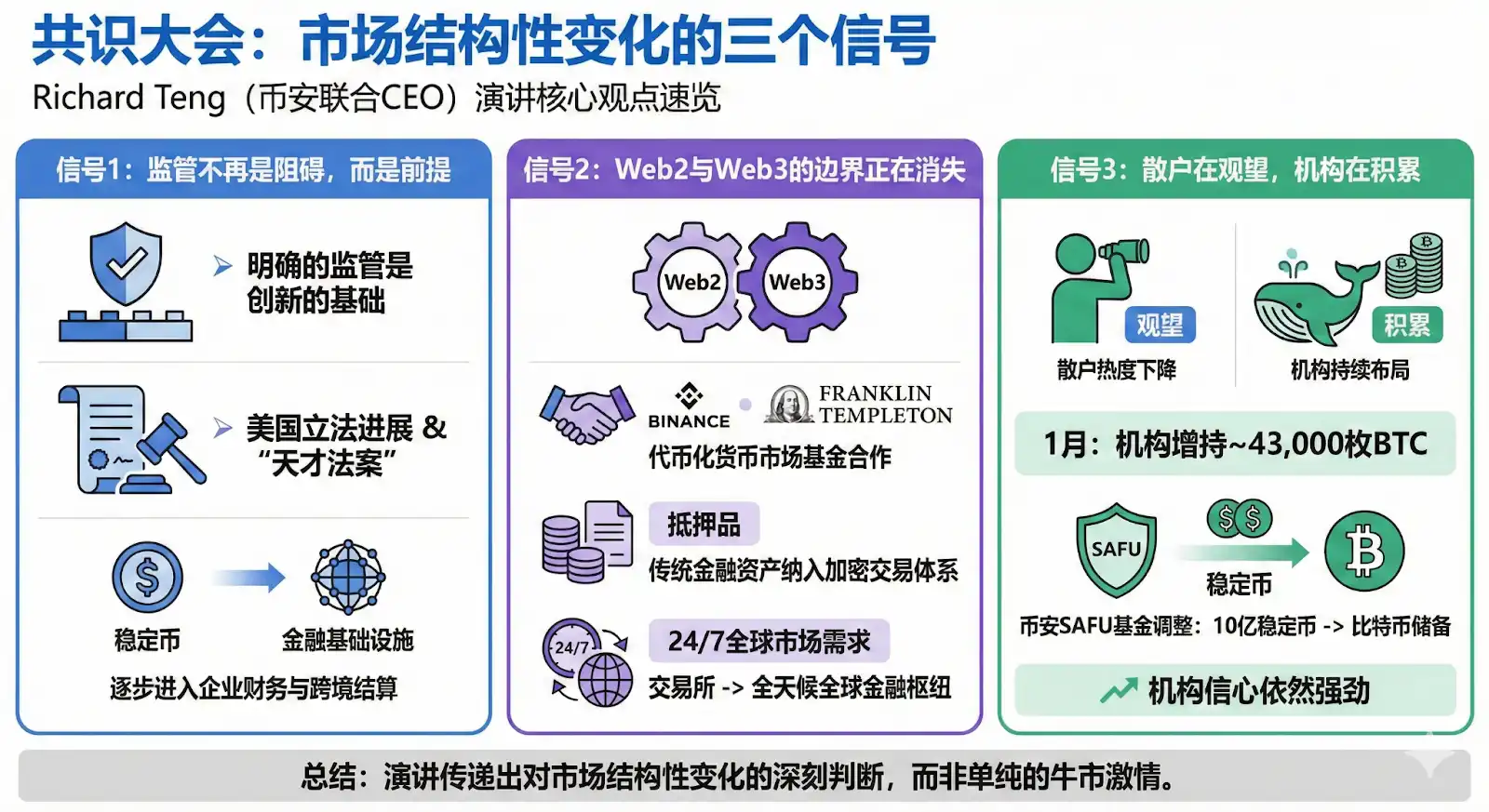
First, regulation is no longer an obstacle but a prerequisite.

Richard emphasized that "clear regulation is the foundation of innovation." He specifically mentioned recent legislative progress in the United States and the confidence boost brought to the stablecoin industry by the "Genius Act." Stablecoins, once a liquidity tool within crypto, are gradually entering corporate finance and cross-border settlement systems, which means crypto assets are migrating towards financial infrastructure.

Second, the boundary between Web2 and Web3 is disappearing.

Another noteworthy part of the speech was Binance's cooperation with Franklin Templeton on tokenized money market funds. Using tokenized funds as institutional collateral also means that traditional financial assets are being incorporated into the crypto trading system.

At the same time, the growth in trading volume of precious metal derivatives reflects the real demand of institutions for 24/7 global markets. When money market funds, gold derivatives, and stablecoins begin to form a closed loop on the same platform, the role of exchanges is no longer just about facilitating trades but more like an all-weather global financial hub.

Third, retail investors are watching, while institutions are accumulating.

A key number given by Richard is that institutional investors increased their holdings by approximately 43,000 Bitcoins in January.

The meaning behind this number is not that prices will rise immediately, but that the market structure is changing. Retail users in Asia-Pacific and Latin America are still active, but overall trading enthusiasm is indeed lower than in a bull market. In contrast, institutional funds are continuously positioning themselves in low-volatility intervals. Combined with Binance's announcement on January 29, 2026, regarding the strategic adjustment of the SAFU fund, which will convert $1 billion of stablecoin reserves in the SAFU fund into Bitcoin reserves within 30 days, it shows that institutional confidence remains strong.

In other words, while retail investors are waiting for clear bottom signals, institutions are already making allocation decisions. Smart money may not have left the market.

So the question is, when institutions are buying and platforms are adjusting their asset structures, how can retail investors gain a deeper understanding of the meaning behind these actions?

II. The Market Is Still Sluggish, Why Are Institutions Already Acting?

Regarding the institutional buying mentioned earlier, let's first review how Bitcoin has attracted a large amount of institutional capital allocation in recent years, especially since the approval of spot Bitcoin ETFs in 2024, which has significantly increased institutional buying.

1. Analysis of Institutional Buying Trends

Today, institutional buying enters the market mainly through ETFs, investment funds, corporations, governments, and other forms. The following points reflect the current institutional layout trends:

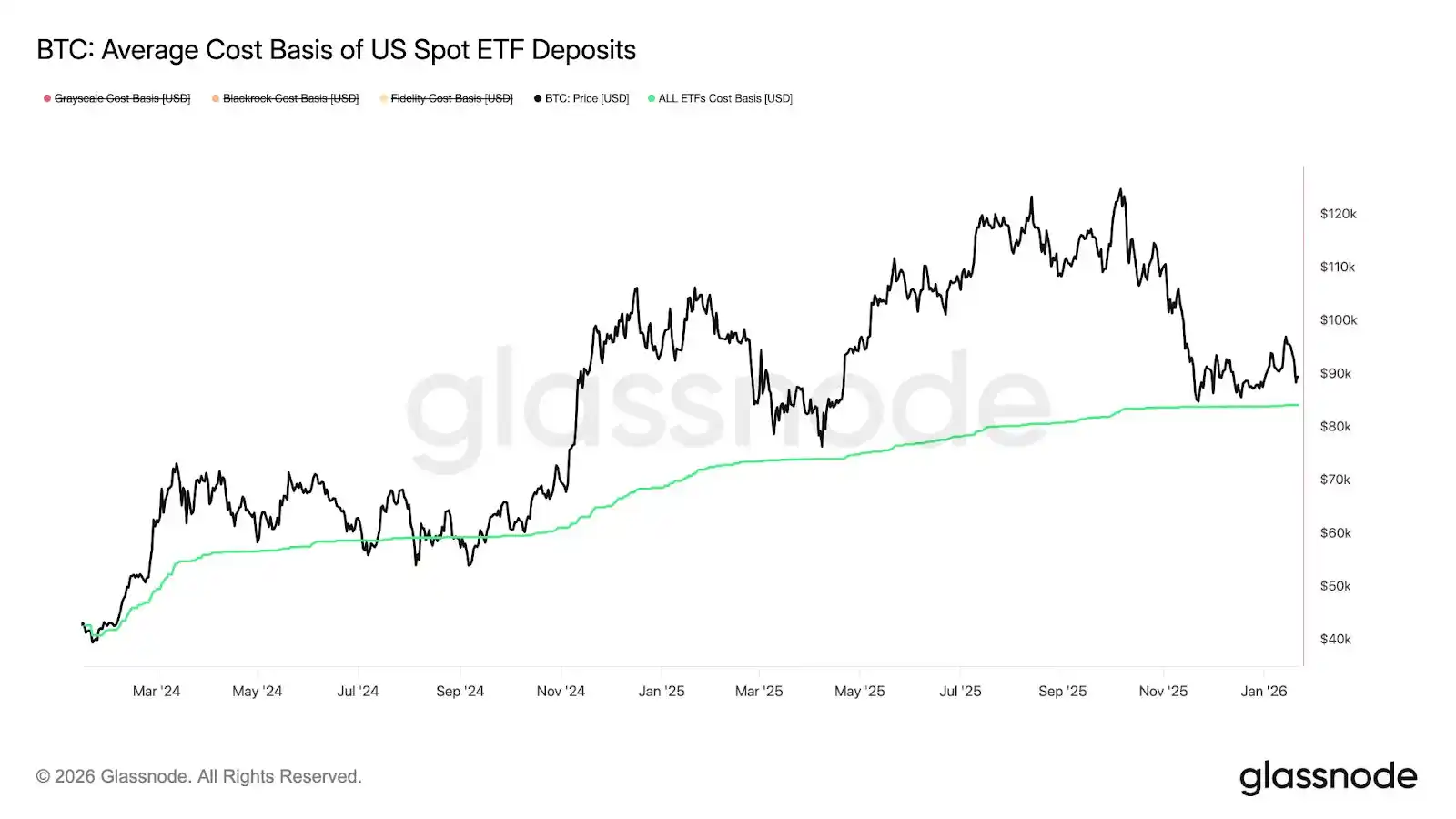
  • Spot ETFs Attract Massive Inflows: Institutions accessing the Bitcoin market through spot ETFs has become a primary method, and ETF data is also a means to gauge market heat. For example, according to SoSoValue data, U.S. spot Bitcoin ETFs saw their largest weekly outflow since last November in late January (approximately $1.22 billion). Historical experience shows that large-scale redemptions often occur near阶段性 bottoms in prices, so Bitcoin may be接近 a local low. The data in the chart below indicates that the average holding cost of ETF investors is about $84,099, a price range that has formed key support levels multiple times in the past. If historical patterns repeat, this round of capital outflows may mean that short-term downward momentum is nearing its end, and a market rebound is possible.
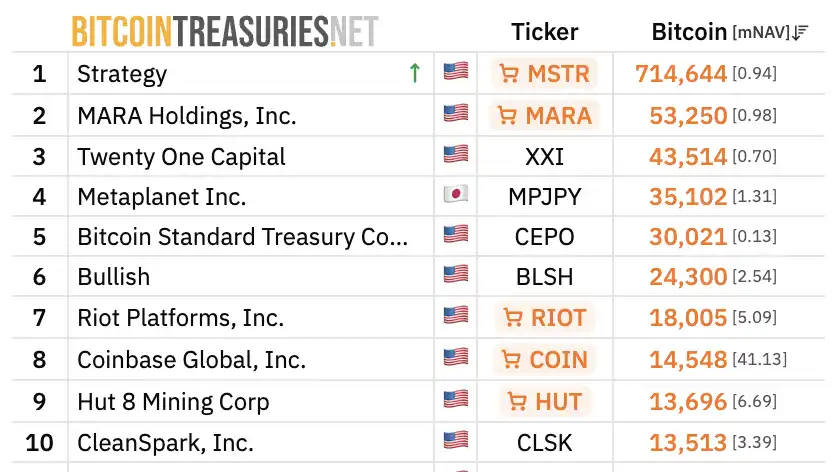
  • Surge in Total Holdings by Listed Companies: It is reported that in Q4 2025, the total Bitcoin held by global listed companies reached approximately 1.1 million (about $94 billion), with 19 new listed companies purchasing Bitcoin. This indicates that Bitcoin is increasingly being regarded as a strategic asset by enterprises. In addition to the well-known strategic treasury companies, several newly listed companies have also joined the buying camp, further validating the trend of institutional capital inflow. The chart below shows the top 10 Bitcoin treasury data.
  • National Level Initiatives: Some countries are also publicly buying Bitcoin. The government of El Salvador announced in November 2025 that it spent $100 million in a single day to buy approximately 1,090 BTC, bringing its cumulative holdings to over 7,000 coins.

In summary, from 2024 to the present, institutional buying has shown characteristics of explosive ETF inflows and密集建仓 by enterprises and investment funds. As Richard Teng said, this trend is expected to continue in 2026 and continue to provide upward momentum for the market.

2. What Are the Historically Representative Public Bitcoin Purchases?

As of early 2026, historically public purchases of Bitcoin for the purpose of "building the market, stabilizing the ecosystem, or reserve assets" can be divided into 5 major categories. Here are a few representative cases:
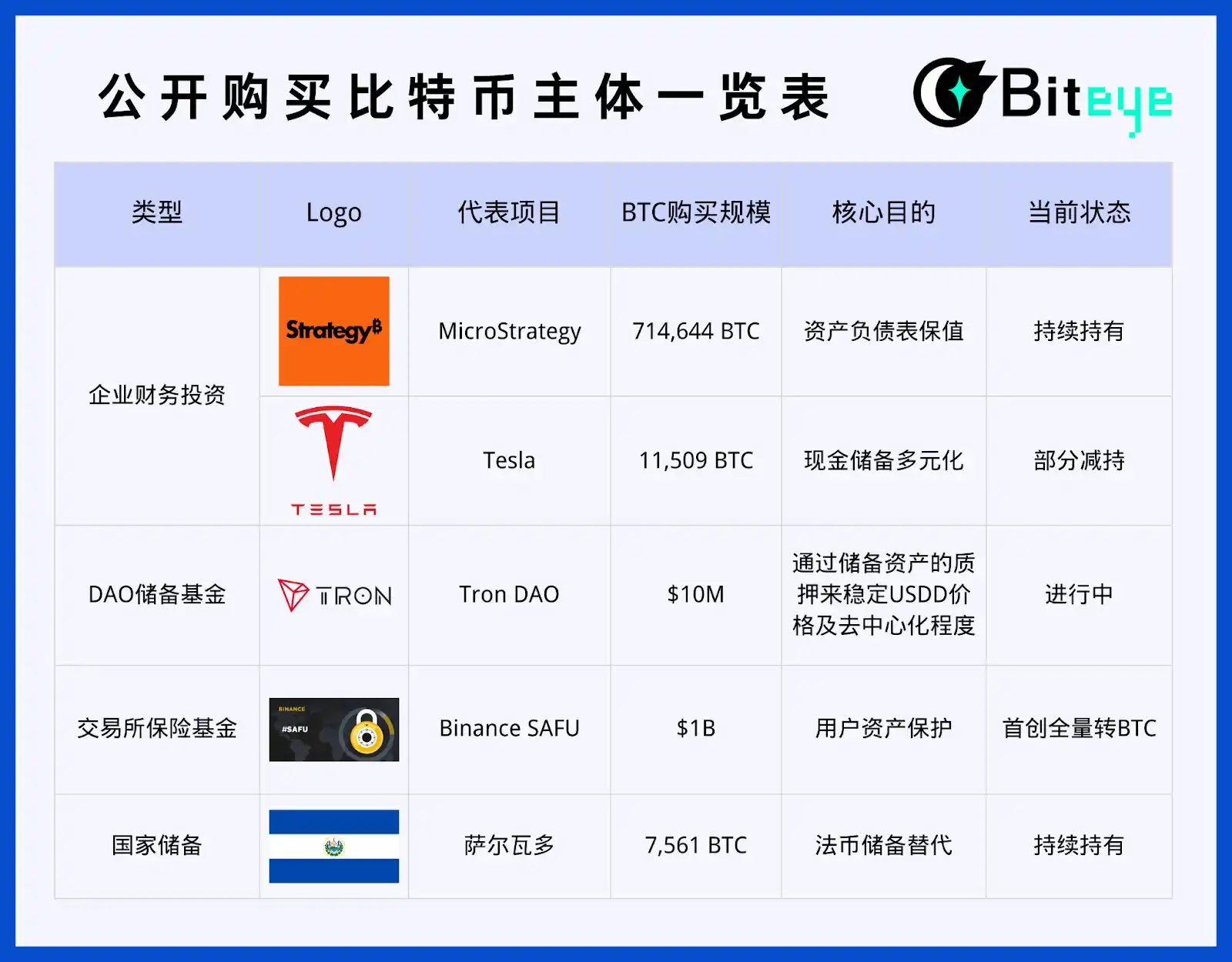
From the table above, it can be seen that institutions buying Bitcoin for market building can be roughly divided into three categories. The first is corporate asset allocation, such as MicroStrategy. These companies use shareholder assets as a basis and treat BTC as a long-term value storage tool. The second category is national/DAO purchases and holdings as reserve alternatives. The third category is exchange buying behavior, such as Binance's current SAFU conversion. This approach shifts reserves from stablecoins to Bitcoin, which is more resistant to inflation and censorship and allows for self-custody. In the event of potential future geopolitical systemic shocks, this can enhance asset independence.

The difference lies here: the starting point for the vast majority of enterprises buying BTC is corporate financial decision-making. Binance, however, is using a user protection fund, meaning this is a purchase for risk structure重构.

3. How Does Binance's Approach Differ Fundamentally from Other Institutions?

First, the asset属性 is different.

MicroStrategy uses company assets; ETF institutions' purchases are passive allocations from user subscription funds and do not bear corporate responsibility for price fluctuations. El Salvador's national purchase is more of a policy strategic行为, and its decision-making logic is difficult to replicate. In contrast, Binance is using a user protection fund. Converting the protection fund to BTC本质上 regards Bitcoin as the most reliable long-term asset.

Second, the execution method is different.

The模式 of MicroStrategy, ETFs, and other institutions is closer to trend/bottom adding. Binance, however, buys in phases and has set up a rebalancing mechanism. If the SAFU market value falls below the既定 safety line, it will continue to add positions. This dynamic replenishment mechanism means this is long-term asset structure management.

Third, the market role is different.

Corporate coin buying mainly affects the company's investment structure. The continuous subscription of ETFs represents the持续放量 of institutional compliance channels. Exchange coin buying affects the entire market liquidity and sentiment structure. When the world's largest exchange locks $1 billion worth of BTC as long-term reserves, it can strengthen the expectation that leading platforms are bullish. This is a demonstration effect.

4. What Retail Investors Need to Care About: What Does This Mean for the Market and BTC Price?

In the short term, large-scale public purchases have not caused剧烈上涨, indicating the market may be in a rational digestion stage. But from a structural analysis, we believe there may be several medium to long-term impacts.

First, $1 billion worth of BTC is locked long-term in the insurance fund, equivalent to reducing circulating supply, although the proportion of total circulation is not high (about 0.1%). According to relevant research data, spreading $1 billion over 30 days means buying about $33.33 million daily. In Bitcoin's全网 daily trading volume of $30-50 billion, this only accounts for 0.1%-0.2%, making it difficult to form a significant impact. After using the TWAP algorithm, the buying volume per minute is only about $23,000, which is hardly noticeable in daily fluctuations. Based on this estimate, the price boost is expected to be within 0.5%-1.5%.

Second, as a strategic purchase by the world's largest exchange, it is seen as an endorsement of Bitcoin by an authoritative institution, which may trigger additional confidence premiums. Therefore,综合考虑, under the叠加 of direct buying and market sentiment, the potential price increase for Bitcoin may exceed around 1%, reaching the 2%-5% level.

Finally, the support mechanism. Since Binance承诺 to replenish if it falls below $800 million, this mechanism effectively sets a strong support level. When prices fall significantly, the market will expect Binance to step in and buy, helping to curb the decline.

In summary, Binance's $1 billion phased purchase is expected to only have a mild boosting effect on Bitcoin. It will not violently pump the price in the short term but provides an invisible layer of support for market sentiment and prices, reflecting more long-term bullish confidence in Bitcoin rather than short-term speculation.

III. Retail Investors' Bear Market Survival Rules: Seeking Defensive Yield

When institutions are allocating underlying assets, how should retail investors respond? Since they cannot change the market like large funds, the best way is not to waste bullets.
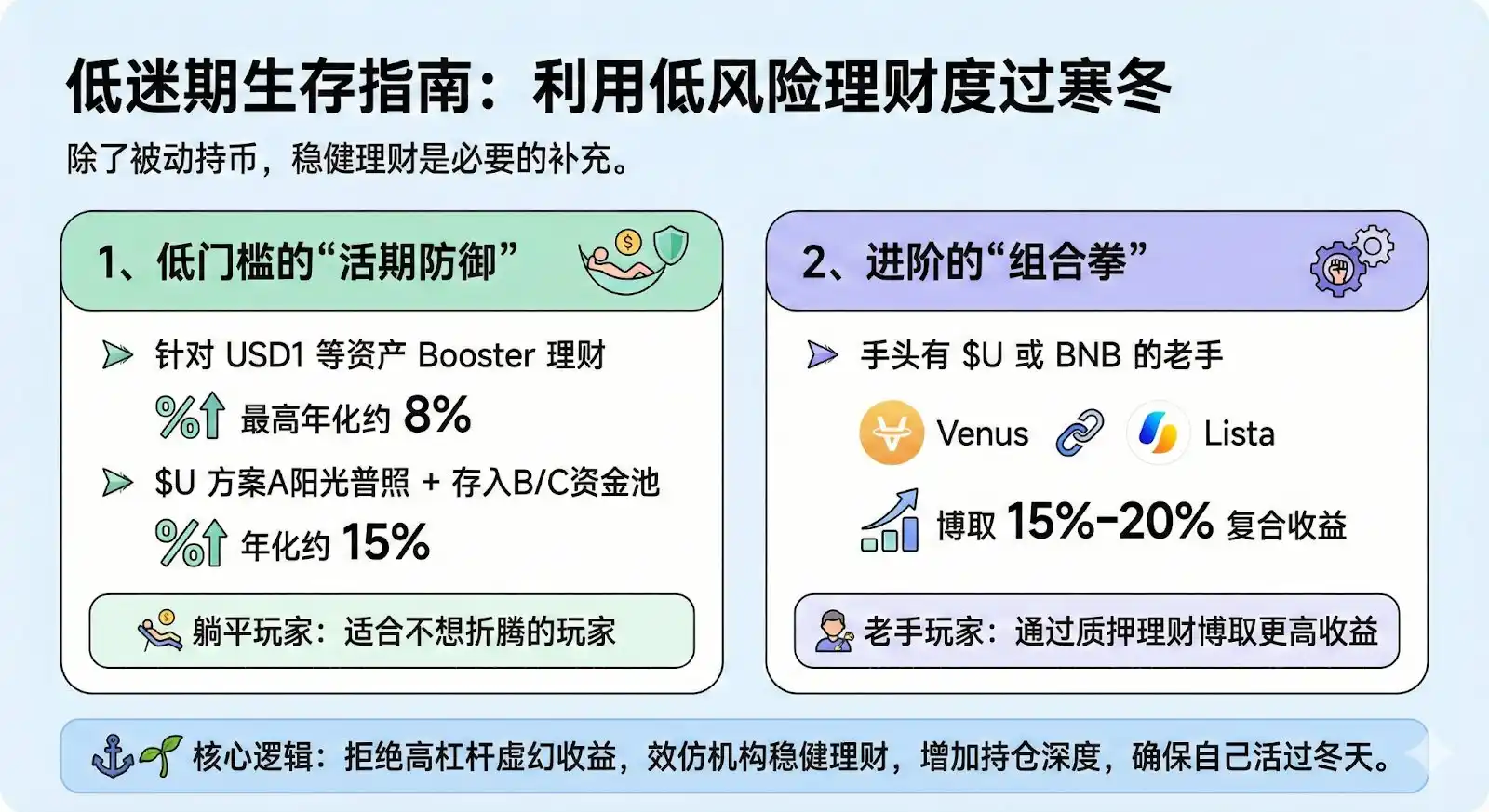
During the current downturn, besides holding coins passively, using platform activities for low-risk wealth management is a necessary supplement to survive the winter. Looking at Binance's recent wealth management actions, the logic is very clear:

1. Low-threshold "Current Defense": Booster wealth management for USD1, with a maximum annualized yield of about 8%. Plan A for $U is sunshine普照 + depositing into pools B/C, with an annualized yield of about 15%.

Suitable for those躺平 players who don't want to折腾.

2. Advanced "Combination Punch": For veterans with $U or BNB, staking for wealth management (such as through Venus or Lista protocols) can aim for复合收益 of 15%-20%.

In short, the core logic is not to chase虚幻收益 with high leverage at this stage but to emulate institutions by increasing holding depth through稳健 wealth management methods to ensure survival through the winter.

IV. Conclusion: Companions in the Winter

The bear market will eventually pass, but only those who survive will be qualified to welcome spring.

At present, this long crypto winter is still testing the patience and will of every market participant. Through the window of the Hong Kong Consensus Conference, we have seen the real choices of leading exchanges.

As the old saying goes, "If winter comes, can spring be far behind?" In a bear market, some are preparing for the worst, which also means the dawn will eventually come. Until then, all we can do is maintain rationality and patience, manage risks well, and cherish the chips in hand.

Domande pertinenti

QWhat were the key signals from Binance's speech at the Hong Kong Consensus Conference regarding market structure?

AThe key signals were: 1) Regulation is no longer a barrier but a prerequisite for innovation, with specific mention of U.S. legislative progress. 2) The boundary between Web2 and Web3 is disappearing, exemplified by Binance and Franklin Templeton's tokenized money market fund collaboration. 3) Retail investors are观望 (waiting and seeing), while institutions are accumulating assets, with institutions purchasing approximately 43,000 BTC in January.

QHow did the approval of spot Bitcoin ETFs in 2024 impact institutional investment, and what is a key indicator of market sentiment from this data?

AThe approval significantly enhanced institutional buying power. A key sentiment indicator is that large-scale redemptions from U.S. spot Bitcoin ETFs (e.g., ~$1.22 billion in late January) have historically occurred near阶段性底部 (phase bottoms), suggesting the market might be near a local low and a rebound is possible.

QWhat are the three main categories of historical, market-building Bitcoin purchases, and how does Binance's SAFU conversion differ from a company like MicroStrategy?

AThe three categories are: 1) Corporate asset allocation (e.g., MicroStrategy). 2) National/DAO reserve replacement. 3) Exchange purchases (e.g., Binance's SAFU conversion). Binance's purchase differs fundamentally: it uses a user protection fund for risk structure重构 (restructuring), views BTC as the most reliable long-term asset, employs a phased buying mechanism with rebalancing, and its role as a major exchange creates a示范效应 (demonstration effect) on market liquidity and sentiment.

QWhat is the estimated direct and indirect impact of Binance's $1 billion BTC purchase for its SAFU fund on the Bitcoin price, according to the article?

AThe direct price impact is estimated to be mild, around 0.5%-1.5%, as the daily buying volume is a small fraction (0.1%-0.2%) of total market volume. However, the indirect effect from the authoritative endorsement and confidence boost could push the potential price increase to a range of 2%-5%. The purchase also establishes a psychological support level for the market.

QWhat defensive strategies does the article suggest for retail investor survival during the bear market?

AThe article suggests avoiding high-leverage speculation and instead focusing on low-risk earning opportunities through platform activities, similar to institutional strategies. Examples given include: 1) '活期防御' (current account defense) like Booster理财 (Booster wealth management) offering ~8% APY. 2) '组合拳' (combination punch) for advanced users, using质押理财 (staking wealth management) on protocols like Venus or Lista to pursue 15%-20% compound yields, thereby increasing holdings to survive the winter.

Letture associate

2026 Robot Track in Practice: Who is Paving the Way, Who is Mining, and Who is Building the System?

The 2026 embodied AI and DePIN narrative is shifting from hype to real-world applications. This analysis examines three leading projects in the robot economy: peaq, PrismaX, and OpenMind. peaq ($PEAQ) is a Layer-1 blockchain for the "Machine Economy," enabling devices to act as autonomous economic agents. A key case is a tokenized robotic farm in Hong Kong that generates real yield (e.g., 3820 USDT distributed to a user) from selling hydroponic vegetables, offering an ~18% APY. With partnerships like Bosch and Mastercard, and a ~$78M FDV, it's seen as an undervalued infrastructure play. PrismaX, backed by a $11M a16z-led round, focuses on generating crucial physical-world AI training data through human teleoperation. Users remotely operate real robots to earn points for a future airdrop. While attracting users, it faces risks from low-quality data farming and unproven commercial scalability. OpenMind ($ROBO) aims to be the "Android OS" for robots, providing a unified app store. It has partnered with 10+ major hardware firms (e.g., Unitree, UBTECH) and launched with 5+ apps. However, its $400M FDV is considered high, and it faces competition from closed systems like Tesla's Optimus. Together, these projects represent the essential stack for decentralized embodied AI: PrismaX (data layer) trains robots, OpenMind (OS/application layer) enables cross-hardware functionality, and peaq (network/incentive layer) facilitates automated economic transactions. The synergy between these layers is key to scaling practical applications.

marsbit14 min fa

2026 Robot Track in Practice: Who is Paving the Way, Who is Mining, and Who is Building the System?

marsbit14 min fa

Trading

Spot
Futures

Articoli Popolari

Cosa è BITCOIN

Comprendere HarryPotterObamaSonic10Inu (ERC-20) e la sua posizione nel mondo delle criptovalute Negli ultimi anni, il mercato delle criptovalute ha assistito a un aumento della popolarità delle meme coin, catturando l'interesse non solo dei trader, ma anche di coloro che cercano coinvolgimento comunitario e valore di intrattenimento. Tra questi token unici c'è HarryPotterObamaSonic10Inu (ERC-20), un progetto intrigante che mescola riferimenti culturali nel tessuto delle criptovalute. Questo articolo esplora gli aspetti chiave di HarryPotterObamaSonic10Inu, analizzando i suoi meccanismi, l'etica guidata dalla comunità e il suo coinvolgimento con il panorama crittografico più ampio. Che cos'è HarryPotterObamaSonic10Inu (ERC-20)? Come suggerisce il suo nome, HarryPotterObamaSonic10Inu è una meme coin costruita sulla blockchain di Ethereum, classificata secondo lo standard ERC-20. A differenza delle criptovalute tradizionali che possono enfatizzare l'utilità pratica o il potenziale investimento, questo token prospera grazie al valore di intrattenimento e alla forza della sua comunità. Il progetto mira a creare un ambiente in cui gli utenti coinvolti possono riunirsi, condividere idee e partecipare ad attività ispirate a diversi fenomeni culturali. Una caratteristica notevole di HarryPotterObamaSonic10Inu è la zero tassa sulle transazioni. Questo elemento allettante tende a incoraggiare il trading e il coinvolgimento della comunità, privo di costi aggiuntivi che possono scoraggiare i trader di piccole dimensioni. L'offerta totale della moneta è fissata a un miliardo di token, un numero che segna la sua intenzione di mantenere una circolazione sostanziale all'interno della comunità. Creatore di HarryPotterObamaSonic10Inu (ERC-20) Le origini di HarryPotterObamaSonic10Inu sono avvolte in un certo mistero; i dettagli sul creatore rimangono sconosciuti. Lo sviluppo di questo token non presenta un team identificabile o un piano esplicito, cosa non rara nel settore delle meme coin. Invece, il progetto è emerso organicamente, con il suo progresso fortemente dipendente dall'entusiasmo e dalla partecipazione della sua comunità. Investitori di HarryPotterObamaSonic10Inu (ERC-20) Per quanto riguarda investimenti esterni e finanziamenti, HarryPotterObamaSonic10Inu rimane ambiguo. Il token non elenca alcuna fondazione di investimento conosciuta o un sostegno organizzativo significativo. Invece, la linfa vitale del progetto è la sua comunità di base, che informa la sua crescita e sostenibilità attraverso azioni collettive e coinvolgimento nello spazio crittografico. Come funziona HarryPotterObamaSonic10Inu (ERC-20)? In quanto meme coin, HarryPotterObamaSonic10Inu opera principalmente al di fuori delle strutture tradizionali che governano spesso il valore degli asset. Ci sono diversi aspetti distintivi che definiscono il funzionamento del progetto: Transazioni senza tasse: Senza costi fiscali sulle transazioni, gli utenti possono comprare e vendere liberamente il token senza preoccuparsi di costi nascosti. Coinvolgimento della comunità: Il progetto prospera sull'interazione della comunità, sfruttando le piattaforme social per creare entusiasmo e facilitare il coinvolgimento. Discussioni, condivisione di contenuti e coinvolgimento sono elementi cruciali che aiutano ad espandere la sua portata e a favorire la lealtà tra i sostenitori. Nessuna utilità pratica: Va notato che HarryPotterObamaSonic10Inu non offre un'utilità concreta all'interno dell'ecosistema finanziario. Piuttosto, è classificato come un token principalmente per attività di intrattenimento e comunitarie. Riferimento culturale: Il token incorpora astutamente elementi della cultura pop per attirare interesse, collegandosi a appassionati di meme e seguaci delle criptovalute. HarryPotterObamaSonic10Inu esemplifica come le meme coin operino in modo diverso rispetto ai progetti di criptovalute più tradizionali, entrando nel mercato come costrutti sociali innovativi piuttosto che come asset utilitari. Cronologia di HarryPotterObamaSonic10Inu (ERC-20) La storia di HarryPotterObamaSonic10Inu è segnata da diversi traguardi notevoli: Creazione: Il token è emerso da un meme virale, catturando l'immaginazione di molti appassionati di criptovalute. Le date di creazione specifiche non sono disponibili, sottolineando la sua crescita organica. Inserimento negli scambi: HarryPotterObamaSonic10Inu ha fatto il suo ingresso in vari scambi, consentendo un accesso e un trading più facili da parte della comunità. Iniziative di coinvolgimento della comunità: Attività in corso volte a migliorare l'interazione della comunità, comprese gare, campagne sui social media e generazione di contenuti da parte di fan e sostenitori. Piani di espansione futura: La tabella di marcia del progetto include il lancio di una collezione NFT, merchandising e un sito di eCommerce relativo ai suoi temi culturali, coinvolgendo ulteriormente la comunità e cercando di aggiungere più dimensioni al suo ecosistema. Punti chiave su HarryPotterObamaSonic10Inu (ERC-20) Natura guidata dalla comunità: Il progetto dà priorità al contributo collettivo e alla creatività, garantendo che il coinvolgimento degli utenti sia al centro del suo sviluppo. Classificazione come meme coin: Rappresenta l'epitome delle criptovalute basate sull'intrattenimento, distinguendosi dai veicoli d'investimento tradizionali. Nessuna affiliazione diretta con Bitcoin: Nonostante la somiglianza nel nome del ticker, HarryPotterObamaSonic10Inu è distintivo e non ha alcuna relazione con Bitcoin o altre criptovalute consolidate. Focus sulla collaborazione: HarryPotterObamaSonic10Inu è progettato per creare uno spazio per la collaborazione e la condivisione di storie tra i suoi detentori, fornendo un canale per la creatività e il legame comunitario. Prospettive future: L'ambizione di espandersi oltre il suo presupposto iniziale verso NFT e merchandising delinea un percorso per il progetto per potenzialmente entrare in strade più mainstream all'interno della cultura digitale. Poiché le meme coin continuano a catturare l'immaginazione della comunità crittografica, HarryPotterObamaSonic10Inu (ERC-20) si distingue per i suoi legami culturali e il suo approccio centrato sulla comunità. Anche se potrebbe non adattarsi al modello tipico di un token orientato all'utilità, la sua essenza risiede nella gioia e nella camaraderia coltivate tra i suoi sostenitori, evidenziando la natura in evoluzione delle criptovalute in un'epoca sempre più digitale. Con la continuazione dello sviluppo del progetto, sarà importante osservare come le dinamiche della comunità influenzano la sua traiettoria nel panorama in continuo cambiamento della tecnologia blockchain.

400 Totale visualizzazioniPubblicato il 2024.04.01Aggiornato il 2024.12.03

Come comprare BTC

Benvenuto in HTX.com! Abbiamo reso l'acquisto di Bitcoin (BTC) semplice e conveniente. Segui la nostra guida passo passo per intraprendere il tuo viaggio nel mondo delle criptovalute.Step 1: Crea il tuo Account HTXUsa la tua email o numero di telefono per registrarti il tuo account gratuito su HTX. Vivi un'esperienza facile e sblocca tutte le funzionalità,Crea il mio accountStep 2: Vai in Acquista crypto e seleziona il tuo metodo di pagamentoCarta di credito/debito: utilizza la tua Visa o Mastercard per acquistare immediatamente BitcoinBTC.Bilancio: Usa i fondi dal bilancio del tuo account HTX per fare trading senza problemi.Terze parti: abbiamo aggiunto metodi di pagamento molto utilizzati come Google Pay e Apple Pay per maggiore comodità.P2P: Fai trading direttamente con altri utenti HTX.Over-the-Counter (OTC): Offriamo servizi su misura e tassi di cambio competitivi per i trader.Step 3: Conserva Bitcoin (BTC)Dopo aver acquistato Bitcoin (BTC), conserva nel tuo account HTX. In alternativa, puoi inviare tramite trasferimento blockchain o scambiare per altre criptovalute.Step 4: Scambia Bitcoin (BTC)Scambia facilmente Bitcoin (BTC) nel mercato spot di HTX. Accedi al tuo account, seleziona la tua coppia di trading, esegui le tue operazioni e monitora in tempo reale. Offriamo un'esperienza user-friendly sia per chi ha appena iniziato che per i trader più esperti.

2.5k Totale visualizzazioniPubblicato il 2024.12.12Aggiornato il 2025.03.21

Cosa è $BITCOIN

ORO DIGITALE ($BITCOIN): Un'Analisi Completa Introduzione all'ORO DIGITALE ($BITCOIN) L'ORO DIGITALE ($BITCOIN) è un progetto basato su blockchain che opera sulla rete Solana, con l'obiettivo di combinare le caratteristiche dei metalli preziosi tradizionali con l'innovazione delle tecnologie decentralizzate. Sebbene condivida un nome con Bitcoin, spesso definito “oro digitale” a causa della sua percezione come riserva di valore, l'ORO DIGITALE è un token separato progettato per creare un ecosistema unico all'interno del panorama Web3. Il suo obiettivo è posizionarsi come un asset digitale alternativo valido, anche se i dettagli riguardanti le sue applicazioni e funzionalità sono ancora in fase di sviluppo. Cos'è l'ORO DIGITALE ($BITCOIN)? L'ORO DIGITALE ($BITCOIN) è un token di criptovaluta esplicitamente progettato per l'uso sulla blockchain di Solana. A differenza di Bitcoin, che fornisce un ruolo di stoccaggio di valore ampiamente riconosciuto, questo token sembra concentrarsi su applicazioni e caratteristiche più ampie. Aspetti notevoli includono: Infrastruttura Blockchain: Il token è costruito sulla blockchain di Solana, nota per la sua capacità di gestire transazioni ad alta velocità e a basso costo. Dinamiche di Offerta: L'ORO DIGITALE ha un'offerta massima fissata a 100 quadrilioni di token (100P $BITCOIN), sebbene i dettagli riguardanti la sua offerta circolante siano attualmente non divulgati. Utilità: Sebbene le funzionalità precise non siano esplicitamente delineate, ci sono indicazioni che il token potrebbe essere utilizzato per varie applicazioni, potenzialmente coinvolgendo applicazioni decentralizzate (dApp) o strategie di tokenizzazione degli asset. Chi è il Creatore dell'ORO DIGITALE ($BITCOIN)? Attualmente, l'identità dei creatori e del team di sviluppo dietro l'ORO DIGITALE ($BITCOIN) rimane sconosciuta. Questa situazione è tipica tra molti progetti innovativi nel settore blockchain, in particolare quelli allineati con la finanza decentralizzata e i fenomeni delle meme coin. Sebbene tale anonimato possa favorire una cultura guidata dalla comunità, intensifica le preoccupazioni riguardo alla governance e alla responsabilità. Chi sono gli Investitori dell'ORO DIGITALE ($BITCOIN)? Le informazioni disponibili indicano che l'ORO DIGITALE ($BITCOIN) non ha alcun sostenitore istituzionale noto o investimenti di venture capital prominenti. Il progetto sembra operare su un modello peer-to-peer incentrato sul supporto e sull'adozione della comunità piuttosto che su percorsi di finanziamento tradizionali. La sua attività e liquidità si trovano principalmente su exchange decentralizzati (DEX), come PumpSwap, piuttosto che su piattaforme di trading centralizzate consolidate, evidenziando ulteriormente il suo approccio di base. Come Funziona l'ORO DIGITALE ($BITCOIN) Le meccaniche operative dell'ORO DIGITALE ($BITCOIN) possono essere elaborate in base al suo design blockchain e alle caratteristiche della rete: Meccanismo di Consenso: Sfruttando il proof-of-history (PoH) unico di Solana combinato con un modello di proof-of-stake (PoS), il progetto garantisce una validazione efficiente delle transazioni contribuendo all'alta performance della rete. Tokenomics: Sebbene meccanismi deflazionistici specifici non siano stati dettagliati ampiamente, l'ampia offerta massima di token implica che potrebbe soddisfare microtransazioni o casi d'uso di nicchia che devono ancora essere definiti. Interoperabilità: Esiste il potenziale per l'integrazione con l'ecosistema più ampio di Solana, inclusi vari piattaforme di finanza decentralizzata (DeFi). Tuttavia, i dettagli riguardanti integrazioni specifiche rimangono non specificati. Cronologia degli Eventi Chiave Ecco una cronologia che evidenzia traguardi significativi riguardanti l'ORO DIGITALE ($BITCOIN): 2023: Il dispiegamento iniziale del token avviene sulla blockchain di Solana, contrassegnato dal suo indirizzo di contratto. 2024: L'ORO DIGITALE guadagna visibilità poiché diventa disponibile per il trading su exchange decentralizzati come PumpSwap, consentendo agli utenti di scambiarlo contro SOL. 2025: Il progetto assiste a un'attività di trading sporadica e a un potenziale interesse per impegni guidati dalla comunità, sebbene non siano state documentate partnership significative o avanzamenti tecnici fino ad ora. Analisi Critica Punti di Forza Scalabilità: L'infrastruttura sottostante di Solana supporta alti volumi di transazioni, il che potrebbe migliorare l'utilità di $BITCOIN in vari scenari di transazione. Accessibilità: Il potenziale basso prezzo di trading per token potrebbe attrarre investitori al dettaglio, facilitando una partecipazione più ampia grazie a opportunità di proprietà frazionata. Rischi Mancanza di Trasparenza: L'assenza di sostenitori, sviluppatori o di un processo di audit pubblicamente noti potrebbe generare scetticismo riguardo alla sostenibilità e all'affidabilità del progetto. Volatilità del Mercato: L'attività di trading è fortemente dipendente dal comportamento speculativo, il che può comportare una significativa volatilità dei prezzi e incertezze per gli investitori. Conclusione L'ORO DIGITALE ($BITCOIN) emerge come un progetto intrigante ma ambiguo all'interno dell'evolvente ecosistema di Solana. Sebbene tenti di sfruttare la narrativa dell'“oro digitale”, la sua partenza dal ruolo consolidato di Bitcoin come riserva di valore sottolinea la necessità di una chiara differenziazione della sua utilità e struttura di governance. L'accettazione e l'adozione future dipenderanno probabilmente dall'affrontare l'attuale opacità e dalla definizione più esplicita delle sue strategie operative ed economiche. Nota: Questo rapporto comprende informazioni sintetizzate disponibili a ottobre 2023, e potrebbero essersi verificati sviluppi oltre il periodo di ricerca.

99 Totale visualizzazioniPubblicato il 2025.05.13Aggiornato il 2025.05.13

Discussioni

Benvenuto nella Community HTX. Qui puoi rimanere informato sugli ultimi sviluppi della piattaforma e accedere ad approfondimenti esperti sul mercato. Le opinioni degli utenti sul prezzo di BTC BTC sono presentate come di seguito.

活动图片