How the GBTC premium trade ruined Barry Silbert, his DCG empire

cryptoslatePubblicato 2023-01-09Pubblicato ultima volta 2023-01-09

Introduzione

DCG struggles as Grayscale trusts face steep discounts and increased competition from ETFs.

Introduction to Digital Currency Group

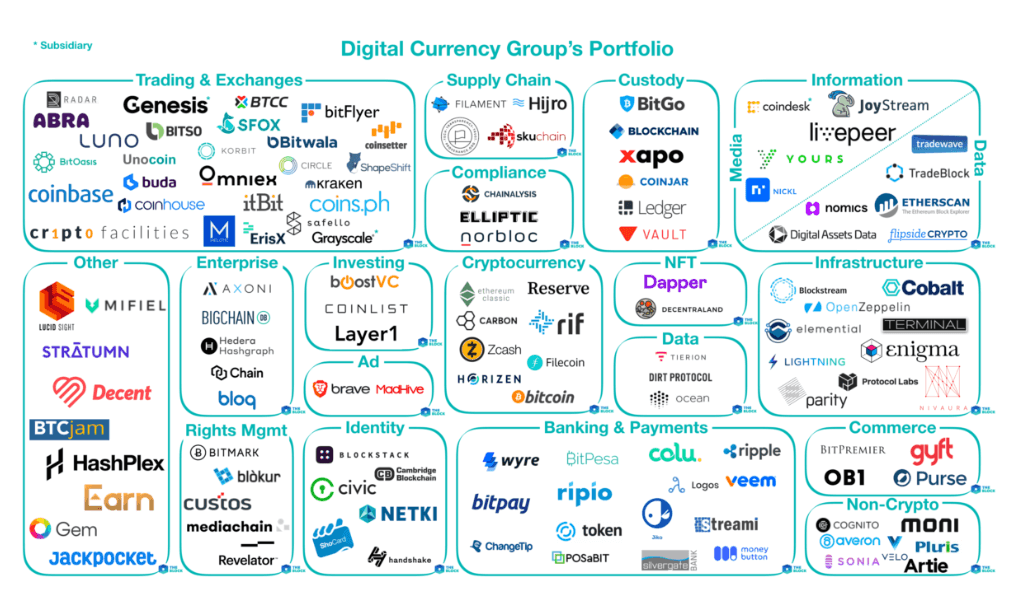
Digital Currency Group was founded by Barry Silbert in 2015, who subsequently created the DCG empire by investing in hundreds of projects and companies.

Digital Currency Portfolio: (Source: DCG)

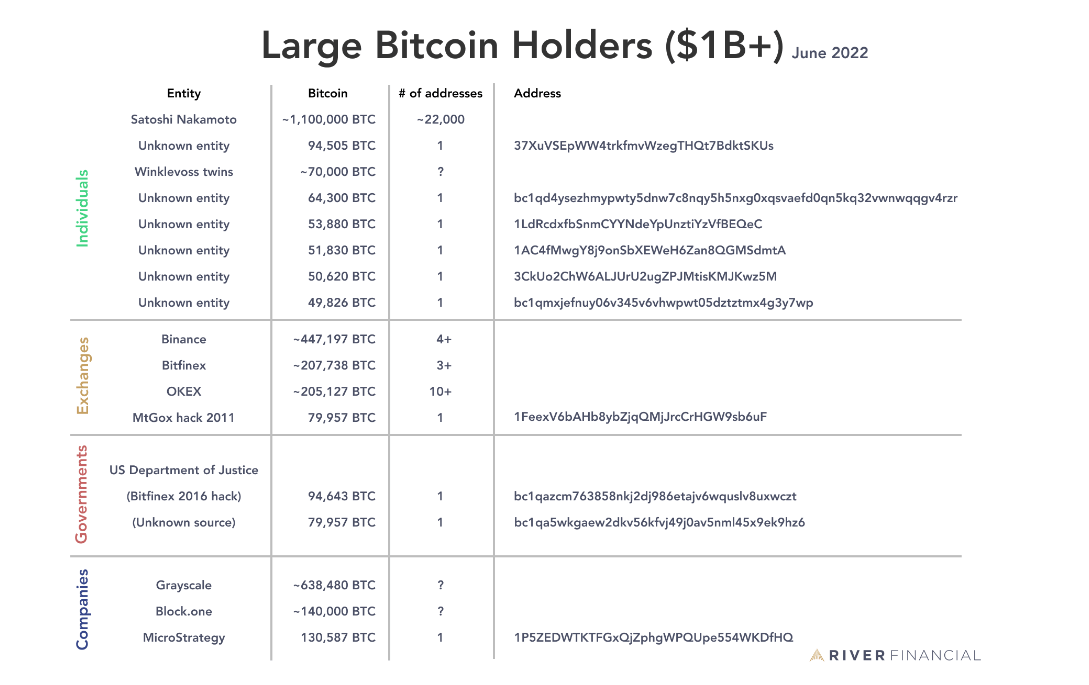
However, the most important company within DCG’s portfolio is Grayscale Investments, the largest holder of Bitcoin in the world, other than Satoshi Nakomoto.

Large Bitcoin Holders: (Source: River Financial)

GBTC holds the equivalent of 633K BTC, just over 3% of the Bitcoin circulating supply. The trust’s Net Asset Value (NAV) is roughly $10.5 billion at the time of writing.

The custody of the BTC is held with Coinbase Custody. However, Coinbase is yet to verify if they have control of the BTC. Yet, as Coinbase is traded as a public company in the U.S. and is therefore subject to audits, it like probable that the BTC is stored under standard practices.

How does DCG make money?

DCG charges a 2% management fee for the underlying Bitcoin held in the trust.

According to SEC filings in Q3 2022, DCG earned $68 million from this fee while bringing in around $230m in revenue annually. The income represents a large percentage of the $800 million it generates annually. Barry Silbert corroborated these numbers in a letter to shareholders on November 22nd.

GBTC, for some time, was the only way U.S. investors could get exposure into their IRAs or 401k accounts, which is one of the reasons it traded at a premium for so many years, as high as 40%.

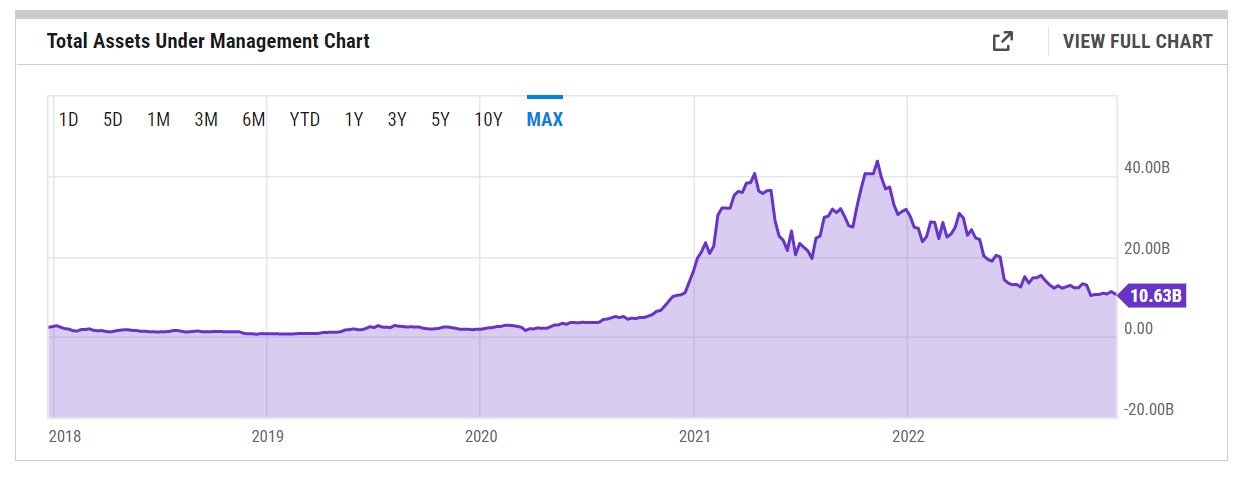
Even though GBTC was deemed a security, it doesn’t have the self-custody risks attributed to holding your keys for BTC. As demand grew, so did assets under management, which topped out at over $40bn during the 2021 bull run.

Total Assets Under Management: (Source: YCharts)

Premium and discount

GBTC trades at a premium when shares are changing hands at a higher price than the underlying BTC. Conversely, if GBTC shares are trading below the NAV, GBTC is deemed at a discount.

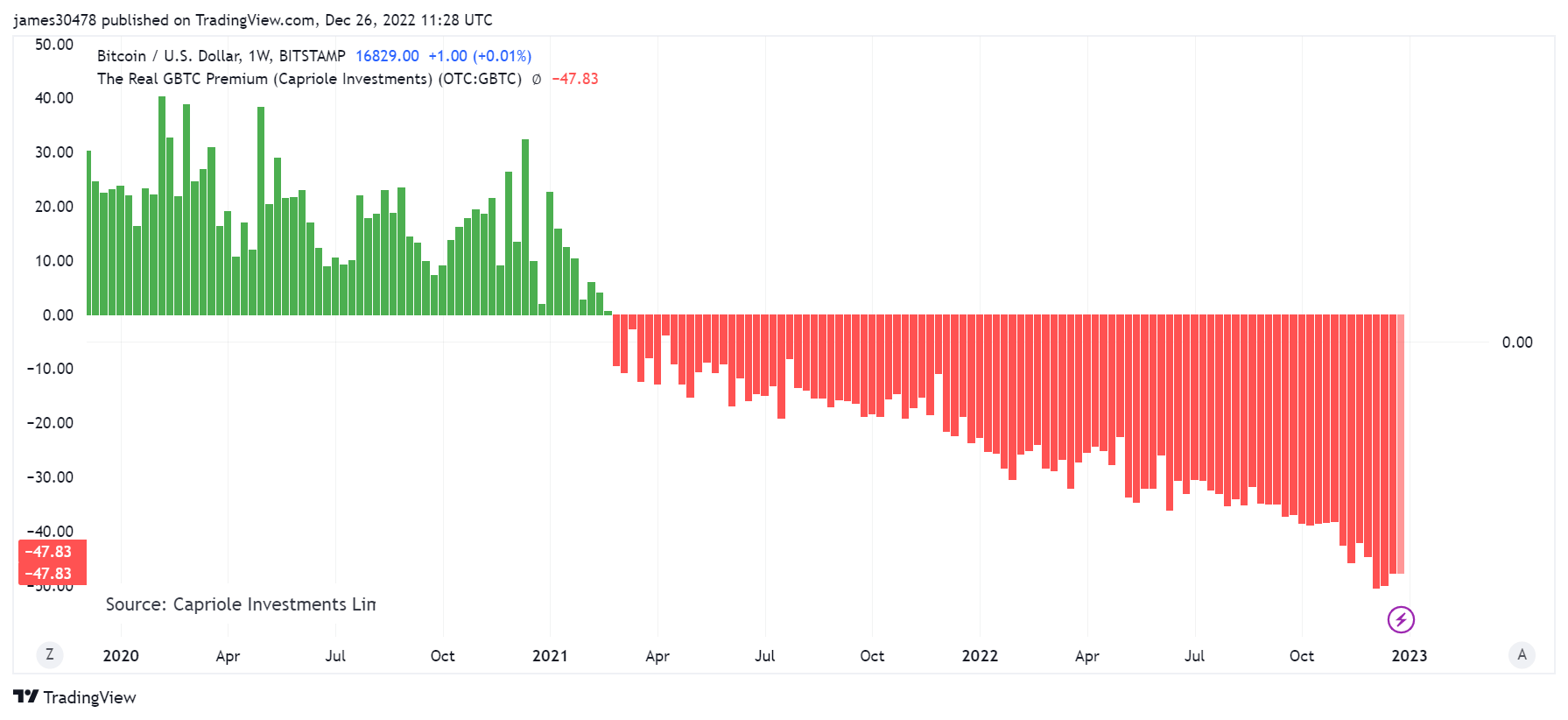
On Feb. 24, 2021, GBTC flipped from a premium to a discount to its net asset value (NAV.) Unfortunately, it has never returned to a premium, and the discount has only deepened.

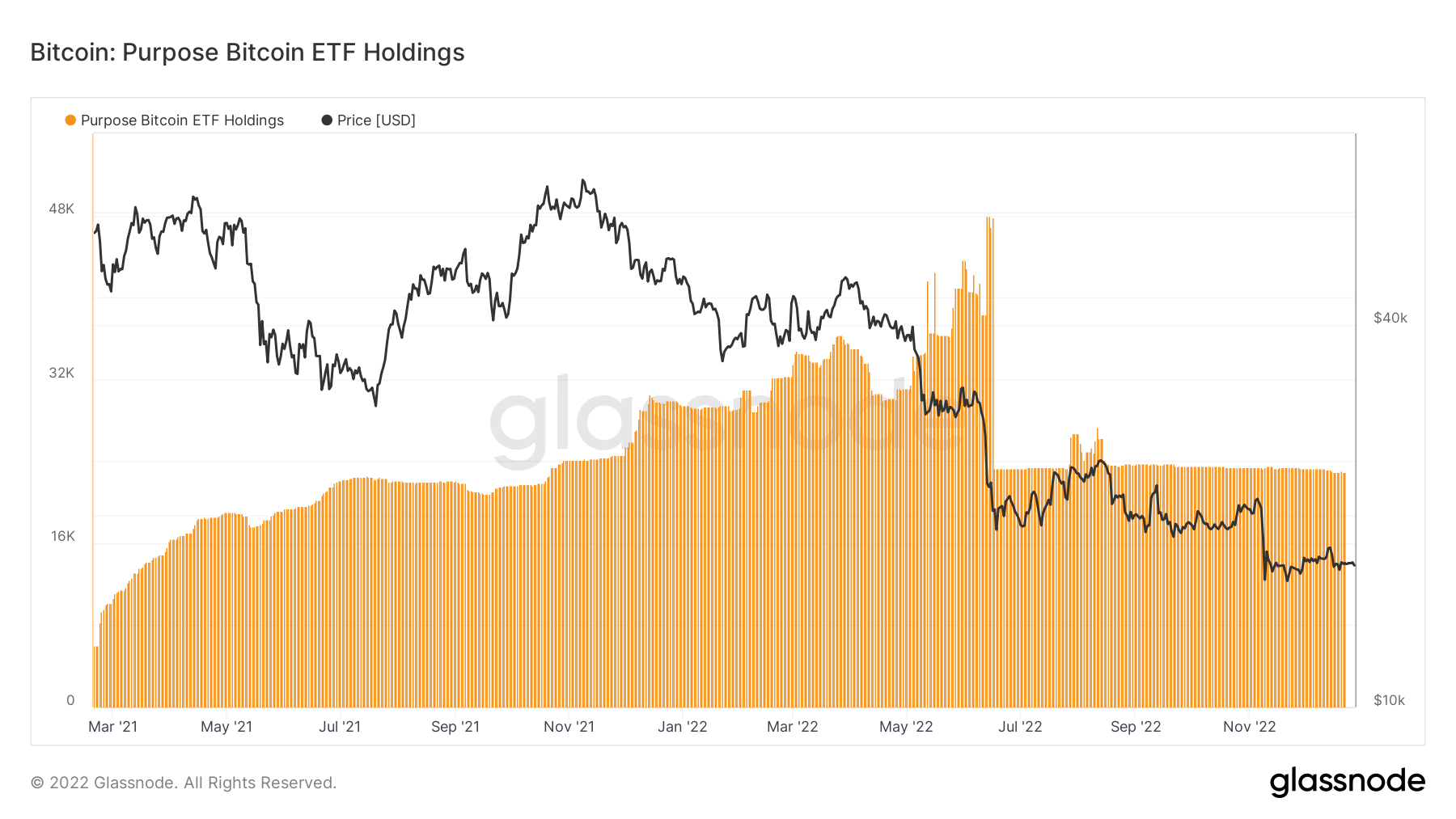
A reason for the discount can be seen in the increased competition from Bitcoin futures ETFs. The Valkyrie Bitcoin Strategy future ETF (BTF) launched during the November 2021 bull run, and the Purpose Bitcoin ETF holdings in Canada are two of the main competitors. The Purpose Bitcoin ETF held 50k BTC in June 2022 but now only has around 24k BTC. In addition, these funds and others tend to offer a smaller management fee, which removes demand from GBTC.

Purpose Bitcoin ETF Holdings: (Source: Glassnode)

The discount for GBTC is currently a whopping 48%, following a fall as low as 50%, which was the most significant discount on record. The issue with holding GBTC is the mandatory 6-month lock-up of GBTC shares, making it highly illiquid. Further, when the discount grows, investors cannot redeem shares. Moreover, holders don’t own the actual BTC as it is a paper derivative of BTC.

GBTC Premium/Discount: (Source: TradingView)

From March 2021 to June 2022, Digital Currency Group bought nearly $800 million worth of GBTC shares after they began trading at a discount to NAV. As a result, the firm owned roughly 10% of the trust’s outstanding shares.

The purchases of GBTC mitigated institutional sell pressure and artificially propped up the fund’s NAV. DCG issued GBTC and attempted to defend the GBTC price by acquiring GBTC using leverage.

One may ask whether this differs from FTX issuing FTT tokens and attempting to defend the token using leverage. FTT and GBTC were large parts of the FTX and DCG balance sheets, respectively.

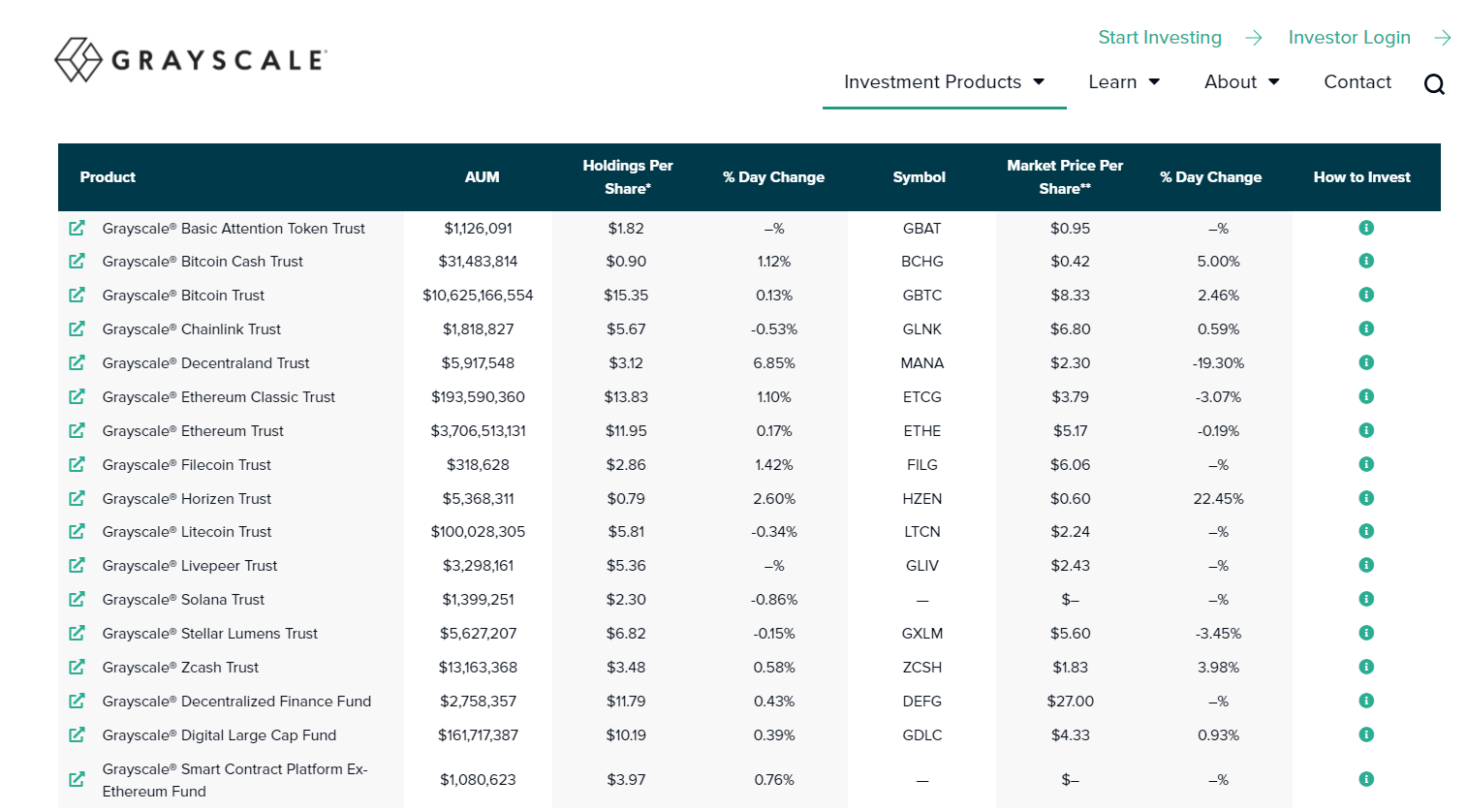
Grayscale offers other similar trusts for alternative crypto assets. For example, the Grayscale Ethereum Trust (ETHE) is currently trading at a steep discount, and as of Jan. 3, the fund’s discount to NAV has plunged to a record 60%.

Grayscale Investment Products: (Source: DCG)

Genesis and lending platforms

Several failed crypto companies, like 3AC and BlockFi, had significant exposure to GBTC shares.

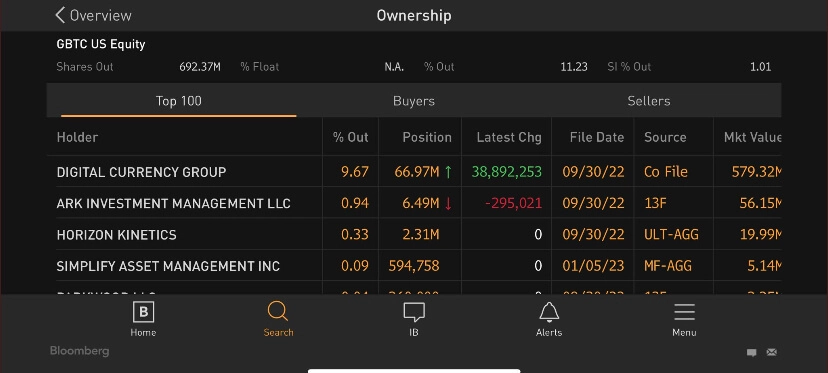
During 2021, 3AC had the most significant position of GBTC shares at almost 40 million, amounting to a value of $1.3bn. To put it into perspective, Ark Invest is now the largest shareholder outside of DCG, with just under 1% of the supply, equivalent to 6.5 million shares.

GBTC Holdings: (Source: Bloomberg Terminal)

As the GBTC premium rose as high as 40%, companies like 3AC and BlockFi leveraged returns to speculate in the market. This is how BlockFi was allowed to offer such high yields to clients. As the lock-up expired every six months, it allowed these companies to keep continuing to roll on profits, while Genesis was happy to keep loaning money to companies like 3AC.

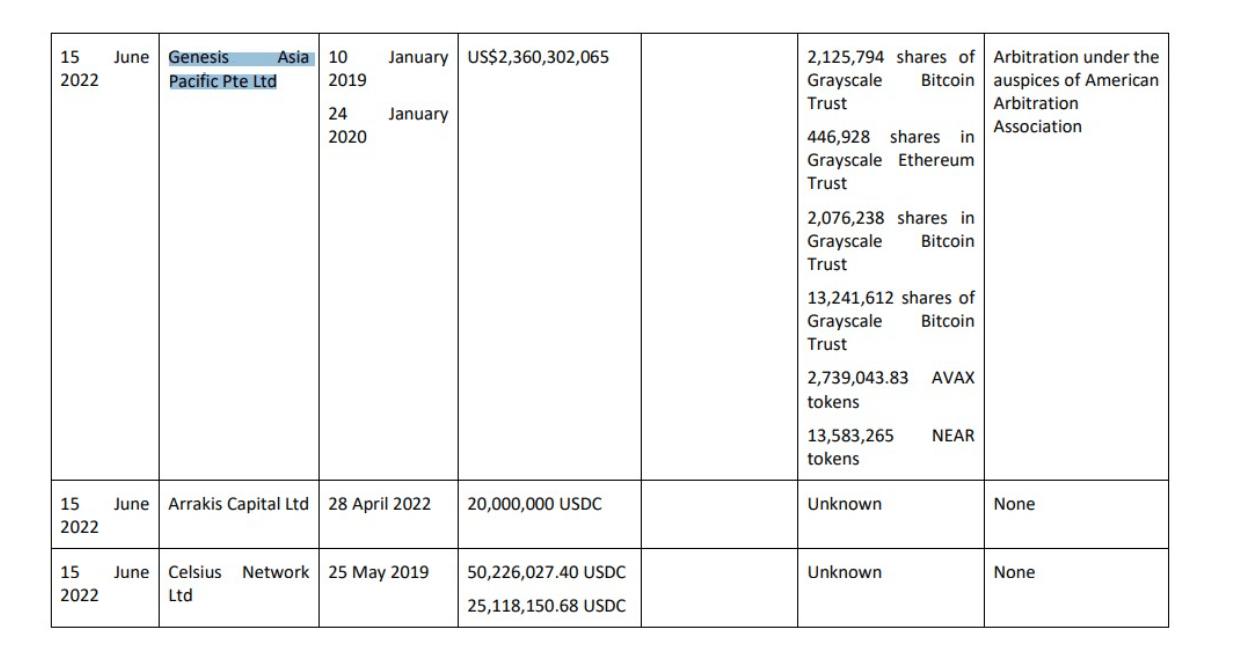
3AC took a $2.36 billion loan from Genesis, another DCG company, which made up almost 50% of the entire Genesis loan book. The loan was made up of illiquid cryptocurrencies and paper derivatives of Bitcoin and Ether.

In total, Genesis’ loan to 3AC was backed by 17 million shares from GBTC. Grayscale is a DCG subsidiary with 446,000 shares in the Grayscale Ethereum Trust, 2 million Avalanche (AVAX) native tokens, and 13 million NEAR tokens.

Genesis loan to 3AC: (Source: Bitcoinist)

ETF

Barry Silbert and DCG have pleaded for many years with the SEC to convert GBTC into an ETF. An ETF would track the underlying product, and there would be no premiums or discounts as the shares would be redeemed to NAV, plus management fees would be considerably less.

The SEC has continued to decline a spot ETF, which would have protected investors. The conversion into a spot ETF would see any investor who bought at a discount make a profit as it would trade to NAV.

ETFs are safer than a closed-ended fund and are more transparent, with no premiums or discounts and lower fees. However, the SEC has approved futures ETFs and a short Bitcoin strategy ETF (BITI).

Grayscale is now suing the SEC, but the SEC has rejected Grayscale, NYDIG, Wisdom Tree, and other institutions. As a result, many countries worldwide have seen spot ETFs approved in Europe, Canada, and Africa.

Grayscale’s ongoing lawsuit with the SEC related to ETFs has a final brief deadline of Feb. 3 before a ruling will occur.

SEC have failed to help investors

As the premium for the GBTC ended, the crypto ecosystem saw blow up after blow up of crypto lending platforms as these funds and lenders had to go further out onto the risk curve to make a profit and make their consumers whole.

The SEC repeatedly failed to approve a spot ETF for GBTC, which would ultimately have prevented this from day one and might have avoided such leverage being wiped out. As a result, the GBTC premium would not have existed, and these firms would not have grown in size and taken on as much leverage as they did.

Grayscale had been doing everything they possibly could have done for a spot ETF to have been approved.

The SEC has rejected the spot ETF due to the possibility of spot bitcoin manipulation. However, approving a CME Bitcoin futures ETF that doesn’t track the underlying spot price can arguably be subject to manipulation and fraud just as quickly.

As outlined above, there are multiple spot ETFs worldwide in Europe and Africa, for example. This has undoubtedly seen capital flow out of America and into these jurisdictions.

Where are we now, heading into 2023?

If DCG were to enter bankruptcy, the company could be forced to liquidate its assets and see sizeable sales in GBTC and ETHC. This would put considerable sell pressure on Bitcoin and Ethereum.

However, according to Ryan Selkis, CEO of blockchain research firm Messari, Grayscale Bitcoin Trust’s (GBTC) controlling shareholders Genesis Global and Digital Currency Group cannot simply “dump” their holdings to raise more capital.

“restrictions are due to Rule 144A of the U.S. Securities Act of 1933, which forces issuers of over-the-counter, or OTC, traded entities to give advance notice of proposed sales, as well as a quarterly cap on sale of either 1% of outstanding shares or weekly traded volume”

One notable option DCG could take is to initiate a Reg M, which would allow investors to redeem shares at NAV, narrowing the current discount gap.

On Jan. 2, Cameron Winklevoss published an open letter to DCG’s CEO Barry Silbert, who questioned Barry on his delay tactics as Genesis owes Gemini Earn users $900m. In addition, Cameron accuses Barry of using NAV trade tactics, which Barry personally benefits from. The letter ended with Cameron Winklevoss telling Barry Silbert to find a solution by Jan. 8.

However, the letter did not reveal if DCG and Barry responded; a scenario that could prevail would be for DCG to file Chapter 11.

On Dec. 28, investment advisor Valkyrie presented a proposal to become the new sponsor and manager of the GBTC while also launching a fund to take advantage of the discounted crypto..

As rumors continue circulating, DCG/Genesis is under active investigation by the SEC. Sources confirmed that multiple whistle-blowers have come forward.

The current DCG situation

Genesis is currently considering bankruptcy

DCG shuts down wealth management subsidiary

DCG Owes $2.025B

Genesis can call their $1.675B loan

Genesis owes $900M to Gemini

What can we learn from all of this?

Bitcoin is a non-bearing digital asset with no counterparty risk; if self custodied correctly, no leverage or yield occurs. However, investors have the personal responsibility of managing their finances.

The number one issue with human beings is often greed, which, as history tells us, usually leads to fraud, manipulation, and centralization. By correct custody of your Bitcoin, you hold Bitcoin, not an IOU or paper derivative.

As we saw in 2022, with the counterparty risk that occurs due to funds chasing high yields and using Bitcoin to chase yield, these companies will take the ‘any means’ approach.

Lessons will be learned from this, but it is crucial always to do your due diligence, which is why the phrase “Not your keys, not your coins” is paramount in the Bitcoin ecosystem.

Crypto di tendenza

Letture associate

a16z: In the AI Era, Company Competition for Talent Starts with Job Title Naming

The article discusses how companies in the AI era are competing for talent through strategic "title arbitrage," or the renaming of key roles to reflect and attract new, high-value capabilities. It uses Palantir's creation of the "Forward-Deployed Engineer" (FDE) as a prime example. This title reframed client-facing technical work from a peripheral "implementation" role into a core, high-status engineering function. The move was strategic, allowing Palantir to attract talent that blended technical skill with business acumen and to dominate the market's perception of this capability. The piece argues that job titles are an organizational language that signals the value and authority of certain work. Effective new titles, like "Data Scientist" or "Site Reliability Engineer," emerge when a role's strategic importance genuinely outgrows its old name. Conversely, mere title inflation without substantive change is ineffective. For AI companies, particularly in B2B, this is a crucial strategy. AI transformation creates new high-leverage roles (e.g., "Legal Engineer," "GTM Engineer") that combine domain expertise with technical automation. By naming these roles, a company can help clients internally legitimize these change-makers. This, in turn, builds market mindshare, associating the company with the new capability. In conclusion, as AI blurs the lines between product and service, the ability to accurately name and organize the critical, client-adjacent work that defines product learning will be a key competitive advantage. The first to define this new organizational language plants a flag in the market's mind.

marsbit26 min fa

a16z: In the AI Era, Company Competition for Talent Starts with Job Title Naming

marsbit26 min fa

Interview with Strategy CEO: Can STRC Recover After Selling Bitcoin?

Interview with Strategy CEO Phong Le on the recent sale of 32 Bitcoin and its impact. He clarifies the move was a small, strategic action to demonstrate liquidity to debt holders, test internal processes, and prove operational discipline—not a response to fears of a "death spiral" from DeFi protocols leveraging STRC (Strategy's preferred stock product), which he notes holds less than 10% of STRC. Le emphasizes Strategy’s long-term focus as the largest corporate Bitcoin holder, using the adage that markets are a "voting machine" short-term but a "weighing machine" long-term. Decision-making is data-driven, involving the board, complex modeling, and multiple stakeholder considerations, moving beyond a founder-centric model. He outlines various capital options but stresses the strategic importance of "doing nothing" as a valid choice, citing resilience built during the 2022 bear market. Le expresses unwavering belief in Bitcoin's foundational value for global sovereignty and its future role in an AI-driven economy with trillions of autonomous agents. Addressing STRC's current price below its $100 face value, Le explains recent pressure was due to using dollar reserves for bond buybacks. He expects STRC to return to par as reserves are replenished and its semi-monthly dividend payments begin, noting the product is heavily over-collateralized. Finally, Le confirms the company sold Bitcoin the week prior to May 31st, as disclosed in an 8-K filing, leaving prediction market interpretations to others. The overarching philosophy remains "Spread Bitcoin with love," embracing all methods of gaining Bitcoin exposure.

marsbit59 min fa

Interview with Strategy CEO: Can STRC Recover After Selling Bitcoin?

marsbit59 min fa

IOSG Founder: Ethereum Doesn't Need Another Leap of Technical Faith, It Needs a Musk-style Compromise

Jocy, founder of IOSG Ventures, argues that Ethereum does not need renewed technological faith but a "Musk-like compromise." The recent formation of ETHLabs—funded by major ETH holders like BitMine and Lubin—highlights a market-driven move to fill a gap left by the Ethereum Foundation (EF), signaling a loss of confidence in its decentralized, hands-off approach. The core critique contrasts Vitalik Buterin's (V) idealistic, technology-first vision with Elon Musk's pragmatic, business-driven execution. The author asserts Ethereum's current shortage is not another technical roadmap but a clear, real-world application narrative and a leader willing to engage directly with commercial realities—like Musk. Internal issues are emphasized, citing EF's management problems and talent drain. While the new decentralized model with independent nodes like ETHLabs addresses the single foundation's limitations, it risks fragmentation without cohesive direction. True cohesion, the author suggests, must come from a shared, compelling narrative around ETH's value, not just from aligned financial interests. Independence claims for new entities are seen as aspirational, needing years of transparency to build trust. The ultimate threat is not competitors like Solana, but the broader shift of attention and talent toward AI. Ethereum has a limited window—12 to 18 months—to recapture focus by delivering tangible, real-world applications. The conclusion urges V to shift from abstract ideals to grounded, pragmatic leadership. The time for this crucial pivot is running out.

marsbit2 h fa

IOSG Founder: Ethereum Doesn't Need Another Leap of Technical Faith, It Needs a Musk-style Compromise

marsbit2 h fa

Trading

Spot
Futures

Articoli Popolari

Cosa è BITCOIN

Comprendere HarryPotterObamaSonic10Inu (ERC-20) e la sua posizione nel mondo delle criptovalute Negli ultimi anni, il mercato delle criptovalute ha assistito a un aumento della popolarità delle meme coin, catturando l'interesse non solo dei trader, ma anche di coloro che cercano coinvolgimento comunitario e valore di intrattenimento. Tra questi token unici c'è HarryPotterObamaSonic10Inu (ERC-20), un progetto intrigante che mescola riferimenti culturali nel tessuto delle criptovalute. Questo articolo esplora gli aspetti chiave di HarryPotterObamaSonic10Inu, analizzando i suoi meccanismi, l'etica guidata dalla comunità e il suo coinvolgimento con il panorama crittografico più ampio. Che cos'è HarryPotterObamaSonic10Inu (ERC-20)? Come suggerisce il suo nome, HarryPotterObamaSonic10Inu è una meme coin costruita sulla blockchain di Ethereum, classificata secondo lo standard ERC-20. A differenza delle criptovalute tradizionali che possono enfatizzare l'utilità pratica o il potenziale investimento, questo token prospera grazie al valore di intrattenimento e alla forza della sua comunità. Il progetto mira a creare un ambiente in cui gli utenti coinvolti possono riunirsi, condividere idee e partecipare ad attività ispirate a diversi fenomeni culturali. Una caratteristica notevole di HarryPotterObamaSonic10Inu è la zero tassa sulle transazioni. Questo elemento allettante tende a incoraggiare il trading e il coinvolgimento della comunità, privo di costi aggiuntivi che possono scoraggiare i trader di piccole dimensioni. L'offerta totale della moneta è fissata a un miliardo di token, un numero che segna la sua intenzione di mantenere una circolazione sostanziale all'interno della comunità. Creatore di HarryPotterObamaSonic10Inu (ERC-20) Le origini di HarryPotterObamaSonic10Inu sono avvolte in un certo mistero; i dettagli sul creatore rimangono sconosciuti. Lo sviluppo di questo token non presenta un team identificabile o un piano esplicito, cosa non rara nel settore delle meme coin. Invece, il progetto è emerso organicamente, con il suo progresso fortemente dipendente dall'entusiasmo e dalla partecipazione della sua comunità. Investitori di HarryPotterObamaSonic10Inu (ERC-20) Per quanto riguarda investimenti esterni e finanziamenti, HarryPotterObamaSonic10Inu rimane ambiguo. Il token non elenca alcuna fondazione di investimento conosciuta o un sostegno organizzativo significativo. Invece, la linfa vitale del progetto è la sua comunità di base, che informa la sua crescita e sostenibilità attraverso azioni collettive e coinvolgimento nello spazio crittografico. Come funziona HarryPotterObamaSonic10Inu (ERC-20)? In quanto meme coin, HarryPotterObamaSonic10Inu opera principalmente al di fuori delle strutture tradizionali che governano spesso il valore degli asset. Ci sono diversi aspetti distintivi che definiscono il funzionamento del progetto: Transazioni senza tasse: Senza costi fiscali sulle transazioni, gli utenti possono comprare e vendere liberamente il token senza preoccuparsi di costi nascosti. Coinvolgimento della comunità: Il progetto prospera sull'interazione della comunità, sfruttando le piattaforme social per creare entusiasmo e facilitare il coinvolgimento. Discussioni, condivisione di contenuti e coinvolgimento sono elementi cruciali che aiutano ad espandere la sua portata e a favorire la lealtà tra i sostenitori. Nessuna utilità pratica: Va notato che HarryPotterObamaSonic10Inu non offre un'utilità concreta all'interno dell'ecosistema finanziario. Piuttosto, è classificato come un token principalmente per attività di intrattenimento e comunitarie. Riferimento culturale: Il token incorpora astutamente elementi della cultura pop per attirare interesse, collegandosi a appassionati di meme e seguaci delle criptovalute. HarryPotterObamaSonic10Inu esemplifica come le meme coin operino in modo diverso rispetto ai progetti di criptovalute più tradizionali, entrando nel mercato come costrutti sociali innovativi piuttosto che come asset utilitari. Cronologia di HarryPotterObamaSonic10Inu (ERC-20) La storia di HarryPotterObamaSonic10Inu è segnata da diversi traguardi notevoli: Creazione: Il token è emerso da un meme virale, catturando l'immaginazione di molti appassionati di criptovalute. Le date di creazione specifiche non sono disponibili, sottolineando la sua crescita organica. Inserimento negli scambi: HarryPotterObamaSonic10Inu ha fatto il suo ingresso in vari scambi, consentendo un accesso e un trading più facili da parte della comunità. Iniziative di coinvolgimento della comunità: Attività in corso volte a migliorare l'interazione della comunità, comprese gare, campagne sui social media e generazione di contenuti da parte di fan e sostenitori. Piani di espansione futura: La tabella di marcia del progetto include il lancio di una collezione NFT, merchandising e un sito di eCommerce relativo ai suoi temi culturali, coinvolgendo ulteriormente la comunità e cercando di aggiungere più dimensioni al suo ecosistema. Punti chiave su HarryPotterObamaSonic10Inu (ERC-20) Natura guidata dalla comunità: Il progetto dà priorità al contributo collettivo e alla creatività, garantendo che il coinvolgimento degli utenti sia al centro del suo sviluppo. Classificazione come meme coin: Rappresenta l'epitome delle criptovalute basate sull'intrattenimento, distinguendosi dai veicoli d'investimento tradizionali. Nessuna affiliazione diretta con Bitcoin: Nonostante la somiglianza nel nome del ticker, HarryPotterObamaSonic10Inu è distintivo e non ha alcuna relazione con Bitcoin o altre criptovalute consolidate. Focus sulla collaborazione: HarryPotterObamaSonic10Inu è progettato per creare uno spazio per la collaborazione e la condivisione di storie tra i suoi detentori, fornendo un canale per la creatività e il legame comunitario. Prospettive future: L'ambizione di espandersi oltre il suo presupposto iniziale verso NFT e merchandising delinea un percorso per il progetto per potenzialmente entrare in strade più mainstream all'interno della cultura digitale. Poiché le meme coin continuano a catturare l'immaginazione della comunità crittografica, HarryPotterObamaSonic10Inu (ERC-20) si distingue per i suoi legami culturali e il suo approccio centrato sulla comunità. Anche se potrebbe non adattarsi al modello tipico di un token orientato all'utilità, la sua essenza risiede nella gioia e nella camaraderia coltivate tra i suoi sostenitori, evidenziando la natura in evoluzione delle criptovalute in un'epoca sempre più digitale. Con la continuazione dello sviluppo del progetto, sarà importante osservare come le dinamiche della comunità influenzano la sua traiettoria nel panorama in continuo cambiamento della tecnologia blockchain.

1.7k Totale visualizzazioniPubblicato il 2024.04.01Aggiornato il 2024.12.03

Cosa è BITCOIN

Come comprare BTC

Benvenuto in HTX.com! Abbiamo reso l'acquisto di Bitcoin (BTC) semplice e conveniente. Segui la nostra guida passo passo per intraprendere il tuo viaggio nel mondo delle criptovalute.Step 1: Crea il tuo Account HTXUsa la tua email o numero di telefono per registrarti il tuo account gratuito su HTX. Vivi un'esperienza facile e sblocca tutte le funzionalità,Crea il mio accountStep 2: Vai in Acquista crypto e seleziona il tuo metodo di pagamentoCarta di credito/debito: utilizza la tua Visa o Mastercard per acquistare immediatamente BitcoinBTC.Bilancio: Usa i fondi dal bilancio del tuo account HTX per fare trading senza problemi.Terze parti: abbiamo aggiunto metodi di pagamento molto utilizzati come Google Pay e Apple Pay per maggiore comodità.P2P: Fai trading direttamente con altri utenti HTX.Over-the-Counter (OTC): Offriamo servizi su misura e tassi di cambio competitivi per i trader.Step 3: Conserva Bitcoin (BTC)Dopo aver acquistato Bitcoin (BTC), conserva nel tuo account HTX. In alternativa, puoi inviare tramite trasferimento blockchain o scambiare per altre criptovalute.Step 4: Scambia Bitcoin (BTC)Scambia facilmente Bitcoin (BTC) nel mercato spot di HTX. Accedi al tuo account, seleziona la tua coppia di trading, esegui le tue operazioni e monitora in tempo reale. Offriamo un'esperienza user-friendly sia per chi ha appena iniziato che per i trader più esperti.

4.1k Totale visualizzazioniPubblicato il 2024.12.12Aggiornato il 2026.06.02

Come comprare BTC

Cosa è $BITCOIN

ORO DIGITALE ($BITCOIN): Un'Analisi Completa Introduzione all'ORO DIGITALE ($BITCOIN) L'ORO DIGITALE ($BITCOIN) è un progetto basato su blockchain che opera sulla rete Solana, con l'obiettivo di combinare le caratteristiche dei metalli preziosi tradizionali con l'innovazione delle tecnologie decentralizzate. Sebbene condivida un nome con Bitcoin, spesso definito “oro digitale” a causa della sua percezione come riserva di valore, l'ORO DIGITALE è un token separato progettato per creare un ecosistema unico all'interno del panorama Web3. Il suo obiettivo è posizionarsi come un asset digitale alternativo valido, anche se i dettagli riguardanti le sue applicazioni e funzionalità sono ancora in fase di sviluppo. Cos'è l'ORO DIGITALE ($BITCOIN)? L'ORO DIGITALE ($BITCOIN) è un token di criptovaluta esplicitamente progettato per l'uso sulla blockchain di Solana. A differenza di Bitcoin, che fornisce un ruolo di stoccaggio di valore ampiamente riconosciuto, questo token sembra concentrarsi su applicazioni e caratteristiche più ampie. Aspetti notevoli includono: Infrastruttura Blockchain: Il token è costruito sulla blockchain di Solana, nota per la sua capacità di gestire transazioni ad alta velocità e a basso costo. Dinamiche di Offerta: L'ORO DIGITALE ha un'offerta massima fissata a 100 quadrilioni di token (100P $BITCOIN), sebbene i dettagli riguardanti la sua offerta circolante siano attualmente non divulgati. Utilità: Sebbene le funzionalità precise non siano esplicitamente delineate, ci sono indicazioni che il token potrebbe essere utilizzato per varie applicazioni, potenzialmente coinvolgendo applicazioni decentralizzate (dApp) o strategie di tokenizzazione degli asset. Chi è il Creatore dell'ORO DIGITALE ($BITCOIN)? Attualmente, l'identità dei creatori e del team di sviluppo dietro l'ORO DIGITALE ($BITCOIN) rimane sconosciuta. Questa situazione è tipica tra molti progetti innovativi nel settore blockchain, in particolare quelli allineati con la finanza decentralizzata e i fenomeni delle meme coin. Sebbene tale anonimato possa favorire una cultura guidata dalla comunità, intensifica le preoccupazioni riguardo alla governance e alla responsabilità. Chi sono gli Investitori dell'ORO DIGITALE ($BITCOIN)? Le informazioni disponibili indicano che l'ORO DIGITALE ($BITCOIN) non ha alcun sostenitore istituzionale noto o investimenti di venture capital prominenti. Il progetto sembra operare su un modello peer-to-peer incentrato sul supporto e sull'adozione della comunità piuttosto che su percorsi di finanziamento tradizionali. La sua attività e liquidità si trovano principalmente su exchange decentralizzati (DEX), come PumpSwap, piuttosto che su piattaforme di trading centralizzate consolidate, evidenziando ulteriormente il suo approccio di base. Come Funziona l'ORO DIGITALE ($BITCOIN) Le meccaniche operative dell'ORO DIGITALE ($BITCOIN) possono essere elaborate in base al suo design blockchain e alle caratteristiche della rete: Meccanismo di Consenso: Sfruttando il proof-of-history (PoH) unico di Solana combinato con un modello di proof-of-stake (PoS), il progetto garantisce una validazione efficiente delle transazioni contribuendo all'alta performance della rete. Tokenomics: Sebbene meccanismi deflazionistici specifici non siano stati dettagliati ampiamente, l'ampia offerta massima di token implica che potrebbe soddisfare microtransazioni o casi d'uso di nicchia che devono ancora essere definiti. Interoperabilità: Esiste il potenziale per l'integrazione con l'ecosistema più ampio di Solana, inclusi vari piattaforme di finanza decentralizzata (DeFi). Tuttavia, i dettagli riguardanti integrazioni specifiche rimangono non specificati. Cronologia degli Eventi Chiave Ecco una cronologia che evidenzia traguardi significativi riguardanti l'ORO DIGITALE ($BITCOIN): 2023: Il dispiegamento iniziale del token avviene sulla blockchain di Solana, contrassegnato dal suo indirizzo di contratto. 2024: L'ORO DIGITALE guadagna visibilità poiché diventa disponibile per il trading su exchange decentralizzati come PumpSwap, consentendo agli utenti di scambiarlo contro SOL. 2025: Il progetto assiste a un'attività di trading sporadica e a un potenziale interesse per impegni guidati dalla comunità, sebbene non siano state documentate partnership significative o avanzamenti tecnici fino ad ora. Analisi Critica Punti di Forza Scalabilità: L'infrastruttura sottostante di Solana supporta alti volumi di transazioni, il che potrebbe migliorare l'utilità di $BITCOIN in vari scenari di transazione. Accessibilità: Il potenziale basso prezzo di trading per token potrebbe attrarre investitori al dettaglio, facilitando una partecipazione più ampia grazie a opportunità di proprietà frazionata. Rischi Mancanza di Trasparenza: L'assenza di sostenitori, sviluppatori o di un processo di audit pubblicamente noti potrebbe generare scetticismo riguardo alla sostenibilità e all'affidabilità del progetto. Volatilità del Mercato: L'attività di trading è fortemente dipendente dal comportamento speculativo, il che può comportare una significativa volatilità dei prezzi e incertezze per gli investitori. Conclusione L'ORO DIGITALE ($BITCOIN) emerge come un progetto intrigante ma ambiguo all'interno dell'evolvente ecosistema di Solana. Sebbene tenti di sfruttare la narrativa dell'“oro digitale”, la sua partenza dal ruolo consolidato di Bitcoin come riserva di valore sottolinea la necessità di una chiara differenziazione della sua utilità e struttura di governance. L'accettazione e l'adozione future dipenderanno probabilmente dall'affrontare l'attuale opacità e dalla definizione più esplicita delle sue strategie operative ed economiche. Nota: Questo rapporto comprende informazioni sintetizzate disponibili a ottobre 2023, e potrebbero essersi verificati sviluppi oltre il periodo di ricerca.

104 Totale visualizzazioniPubblicato il 2025.05.13Aggiornato il 2025.05.13

Cosa è $BITCOIN

Discussioni

Benvenuto nella Community HTX. Qui puoi rimanere informato sugli ultimi sviluppi della piattaforma e accedere ad approfondimenti esperti sul mercato. Le opinioni degli utenti sul prezzo di BTC BTC sono presentate come di seguito.

活动图片