DappRadar: crypto attacks surged in 2022

Crypto.newsPubblicato 2022-12-29Pubblicato ultima volta 2022-12-29

Introduzione

2022 was one of the worst years in recent memory for the crypto space. While there were many positive developments, there were also huge losses, hacks, and scams.

DappRadar’s recent report explored some significant crypto market events, and security issues that rocked the markets in Dapp world 2022. Before looking into the worst parts, let’s highlight some of the positive developments in 2022.

Crypto positives in 2022

The blockchain space passed several milestones crossed in 2022. Some of them include technical and simple regulatory upgrades. The milestones achieved in 2022 include the following;

The full implementation and merge of the ethereum PoS network in September

The implementation of the Cardano Vasil upgrade

The creation of a new regulatory framework for cryptos in 2022

The registration of a multiple cryptocurrency exchange network

Crypto clouded by attacks

The DappRadar report explored the performance of Dapps and blockchains hosting them throughout the year. However, their primary area of focus remained the hacks and vulnerabilities suffered by different Dapps.

The hacks and attacks have been explored within the industry to learn from the vulnerabilities. The DappRadar report stated that there were numerous attacks associated with crypto networks in 2022, hitting about 312 in total.

The data from DappRadar indicated that the losses recorded throughout the year hit about $48 billion. However, while the amounts recorded were insanely high, according to their analytics, most of the losses were driven by a small number of attacks.

The report demonstrates that most funds were lost not via decentralized platforms, but actually on centralized platforms, like LUNA.

Excluding Terra, scam volumes were low

According to reports, scams in 2022 besides Terra generated relatively low losses. In fact, according to analysis, the total volume of scams was way lower than Terra’s.

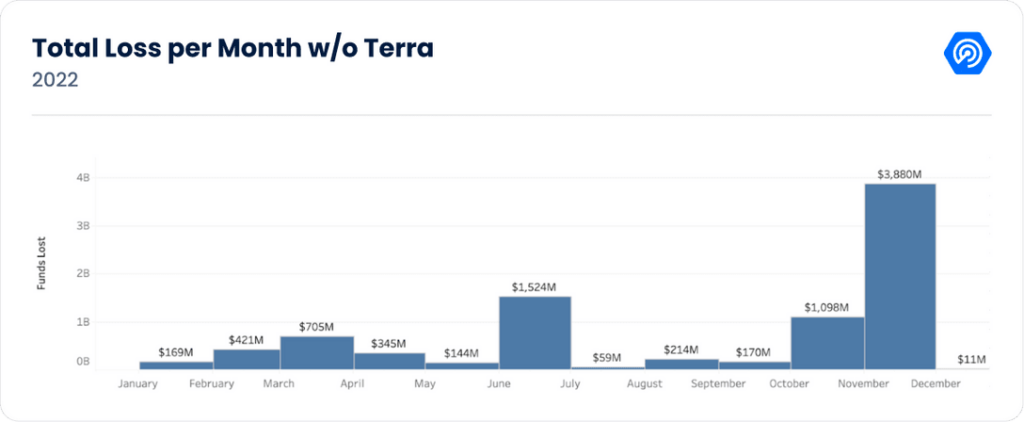
DappRadar’s analytical charts indicate that between January and April, the funds lost in the Dapp landscape were around $1 billion. The number of scams per month in the four months ranged between 9 and 25.

Total losses per month without Terra. Source: DappRadar

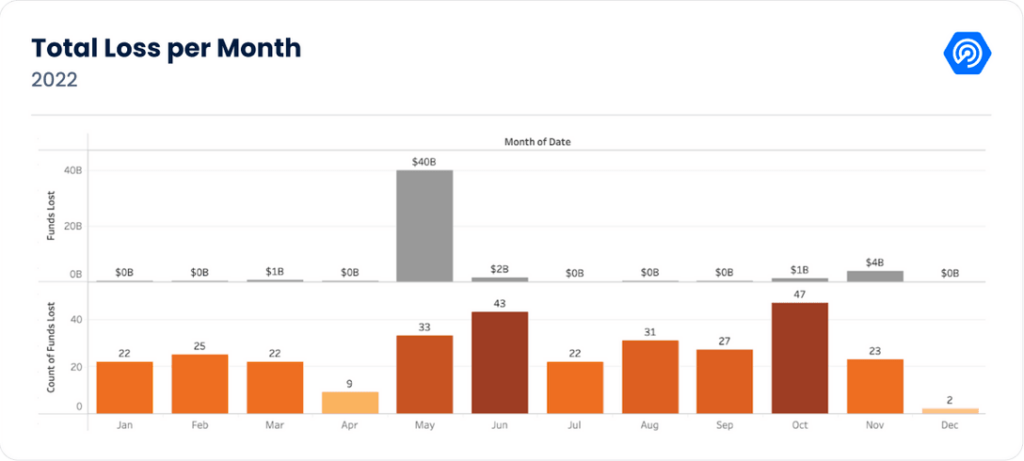
After the collapse of Terra in May, the market conditions became harsher, and there have been several substantial scams and crashes since then. In June, losses of $2 billion were recorded. Later, in October, losses amounted to $1 billion.

Total losses per month. Source: DappRadar

As the year was nearly closed, in early November, more big crypto scams occurred, with losses amounting to $4 billion. Throughout this year, there was an average of 25 hacks and scams every month. The average monthly losses, according to analysis, were $345 million.

Centralized networks recorded more losses

The DappRadar report also noted that most of the attacks that occurred within the year were on centralized networks. Centralized platforms like LUNA and other crypto exchanges suffered the most damaging attacks, totaling $44 billion in the year.

Further, the report dug deep into the specifics of the blockchains involved.

The report noted that, on average, the amounts stolen per hack on the ethereum blockchain were 30% higher than the BNB chain. However, while the amount per hack was higher on the ethereum blockchain than BNB chain, the total values indicate that more ($1.578 billion) was stolen from the BNB Chain than from ethereum ($1.02 billion).

Rug pulls remained prevalent

According to the report, there were about 119 incidents associated with cryptocurrency rug pulls. Interestingly, the amount stolen was close to $200 million, indicating an average of $1.6 million lost per rug pull.

Access control breaches

The next most common hack was an access control breach, with 30 incidents throughout the year, and a total loss of $1.02 billion. An access control breach is simply unauthorized access to a blockchain network.

Flash loan attacks

DappRadar also reported numerous flash loan attacks throughout the year, with about 20 incidents costing the industry about $240 million in losses. There were 20 exit scams reported, a popular kind of rug pull, with $50 million recorded as losses.

Normal exploit hacks, phishing, and Oracle incidents

There were around nine phishing attacks which only cost the industry about $0.01 billion. Around seven oracle incident reports also recorded $0.05 billion as losses. Ordinary exploit hacks hit a high at 19 incidents in the year, creating $220 million in losses throughout this year.

The DappRadar charts give a full view of the attacks throughout the year. As seen, Rug Pulls were the most, but the value garnered is relatively lower compared to other lost funds models.

Highlighting the top crypto scam noted by DappRadar

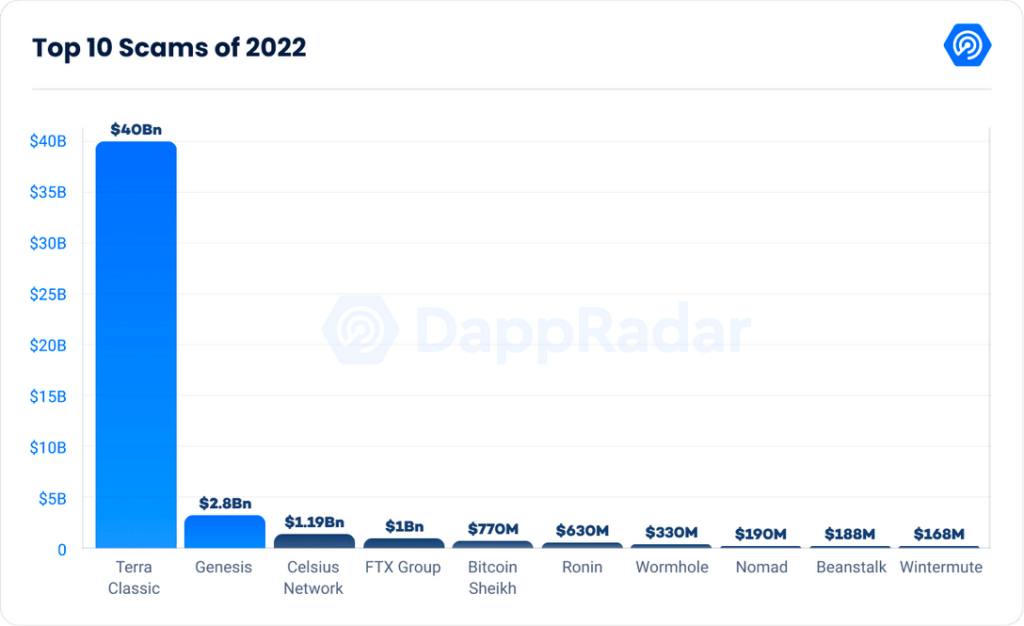
Top ten crypto scams in 2022. Source: Dappradar

The Terra Luna saga

The largest and most costly attack in the crypto ecosystem in 2022 was Terra Luna‘s fall. According to the data, the fall of the Terra Luna network led to losses amounting to about $40 billion in a couple of days. Nothing that occurred in 2022 can even remotely compare to the losses suffered after the Terra implosion.

The timeline of events before and after the Terra fall is astonishing. All the trouble began in early May when the UST stablecoin, Terra network’s native stablecoin, lost its $1 peg. For clarity purposes, the value of 1UST was the same as that of $1. Therefore, this stablecoin could be used as a direct replacement for the dollar in online markets.

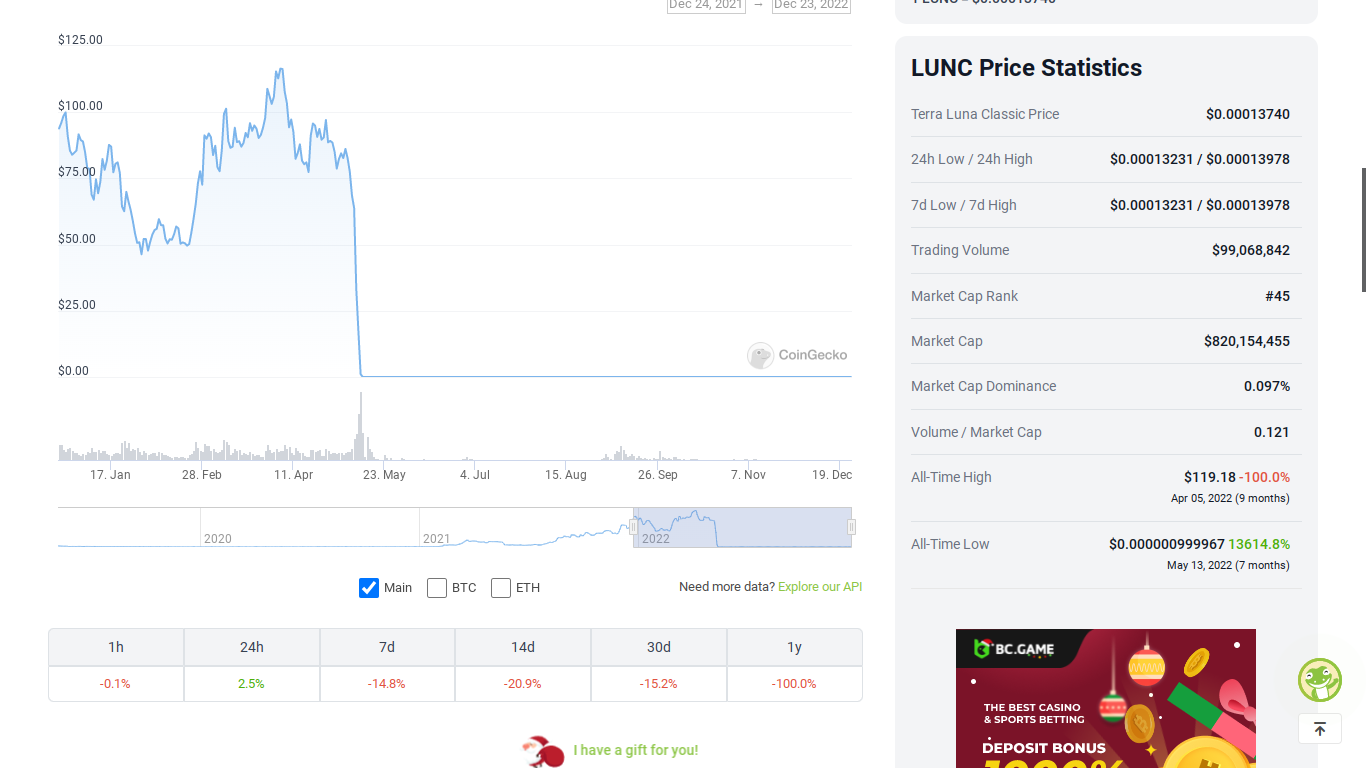
However, based on reports, the UST peg plunged to as low as $0.3, $0.7 off its $1 dollar peg in merely a few hours. Due to the de-pegging, LUNA, UST’s backing coin, immediately lost value. In simply a few hours, LUNA plunged from $87 to less than a dollar. In fact, by May 13th, LUNA’s price had declined to just about $0.0012. A $40 billion network dropped below $1 million in only a few days.

LUNC Price. Source Coingecko.com

Reports indicate the possibility of foul play from other investors, including market manipulation. However, nothing conclusive has been shown that would prove wrongdoing.

The Terra Luna fall led to massive losses amounting to $40 billion in just two crypto tokens. However, reports indicate several small rug pulls and exploits during the year. Dapp Radar reported that only this single fall was larger than the combination of all DeFi scams recorded in 2022.

Genesis’ fall

The fall of the Genesis network is considered the second-largest scam of the year 2022, according to a report by DappRadar. Genesis’s fall led to a massive loss of around $2.8 billion.

While the platform’s problems began months ago, it made its final bow sometime in November. In fact, towards the end of November and early December, Genesis maintained that getting a $1 billion loan would help keep them afloat.

However, before all these problems, Genesis was already in a deal to be salvaged by FTX. Furthermore, the lender had $175 million held in an FTX account, hence was forced to stop any further withdrawals because of the preexisting market conditions.

Celsius Network implodes

Another network’s death occurred in June this year and was the popular lender Celsius. At its death, Celsius recorded losses amounting to $1.2 billion on June.13. This borrowing and earning platform filed for chapter 11 bankruptcy, listing a deficit amounting to $1.18 billion on its financial statements.

With liabilities hitting $5.5 billion, Celsius had assets amounting to $4.3 billion.

The bankruptcy proceedings continue today, and Celsius is still amassing large volumes of expenses despite publicly declaring a lack of operational funds. The fall of the Celsius network is the third-largest crypto network failure recorded in 2022.

FTX falls apart

A couple of weeks ago, FTX, one of the three largest crypto exchanges globally, suffered one of the industry’s most widely noticed failures. The exchange fell from glory, was almost saved by Binance, but ended up filing for bankruptcy.

FTX group was a collection of many crypto-focused brands, and had connections with most of the major crypto exchanges.

Investigations into this fall have led to more questions than answers, especially concerning the dead exchange’s financial dealings. The most recent reports suggest that the exchange service provider made fraudulent transactions, and funded purchases of top networks using its self-created token FTT.

Bitcoin Sheikh

Bitcoin Sheikh is a name given to Ponzi Scheme runner Francisco Valdevino da Silva who stole about $766 million from investors, promising them high returns. According to the reports, many celebrities and footballers were among the biggest losers from the scheme. This scam is undoubtedly one of the biggest of the year.

Axie Infinity’s Ronin bridge exploit

The Ronin exploit associated with Axie infinity was among the biggest problems in the Dapp world in 2022. Axie Infinity created the Ronin Bridge to keep transaction fees lower. However, the Ronin Bridge opened an unforeseen vulnerability which led to a massive hack. The hack stole $578 million (173.6k ETH). Later, it was discovered that the Lazarus hack group was involved in the attack.

BNB Chain got rekt

A couple of weeks ago, in mid-October, the BNB chain was hit by a massive hack that led to a loss of about 2 million BNB tokens valued at $586 million. While the attacker manipulated and could have gone away with $586 million, reports note that validators halted the network. As such, the attacker only stole $150 million.

Other issues in the Chainalysis report

Ethereum remained the dominant protocol in 2022

According to the DappRadar report, ethereum remained the most dominant decentralized applications host in 2022. Ethereum is the second largest blockchain ecosystem after Bitcoin and the most prominent host for smart contracts.

Statistical analysis indicates that despite the massive problems noticed in the crypto landscape, ethereum maintained its superiority over every other decentralized applications host. According to the report, ethereum’s TVL for DeFi protocols was $32.12 billion, with other platforms indicating the TVL is about $39.65 billion.

Ethereum’s domination stems from the fact that this is simply the blockchain focused on hosting decentralized applications. However, several other networks grew in numbers in 2022, some amassing a strong market share.

While Ethereum’s dominance is almost 100% asserted, the DappRadar report indicates that the dominance plunged by 74.56% from 2021’s values. Reports indicate that Binance Smart Chain reclaimed its position as the second largest DeFi host, recording a 62.5% decrease and hitting $6.5 billion.

Gaming, Gambling, and DeFi were the most popular Dapp categories

The report also explored the different subcategories of decentralized applications and how they performed in 2022. According to DappRadar, the Dapps can be sub-categorized into DeFi, Games, and Gambling.

DappRadar’s analytics indicate that in 2022, Gaming decentralized applications towered over other market competitors throughout the year. So, according to DappRadar, the gaming Dapps maintained dominance as the most prevalent category. For instance, DappRadar’s charts suggest that the game Dapps averaged 622,620 dUAW, surging by 85% in 2022 to hit 1,152,255 dUAW.

The charts also suggest that DeFi Dapps recorded a slight increase in Unique active wallets by 2% to 652 thousand wallets in 2022.

Another one of the biggest gainers in the year was gambling Dapps, which recorded a 100% surge in UAW to just about 110k from 53k. This indicates that the gambling world grew two folds within the blockchain space.

Other subcategories also grew lightly in the year, with NFTs recording 33% more UAW to 178k in 2022. Interestingly, DappRadar’s charts suggest that the high-risk category of decentralized applications recorded a 291% surge in UAW from 2021 to 2022. In the period, high-risk Dapps recorded 145k wallets.

Final word

This guide explored the insecurity issues highlighted by DappRadar, which affected crypto networks and investors in 2022. The problems led to colossal losses, with the total amount lost hitting $48 billion.

The DappRadar report also indicates the insecurity and uncertainty problem that still resides in the cryptocurrency landscape. However, investors are still losing from network mismanagements, hacking, and more.

Crypto di tendenza

Letture associate

IOSG Founder: Ethereum Doesn't Need Another Leap of Technical Faith, It Needs a Musk-style Compromise

Jocy, founder of IOSG Ventures, argues that Ethereum does not need renewed technological faith but a "Musk-like compromise." The recent formation of ETHLabs—funded by major ETH holders like BitMine and Lubin—highlights a market-driven move to fill a gap left by the Ethereum Foundation (EF), signaling a loss of confidence in its decentralized, hands-off approach. The core critique contrasts Vitalik Buterin's (V) idealistic, technology-first vision with Elon Musk's pragmatic, business-driven execution. The author asserts Ethereum's current shortage is not another technical roadmap but a clear, real-world application narrative and a leader willing to engage directly with commercial realities—like Musk. Internal issues are emphasized, citing EF's management problems and talent drain. While the new decentralized model with independent nodes like ETHLabs addresses the single foundation's limitations, it risks fragmentation without cohesive direction. True cohesion, the author suggests, must come from a shared, compelling narrative around ETH's value, not just from aligned financial interests. Independence claims for new entities are seen as aspirational, needing years of transparency to build trust. The ultimate threat is not competitors like Solana, but the broader shift of attention and talent toward AI. Ethereum has a limited window—12 to 18 months—to recapture focus by delivering tangible, real-world applications. The conclusion urges V to shift from abstract ideals to grounded, pragmatic leadership. The time for this crucial pivot is running out.

marsbit47 min fa

IOSG Founder: Ethereum Doesn't Need Another Leap of Technical Faith, It Needs a Musk-style Compromise

marsbit47 min fa

Google Starts Selling TPUs, Big Tech Aims to Produce "Low-Cost Tokens" with AI Chips

Google has begun selling its proprietary TPU chips and AI computing hardware directly to third-party data centers and clients, marking a strategic shift. Previously only accessible via cloud rentals, TPUs are specialized processors designed for the matrix and tensor operations central to AI models. By combining thousands into supercomputing clusters managed by CPUs, Google achieves high-efficiency AI processing. This move enables Google’s Gemini AI to offer competitive token pricing, challenging rivals like OpenAI. It also signals a broader industry trend where AI compute is becoming a commoditized resource like electricity. While NVIDIA remains dominant with its CUDA ecosystem and high-performance GPUs, the focus is shifting from raw power to cost efficiency and system integration. Google’s approach mirrors NVIDIA’s by selling an entire ecosystem—hardware, software, and data center expertise—rather than just chips. This threatens NVIDIA’s grip on the mid-range inference market, where lower-cost, efficient solutions are increasingly demanded. Similarly, cloud providers like Huawei Cloud and Alibaba Cloud in China are developing their own AI chip ecosystems (e.g., Ascend, Zhenwu), packaging chips, clusters, and tools into full-stack solutions. They aim to reduce token costs and capture market share through integrated systems. In summary, the AI infrastructure race is evolving from a competition for the strongest chips to a contest for the most efficient and cost-effective systems. Google’s TPU sales highlight this transition, emphasizing that future success lies in delivering affordable, scalable AI compute as a foundational service.

marsbit1 h fa

Google Starts Selling TPUs, Big Tech Aims to Produce "Low-Cost Tokens" with AI Chips

marsbit1 h fa

Trading

Spot
Futures

Articoli Popolari

Cosa è $LUNA

Luna28 ($$LUNA): Un'Iniziativa Crypto Ispirata alla Luna Introduzione Nel mondo in continua evoluzione delle criptovalute, l'innovazione è fondamentale. Luna28 si distingue come un progetto che non solo abbraccia la tecnologia, ma la intreccia anche con la mistica dei cicli cosmici. Ispirato al ciclo lunare di 28 giorni, Luna28 ($$LUNA) mira a creare un'esperienza unica e coinvolgente per la sua comunità, unendo i concetti di tokenomics e token non fungibili (NFT) a tema lunare. Al suo centro, questo progetto utilizza un meccanismo di burn dei token distintivo allineato con le eclissi lunari e solari, stabilendo un nuovo precedente nel mondo crypto. Cos'è Luna28? Luna28 è un progetto di criptovaluta basato su token costruito sulla blockchain di Ethereum. Cerca di offrire ai suoi utenti un mix di coinvolgimento cosmico attraverso una serie di funzionalità innovative. Fondamentale per la sua identità è il lancio di NFT a tema lunare che migliorano l'interazione della comunità celebrando al contempo l'importanza culturale della luna. Il progetto punta a creare un legame più profondo tra i membri della sua comunità e il cosmo. Questo legame è facilitato attraverso un ecosistema accuratamente progettato che sfrutta i temi lunari, i burn dei token e attività dinamiche associate agli eventi celesti. L'obiettivo non riguarda solo il miglioramento del valore del token, ma anche il promuovere un senso di appartenenza e divertimento all'interno della comunità. Creatore di Luna28 I dettagli riguardanti il creatore di Luna28 rimangono per lo più sconosciuti. Questa mancanza di informazioni ha conferito un'aura di mistero al progetto, aggiungendo ulteriormente alla sua unicità. La natura anonima della sua creazione riflette una tendenza più ampia nell'industria crypto, dove l'attenzione è spesso rivolta al progetto e alla sua comunità piuttosto che ai profili individuali. Investitori di Luna28 Attualmente, non ci sono informazioni pubblicamente disponibili riguardo alle specifiche fondazioni di investimento o organizzazioni che supportano Luna28. Questo aspetto potrebbe indicare un'iniziativa di base in cui la comunità svolge un ruolo fondamentale nello sviluppo e nella crescita del progetto. L'assenza di investitori prominenti può talvolta creare un progetto più decentralizzato e indipendente, consentendo un coinvolgimento e una partecipazione organici della comunità. Come Funziona Luna28? Uno degli aspetti più affascinanti di Luna28 è il suo funzionamento, in particolare le sue caratteristiche uniche che la distinguono da altri progetti di criptovaluta. 1. Burn dei Token per Eclissi Lunari e Solari Luna28 incorpora un meccanismo speciale di burn dei token, che prevede di bruciare periodicamente una porzione della propria offerta di token durante le eclissi lunari e solari. Questo approccio non solo crea eccitazione attorno agli eventi celesti, ma lavora anche sul principio fondamentale di aumentare la scarsità. Riducendo l'offerta totale di token attraverso i burn, i token rimanenti hanno il potenziale per un aumento del valore, beneficiando tutti i detentori. 2. Tokenomics La struttura economica di Luna28 è progettata per garantire sostenibilità e crescita. Ogni transazione comporta una tassa del 4,4%: 2% contribuisce al Moon Cycle Fund, che viene bruciato ogni 28 giorni durante la luna piena. Il restante 2,4% è destinato allo sviluppo e al marketing, facilitando l'espansione e il miglioramento continuo del progetto. Questa struttura fiscale stabilisce un flusso costante di finanziamenti mantenendo al contempo un approccio deflazionistico che può migliorare la proposta di valore del token. 3. Liquidità Bruciata al 100% La sicurezza e la fiducia sono fondamentali in qualsiasi progetto di criptovaluta. Luna28 affronta queste preoccupazioni bloccando i token della sua liquidità in un portafoglio di burn. Questo assicura che la liquidità sia permanentemente garantita, coltivando fiducia all'interno della comunità mentre interagiscono con la piattaforma. 4. Rilascio di NFT Ulteriormente per migliorare il coinvolgimento della comunità, Luna28 prevede di rilasciare NFT a tema lunare. Questi oggetti da collezione digitali non solo servono come fonte di divertimento e creatività, ma offrono anche agli utenti asset unici legati al tema lunare più ampio. L'introduzione degli NFT riflette una crescente tendenza nel mondo crypto, mescolando forme tradizionali di espressione artistica con tecnologia innovativa. 5. Token Iper Deflazionistico Luna28 è classificato come un token iper deflazionistico, enfatizzando il suo impegno a una diminuzione della fornitura di token attraverso burn sistematici. Questo design incoraggia la detenzione a lungo termine, poiché i membri della comunità anticipano un potenziale aumento di valore guidato dalla scarsità. 6. Incentivo per il Primo Acquirente In un tentativo di promuovere la partecipazione attiva, Luna28 offre un incentivo unico per il primo acquirente. Dopo ogni evento di burn celeste, il primo partecipante sul mercato riceve 10% dei token bruciati durante quell'evento. Questo incoraggia il coinvolgimento immediato e l'interesse attorno a ciascun fenomeno celeste significativo. 7. Struttura Fiscale Sostenibile Il modello fiscale del progetto è specificamente progettato per incoraggiare una crescita sostenibile, bilanciando la necessità di un continuo sviluppo del progetto con l'obiettivo di migliorare il valore del token. Questa struttura fiscale innovativa svolge il doppio scopo di supportare gli interessi della comunità mantenendo al contempo un ecosistema sano per il progetto. Timeline di Luna28 Una timeline ben tracciata aiuta a comprendere la progressione e i traguardi di Luna28. Ecco un riepilogo degli eventi importanti nella storia del progetto: Lanciatore Stealth: Il progetto è entrato nell'arena crypto sotto un lancio stealth, suscitando un notevole interesse da parte della comunità e registrando un aumento straordinario del 1792% dalla sua prima quotazione. Questo aumento iniziale ha indicato un forte ricevimento da parte della comunità e una base solida per la crescita futura. Burn dei Token: Impegnandosi nel suo approccio unico, Luna28 prevede di bruciare il 28% della propria offerta di token in un periodo di tre anni, temporizzato specificamente durante le eclissi lunari e solari. I membri della comunità attendono con ansia le loro opportunità di partecipare a questi eventi. Coinvolgimento della Comunità: Enfatizzando la trasparenza e l'importanza del feedback della comunità, Luna28 prevede di notificare i propri utenti in anticipo riguardo ai prossimi eventi di burn dei token. Questo approccio al coinvolgimento incoraggia la partecipazione attiva, promuovendo un forte senso di comunità. Caratteristiche Chiave Le caratteristiche distintive di Luna28 rafforzano il suo fascino nel settore delle criptovalute: Natura Iper Deflazionistica: Il focus del progetto su meccaniche iper deflazionistiche consente una riduzione strategica dell'offerta, mirando a una migliore retention del valore. Incentivi per il Coinvolgimento Precoce: Il progetto premia i partecipanti precoci con benefici diretti, coltivando una comunità proattiva e desiderosa di contribuire. Impegno per lo Sviluppo della Comunità: Il modello fiscale sostenibile non solo garantisce la crescita del progetto, ma coinvolge attivamente la comunità nel plasmare la sua direzione futura. Conclusione Luna28 rappresenta una fusione unica di tecnologia, coinvolgimento comunitario e ispirazione celeste nel panorama delle criptovalute. Integrando meccanismi innovativi come i burn dei token durante eventi astrologici e creando NFT coinvolgenti a tema lunare, il progetto si distingue come un pioniere all'interno della sua nicchia. Come iniziativa guidata dalla comunità, Luna28 promette di offrire non solo un'altra criptovaluta, ma un'esperienza che unisce elementi di fascinazione cosmica con la tecnologia blockchain. Con le sue caratteristiche innovative e un forte focus sul coinvolgimento della comunità, Luna28 ha il potenziale per creare un impatto duraturo nel mondo delle valute digitali. Il legame che stabilisce tra i suoi utenti e l'universo rappresenta non solo un'iniziativa creativa, ma anche una strategia commerciale brillantemente calcolata pronta per la crescita. Osservando l'evoluzione di Luna28, è evidente che è più di un semplice token; è un concetto che incoraggia la sua comunità a guardare il cosmo e riflettere sul proprio posto al suo interno, il tutto mentre si muovono nel mondo emozionante delle criptovalute. Il futuro di Luna28 sembra luminoso e pieno di potenziale, in attesa del suo prossimo ciclo lunare.

122 Totale visualizzazioniPubblicato il 2024.04.05Aggiornato il 2024.12.03

Cosa è $LUNA

Come comprare LUNA

Benvenuto in HTX.com! Abbiamo reso l'acquisto di Terra (LUNA) semplice e conveniente. Segui la nostra guida passo passo per intraprendere il tuo viaggio nel mondo delle criptovalute.Step 1: Crea il tuo Account HTXUsa la tua email o numero di telefono per registrarti il tuo account gratuito su HTX. Vivi un'esperienza facile e sblocca tutte le funzionalità,Crea il mio accountStep 2: Vai in Acquista crypto e seleziona il tuo metodo di pagamentoCarta di credito/debito: utilizza la tua Visa o Mastercard per acquistare immediatamente TerraLUNA.Bilancio: Usa i fondi dal bilancio del tuo account HTX per fare trading senza problemi.Terze parti: abbiamo aggiunto metodi di pagamento molto utilizzati come Google Pay e Apple Pay per maggiore comodità.P2P: Fai trading direttamente con altri utenti HTX.Over-the-Counter (OTC): Offriamo servizi su misura e tassi di cambio competitivi per i trader.Step 3: Conserva Terra (LUNA)Dopo aver acquistato Terra (LUNA), conserva nel tuo account HTX. In alternativa, puoi inviare tramite trasferimento blockchain o scambiare per altre criptovalute.Step 4: Scambia Terra (LUNA)Scambia facilmente Terra (LUNA) nel mercato spot di HTX. Accedi al tuo account, seleziona la tua coppia di trading, esegui le tue operazioni e monitora in tempo reale. Offriamo un'esperienza user-friendly sia per chi ha appena iniziato che per i trader più esperti.

221 Totale visualizzazioniPubblicato il 2024.12.12Aggiornato il 2026.06.02

Come comprare LUNA

Cosa è TERRA

Esplorando l'Ecosistema Terra: Una Panoramica Completa Introduzione Nel panorama in continua evoluzione della tecnologia blockchain e delle criptovalute, l'Ecosistema Terra è emerso come un progetto ambizioso progettato per facilitare un sistema finanziario decentralizzato. Questa piattaforma innovativa si concentra sulla creazione di stablecoin algoritmiche stabili e scalabili, mirate a promuovere l'adozione diffusa delle criptovalute. In questo articolo, approfondiremo gli aspetti fondamentali dell'Ecosistema Terra, esplorando i suoi meccanismi operativi, i suoi creatori, investitori, componenti notevoli e la cronologia del suo sviluppo. Cos'è l'Ecosistema Terra? Fondato nel 2018, l'Ecosistema Terra è una blockchain di livello uno progettata per fornire una piattaforma di pagamento efficiente e affidabile. La missione principale di Terra è creare una forma di denaro preferita che sia non solo decentralizzata, ma anche pratica per l'uso quotidiano. Al centro dell'ecosistema c'è la sua stablecoin algoritmica nativa, TerraUSD (UST), che è ancorata al dollaro statunitense utilizzando un meccanismo algoritmico innovativo. Questo approccio unico affronta una preoccupazione comune nel settore delle criptovalute: la volatilità che spesso accompagna gli asset digitali. L'Ecosistema Terra mira a migliorare l'usabilità delle criptovalute creando un ambiente in cui le valute digitali funzionano in modo simile alle valute tradizionali. Essendo user-friendly e stabile, Terra si propone di attrarre utenti al di fuori della comunità crypto, promuovendo infine l'adozione di massa. I Creatori dell'Ecosistema Terra L'Ecosistema Terra è emerso sotto la guida dei suoi co-fondatori Daniel Shin e Do Kwon. Entrambi, con una vasta esperienza nell'imprenditorialità e nella tecnologia, hanno lanciato Terraform Labs per guidare questo progetto innovativo. Daniel Shin, una figura prominente nel panorama tecnologico sudcoreano, ha co-fondato diverse aziende tecnologiche, mentre Do Kwon ha un ampio background in informatica e ingegneria. La loro partnership è fondamentale per indirizzare lo sviluppo e la traiettoria di crescita dell'Ecosistema Terra. Investitori nell'Ecosistema Terra Sebbene le informazioni dettagliate su investitori specifici rimangano limitate, è ampiamente riconosciuto che Terraform Labs ha ottenuto un sostanziale supporto finanziario da una varietà di investitori angel e fondi di venture capital. Questo sostegno fornisce le risorse necessarie per lo sviluppo e l'espansione continua dell'Ecosistema Terra. L'accento posto sull'acquisizione di fonti di investimento diversificate riflette la forte convinzione nel potenziale del progetto all'interno della comunità delle criptovalute. Come Funziona l'Ecosistema Terra? Al centro della funzionalità dell'Ecosistema Terra si trova il suo innovativo meccanismo di consenso proof-of-stake (PoS). Questo consente ai detentori del token LUNA, la valuta nativa dell'ecosistema, di partecipare alla governance e all'operazione della rete. La struttura a doppio token differenzia Terra da molti altri progetti, con LUNA che funge sia da stake per i validatori sia da token di governance. Il meccanismo opera in un modo distintivo, in cui l'offerta di LUNA sostiene la stablecoin UST. Se la domanda di UST aumenta, l'algoritmo regola automaticamente l'offerta di LUNA per mantenere la stabilità di UST al suo ancoraggio al dollaro. Gli utenti possono scambiare 1 UST per un valore equivalente in LUNA, garantendo che le fluttuazioni nella domanda non influenzino l'ancoraggio. Questo approccio innovativo consente all'Ecosistema Terra di mantenere la stabilità dei prezzi, uno dei suoi obiettivi principali. Cronologia dell'Ecosistema Terra Il percorso di sviluppo dell'Ecosistema Terra è stato contrassegnato da traguardi significativi: 2018: Fondazione di Terraform Labs da parte di Daniel Shin e Do Kwon, ponendo le basi per l'Ecosistema Terra. Aprile 2019: Il rilascio iniziale della blockchain Terra, avviando il suo viaggio nel panorama più ampio delle criptovalute. 2021: Terra vive una crescita notevole mentre il suo valore totale bloccato (TVL) raggiunge nuove vette, posizionandosi come un attore dominante nella finanza decentralizzata (DeFi). Maggio 2022: Un periodo turbolento si presenta quando la blockchain Terra viene temporaneamente interrotta dopo il crollo di UST e LUNA, portando a un impatto significativo sulla percezione e sulla capitalizzazione di mercato. Gennaio 2024: Terraform Labs presenta istanza di fallimento, segnando un altro evento critico nella storia del progetto, innescando discussioni sulla sostenibilità e sul futuro dell'ecosistema. Componenti Chiave dell'Ecosistema Terra Una varietà di funzionalità contribuisce alla funzionalità unica dell'Ecosistema Terra: Funzionalità Core L'Ecosistema Terra include funzionalità essenziali come la gestione delle commissioni di transazione, il monitoraggio delle fluttuazioni dei prezzi e il mantenimento dei saldi storici delle transazioni, tutte cruciali per garantire l'esperienza dell'utente e l'integrità operativa. Applicazioni Una delle caratteristiche di punta dell'Ecosistema Terra è la sua vasta gamma di applicazioni. Questo include: Anchor Protocol: Un protocollo di mercato monetario che offre alti rendimenti sulle stablecoin e stake tokenizzati per gli utenti che cercano di massimizzare i ritorni sui loro investimenti. Tecnologia di Mirroring: Consente agli utenti di creare asset che rispecchiano asset e scambi del mondo reale, permettendo casi d'uso e applicazioni più ampie. Chai: Una piattaforma di pagamento progettata per facilitare le transazioni quotidiane utilizzando la tecnologia delle stablecoin di Terra. Scambi e Swap L'ecosistema fornisce funzionalità per scambi di asset senza soluzione di continuità. Caratteristiche notevoli includono capacità di swapping native e piattaforme come Terraswap, che consentono agli utenti di scambiare asset Terra in modo efficiente beneficiando di tassi competitivi. Governance La governance gioca un ruolo critico nella natura decentralizzata dell'Ecosistema Terra. I detentori di token utilizzano i loro token LUNA per proporre modifiche o votare su proposte che influenzano la rete, garantendo decisioni collettive e coinvolgimento della comunità nell'evoluzione dell'ecosistema. Progetti Notabili nell'Ecosistema Terra Oltre alle funzionalità core, l'Ecosistema Terra ospita anche progetti notevoli che ne amplificano ulteriormente le capacità: Terraswap: Questo scambio decentralizzato (DEX) è emerso per facilitare lo scambio facile di asset Terra, promuovendo così un ambiente di trading vivace all'interno dell'ecosistema. Astroport: Un altro DEX noto per il suo alto valore totale bloccato, Astroport migliora le opportunità di trading e la fornitura di liquidità per gli utenti. Loop Markets: Questo hub di scambio integrato offre agli utenti una gamma di strumenti e servizi di trading, contribuendo significativamente all'esperienza dell'utente sulla piattaforma Terra. Conclusione L'Ecosistema Terra si presenta come un attore significativo nei domini della blockchain e delle criptovalute, mirato a creare una piattaforma finanziaria stabile e scalabile progettata per l'adozione diffusa delle criptovalute. Sebbene l'ecosistema abbia affrontato sfide drammatiche, in particolare il crollo della sua stablecoin UST e del token LUNA, continua ad adattarsi ed evolversi di fronte alle avversità. Mentre il progetto naviga nel suo futuro, rimane impegnato nella sua visione fondamentale di costruire prodotti pratici accessibili a un pubblico più ampio, rafforzando così il potenziale della finanza decentralizzata. L'Ecosistema Terra, con le sue robuste funzionalità e il suo approccio innovativo, promette di ridefinire il panorama dell'uso delle valute digitali, rimanendo un punto focale per appassionati e investitori nella continua evoluzione della tecnologia blockchain.

93 Totale visualizzazioniPubblicato il 2024.12.18Aggiornato il 2024.12.18

Cosa è TERRA

Discussioni

Benvenuto nella Community HTX. Qui puoi rimanere informato sugli ultimi sviluppi della piattaforma e accedere ad approfondimenti esperti sul mercato. Le opinioni degli utenti sul prezzo di LUNA LUNA sono presentate come di seguito.

活动图片