团结AAVE挑战大空头?又热起来的老DeFi CRV 近日"惊险"复盘

白话区块链Pubblicato 2022-11-29Pubblicato ultima volta 2022-11-29

Introduzione

最近圈内最火的项目,恐怕莫属Crv了!

最近圈内最火的项目,恐怕莫属Crv了!

老Defi项目怎么又火了呢?原因有二:一是发生了一起大空头事件,二是Crv发布了crvUSD的白皮书。

两件事都绝对值得念叨一下。

01

Crv大空头事件

链上有个"Crv大空头"前几天进行了如下操作,简单的复个盘:

11月13号先是扔了3900万美元进AAVE 做抵押资产;

14号开始借入Crv,20号之前一共借了1700万个Crv;

14号到20号之间在不同的Dex与CEX(Sushiswap,1inch,OKX)等等大量抛售借来的Crv,换成了USDC,转头又存进了AAVE;

你可以看到Crv的价格14号开始从0.62缓缓往0.53下滑,就是这厮干的!

22号,他又借了好几千万个Crv(看着好吓人……),开始往OKX充值,疑似又要砸一波大的,22号下午Crv的价格也低到了0.4这个价位,几天直接跌掉了1/3的市值;

同一天,散户和钻石手们开始了价格保卫战+狙击大空头的操作,毕竟Crv这东西,无论是现金流的收入还是Curve War的贿选,0.4的价格你都买不了吃亏,买不了上当,如果把这个大空头给爆了就更大快人心了!(大空头的爆仓价在0.63左右);

同一天,Curve创始人下场,往AAVE补了2000万颗Crv,以确保自己的仓位不会被清算(他的清算价格据说在0.25左右);

还是同一天,Crv的稳定币CrvUSD白皮书发布,算是个不错的利好消息。

于是乎,在散户+钻石手的买买买+Crv创始人的亲自下场+稳定币白皮书的发布三重利好刺激下,Crv价格从0.4直接起飞飙到了0.74,大空头的仓位"惨遭清算"。

02

清算之后的盘点

首先为什么会清算?因为他存了稳定币,借出的是Crv,当Crv价格不断上涨之后,AAVE需要确保协议能买回足够的Crv,当价格涨到一定的时候,协议便会启动清算程序,不断使用稳定币来购买Crv,这个行为本身也会进一步刺激Crv价格的增长。

清算之后各方的收益情况如何呢?

大空头

Aave上面超过一半的Crv都被他借走了,前前后后总共抵押6000多万美元,借入了9000万个Crv,最终他的6000多万美元抵押品被清算买回来8000多万个Crv。

清算人

11月22日那天总共有21名清算人发起了300 多笔交易来清算这个大空头,最牛的一个清算人获得了2310万美元的USDC,还了2240万Crv的债务,净赚70万美元利润(要不怎么说有时候清算也是个香饽饽的活呢,就是门槛不低),当然,也有清算人没挣钱还亏了大几千,还有清算人清算的时候被夹子给夹了(套利机器人抢先套利,利润被机器人所得)……

AAVE

产生了坏账,因为被借出了9000万的Crv,拿抵押的USDC清算只买回来8000多万个Crv,最终有200多万个Crv的亏空,差不多160万美金,这部分只能靠AAVE当前设计 - 即出售协议所拥有的AAVE Token以弥补资金缺口。

03

几点疑惑

大空头亏钱了么?

虽说看似他是亏的,毕竟他大几千万的资金被清算,相当于平均买入价格在0.6-0.7左右,而他Crv砸盘的价格则是在0.6-0.4左右,算下来至少亏了1000多万美元。

但是!他转去OKX的几千万的Crv貌似是要砸盘,但从OKX 22号的交易量来看,貌似并没有卖出很多,这人手里(OKX账户里)很有可能还攥着几千万个Crv没动,不管是现在0.7价格慢慢卖出,还是吃Crv的贿选,貌似都亏不了太多。

他有可能提前在OKX布好了空单,边砸盘边通过空单盈利,甚至后面大家开始狙击他要清算他的时候,转手做多二次盈利也不是不可能……

还有个阴谋论是,这次"做空事件"其实针对的反而是AAVE?毕竟短短几天几千万的资金就给AAVE留下了160万美元的坏账。大空头本人也是之前搞坏Solana上面Mango协议的那位"本尊",可能就是喜欢找漏洞来搞坏Defi协议顺道赚钱?当然纯属阴谋论,听听完事~

说完了Crv的做空事件,再来简单看看Crv新出的CrvUSD白皮书,还是有点意思。

04

CrvUSD:算稳重现?

这个CrvUSD是什么呢?直观上没什么特别的,基本上大家都是仿照MakerDAO与DAI的模式,超额抵押一些流动性好的主流资产,然后铸造出来自己的稳定币,MakerDAO原先是ETH超额抵押,现在加入了很多的USDC,Atom那边也有各种抵押Atom铸造稳定币之类的"仿盘"。

那么稳定币CrvUSD有啥特别的么?

还真有两个点,而且你会发现,这两个"创新点",可能还真就适合Curve来干,其他家不太好弄。

第一个是他们主打的Lending-Liquidating AMM(LLAMMA)- 借代流动性AMM。

这个主要针对的就是清算。你看上面那个Crv的大空头,发生清算时那叫一个惨烈,几千万的资金,想要清算流动性都有点吃紧。然后一通清算下来,最后还是没买回来当初借的数量,Crv的价格也是受清算影响忽上忽下的

究其本质,还是因为清算是个"红线触发"机制,一到那个价位,直接引爆,过于刚猛。

所以CrvUSD把Uniswap V3那套玩法给搬了过来,弄成了一个类似"网格清算"的Style,在一个价格区间内,当抵押物价格下跌的时候,它会慢慢帮你卖成CrvUSD,跟传统的AAVE,MakerDAO这种清算机制相比,你会发现Curve这个,几乎不存在坏账或者用户因为清算而导致大额损失的问题,因为跌倒传统清算线的时候,系统早就帮你一路卖,一路全都换成稳定币了。

不过既然是"网格"或者说"AMM"清算,肯定就不会只有卖出没有买入,你的抵押品价格下跌,系统自己帮你卖,如果跌了一段时间又涨了呢? 系统完全跟网格或者AMM有一样,再帮你买回来呗!不过有人提出一个风险,那就是这个先下跌再买回的操作,因为跟在预言机价格后面跑,所以是有滞后性的,当价格变化比较快速剧烈时,用户买回的价格有可能会比市价高,导致一定程度的无常损失。这个么……等产品真的上了之后,实操一下就知道这个理论是不是正确了。

第二个是稳定机制 - 算稳Style重现??

你乍一看CrvUSD那个稳定机制,会惊呼,我去,BAS回来了??

因为当CrvUSD>1美元的时候,协议是会"自动印钱",mint出更多的CrvUSD到池子里,把价格压回1美元的。

是不是当年算法稳定币既视感??但人家真的不是,因为每一个CrvUSD是有超额抵押的,所以虽然有自动印钱这个步骤,自动印出来的也不完全是空气,只是帮助市场"纠正"稳定币价格的作用。

等到CrvUSD<1美元的时候,mint退场,Burn上场,直接烧掉一些CrvUSD,帮助价格冲回一美元。

所以一个Mint,一个Burn,一个凭空印钱,一个凭空烧钱,上下都有手段帮助CrvUSD"回锚",反正每个CrvUSD有真金白银的超额抵押,算稳时代的死亡螺旋之类不可能在这里出现。

再者,Curve本身就是专业做稳定币兑换的,也有着最为深厚的稳定币兑换池,甚至可以说掌握了稳定币的定价权,配合上这个稳定机制的加成,可以说CrvUSD想要大幅度脱锚,实在是"难上加难"。

DAI因为USDC的介入,已经不再纯粹,或许,CrvUSD会是一个更好的"加密原生稳定币"?朋友们,你怎么看呢?

Crypto di tendenza

Letture associate

Financing Weekly Report | 11 Public Financing Events, Stablecoin Payment Infrastructure Company Trace Finance Completes $32 Million Series A Round Led by CoinFund

Financing Weekly Report | 11 public funding events recorded, with a total scale exceeding $264 million. The stablecoin payment infrastructure sector remains a hot spot. Key Deals: - Trace Finance, a stablecoin payment infrastructure firm, raised $32 million in a Series A round led by CoinFund to expand in Latin America and Asia-Pacific. - Galaxy Ventures co-led a $140 million Series A round for Karta, a US credit card provider for global travelers without requiring an SSN. - Instant payment platform Interchecks completed a $50 million Series C round. - Paradigm led a $9 million Series A for Latin American cross-border payment app El Dorado. - Range, a stablecoin compliance startup, raised $8.3 million in an oversubscribed Series A. - RWA infrastructure project Renaiss raised $1.5 million to expand its on-chain collectibles platform. Sector Breakdown: - Infrastructure & Tools: 6 deals, including the above-mentioned Trace Finance, Range, and Renaiss. - Centralized Finance (CeFi): 3 deals, led by Karta's $140 million round. - DeFi: 1 deal – reinsurance protocol Re secured strategic investment from Coinbase Ventures. - Prediction Markets: 1 deal – K25.ai completed a $10 million Pre-A round from NewGen. Other notable transactions include digital asset depository RDC raising $7 million, ad-tech startup EarnOS securing $6 million, and a $1 million strategic investment in LitVM, a ZK Layer 2 for Litecoin. The report highlights sustained investor interest in stablecoin payment infrastructure, compliant on-chain finance, and real-world asset (RWA) tokenization.

marsbit40 min fa

Financing Weekly Report | 11 Public Financing Events, Stablecoin Payment Infrastructure Company Trace Finance Completes $32 Million Series A Round Led by CoinFund

marsbit40 min fa

When Transfers Become Truly Frictionless: How Sui Uses 'Zero Gas' to Become the Underlying Infrastructure for Stablecoin Payments

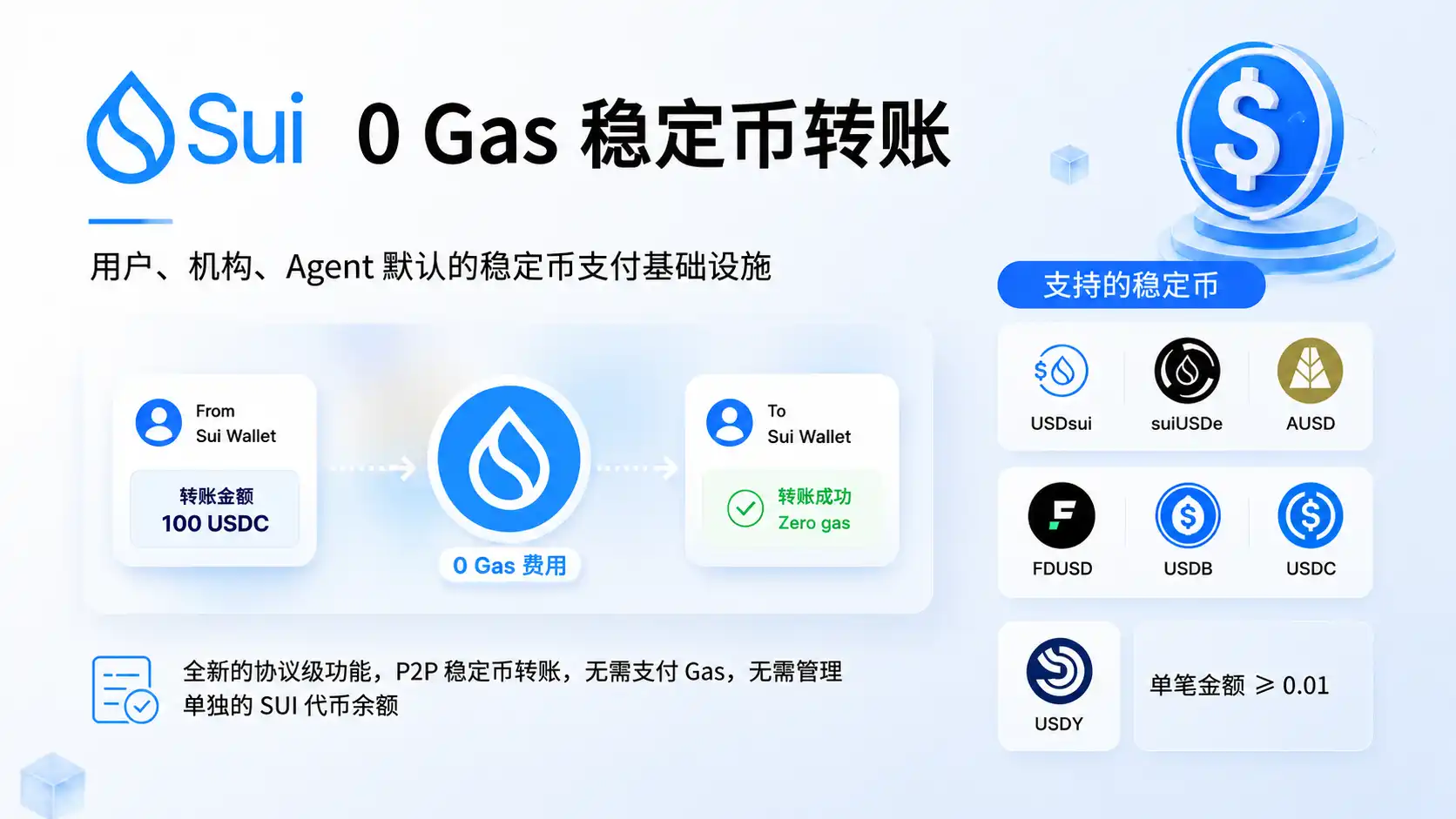
Title: Sui Launches Zero-Gas Stablecoin Transfers to Become the Foundation for Stablecoin Payments Sui has introduced a zero-gas fee feature for peer-to-peer stablecoin transfers, eliminating the need for users or businesses to hold separate SUI tokens to pay transaction costs. This innovation, built on a new underlying account architecture called Address Balances, significantly reduces validator processing costs for eligible transactions. Currently, the feature applies to a whitelist of stablecoins for transfers meeting a minimum amount, effectively preventing spam. This development aims to unlock mainstream payment use cases for stablecoins—such as everyday purchases, remittances, and subscriptions—by removing cost and complexity barriers. It is also positioned to benefit high-frequency micro-payments for AI agents and institutional B2B payments, reducing operational friction. Major custody provider Fireblocks has already announced support. The move follows Sui processing over $1 trillion in stablecoin transfer volume since August 2025. Looking ahead, Sui plans to enhance this infrastructure with protocol-level confidential transactions later in 2026, aiming to provide scalable, free, and privacy-preserving payments. Together, these advancements strengthen Sui's goal of becoming the default settlement layer for stablecoin payments.

marsbit41 min fa

When Transfers Become Truly Frictionless: How Sui Uses 'Zero Gas' to Become the Underlying Infrastructure for Stablecoin Payments

marsbit41 min fa

Ethereum Is Retracing the Path of the Internet and Linux: No One Yields, and the Neutral Party Ultimately Prevails

This article argues that Ethereum is following the historical path of open, neutral systems like the Internet and Linux, which eventually triumphed over proprietary, centrally-controlled alternatives. Major financial institutions like JPMorgan, Stripe, and Circle are building their own proprietary blockchains or networks (e.g., Tempo, Arc), but will never agree to build on a competitor's controlled infrastructure. This creates the perfect opportunity for Ethereum as the only neutral, credibly neutral settlement layer that no single entity controls. The piece draws parallels to the 1990s, when experts like Bill Gates predicted proprietary networks (from Microsoft, Oracle) would win over the open Internet, and when Sun Microsystems' Unix lost to the open-source "bazaar" development model of Linux. This model, described in Eric Raymond's "The Cathedral and the Bazaar," thrives on permissionless innovation where countless contributors improve the system, outpacing any centralized competitor. Ethereum embodies this through its decentralized development, broad validator distribution, and credible neutrality—rules that are transparent, equally applied, hard to change, and open to all. This has attracted over a million developers and major institutions like Coinbase, BlackRock, and JPMorgan, who choose Ethereum for its security, ecosystem, and sovereignty (the inability of any single party to change the rules). While proprietary chains offer initial speed and control, they inherit the downsides of both centralization and decentralization without the long-term innovation benefits. The article concludes that, just as open systems historically win, Ethereum is poised to become the foundational, neutral settlement layer for global finance.

marsbit51 min fa

Ethereum Is Retracing the Path of the Internet and Linux: No One Yields, and the Neutral Party Ultimately Prevails

marsbit51 min fa

Kalshi's Biggest Rival is Not Polymarket

Kalshi's CEO Tarek Mansour has identified the company's primary competitors not as the crypto-based prediction market Polymarket, but as established financial and gaming giants: CME Group, Robinhood, and DraftKings. This reflects a shift in the prediction market landscape, where the 2026 FIFA World Cup is expected to bring massive new trading volume. Traditional platforms are increasingly integrating prediction markets as a feature within their existing ecosystems. Robinhood has seen rapid growth with its prediction markets, contributing significantly to its "other transaction revenue." Similarly, Interactive Brokers (IBKR) integrates contracts from Kalshi and CME Group, while DraftKings and FanDuel (via CME) have launched their own prediction products. This allows these firms to leverage their vast user bases and infrastructure at low marginal cost, turning prediction markets from standalone apps into embedded functionalities. In response, prediction market platforms are evolving along two paths. First, they are expanding into new event categories like sports (e.g., the World Cup) and financial data to reduce reliance on election cycles. Second, they are moving towards becoming infrastructure and liquidity providers for distribution platforms. Kalshi's lead over Polymarket in trading volume is partly attributed to this channel strategy, integrating with brokers like Robinhood, Coinbase, and Webull. However, this strategy faces a challenge as distributors like Robinhood begin building their own in-house prediction market capabilities (e.g., Rothera), potentially threatening the value of pure infrastructure providers. The situation parallels historical tech battles, such as Zoom competing with Microsoft Teams and Google Meet, where embedded features in larger platforms reshape market dynamics. The future of standalone prediction market leaders like Kalshi and Polymarket will depend on their ability to navigate this new competitive landscape dominated by integrated financial and gaming titans.

链捕手58 min fa

Kalshi's Biggest Rival is Not Polymarket

链捕手58 min fa

Trading

Spot
Futures

Articoli Popolari

Come comprare CRV

Benvenuto in HTX.com! Abbiamo reso l'acquisto di Curve DAO Token (CRV) semplice e conveniente. Segui la nostra guida passo passo per intraprendere il tuo viaggio nel mondo delle criptovalute.Step 1: Crea il tuo Account HTXUsa la tua email o numero di telefono per registrarti il tuo account gratuito su HTX. Vivi un'esperienza facile e sblocca tutte le funzionalità,Crea il mio accountStep 2: Vai in Acquista crypto e seleziona il tuo metodo di pagamentoCarta di credito/debito: utilizza la tua Visa o Mastercard per acquistare immediatamente Curve DAO TokenCRV.Bilancio: Usa i fondi dal bilancio del tuo account HTX per fare trading senza problemi.Terze parti: abbiamo aggiunto metodi di pagamento molto utilizzati come Google Pay e Apple Pay per maggiore comodità.P2P: Fai trading direttamente con altri utenti HTX.Over-the-Counter (OTC): Offriamo servizi su misura e tassi di cambio competitivi per i trader.Step 3: Conserva Curve DAO Token (CRV)Dopo aver acquistato Curve DAO Token (CRV), conserva nel tuo account HTX. In alternativa, puoi inviare tramite trasferimento blockchain o scambiare per altre criptovalute.Step 4: Scambia Curve DAO Token (CRV)Scambia facilmente Curve DAO Token (CRV) nel mercato spot di HTX. Accedi al tuo account, seleziona la tua coppia di trading, esegui le tue operazioni e monitora in tempo reale. Offriamo un'esperienza user-friendly sia per chi ha appena iniziato che per i trader più esperti.

468 Totale visualizzazioniPubblicato il 2024.12.11Aggiornato il 2026.06.02

Come comprare CRV

Discussioni

Benvenuto nella Community HTX. Qui puoi rimanere informato sugli ultimi sviluppi della piattaforma e accedere ad approfondimenti esperti sul mercato. Le opinioni degli utenti sul prezzo di CRV CRV sono presentate come di seguito.

活动图片