针对两种衍生品资产的价格预言机:跨链资产和流动性质押衍生品

ETH中文网Pubblicato 2022-11-29Pubblicato ultima volta 2022-11-29

Introduzione

在这篇文章中,我们将分析在 DeFi 借贷协议的背景下,针对衍生资产价格的预言机的现有假设。

目录

介绍

跨链资产

流动性质押衍生品(LSD)

总结性思考

1. 介绍

在这篇文章中,我们将分析在 DeFi 借贷协议的背景下,针对衍生资产价格的预言机的现有假设。具体来说,我们将讨论为什么使用基础资产 (underlying asset) 的价格作为衍生资产的喂价,通常是一种应该避免的坏做法。鉴于这种做法的普遍性,我们认为这是一个及时和重要的问题。

我们将重点讨论两种类型的衍生资产:跨链资产和流动性质押衍生品。然而,类似的分析也可以泛用为任何类型的衍生资产。

这篇文章分为三个部分:跨链资产、流动性质押衍生品和总结性思考。

2. 跨链资产

当一项衍生资产以基础资产作为代理进行定价时,有一个基本的假设(或至少是隐含在决策中的假设):这两种资产在一段时间内将遵循相同的价格轨迹。而一般来说,情况就是这样。

如果一切运作正常,基础资产价格应该密切跟踪衍生品的价格。然而,当事情不按预期进行时,这一假设就会被打破,在跨链资产的案例中,这种情况经常发生。让我们探讨一个例子来了解原因。

假设我们有 bridgedETH,即不同 L1 链上的 ETH 的跨链版本。在正常情况下,每个 bridgedETH 由锁定在以太坊的一个智能合约上的 ETH 支撑 (基于 1:1 的比率锚定)。然而,这些正常情况并不总是成立。特别是,正如已经发生过的几次情况,跨链可以被利用,导致基础资产被盗。举个例子,让我们假设这正是发生在我们的 bridgedETH 上的情况,攻击者利用了跨链并能够窃取支持 bridgedETH 的所有ETH。

那么,这将如何影响使用 ETH 价格作为 bridgedETH 的代理的借贷协议?从根本上说,这意味着该协议对每个 bridgedETH 的估值为 1 ETH,而其真实价格为 0 ETH(假设这也是其市场价格)。这就使协议出现了以下的漏洞:

它允许攻击者使用 bridgedETH 作为抵押品,从协议中窃取资金。任何攻击者都能够以 0 的价格从市场上购买桥接 ETH,并将其作为抵押品存入协议(在那里它的价值为 1 ETH,并以一种有效的无抵押方式借入(盗取)其他资产。这种类型的攻击已经被用于不同的实时协议(例如,对 Moonriver 上的 Hundred Finance 和对 Harmony 上的 Aave)。

它阻碍了清算的正确运作。当 bridgedETH 的市场价格从 1 ETH跌至 0 ETH 时,一些使用 bridgedETH 作为抵押品的头寸应该变得可以清算。然而,鉴于协议仍然将每个 bridgedETH 估值定为 1 个 ETH,这些头寸不会成为可清算的对象。如果使用一个强大的预言机,这些头寸是否真的会被清算是另一个有趣的问题,最终将取决于 bridgedETH 的市场价格下跌的速度。然而,这种分析不在本篇文章的范围之内。重要的一点是,在脆弱的预言机机制下,这些头寸甚至不会成为可被清算的坏账。

作为这个问题的潜在解决方案,Aave 正在考虑接入 Chainlink 的 Proof-of-reserve (储备金证明) 喂价。在宏观上,这些喂价将允许 Aave 验证支持跨链衍生品的基础资产确实存在。虽然这可能是一个可行的解决方案,但其实施的细节仍然很少,无法进行全面评估。此外,这个解决方案不能很好地处理一些特殊情况。

例如,基础资产可能变得无法访问或 "失效",这意味着合约中的一个错误永远锁定了合约中的基础资产。在这种情况下,基础资产实际上是存在的,所以不会有储备证明的问题。然而,如果基础资产不能被收回,衍生品将毫无价值。市场价格很可能会反映出这一点,这将使该协议出现上面所探讨的漏洞。虽然这是一个低概率事件,但在评估解决方案的时候应该考虑到这一点。

3.流动性质押衍生品(LSD)

当使用基础资产的价格作为衍生资产的代理时,LSD 会受到与跨链资产相同的脆弱性的影响。鉴于我们已经在上一节中谈到了这些问题,让我们来看看 DeFi 中专门针对 LSD 的更复杂的案例。

在进入具体问题之前,我们值得简单探讨一下 LSD 的工作原理。正如它的名字所示,LSD 是抵押基础资产(通常在 PoS 网络中)的可流动证明。在这种情况下,流动性质押协议的工作方式如下:

它从用户方接收要被抵押的资产

它将这些资产委托给一些验证者 (节点)

它向用户返回被抵押资产的证明 (可流通的):即 LSD

当用户想要提取基础资产时 (将LSD换为流通资产),协议的工作过程如下:

它从用户方收到 LSD

它使用赎回率计算出应该向用户归还多少基础资产。赎回率是 LSD 供应与基础资产的比率 (即它表明每个 LSD 所代表的基础资产数额)。

它解除了必要的基础资产的质押

在释放期过后,用户便可以认领资产

在这个背景下,让我们回到价格问题。目前一些协议使用的计算 LSD 价格的方式是将基础资产的价格及赎回率都纳入考量标准,计算方式如下:

其中:

通过将赎回率纳入计算,这种方法解决了上一节所探讨的情况,即基础资产可能被盗(或在 PoS 协议的情况下被罚没)。例如,如果基础资产被盗,将被反映在赎回率上,因此,价格也将受到影响。

那么,这种方法有什么问题呢?让我们用以下例子来探讨这个问题。在这个例子中,假设我们有一个名为 stakedATOM 的 ATOM 的 LSD,其工作方式与我们上面描述的 LSD 的方式类似,并且有一个 21 天的释放期。使用上面描述的定价方法,stakedATOM 的价格计算方式如下(假设我们以美元计价):

其中:

这种方法有一个基本问题:stakedATOM 的实际市场价格可能与上面探讨的计算价格有出入。这是因为,虽然当 stakedATOM 的市场价格高于计算价格时,存在一个套利机会,但当 stakedATOM 的价格低于计算价格时,就不是这样了。

换句话说,虽然 stakedATOM 的市场价格在上行方面有一个硬挂钩(相当于计算价格),但在下行时却不存在了。为了了解原因,让我们来探讨一下这两种情况下的套利机会是如何运作的。上涨的情况如下:

假设赎回率为 1 ATOM/stakedATOM。

市场价格是 1.1 ATOM/stakedATOM(stakedATOM 在市场上被高估了)。

一个套利者可以质押 1 ATOM,并收到 1 stakedATOM,然后在市场上卖出该 stakedATOM 并获得 0.1 ATOM 的利润。

上述情况会发生,直到套利机会不再存在。这种机制保证了市场价格将倾向于有一个等于计算价格的上限。然而,价格下行时,情况并不是这样的,其原因是 21 天的释放期打破了套利机会。以下是另一个例子:

假设赎回率为 1 ATOM/stakedATOM。

市场价格是 0.9 ATOM/stakedATOM。

如果没有释放期,套利者可以在市场上用 0.9 个 ATOM 买 1 个 stakedATOM 并解除质押 ATOM,取回1ATOM,其利润为 0.1 ATOM。

然而,释放期为 21 天,所以不存在立即套利的机会。

所以,对于价格上升来说这存在一个“硬挂钩”,而对于价格下降来说却是一个“软挂钩”。这种软挂钩意味着,从长远来看,市场价格应该趋向于跟随赎回率。但在短期内,stakedATOM的价格没有一个真正的下限。这不仅仅是一个理论上或抽象的发现,在现实中,我们已经看到了这一点,例如臭名昭著的 stETH脱锚事件和其他 LSD,如 stLUNA。基本上,当有足够多的人想要提出 LSD 而不想要等待释放期时,价格就会趋向于向下 "脱钩"。

对于使用计算出的价格作为 LSD 的预言机喂价的借贷协议而言,上述波动可能会导致资不抵债。让我们来看看下面的例子来了解这种情况是如何发生的:

假设我们在 DeFi 借贷协议中拥有下述仓位:

一位用户存入了 100 个 stakedATOM 作为抵押品,其最高贷款利率为 70%

该用户使用 stakedATOM 作为抵押,借出了价值 600 美元的其他资产

现在让我们探讨一下下图中 T1、T2 和 T3 时间节点中仓位是如何变化的:
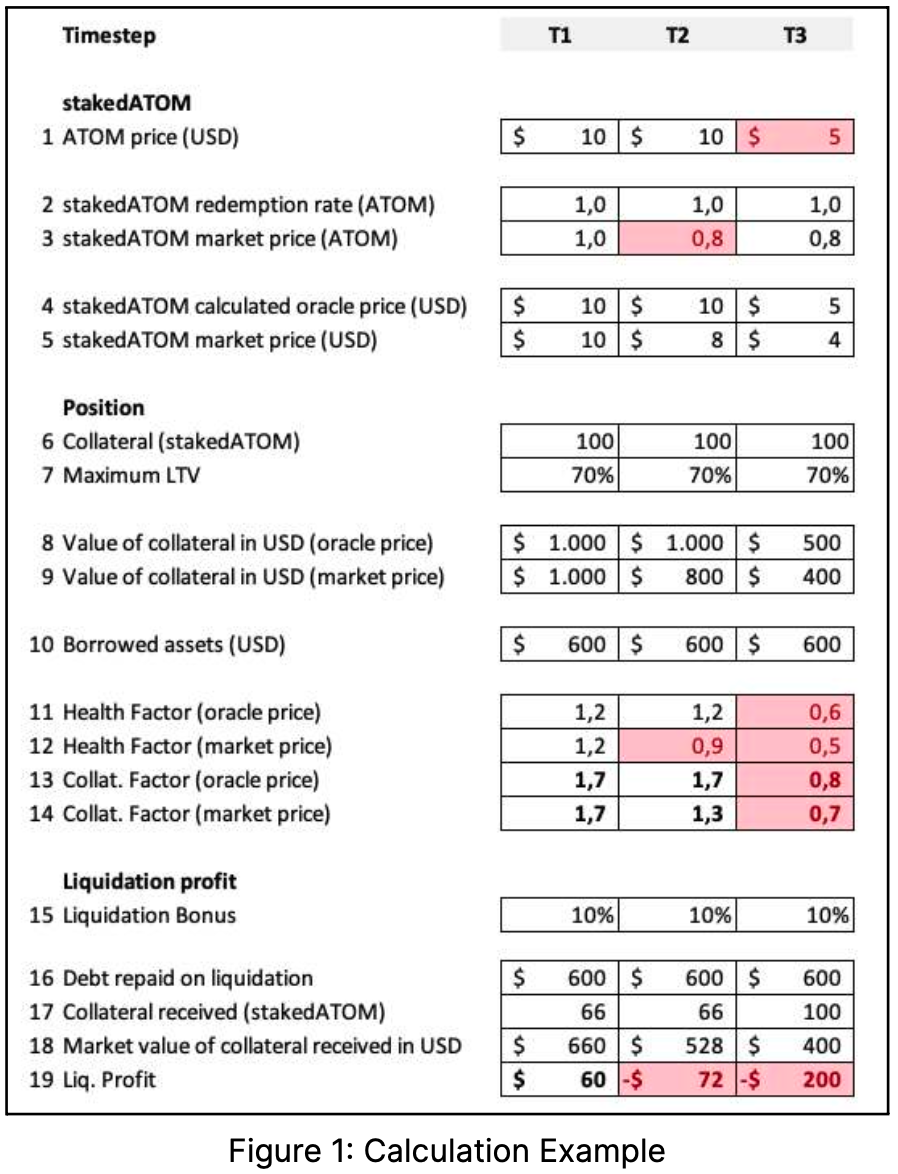
在 T1 中,stakedATOM 的市场价格 (第 4 行) 完美反映了计算出的预言机价格 (第 5 行),所以一切都运行顺利;具体来说,健康系数 (Collateral*Max.LTV/Debt) 和抵押品系数 (Collateral/Debt) 都高于 1,所以这个账户是健康并且超抵押的;

在 T2 中,stakedATOM 的市场价格偏离了赎回率 (也因此偏离了预言机价格)。具体来说,虽然赎回价格是 1 ATOM,但市场价格是 0.8 ATOM (有 20% 的偏差);这种情况下有几个部分值得详述:

用 stakedATOM 的市场价格计算的健康系数 (第 12 行) 不再高于 1,意味着用市场价格衡量的头寸是不健康的,应该是可以清算的。然而,考虑到协议使用的是预言机价格,而预言机价格并没有改变,使用预言机价格计算的健康系数 (第 11 行) 仍然与 T1 中的完全相同,并且高于 1。因此,该头寸无法被清算。

请注意,在这一点上,对清算人来说,该头寸的清算已经无利可图 (见最后一行)。这是由于协议根据预言机的价格计算要支付给清算人的。stakedATOM 抵押品的数量,而预言机的价格被高估了。如果预言机使用的是市场价格,那么这个头寸是可以清算的,在这个时候清算是有利可图的。

虽然这种情况并不理想,但考虑到应该清算的头寸并没有清算,这并不是很糟糕,因为该头寸仍有偿付能力。换句话说,它仍然是过度抵押的 (抵押系数高于 1)。

在 T3 中,市场价格和赎回率之间的偏差与 T2 相同,但 ATOM 的价格从 10 美元降至 5 美元。这实际上会导致一个无力偿还的头寸,因为它不会被清算,现在抵押率已经降至 1 以下。

从根本上说,这种预言机方法的问题在于,即使一切都在按计划进行,没有发生价格操纵,系统也会变得无力偿还,正如上文所探讨的那样。

4. 总结性思考

预言机是 DeFi 借贷协议的核心。它们是如此重要,以至于它们往往决定了整个协议的未来。一个不健全的预言机可能会使价值数百万美元的资产面临风险,这就是为什么我们花了这么多时间分析预言机的实现。

通过这篇文章,我们希望能对衍生资产的预言机的使用情况有所了解。特别是,我们已经表明为什么一些常用的做法并不理想,应该避免。这篇文章的目的并不是要阻止衍生资产的上市,因为我们知道它们是一些可以作为抵押品的最佳资产。我们的目的是不鼓励这些衍生资产上市时使用不够稳健的预言机,这可能导致最坏的结果。

我们知道,衍生资产的流动性往往比它们的基础资产要差,这使得专门为它们建立健全的预言机制很困难。然而,我们认为这不应该成为使用非稳健预言机的借口。我们强烈鼓励协议在使用非稳健预言机之前,等待流动性的建立和针对特定资产的稳健预言机的开发。


Crypto di tendenza

Letture associate

Annualized Revenue Exceeds $20 Billion, Kalshi Aims to Become the First Prediction Platform IPO?

Kalshi, a leading U.S. prediction markets platform, is reportedly in early, informal discussions for an Initial Public Offering (IPO). The company's annualized revenue now exceeds $2 billion, fueled by its dominance of over 90% of the domestic prediction market activity. This growth stems from a surge in trading volume—reaching a total of $52.7 billion—and an increase in fee rates, largely driven by sports event contracts like the NBA playoffs and the 2026 FIFA World Cup. Monthly active users are approximately 2 million. Kalshi recently raised $1 billion in a funding round led by Coatue Management, valuing the company at $22 billion. It has also expanded its offerings to include Bitcoin perpetual contracts and plans to launch a dedicated trading platform, Kalshi Pro. However, Kalshi's path to an IPO faces significant regulatory hurdles. The core risk involves jurisdictional conflicts, as multiple U.S. states are challenging its operations under local gambling laws. For instance, Arizona has filed criminal charges against the platform, while states like Kentucky have filed lawsuits. Kalshi and the Commodity Futures Trading Commission (CFTC) argue that its event contracts fall under exclusive federal jurisdiction as "swaps." The outcomes of these ongoing legal battles could critically impact Kalshi's core revenue and its IPO timeline. Analysts suggest that while an IPO could theoretically occur by late 2026, a more likely timeframe is late 2027 or 2028, contingent on resolving legal issues and favorable market conditions. If successful, its fundraising could significantly exceed $1 billion, given its current valuation and revenue multiple.

Foresight News3 min fa

Annualized Revenue Exceeds $20 Billion, Kalshi Aims to Become the First Prediction Platform IPO?

Foresight News3 min fa

Financing Weekly Report | 11 Public Financing Events, Stablecoin Payment Infrastructure Company Trace Finance Completes $32 Million Series A Round Led by CoinFund

Financing Weekly Report | 11 public funding events recorded, with a total scale exceeding $264 million. The stablecoin payment infrastructure sector remains a hot spot. Key Deals: - Trace Finance, a stablecoin payment infrastructure firm, raised $32 million in a Series A round led by CoinFund to expand in Latin America and Asia-Pacific. - Galaxy Ventures co-led a $140 million Series A round for Karta, a US credit card provider for global travelers without requiring an SSN. - Instant payment platform Interchecks completed a $50 million Series C round. - Paradigm led a $9 million Series A for Latin American cross-border payment app El Dorado. - Range, a stablecoin compliance startup, raised $8.3 million in an oversubscribed Series A. - RWA infrastructure project Renaiss raised $1.5 million to expand its on-chain collectibles platform. Sector Breakdown: - Infrastructure & Tools: 6 deals, including the above-mentioned Trace Finance, Range, and Renaiss. - Centralized Finance (CeFi): 3 deals, led by Karta's $140 million round. - DeFi: 1 deal – reinsurance protocol Re secured strategic investment from Coinbase Ventures. - Prediction Markets: 1 deal – K25.ai completed a $10 million Pre-A round from NewGen. Other notable transactions include digital asset depository RDC raising $7 million, ad-tech startup EarnOS securing $6 million, and a $1 million strategic investment in LitVM, a ZK Layer 2 for Litecoin. The report highlights sustained investor interest in stablecoin payment infrastructure, compliant on-chain finance, and real-world asset (RWA) tokenization.

marsbit45 min fa

Financing Weekly Report | 11 Public Financing Events, Stablecoin Payment Infrastructure Company Trace Finance Completes $32 Million Series A Round Led by CoinFund

marsbit45 min fa

When Transfers Become Truly Frictionless: How Sui Uses 'Zero Gas' to Become the Underlying Infrastructure for Stablecoin Payments

Title: Sui Launches Zero-Gas Stablecoin Transfers to Become the Foundation for Stablecoin Payments Sui has introduced a zero-gas fee feature for peer-to-peer stablecoin transfers, eliminating the need for users or businesses to hold separate SUI tokens to pay transaction costs. This innovation, built on a new underlying account architecture called Address Balances, significantly reduces validator processing costs for eligible transactions. Currently, the feature applies to a whitelist of stablecoins for transfers meeting a minimum amount, effectively preventing spam. This development aims to unlock mainstream payment use cases for stablecoins—such as everyday purchases, remittances, and subscriptions—by removing cost and complexity barriers. It is also positioned to benefit high-frequency micro-payments for AI agents and institutional B2B payments, reducing operational friction. Major custody provider Fireblocks has already announced support. The move follows Sui processing over $1 trillion in stablecoin transfer volume since August 2025. Looking ahead, Sui plans to enhance this infrastructure with protocol-level confidential transactions later in 2026, aiming to provide scalable, free, and privacy-preserving payments. Together, these advancements strengthen Sui's goal of becoming the default settlement layer for stablecoin payments.

marsbit46 min fa

When Transfers Become Truly Frictionless: How Sui Uses 'Zero Gas' to Become the Underlying Infrastructure for Stablecoin Payments

marsbit46 min fa

Ethereum Is Retracing the Path of the Internet and Linux: No One Yields, and the Neutral Party Ultimately Prevails

This article argues that Ethereum is following the historical path of open, neutral systems like the Internet and Linux, which eventually triumphed over proprietary, centrally-controlled alternatives. Major financial institutions like JPMorgan, Stripe, and Circle are building their own proprietary blockchains or networks (e.g., Tempo, Arc), but will never agree to build on a competitor's controlled infrastructure. This creates the perfect opportunity for Ethereum as the only neutral, credibly neutral settlement layer that no single entity controls. The piece draws parallels to the 1990s, when experts like Bill Gates predicted proprietary networks (from Microsoft, Oracle) would win over the open Internet, and when Sun Microsystems' Unix lost to the open-source "bazaar" development model of Linux. This model, described in Eric Raymond's "The Cathedral and the Bazaar," thrives on permissionless innovation where countless contributors improve the system, outpacing any centralized competitor. Ethereum embodies this through its decentralized development, broad validator distribution, and credible neutrality—rules that are transparent, equally applied, hard to change, and open to all. This has attracted over a million developers and major institutions like Coinbase, BlackRock, and JPMorgan, who choose Ethereum for its security, ecosystem, and sovereignty (the inability of any single party to change the rules). While proprietary chains offer initial speed and control, they inherit the downsides of both centralization and decentralization without the long-term innovation benefits. The article concludes that, just as open systems historically win, Ethereum is poised to become the foundational, neutral settlement layer for global finance.

marsbit56 min fa

Ethereum Is Retracing the Path of the Internet and Linux: No One Yields, and the Neutral Party Ultimately Prevails

marsbit56 min fa

Trading

Spot
Futures

Articoli Popolari

Come comprare ATOM

Benvenuto in HTX.com! Abbiamo reso l'acquisto di Cosmos (ATOM) semplice e conveniente. Segui la nostra guida passo passo per intraprendere il tuo viaggio nel mondo delle criptovalute.Step 1: Crea il tuo Account HTXUsa la tua email o numero di telefono per registrarti il tuo account gratuito su HTX. Vivi un'esperienza facile e sblocca tutte le funzionalità,Crea il mio accountStep 2: Vai in Acquista crypto e seleziona il tuo metodo di pagamentoCarta di credito/debito: utilizza la tua Visa o Mastercard per acquistare immediatamente CosmosATOM.Bilancio: Usa i fondi dal bilancio del tuo account HTX per fare trading senza problemi.Terze parti: abbiamo aggiunto metodi di pagamento molto utilizzati come Google Pay e Apple Pay per maggiore comodità.P2P: Fai trading direttamente con altri utenti HTX.Over-the-Counter (OTC): Offriamo servizi su misura e tassi di cambio competitivi per i trader.Step 3: Conserva Cosmos (ATOM)Dopo aver acquistato Cosmos (ATOM), conserva nel tuo account HTX. In alternativa, puoi inviare tramite trasferimento blockchain o scambiare per altre criptovalute.Step 4: Scambia Cosmos (ATOM)Scambia facilmente Cosmos (ATOM) nel mercato spot di HTX. Accedi al tuo account, seleziona la tua coppia di trading, esegui le tue operazioni e monitora in tempo reale. Offriamo un'esperienza user-friendly sia per chi ha appena iniziato che per i trader più esperti.

333 Totale visualizzazioniPubblicato il 2024.12.10Aggiornato il 2026.06.02

Come comprare ATOM

Discussioni

Benvenuto nella Community HTX. Qui puoi rimanere informato sugli ultimi sviluppi della piattaforma e accedere ad approfondimenti esperti sul mercato. Le opinioni degli utenti sul prezzo di ATOM ATOM sono presentate come di seguito.

活动图片