'Metaverse’ a top 3 contender for Oxford’s Word of the Year

CointelegraphPubblicato 2022-11-23Pubblicato ultima volta 2022-11-23

Introduzione

Oxford University has opened public voting for the first time with polls set to close on Dec. 2.

The word “Metaverse” is one of three in the running to be crowned the Oxford "Word of the Year” (WOTY) in a competition run by the Oxford University Press (OUP), the publisher of the Oxford English Dictionary.

OUP officially announced the launch of the competition and its three finalist words for 2022 on Nov. 22 with this year marking the first time the public can participate in voting for the WOTY.

“Metaverse” will compete against the terms “#IStandWith” and “Goblin Mode”.
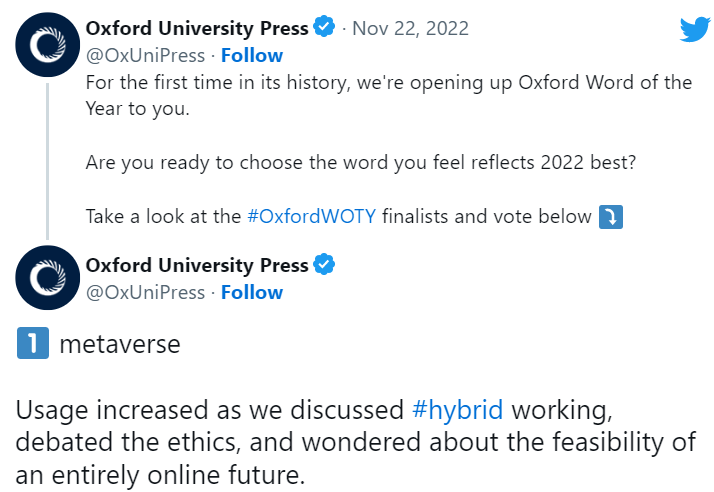
In OUP’s video pitch for the Metaverse, it described it as “a hypothetical virtual reality environment in which users interact with one another’s avatars and their surroundings in an immersive way.”

“The term dates back to the 1990s, with the first recorded use in the Oxford English Dictionary in 1992 in the science fiction novel Snow Crash by Neil Stephenson,” the video stated.

Oxford noted that "Metaverse" has quadrupled in usage in Oct. 2022 compared to that of Oct. 2021. The video stated that more lifestyle and work-related activities taking place in virtual reality environments may bring about “more debates over the ethics and feasibility of an entirely online future.”

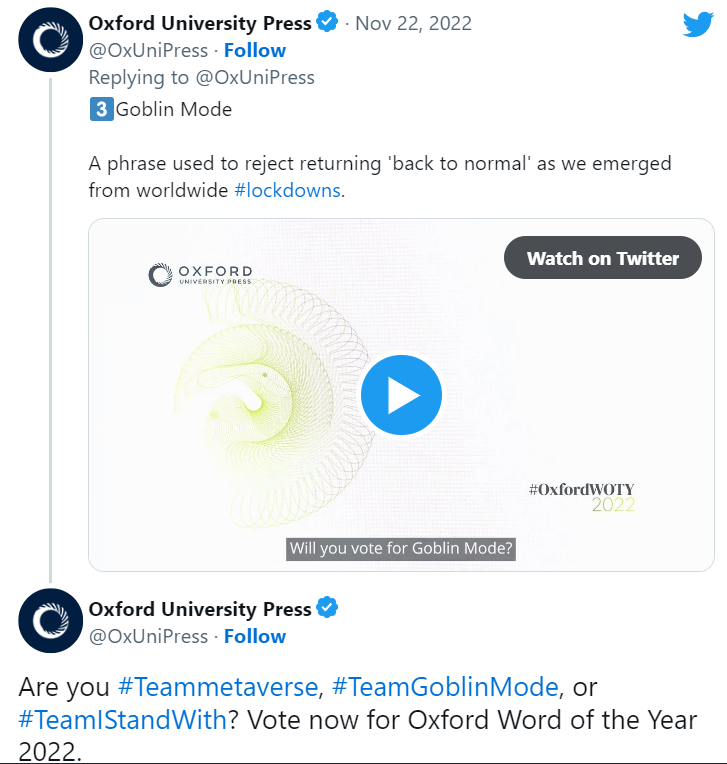
As for the other two WOTY candidates, “#IStandWith” has become an increasingly used phrase for political activism, while “Goblin Mode” emerged as a post-COVID-19 lockdown concept in which one rejects “returning back to normal” and instead does what they want to do.

As for how the three phrases were chosen, OUP stated that they ran an analysis on a language data system in order to narrow down the candidates to three.

In order to officially vote for “Metaverse” or the other two candidates, voters must cast their vote on Oxford Languages’ website.

Over 237,000 votes have been cast so far, with voting set to close Dec. 2.

Oxford did not state when the winning word would be announced.

In what could spell how the votes are panning out, at the time of writing a Twitter poll by OUP shows 63% of 929 voters favored "Goblin Mode", followed by "Metaverse" at 22% then "#IStandWith" at 15%:
Whatever the results of the poll, the Metaverse is predicted to be a significant industry in the near future, with a recent report by international consulting firm McKinsey estimating Metaverse-related technologies to be worth $5 trillion by 2030.

Investment bank Citi upped that prediction, saying the total addressable market for the Metaverse economy may fall within the range of $8-13 trillion over the same time frame.

The understanding of the Metaverse has been most significantly influenced by the blockchain and cryptocurrency industry, along with Meta CEO Mark Zuckerberg’s rebranding of Facebook to Meta in Oct. 2021 and its recent developments on its Metaverse products through its Reality Labs business.


Letture associate

The Verdict in Choi Tae-won's Divorce Case: Revealing the Inheritance Undercurrent Behind SK Hynix's Trillion-Won Empire

SK Group Chairman Chey Tae-won's high-profile divorce case, involving a record 1.38 trillion won settlement, has drawn attention to the succession plans for Korea's second-largest conglomerate, especially its crown jewel, SK hynix. Unlike traditional chaebol scripts centered on the eldest son, Chey's three children from his marriage to former President Roh Tae-woo's daughter, Roh Soh-yeong, are carving distinct, non-traditional paths. Eldest daughter Chey Yun-jung (b. 1989) is seen as the most evident successor. With a scientific and consulting background, she holds executive roles at SK bioscience and SK Inc.'s growth support department, focusing on future strategy and biopharma. Her marriage is to an AI infrastructure entrepreneur, not a traditional business alliance. Second daughter Chey Min-jung (b. 1991) took a unique route, voluntarily serving as a South Korean naval officer, including an anti-piracy deployment. She later worked on policy and strategy for SK hynix in Washington D.C. before co-founding an AI-driven healthcare startup. She married a former U.S. Marine Corps officer, connecting her to U.S. defense and policy circles—networks crucial for a global semiconductor giant. The only son, Chey In-geun (b. 1995), who studied physics like his father, worked briefly at SK E&S before joining McKinsey. Despite fitting the traditional "heir" profile as the eldest son, he remains silent and holds no public position or shares in SK, suggesting the old succession playbook is obsolete. As SK hynix's valuation soars, becoming a geopolitical asset in the AI era, the heirs' legitimacy is no longer automatic. They must prove themselves in fields like AI biotech, global policy, and strategic consulting. Their marriages also reflect new elite networks in tech and defense, not old political alliances. Their inheritance is the complex challenge of navigating a globalized, tech-driven world, not just a corporate throne.

marsbitIeri 09:06

The Verdict in Choi Tae-won's Divorce Case: Revealing the Inheritance Undercurrent Behind SK Hynix's Trillion-Won Empire

marsbitIeri 09:06

From OpenSea to OpenRouter: Is Alex Atallah Repeating His 'Exit at the Peak' Playbook?

From OpenSea to OpenRouter: Is Alex Atallah Repeating His "Exit at the Peak" Playbook? According to the Wall Street Journal, payments giant Stripe is in talks to acquire the AI model aggregation platform OpenRouter in a potential deal valuing the company near $100 billion. This would mark founder Alex Atallah's second creation of a company reaching a $100 billion valuation, following his co-founding of NFT marketplace OpenSea. OpenRouter, founded just over three years ago, has grown rapidly by acting as a unified gateway for developers to access over 400 AI models. It currently has about 10 million users and processes over 200 trillion tokens monthly. While the platform's annualized revenue is around $50 million, its valuation has skyrocketed from $1.3 billion in March 2026. The potential acquisition by Stripe, a company OpenRouter's founder once likened it to, represents a major expansion into AI infrastructure for the payments leader. This move echoes Atallah's previous timing with OpenSea, where he departed before the NFT market's significant downturn. For OpenRouter, selling now may be strategic. Despite its scale, its business model—charging a 5-5.5% fee on AI inference calls—faces pressure from competition, open-source models, and potential price wars among model providers, limiting its profitability narrative for an IPO. A key asset for potential acquirers like Stripe is OpenRouter's vast repository of real-world AI usage data, which offers unique insights into model performance and developer preferences that are difficult to replicate. Whether this potential deal signifies a new valuation benchmark for AI infrastructure or another market peak signal remains to be seen.

链捕手Ieri 08:42

From OpenSea to OpenRouter: Is Alex Atallah Repeating His 'Exit at the Peak' Playbook?

链捕手Ieri 08:42

Trading

Spot
活动图片



