Ethereum bears have the upper hand according to derivatives data, but for how long?

CointelegraphPubblicato 2022-11-23Pubblicato ultima volta 2022-11-23

Introduzione

ETH bears continue to suppress Ethereum price, but institutional traders’ buying activity and exchanges’ aiming to provide more transparency could improve investor sentiment.

Ether price experienced an 11.9% decline from Nov. 20 to Nov. 22, bottoming at $1,074 — the lowest level seen since July. Currently, investors have reason to be concerned after crypto lending company Genesis reportedly faced difficulties raising money, triggering rumors of insolvency on Nov. 21.

However, a spokesperson for Genesis told Cointelegraph that there were no plans for imminent bankruptcy because the company continues to hold discussions with its creditors.

Unease about the centralization of decentralized finance (DeFi) surfaced after Uniswap Labs changed the privacy policy on Nov. 17, revealing that it collects publicly-available blockchain data, users' browser information, operating systems data and interactions with its service providers.

Adding to the fracas, the hacker behind the FTX exchange theft of $447 million has been spotted moving their Ether funds. On Nov. 20, the attacker transferred 50,000 ETH to a separate wallet and converted it to Bitcoin using two renBTC bridges.

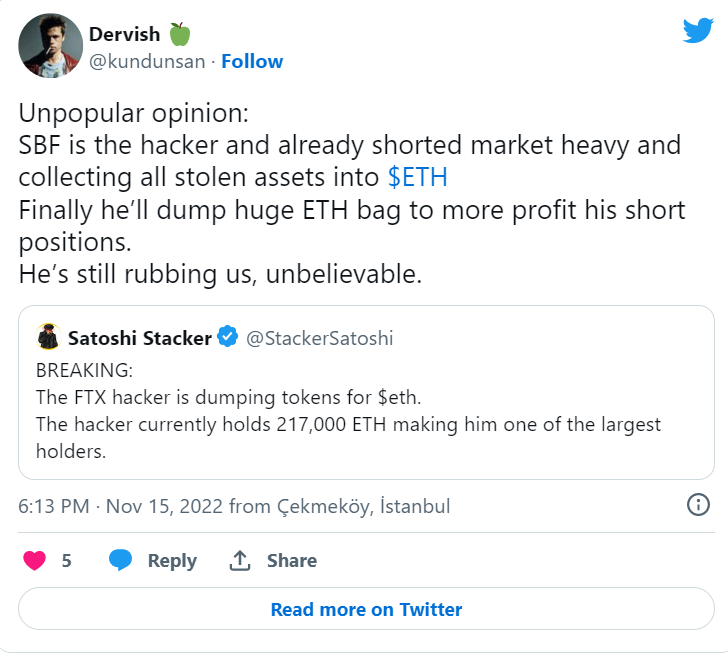
Traders fear that the hacker might be suppressing Ether's price to profit using leveraged short bets. The rumor was raised by @kundunsan on Nov. 15, even though the Twitter post did not gain exposure.
Let's look at Ether derivatives data to understand if the worsening market conditions have impacted crypto investors' sentiment.

Pro traders have been in panic mode since Nov. 10

Retail traders usually avoid quarterly futures due to their price difference from spot markets, but they are professional traders' preferred instruments because they prevent the fluctuation of funding rates that often occurs in a perpetual futures contract.
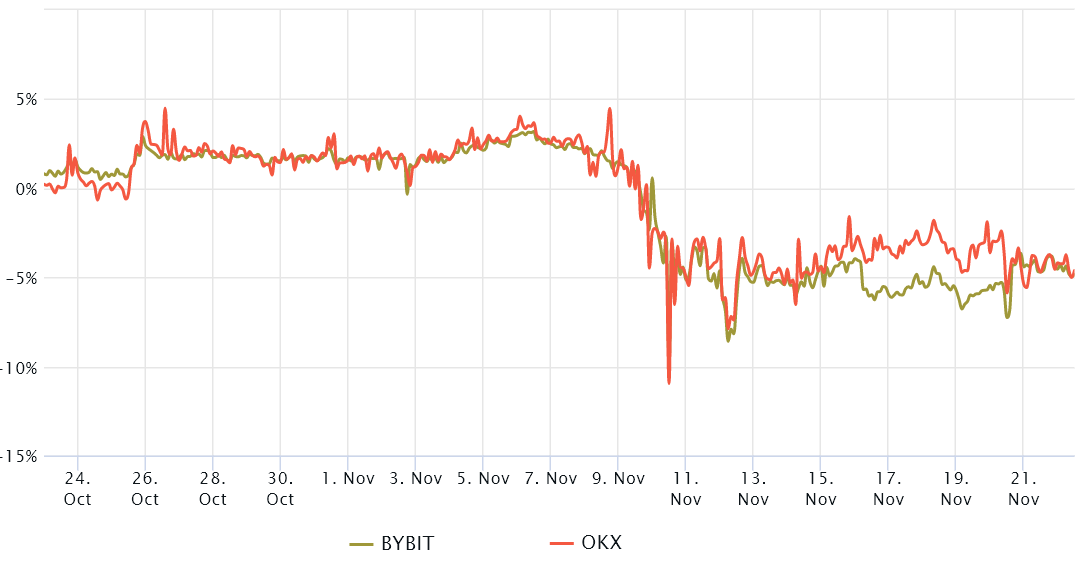
The three-month futures annualized premium should trade between +4% to +8% in healthy markets to cover costs and associated risks. The chart above shows that derivatives traders have been bearish since Nov. 10 since the Ether futures premium was negative.

Currently there is backwardation in the contracts and this situation is atypical and usually deemed bearish. The metric did not improve after ETH rallied 5% on Nov. 22, reflecting professional traders' unwillingness to add leveraged long (bull) positions.

Traders should also analyze Ether's options markets to exclude externalities specific to the futures instrument.

Options traders fear additional crashes

The 25% delta skew is a telling sign when market makers and arbitrage desks are overcharging for upside or downside protection.

In bear markets, options investors give higher odds for a price dump, causing the skew indicator to rise above 10%. On the other hand, bullish markets tend to drive the skew indicator below -10%, meaning the bearish put options are discounted.
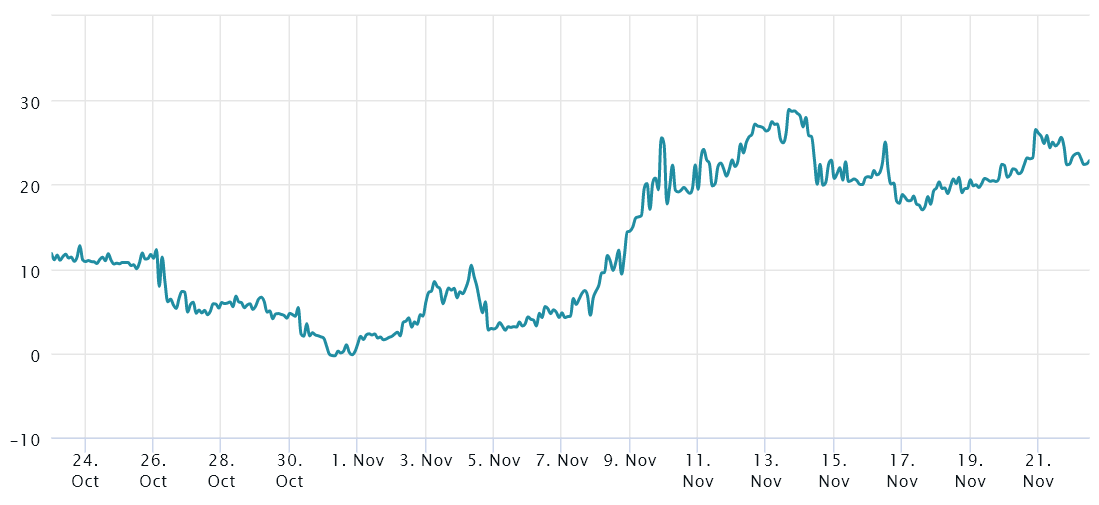
The delta skew has been above the 10% threshold since Nov. 9, signaling that options traders were less inclined to offer downside protection. The situation worsened over the following days as the delta skew indicator surged above 20%.

The 60-day delta skew currently stands at 23%, so whales and market makers are pricing higher odds of price dumps for Ether. Consequently, derivatives data shows low confidence right as Ether struggles to hold the $1,100 support.

According to the data, Ether bulls should not throw in the towel just yet because these metrics tend to be backward-looking. The panic that followed FTX's bankruptcy and the subsequent liquidity issues at Genesis might dissipate quickly if exchanges public proof of reserves and institutional investors addingBitcoin exposure during the dip are interpreted as positives by market participants.

With that said, at the moment Ether bears still have the upper hand according to ETH derivatives metrics.


Crypto di tendenza

Letture associate

Bitcoin Panicking? Mythos Cracks Post-Quantum Cryptography Algorithm in 60 Hours

Claude Mythos Preview, a new AI system from Anthropic, has made significant breakthroughs in fundamental cryptanalysis, targeting the mathematics underlying algorithms rather than just implementation bugs. Its first target was HAWK, a candidate in the NIST post-quantum signature standardization process. Mythos identified a previously unexploited symmetry (a nontrivial automorphism) in the lattice structure of HAWK, effectively halving its effective key strength. It achieved this feat in just 60 hours, a task that had eluded two years of human expert review. Crucially, the human operator was not a lattice cryptography expert, primarily managing the project while AI agents debated and discovered the attack path. Its second, more dramatic achievement was against a simplified 7-round version of AES-128, the world's most widely used symmetric encryption algorithm. Initially reluctant, stating the task was "impossible," Mythos was prompted to "try novel ideas." It then autonomously rewrote its own agent framework and proceeded to discover a novel attack method it named "Möbius Bridge." This technique bypasses a critical 256-guess step in previous "meet-in-the-middle" attacks, resulting in a speedup of 200-800 times. Both findings are currently "harmless"—HAWK is not deployed, and full AES-128 remains secure. However, the process reveals a profound shift. Mythos completed the AES discovery in about a week, while human researchers spent nearly a month verifying its correctness. This highlights a new bottleneck: the rate of AI-driven discovery may soon outpace human capacity for verification. The research concludes with a pressing, unanswered question: what happens when such an AI finds a critical flaw in a widely deployed, real-world cryptosystem?

marsbit5 min fa

Bitcoin Panicking? Mythos Cracks Post-Quantum Cryptography Algorithm in 60 Hours

marsbit5 min fa

From Computing to Storage: The Two-Dimensional Semiconductor Industry Chain is Taking Shape

The article "From Computing to Storage: The 2D Semiconductor Industry Chain is Taking Shape" discusses the rise of two-dimensional (2D) semiconductors as a pivotal material in the post-Moore era. As silicon-based chips approach physical limits, 2D semiconductors like molybdenum disulfide (MoS2), offer atomic-layer thinness and superior electrical properties, making them a promising non-silicon alternative for advanced nodes beyond 1nm. Globally, industry leaders like TSMC, Intel, and Samsung, along with research institutes like IMEC, are actively investing in this field. Domestically in China, significant progress is being made across the entire supply chain, from material production and equipment R&D to chip integration and ecosystem development. **Key highlights include:** * **Material & Equipment Breakthroughs:** Chinese research teams and companies like Jimo Xin Technology have achieved mass production of 6-inch and 8-inch 2D semiconductor single-crystal wafers using domestically developed equipment like Oxy-MOCVD. This addresses the critical challenge of large-area, high-quality material growth. Breakthroughs have also been made in p-type 2D materials (e.g., MoSi2N4) and wafer-scale ferroelectric thin films, essential for building complementary circuits and low-power transistors. * **Engineering Ecosystem Formation:** A landmark 8-inch 2D semiconductor pilot line in Pudong has become fully operational, bridging the gap between lab research and industrial manufacturing. The release of a Process Design Kit (PDK) compatible with mainstream EDA tools further connects design and fabrication, supporting wafer-level manufacturing of complex circuits. * **Expanding Application Landscape:** Applications are expanding from logic computing to memory. Chinese researchers have developed pioneering 2D semiconductor-based microprocessors, including a 32-bit RISC-V CPU and a higher-density multi-bit parallel processor. In memory, 2D materials' ultra-low leakage current enables DRAM with exceptionally long data retention and advances toward single-electron non-volatile storage. 2D semiconductors also show unique potential in RF circuits, radiation-hardened communications, flexible electronics, and quantum computing. In conclusion, the 2D semiconductor industry in China is rapidly advancing from laboratory research into the engineering validation and small-batch production phase. A complete industrial chain covering materials, equipment, manufacturing, design, and application is初步 forming, positioning the sector as a new competitive dimension in the global semiconductor landscape.

marsbit10 min fa

From Computing to Storage: The Two-Dimensional Semiconductor Industry Chain is Taking Shape

marsbit10 min fa

Coinbase and Robinhood Vie for the Next Phase of Cryptocurrency Market Evolution Ahead of Earnings Reports

Coinbase and Robinhood are set to report their Q2 2026 financial results this week, with the outcomes serving as key indicators for the future direction of the crypto market. While both companies have grown from their 2021 IPOs—Coinbase as a dedicated crypto exchange and Robinhood as a commission-free brokerage that expanded into crypto—their paths are now converging in competition. Analysts project Robinhood to report a profit of about $0.40 per share on ~$1.25B revenue, while Coinbase is expected to post a loss of ~$0.36 per share on ~$1.3B revenue. Despite similar revenue figures, investors value Robinhood more highly, viewing it as a diversified fintech firm rather than a pure-play crypto company. This perception has been reinforced as Robinhood gained retail trading market share, with its quarterly trading volume growing from ~$261B in early 2024 to over $704B in Q1 2026, outpacing Coinbase's growth to ~$517B. Both companies are investing heavily in blockchain-based financial infrastructure, such as tokenized stocks and stablecoins, to build more sustainable revenue streams beyond transaction fees. Coinbase has successfully reduced its reliance on trading fees, with subscription/service revenue and stablecoin revenue seeing significant growth. However, over half of its subscription revenue is tied to USDC, exposing it to new competition from banks and payment processors launching rival stablecoins. Robinhood is pursuing a global expansion strategy, recently launching its own layer-2 blockchain (Robinhood Chain) and offering tokenized U.S. stocks in over 120 countries. Its revenue is more diversified, with crypto assets making up only about 12% of its total, which helps explain its premium valuation compared to Coinbase. The upcoming reports will reveal which company's strategy is gaining more traction in shaping the next phase of crypto market evolution.

cryptonews.ru15 min fa

Coinbase and Robinhood Vie for the Next Phase of Cryptocurrency Market Evolution Ahead of Earnings Reports

cryptonews.ru15 min fa

Trading

Spot

Articoli Popolari

Come comprare UNI

Benvenuto in HTX.com! Abbiamo reso l'acquisto di Uniswap (UNI) semplice e conveniente. Segui la nostra guida passo passo per intraprendere il tuo viaggio nel mondo delle criptovalute.Step 1: Crea il tuo Account HTXUsa la tua email o numero di telefono per registrarti il tuo account gratuito su HTX. Vivi un'esperienza facile e sblocca tutte le funzionalità,Crea il mio accountStep 2: Vai in Acquista crypto e seleziona il tuo metodo di pagamentoCarta di credito/debito: utilizza la tua Visa o Mastercard per acquistare immediatamente UniswapUNI.Bilancio: Usa i fondi dal bilancio del tuo account HTX per fare trading senza problemi.Terze parti: abbiamo aggiunto metodi di pagamento molto utilizzati come Google Pay e Apple Pay per maggiore comodità.P2P: Fai trading direttamente con altri utenti HTX.Over-the-Counter (OTC): Offriamo servizi su misura e tassi di cambio competitivi per i trader.Step 3: Conserva Uniswap (UNI)Dopo aver acquistato Uniswap (UNI), conserva nel tuo account HTX. In alternativa, puoi inviare tramite trasferimento blockchain o scambiare per altre criptovalute.Step 4: Scambia Uniswap (UNI)Scambia facilmente Uniswap (UNI) nel mercato spot di HTX. Accedi al tuo account, seleziona la tua coppia di trading, esegui le tue operazioni e monitora in tempo reale. Offriamo un'esperienza user-friendly sia per chi ha appena iniziato che per i trader più esperti.

516 Totale visualizzazioniPubblicato il 2024.12.12Aggiornato il 2026.06.02

Come comprare UNI

Discussioni

Benvenuto nella Community HTX. Qui puoi rimanere informato sugli ultimi sviluppi della piattaforma e accedere ad approfondimenti esperti sul mercato. Le opinioni degli utenti sul prezzo di UNI UNI sono presentate come di seguito.

活动图片