[Key interpretation] BTC closed at a new low, and LTC is strong

JinsPubblicato 2022-11-22Pubblicato ultima volta 2022-11-23

Introduzione

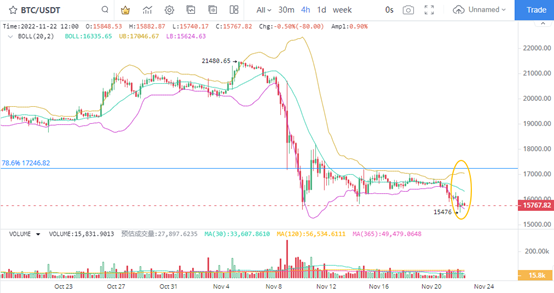
The downward trend of BTC price continued, and the lowest point on November 22 reached 15476 dollars.

1. BTC downward trend continues

The downward trend of BTC price continued, and the lowest point on November 22 reached 15476 dollars. In other words, the market is in a very critical position. The 4-hour K line chart shows that the Bollinger line of BTC price has begun to expand, and a further break is in the pipeline. After BTC turnover has returned to a flat level recently, the downward trend is still expected to continue.
2. Increase in proportion of unrecognized losses of BTC

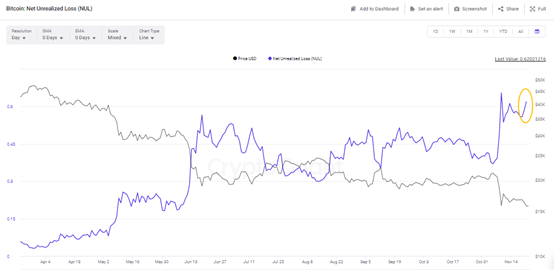
With the continuous expansion of the decline, the proportion of unconfirmed loss transactions of BTC rebounded significantly, reaching 0.62 on November 22, the highest level in three years. At the same time, as the BTC price continues to be depressed and the short-term rebound space is not high, the proportion of gains and losses remains high. The proportion of unconfirmed loss trading exceeds 60%, which means that new investors are under great pressure to hold money at loss, and the impact on BTC rebound is obviously negative.
3. ETH short line retreats to support position

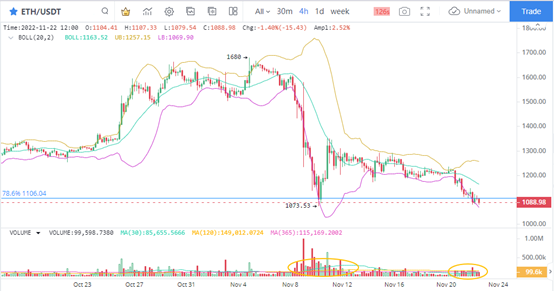
The ETH price is currently in a downturn operation stage. The 4-hour K line chart shows that the price has reached a recent low of around $1073. From the perspective of trading volume, the trading volume of ETH has significantly increased during the early decline, while the recent trading volume has rebounded again, and the price may usher in another downward turning signal.

In terms of proportion, Bollinger Line has begun to expand, and ETH prices may break at any time, so we need to pay attention to the performance of price changes.
4. ETH financing interest rate rebounded slightly

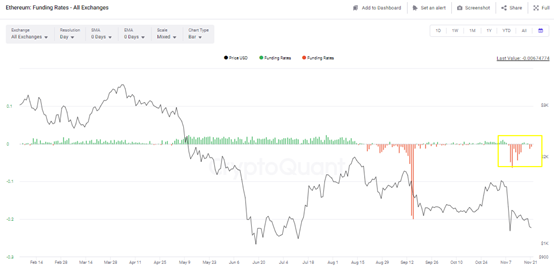
After the ETH financing interest rate rebounded from the region below zero, the value has gradually approached the zero axis. Unlike the sluggish performance on November 10, ETH investors have started to actively trade ETH. According to this judgment, although the ETH price is operating at a recent low level, the selling pressure has not increased significantly. However, near the support point of USD 1073, attention should be paid to the adjustment risk before the price rebound. At the same time, 78.6% of Fibonacci's corresponding US $1106 pressure is strong, and falling below this point means that adjustment pressure of as high as appears.
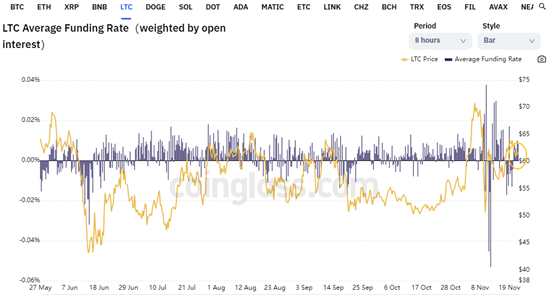
5. LTC short-term strength

As the financing interest rate fluctuates little, it often shows positive financing interest rate, so the LTC market performs well. LTC prices are still running above $60. From the perspective of support, LTC has strong long support at $60. In recent half a year, prices have maintained a sideways consolidation, and we can continue to focus on opportunities for improvement in the near future.

Letture associate

Research Report Analysis: Morgan Stanley Details SanDisk SNDK, The Truth About Cloud Data Center Pricing Power and AI Inference Benefits

Morgan Stanley raised its price target for SanDisk (SNDK) from $1100 to $1750 on June 22, maintaining an Overweight rating. The upgrade is driven by AI inference demand reshaping the NAND market, particularly for KV Cache and context window storage in cloud data centers. These cloud clients exhibit price inelasticity and sign long-term contracts, granting SanDisk significant pricing power. SanDisk's New Business Model (NBM) agreements, covering over one-third of FY27 bit shipments with 3-5 year terms and fixed price/price collar structures, are crucial. They are projected to sustain gross margins around 80% even at floor prices, providing a buffer against cyclical downturns. Morgan Stanley forecasts gross margins to surge from 30.3% in FY25 to 86.7% in FY27e. With NAND supply expected to remain tight into 2026/2027 and cloud/data centers becoming the largest end-market, SanDisk holds supply-side pricing power. The company targets 15-19% bit growth via technology transitions, not capacity expansion. Revenue is projected to grow ~6.6x from FY25 to FY27, with EPS rising from $2.74 to $14.73, driven by high-margin cloud business. Key upside catalysts include faster enterprise SSD adoption and edge AI growth. Downside risks involve slower industry growth, competitor capex increases, market share loss, and competition from Chinese players like YMTC. The investment thesis rests on AI-driven structural demand, NBM's margin protection, and sustained supply tightness. The $1750 target implies ~28x FY27e P/E.

marsbit6 min fa

Research Report Analysis: Morgan Stanley Details SanDisk SNDK, The Truth About Cloud Data Center Pricing Power and AI Inference Benefits

marsbit6 min fa

A Threefold Performance Leap! NEAR Achieves 200ms Physical Block Time Limit with SPICE

NEAR's core development team, Near One, has announced its next major protocol evolution: SPICE (Separation of Consensus and Execution). Currently in development, SPICE represents the most significant upgrade before the full implementation of Nightshade 3.0. Its core innovation is decoupling the consensus layer, responsible for ordering transactions, from the execution layer, which processes them. This allows the consensus layer to run at full speed without waiting for transaction execution to complete. Once deployed, SPICE is projected to triple NEAR's block production speed, achieving a 200ms block time, which is considered the physical limit due to the speed of light and network latency. This leap will dramatically reduce transaction latency and finality, with transactions confirming in roughly 0.4 seconds—faster than a typical card payment. The upgrade also enables more complex, long-running transactions and significantly improves user experience for applications like NEAR Intents and near.com. Beyond raw speed, SPICE enhances network scalability and security. It enables deeper parallelism, efficiently distributing workload across shards and improving resource utilization. The simpler block structure and lighter contracts also facilitate formal verification and security auditing. Furthermore, SPICE lays the critical groundwork for future Nightshade 3.0 features, most notably atomic cross-shard transactions, which would simplify complex contract logic and eliminate development hurdles caused by asynchronous execution. The Near One team is actively developing SPICE, targeting deployment in the coming months.

Foresight News1 h fa

A Threefold Performance Leap! NEAR Achieves 200ms Physical Block Time Limit with SPICE

Foresight News1 h fa

Trading

Spot
Futures
活动图片