Having a safe CEX: proof of solvency and beyond

Vitalik ButerinPubblicato 2022-11-19Pubblicato ultima volta 2022-11-19

Introduzione

Every time a major centralized exchange blows up, a common question that comes up is whether or not we can use cryptographic techniques to solve the problem.

Every time a major centralized exchange blows up, a common question that comes up is whether or not we can use cryptographic techniques to solve the problem. Rather than relying solely on "fiat" methods like government licenses, auditors and examining the corporate governance and the backgrounds of the individuals running the exchange, exchanges could create cryptographic proofs that show that the funds they hold on-chain are enough to cover their liabilities to their users.

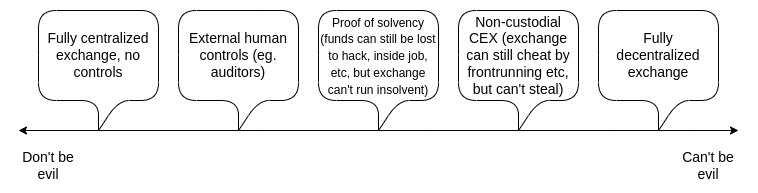
Even more ambitiously, an exchange could build a system where it can't withdraw a depositor's funds at all without their consent. Potentially, we could explore the entire spectrum between the "don't be evil" aspiring-good-guy CEX and the "can't be evil", but for-now inefficient and privacy-leaking, on-chain DEX. This post will get into the history of attempts to move exchanges one or two steps closer to trustlessness, the limitations of these techniques, and some newer and more powerful ideas that rely on ZK-SNARKs and other advanced technologies.

Balance lists and Merkle trees: old-school proof-of-solvency

The earliest attempts by exchanges to try to cryptographically prove that they are not cheating their users go back quite far. In 2011, then-largest Bitcoin exchange MtGox proved that they had funds by sending a transaction that moved 424242 BTC to a pre-announced address. In 2013, discussions started on how to solve the other side of the problem: proving the total size of customers' deposits. If you prove that customers' deposits equal X ("proof of liabilities"), and prove ownership of the private keys of X coins ("proof of assets"), then you have a proof of solvency: you've proven the exchange has the funds to pay back all of its depositors.

The simplest way to prove deposits is to simply publish a list of (username, balance) pairs. Each user can check that their balance is included in the list, and anyone can check the full list to see that (i) every balance is non-negative, and (ii) the total sum is the claimed amount. Of course, this breaks privacy, so we can change the scheme a little bit: publish a list of (hash(username, salt), balance) pairs, and send each user privately their salt value. But even this leaks balances, and it leaks the pattern of changes in balances. The desire to preserve privacy brings us to the next invention: the Merkle tree technique.

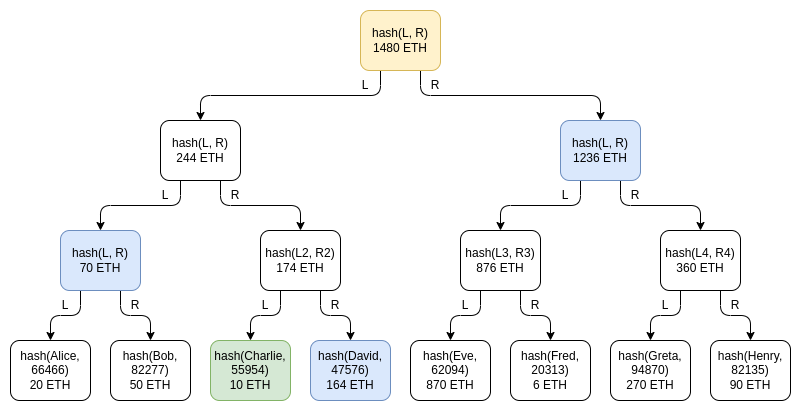
The Merkle tree technique consists of putting the table of customers' balances into a Merkle sum tree. In a Merkle sum tree, each node is a (balance, hash) pair. The bottom-layer leaf nodes represent the balances and salted username hashes of individual customers. In each higher-layer node, the balance is the sum of the two balances below, and the hash is the hash of the two nodes below. A Merkle sum proof, like a Merkle proof, is a "branch" of the tree, consisting of the sister nodes along the path from a leaf to the root.

The exchange would send each user a Merkle sum proof of their balance. The user would then have a guarantee that their balance is correctly included as part of the total.

Privacy leakage in this design is much lower than with a fully public list, and it can be decreased further by shuffling the branches each time a root is published, but some privacy leakage is still there: Charlie learns that someone has a balance of 164 ETH, some two users have balances that add up to 70 ETH, etc. An attacker that controls many accounts could still potentially learn a significant amount about the exchange's users.

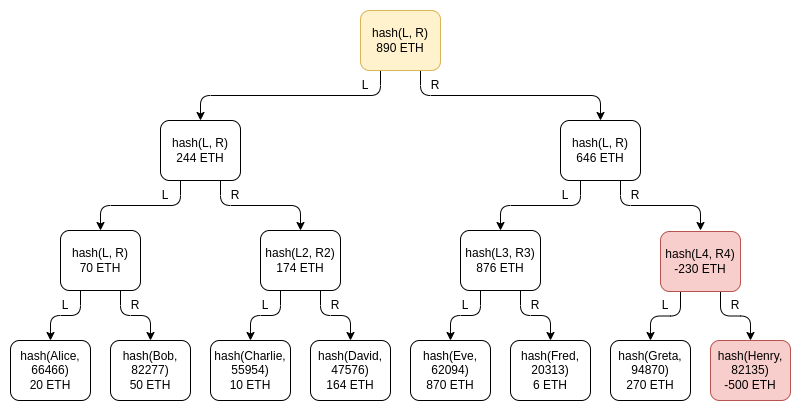
One important subtlety of the scheme is the possibility of negative balances: what if an exchange that has 1390 ETH of customer balances but only 890 ETH in reserves tries to make up the difference by adding a -500 ETH balance under a fake account somewhere in the tree? It turns out that this possibility does not break the scheme, though this is the reason why we specifically need a Merkle sum tree and not a regular Merkle tree. Suppose that Henry is the fake account controlled by the exchange, and the exchange puts -500 ETH there:

Greta's proof verification would fail: the exchange would have to give her Henry's -500 ETH node, which she would reject as invalid. Eve and Fred's proof verification would also fail, because the intermediate node above Henry has -230 total ETH, and so is also invalid! To get away with the theft, the exchange would have to hope that nobody in the entire right half of the tree checks their balance proof.

If the exchange can identify 500 ETH worth of users that they are confident will either not bother to check the proof, or will not be believed when they complain that they never received a proof, they could get away with the theft. But then the exchange could also just exclude those users from the tree and have the same effect. Hence, the Merkle tree technique is basically as good as a proof-of-liabilities scheme can be, if only achieving a proof of liabilities is the goal. But its privacy properties are still not ideal. You can go a little bit further by using Merkle trees in more clever ways, like making each satoshi or wei a separate leaf, but ultimately with more modern tech there are even better ways to do it.

Improving privacy and robustness with ZK-SNARKs

ZK-SNARKs are a powerful technology. ZK-SNARKs may be to cryptography what transformers are to AI: a general-purpose technology that is so powerful that it will completely steamroll a whole bunch of application-specific techniques for a whole bunch of problems that were developed in the decades prior. And so, of course, we can use ZK-SNARKs to greatly simplify and improve privacy in proof-of-liabilities protocols.

The simplest thing that we can do is put all users' deposits into a Merkle tree (or, even simpler, a KZG commitment), and use a ZK-SNARK to prove that all balances in the tree are non-negative and add up to some claimed value. If we add a layer of hashing for privacy, the Merkle branch (or KZG proof) given to each user would reveal nothing about the balance of any other user.

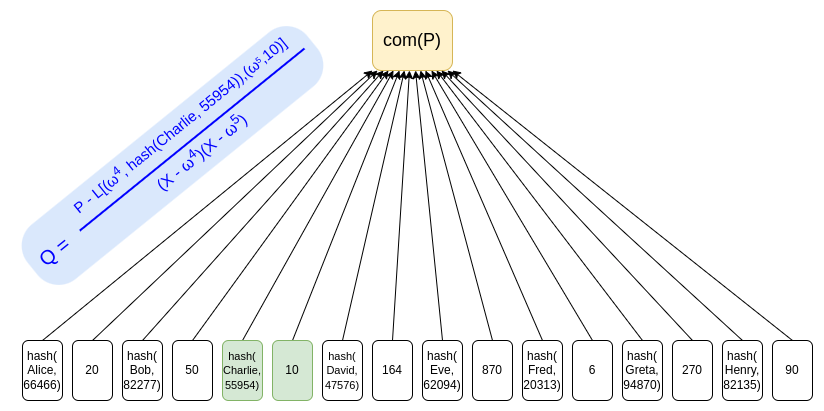
Using KZG commitments is one way to avoid privacy leakage, as there is no need to provide "sister nodes" as proofs, and a simple ZK-SNARK can be used to prove the sum of the balances and that each balance is non-negative.

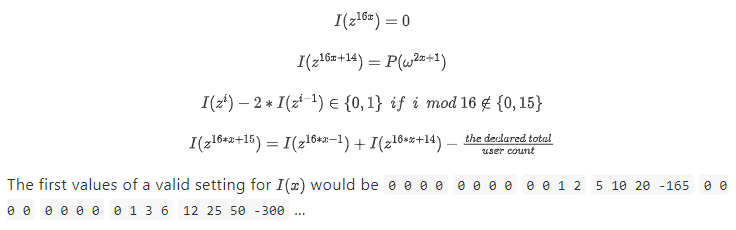
We can prove the sum and non-negativity of balances in the above KZG with a special-purpose ZK-SNARK. Here is one simple example way to do this. We introduce an auxiliary polynomial , which "builds up the bits" of each balance (we assume for the sake of example that balances are under ) and where every 16th position tracks a running total with an offset so that it sums to zero only if the actual total matches the declared total. If is an order-128 root of unity, we might prove the equations:

See here and here in my post on ZK-SNARKs for further explanation of how to convert equations like these into a polynomial check and then into a ZK-SNARK. This isn't an optimal protocol, but it does show how these days these kinds of cryptographic proofs are not that spooky!

With only a few extra equations, constraint systems like this can be adapted to more complex settings. For example, in a leverage trading system, an individual users having negative balances is acceptable but only if they have enough other assets to cover the funds with some collateralization margin. A SNARK could be used to prove this more complicated constraint, reassuring users that the exchange is not risking their funds by secretly exempting other users from the rules.

In the longer-term future, this kind of ZK proof of liabilities could perhaps be used not just for customer deposits at exchanges, but for lending more broadly. Anyone taking out a loan would put a record into a polynomial or a tree containing that loan, and the root of that structure would get published on-chain. This would let anyone seeking a loan ZK-prove to the lender that they have not yet taken out too many other loans. Eventually, legal innovation could even make loans that have been committed to in this way higher-priority than loans that have not. This leads us in exactly the same direction as one of the ideas that was discussed in the "Decentralized Society: Finding Web3's Soul" paper: a general notion of negative reputation or encumberments on-chain through some form of "soulbound tokens".

Proof of assets

The simplest version of proof of assets is the protocol that we saw above: to prove that you hold X coins, you simply move X coins around at some pre-agreed time or in a transaction where the data field contains the words "these funds belong to Binance". To avoid paying transaction fees, you could sign an off-chain message instead; both Bitcoin and Ethereum have standards for off-chain signed messages.

There are two practical problems with this simple proof-of-assets technique:

Dealing with cold storage

Collateral dual-use

For safety reasons, most exchanges keep the great majority of customer funds in "cold storage": on offline computers, where transactions need to be signed and carried over onto the internet manually. Literal air-gapping is common: a cold storage setup that I used to use for personal funds involved a permanently offline computer generating a QR code containing the signed transaction, which I would scan from my phone. Modern exchange protocols are crazier still, and often involve multi-party computation between several devices. Given this kind of setup, making even a single extra message to prove control of an address is an expensive operation!

There are several paths that an exchange can take:

Keep a few public long-term-use addresses. The exchange would generate a few addresses, publish a proof of each address once to prove ownership, and then use those addresses repeatedly. This is by far the simplest option, though it does add some constraints in how to preserve security and privacy.

Have many addresses, prove a few randomly. The exchange would have many addresses, perhaps even using each address only once and retiring it after a single transaction. In this case, the exchange may have a protocol where from time to time a few address get randomly selected and must be "opened" to prove ownership. Some exchanges already do something like this with an auditor, but in principle this technique could be turned into a fully automated procedure.

More complicated ZKP options. For example, an exchange could set all of its addresses to be 1-of-2 multisigs, where one of the keys is different per address, and the other is a blinded version of some "grand" emergency backup key stored in some complicated but very high-security way, eg. a 12-of-16 multisig. To preserve privacy and avoid revealing the entire set of its addresses, the exchange could even run a zero knowledge proof over the blockchain where it proves the total balance of all addresses on chain that have this format.

The other major issue is guarding against collateral dual-use. Shuttling collateral back and forth between each other to do proof of reserves is something that exchanges could easily do, and would allow them to pretend to be solvent when they actually are not. Ideally, proof of solvency would be done in real time, with a proof that updates after every block. If this is impractical, the next best thing would be to coordinate on a fixed schedule between the different exchanges, eg. proving reserves at 1400 UTC every Tuesday.

One final issue is: can you do proof-of-assets on fiat? Exchanges don't just hold cryptocurrency, they also hold fiat currency within the banking system. Here, the answer is: yes, but such a procedure would inevitably rely on "fiat" trust models: the bank itself can attest to balances, auditors can attest to balance sheets, etc. Given that fiat is not cryptographically verifiable, this is the best that can be done within that framework, but it's still worth doing.

An alternative approach would be to cleanly separate between one entity that runs the exchange and deals with asset-backed stablecoins like USDC, and another entity (USDC itself) that handles the cash-in and cash-out process for moving between crypto and traditional banking systems. Because the "liabilities" of USDC are just on-chain ERC20 tokens, proof of liabilities comes "for free" and only proof of assets is required.

Plasma and validiums: can we make CEXes non-custodial?

Suppose that we want to go further: we don't want to just prove that the exchange has the funds to pay back its users. Rather, we want to prevent the exchange from stealing users' funds completely.

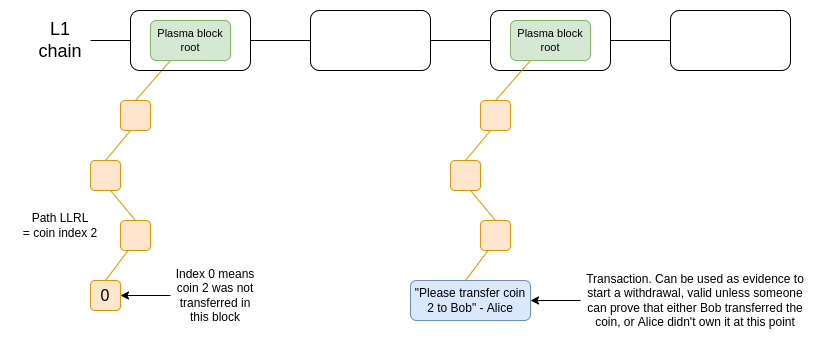
The first major attempt at this was Plasma, a scaling solution that was popular in Ethereum research circles in 2017 and 2018. Plasma works by splitting up the balance into a set of individual "coins", where each coin is assigned an index and lives in a particular position in the Merkle tree of a Plasma block. Making a valid transfer of a coin requires putting a transaction into the correct position of a tree whose root gets published on-chain.

Oversimplified diagram of one version of Plasma. Coins are held in a smart contract that enforces the rules of the Plasma protocol at withdrawal time.

OmiseGo attempted to make a decentralized exchange based on this protocol, but since then they have pivoted to other ideas - as has, for that matter, Plasma Group itself, which is now the optimistic EVM rollup project Optimism.

It's not worth looking at the technical limitations of Plasma as conceived in 2018 (eg. proving coin defragmentation) as some kind of morality tale about the whole concept. Since the peak of Plasma discourse in 2018, ZK-SNARKs have become much more viable for scaling-related use cases, and as we have said above, ZK-SNARKs change everything.

The more modern version of the Plasma idea is what Starkware calls a validium: basically the same as a ZK-rollup, except where data is held off-chain. This construction could be used for a lot of use cases, conceivably anything where a centralized server needs to run some code and prove that it's executing code correctly. In a validium, the operator has no way to steal funds, though depending on the details of the implementation some quantity of user funds could get stuck if the operator disappears.

This is all really good: far from CEX vs DEX being a binary, it turns out that there is a whole spectrum of options, including various forms of hybrid centralization where you gain some benefits like efficiency but still have a lot of cryptographic guardrails preventing the centralized operator from engaging in most forms of abuses.

But it's worth getting to the fundamental issue with the right half of this design space: dealing with user errors. By far the most important type of error is: what if a user forgets their password, loses their devices, gets hacked, or otherwise loses access to their account?

Exchanges can solve this problem: first e-mail recovery, and if even that fails, more complicated forms of recovery through KYC. But to be able to solve such problems, the exchange needs to actually have control over the coins. In order to have the ability to recover user accounts' funds for good reasons, exchanges need to have power that could also be used to steal user accounts' funds for bad reasons. This is an unavoidable tradeoff.

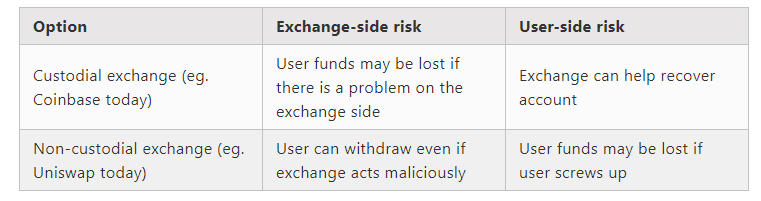
The ideal long-term solution is to rely on self-custody, augmented by technologies such as multisig and social recovery wallets to help users deal with emergency situations. But in the short term, there are two clear alternatives that have clearly distinct costs and benefits:

Conclusions: the future of better exchanges

In the short term, there are two clear "classes" of exchanges: custodial exchanges and non-custodial exchanges. Today, the latter category is just DEXes such as Uniswap, and in the future we may also see cryptographically "constrained" CEXes where user funds are held in something like a validium smart contract. We may also see half-custodial exchanges where we trust them with fiat but not cryptocurrency.

Both types of exchanges will continue to exist, and the easiest backwards-compatible way to improve the safety of custodial exchanges is to add proof of reserve. This consists of a combination of proof of assets and proof of liabilities. There are technical challenges in making good protocols for both, but we can and should go as far as possible to make headway in both, and open-source the software and processes as much as possible so that all exchanges can benefit.

In the longer-term future, my hope is that we move closer and closer to all exchanges being non-custodial, at least on the crypto side. Wallet recovery would exist, and there may need to be highly centralized recovery options for new users dealing with small amounts, as well as institutions that require such arrangements for legal reasons, but this can be done at the wallet layer rather than within the exchange itself. The way magic.link interacts with platforms like Polymarket is an example of such an approach in action. On the fiat side, movement between the traditional banking system and the crypto ecosystem could be done via cash in / cash out processes native to asset-backed stablecoins such as USDC. However, it will still take a while before we can fully get there.

Letture associate

Bitcoin Trading Strategy Breakdown: Celebrity Predictions and Classic Models All Fail, Only These Four Indicators Remain

Analysis of Bitcoin Trading Strategies: Why Celebrity Forecasts and Classic Models Fail, Leaving Only These Four Reliable Indicators This analysis examines the failure of common Bitcoin prediction methods and identifies four reliable indicators for constructing a trading strategy. The author reviewed all major BTC prediction approaches from 2017-2025, categorizing them into three groups: celebrity price targets (consistently over-optimistic), analytical models like Stock-to-Flow (broken post-2022), and on-chain signals. The key finding is that more data often creates confusion, not clarity. The strategy discards unreliable elements: celebrity predictions (incentivized to be extreme), pure models (invalidated by post-ETF market changes), and the Fear & Greed Index used alone (too many false signals). Four reliable indicators were selected: 1. **MVRV Z-Score:** Accurately identifies cycle bottoms when entering its green zone (e.g., 2018, 2020, 2022). Note: Its ability to call tops is now ineffective post-2024. 2. **SOPR (28-day MA):** Consistently signals bottoms when below 1.0, indicating holders are selling at a loss. 3. **ETF Net Flow:** A crucial post-2024 metric showing institutional momentum (e.g., sustained inflows = buying). 4. **Macro Liquidity (Fed policy & M2):** Sets the overall directional bias (e.g., bullish during easing cycles). The core strategy involves waiting for a multi-signal共振 (resonance). For example, a bottom signal requires MVRV in the green zone + SOPR < 1.0. A top signal requires overheated on-chain data + sustained ETF outflows. Macro policy sets the overall direction. The Fear & Greed Index is only used as a weighted confirmatory signal, never alone. Action is only taken when three or more indicators align. The author automated this into a monitoring system that sends Telegram alerts only when signals trigger. As of the article's date (April 15, 2026), the system showed a strong bottom signal: extreme fear (F&G=12), MVRV in the buy zone, and SOPR < 1.0. The only contrary signal was weak ETF flows. Historically, such triple on-chain共振 has preceded 100%+ returns. The conclusion emphasizes building a personal framework over relying on external predictions, allowing for iterative improvement and customization based on individual risk tolerance.

marsbit2 h fa

Bitcoin Trading Strategy Breakdown: Celebrity Predictions and Classic Models All Fail, Only These Four Indicators Remain

marsbit2 h fa

Trading

Spot
Futures

Articoli Popolari

Cosa è BITCOIN

Comprendere HarryPotterObamaSonic10Inu (ERC-20) e la sua posizione nel mondo delle criptovalute Negli ultimi anni, il mercato delle criptovalute ha assistito a un aumento della popolarità delle meme coin, catturando l'interesse non solo dei trader, ma anche di coloro che cercano coinvolgimento comunitario e valore di intrattenimento. Tra questi token unici c'è HarryPotterObamaSonic10Inu (ERC-20), un progetto intrigante che mescola riferimenti culturali nel tessuto delle criptovalute. Questo articolo esplora gli aspetti chiave di HarryPotterObamaSonic10Inu, analizzando i suoi meccanismi, l'etica guidata dalla comunità e il suo coinvolgimento con il panorama crittografico più ampio. Che cos'è HarryPotterObamaSonic10Inu (ERC-20)? Come suggerisce il suo nome, HarryPotterObamaSonic10Inu è una meme coin costruita sulla blockchain di Ethereum, classificata secondo lo standard ERC-20. A differenza delle criptovalute tradizionali che possono enfatizzare l'utilità pratica o il potenziale investimento, questo token prospera grazie al valore di intrattenimento e alla forza della sua comunità. Il progetto mira a creare un ambiente in cui gli utenti coinvolti possono riunirsi, condividere idee e partecipare ad attività ispirate a diversi fenomeni culturali. Una caratteristica notevole di HarryPotterObamaSonic10Inu è la zero tassa sulle transazioni. Questo elemento allettante tende a incoraggiare il trading e il coinvolgimento della comunità, privo di costi aggiuntivi che possono scoraggiare i trader di piccole dimensioni. L'offerta totale della moneta è fissata a un miliardo di token, un numero che segna la sua intenzione di mantenere una circolazione sostanziale all'interno della comunità. Creatore di HarryPotterObamaSonic10Inu (ERC-20) Le origini di HarryPotterObamaSonic10Inu sono avvolte in un certo mistero; i dettagli sul creatore rimangono sconosciuti. Lo sviluppo di questo token non presenta un team identificabile o un piano esplicito, cosa non rara nel settore delle meme coin. Invece, il progetto è emerso organicamente, con il suo progresso fortemente dipendente dall'entusiasmo e dalla partecipazione della sua comunità. Investitori di HarryPotterObamaSonic10Inu (ERC-20) Per quanto riguarda investimenti esterni e finanziamenti, HarryPotterObamaSonic10Inu rimane ambiguo. Il token non elenca alcuna fondazione di investimento conosciuta o un sostegno organizzativo significativo. Invece, la linfa vitale del progetto è la sua comunità di base, che informa la sua crescita e sostenibilità attraverso azioni collettive e coinvolgimento nello spazio crittografico. Come funziona HarryPotterObamaSonic10Inu (ERC-20)? In quanto meme coin, HarryPotterObamaSonic10Inu opera principalmente al di fuori delle strutture tradizionali che governano spesso il valore degli asset. Ci sono diversi aspetti distintivi che definiscono il funzionamento del progetto: Transazioni senza tasse: Senza costi fiscali sulle transazioni, gli utenti possono comprare e vendere liberamente il token senza preoccuparsi di costi nascosti. Coinvolgimento della comunità: Il progetto prospera sull'interazione della comunità, sfruttando le piattaforme social per creare entusiasmo e facilitare il coinvolgimento. Discussioni, condivisione di contenuti e coinvolgimento sono elementi cruciali che aiutano ad espandere la sua portata e a favorire la lealtà tra i sostenitori. Nessuna utilità pratica: Va notato che HarryPotterObamaSonic10Inu non offre un'utilità concreta all'interno dell'ecosistema finanziario. Piuttosto, è classificato come un token principalmente per attività di intrattenimento e comunitarie. Riferimento culturale: Il token incorpora astutamente elementi della cultura pop per attirare interesse, collegandosi a appassionati di meme e seguaci delle criptovalute. HarryPotterObamaSonic10Inu esemplifica come le meme coin operino in modo diverso rispetto ai progetti di criptovalute più tradizionali, entrando nel mercato come costrutti sociali innovativi piuttosto che come asset utilitari. Cronologia di HarryPotterObamaSonic10Inu (ERC-20) La storia di HarryPotterObamaSonic10Inu è segnata da diversi traguardi notevoli: Creazione: Il token è emerso da un meme virale, catturando l'immaginazione di molti appassionati di criptovalute. Le date di creazione specifiche non sono disponibili, sottolineando la sua crescita organica. Inserimento negli scambi: HarryPotterObamaSonic10Inu ha fatto il suo ingresso in vari scambi, consentendo un accesso e un trading più facili da parte della comunità. Iniziative di coinvolgimento della comunità: Attività in corso volte a migliorare l'interazione della comunità, comprese gare, campagne sui social media e generazione di contenuti da parte di fan e sostenitori. Piani di espansione futura: La tabella di marcia del progetto include il lancio di una collezione NFT, merchandising e un sito di eCommerce relativo ai suoi temi culturali, coinvolgendo ulteriormente la comunità e cercando di aggiungere più dimensioni al suo ecosistema. Punti chiave su HarryPotterObamaSonic10Inu (ERC-20) Natura guidata dalla comunità: Il progetto dà priorità al contributo collettivo e alla creatività, garantendo che il coinvolgimento degli utenti sia al centro del suo sviluppo. Classificazione come meme coin: Rappresenta l'epitome delle criptovalute basate sull'intrattenimento, distinguendosi dai veicoli d'investimento tradizionali. Nessuna affiliazione diretta con Bitcoin: Nonostante la somiglianza nel nome del ticker, HarryPotterObamaSonic10Inu è distintivo e non ha alcuna relazione con Bitcoin o altre criptovalute consolidate. Focus sulla collaborazione: HarryPotterObamaSonic10Inu è progettato per creare uno spazio per la collaborazione e la condivisione di storie tra i suoi detentori, fornendo un canale per la creatività e il legame comunitario. Prospettive future: L'ambizione di espandersi oltre il suo presupposto iniziale verso NFT e merchandising delinea un percorso per il progetto per potenzialmente entrare in strade più mainstream all'interno della cultura digitale. Poiché le meme coin continuano a catturare l'immaginazione della comunità crittografica, HarryPotterObamaSonic10Inu (ERC-20) si distingue per i suoi legami culturali e il suo approccio centrato sulla comunità. Anche se potrebbe non adattarsi al modello tipico di un token orientato all'utilità, la sua essenza risiede nella gioia e nella camaraderia coltivate tra i suoi sostenitori, evidenziando la natura in evoluzione delle criptovalute in un'epoca sempre più digitale. Con la continuazione dello sviluppo del progetto, sarà importante osservare come le dinamiche della comunità influenzano la sua traiettoria nel panorama in continuo cambiamento della tecnologia blockchain.

1.0k Totale visualizzazioniPubblicato il 2024.04.01Aggiornato il 2024.12.03

Cosa è BITCOIN

Come comprare BTC

Benvenuto in HTX.com! Abbiamo reso l'acquisto di Bitcoin (BTC) semplice e conveniente. Segui la nostra guida passo passo per intraprendere il tuo viaggio nel mondo delle criptovalute.Step 1: Crea il tuo Account HTXUsa la tua email o numero di telefono per registrarti il tuo account gratuito su HTX. Vivi un'esperienza facile e sblocca tutte le funzionalità,Crea il mio accountStep 2: Vai in Acquista crypto e seleziona il tuo metodo di pagamentoCarta di credito/debito: utilizza la tua Visa o Mastercard per acquistare immediatamente BitcoinBTC.Bilancio: Usa i fondi dal bilancio del tuo account HTX per fare trading senza problemi.Terze parti: abbiamo aggiunto metodi di pagamento molto utilizzati come Google Pay e Apple Pay per maggiore comodità.P2P: Fai trading direttamente con altri utenti HTX.Over-the-Counter (OTC): Offriamo servizi su misura e tassi di cambio competitivi per i trader.Step 3: Conserva Bitcoin (BTC)Dopo aver acquistato Bitcoin (BTC), conserva nel tuo account HTX. In alternativa, puoi inviare tramite trasferimento blockchain o scambiare per altre criptovalute.Step 4: Scambia Bitcoin (BTC)Scambia facilmente Bitcoin (BTC) nel mercato spot di HTX. Accedi al tuo account, seleziona la tua coppia di trading, esegui le tue operazioni e monitora in tempo reale. Offriamo un'esperienza user-friendly sia per chi ha appena iniziato che per i trader più esperti.

3.4k Totale visualizzazioniPubblicato il 2024.12.12Aggiornato il 2025.03.21

Come comprare BTC

Cosa è $BITCOIN

ORO DIGITALE ($BITCOIN): Un'Analisi Completa Introduzione all'ORO DIGITALE ($BITCOIN) L'ORO DIGITALE ($BITCOIN) è un progetto basato su blockchain che opera sulla rete Solana, con l'obiettivo di combinare le caratteristiche dei metalli preziosi tradizionali con l'innovazione delle tecnologie decentralizzate. Sebbene condivida un nome con Bitcoin, spesso definito “oro digitale” a causa della sua percezione come riserva di valore, l'ORO DIGITALE è un token separato progettato per creare un ecosistema unico all'interno del panorama Web3. Il suo obiettivo è posizionarsi come un asset digitale alternativo valido, anche se i dettagli riguardanti le sue applicazioni e funzionalità sono ancora in fase di sviluppo. Cos'è l'ORO DIGITALE ($BITCOIN)? L'ORO DIGITALE ($BITCOIN) è un token di criptovaluta esplicitamente progettato per l'uso sulla blockchain di Solana. A differenza di Bitcoin, che fornisce un ruolo di stoccaggio di valore ampiamente riconosciuto, questo token sembra concentrarsi su applicazioni e caratteristiche più ampie. Aspetti notevoli includono: Infrastruttura Blockchain: Il token è costruito sulla blockchain di Solana, nota per la sua capacità di gestire transazioni ad alta velocità e a basso costo. Dinamiche di Offerta: L'ORO DIGITALE ha un'offerta massima fissata a 100 quadrilioni di token (100P $BITCOIN), sebbene i dettagli riguardanti la sua offerta circolante siano attualmente non divulgati. Utilità: Sebbene le funzionalità precise non siano esplicitamente delineate, ci sono indicazioni che il token potrebbe essere utilizzato per varie applicazioni, potenzialmente coinvolgendo applicazioni decentralizzate (dApp) o strategie di tokenizzazione degli asset. Chi è il Creatore dell'ORO DIGITALE ($BITCOIN)? Attualmente, l'identità dei creatori e del team di sviluppo dietro l'ORO DIGITALE ($BITCOIN) rimane sconosciuta. Questa situazione è tipica tra molti progetti innovativi nel settore blockchain, in particolare quelli allineati con la finanza decentralizzata e i fenomeni delle meme coin. Sebbene tale anonimato possa favorire una cultura guidata dalla comunità, intensifica le preoccupazioni riguardo alla governance e alla responsabilità. Chi sono gli Investitori dell'ORO DIGITALE ($BITCOIN)? Le informazioni disponibili indicano che l'ORO DIGITALE ($BITCOIN) non ha alcun sostenitore istituzionale noto o investimenti di venture capital prominenti. Il progetto sembra operare su un modello peer-to-peer incentrato sul supporto e sull'adozione della comunità piuttosto che su percorsi di finanziamento tradizionali. La sua attività e liquidità si trovano principalmente su exchange decentralizzati (DEX), come PumpSwap, piuttosto che su piattaforme di trading centralizzate consolidate, evidenziando ulteriormente il suo approccio di base. Come Funziona l'ORO DIGITALE ($BITCOIN) Le meccaniche operative dell'ORO DIGITALE ($BITCOIN) possono essere elaborate in base al suo design blockchain e alle caratteristiche della rete: Meccanismo di Consenso: Sfruttando il proof-of-history (PoH) unico di Solana combinato con un modello di proof-of-stake (PoS), il progetto garantisce una validazione efficiente delle transazioni contribuendo all'alta performance della rete. Tokenomics: Sebbene meccanismi deflazionistici specifici non siano stati dettagliati ampiamente, l'ampia offerta massima di token implica che potrebbe soddisfare microtransazioni o casi d'uso di nicchia che devono ancora essere definiti. Interoperabilità: Esiste il potenziale per l'integrazione con l'ecosistema più ampio di Solana, inclusi vari piattaforme di finanza decentralizzata (DeFi). Tuttavia, i dettagli riguardanti integrazioni specifiche rimangono non specificati. Cronologia degli Eventi Chiave Ecco una cronologia che evidenzia traguardi significativi riguardanti l'ORO DIGITALE ($BITCOIN): 2023: Il dispiegamento iniziale del token avviene sulla blockchain di Solana, contrassegnato dal suo indirizzo di contratto. 2024: L'ORO DIGITALE guadagna visibilità poiché diventa disponibile per il trading su exchange decentralizzati come PumpSwap, consentendo agli utenti di scambiarlo contro SOL. 2025: Il progetto assiste a un'attività di trading sporadica e a un potenziale interesse per impegni guidati dalla comunità, sebbene non siano state documentate partnership significative o avanzamenti tecnici fino ad ora. Analisi Critica Punti di Forza Scalabilità: L'infrastruttura sottostante di Solana supporta alti volumi di transazioni, il che potrebbe migliorare l'utilità di $BITCOIN in vari scenari di transazione. Accessibilità: Il potenziale basso prezzo di trading per token potrebbe attrarre investitori al dettaglio, facilitando una partecipazione più ampia grazie a opportunità di proprietà frazionata. Rischi Mancanza di Trasparenza: L'assenza di sostenitori, sviluppatori o di un processo di audit pubblicamente noti potrebbe generare scetticismo riguardo alla sostenibilità e all'affidabilità del progetto. Volatilità del Mercato: L'attività di trading è fortemente dipendente dal comportamento speculativo, il che può comportare una significativa volatilità dei prezzi e incertezze per gli investitori. Conclusione L'ORO DIGITALE ($BITCOIN) emerge come un progetto intrigante ma ambiguo all'interno dell'evolvente ecosistema di Solana. Sebbene tenti di sfruttare la narrativa dell'“oro digitale”, la sua partenza dal ruolo consolidato di Bitcoin come riserva di valore sottolinea la necessità di una chiara differenziazione della sua utilità e struttura di governance. L'accettazione e l'adozione future dipenderanno probabilmente dall'affrontare l'attuale opacità e dalla definizione più esplicita delle sue strategie operative ed economiche. Nota: Questo rapporto comprende informazioni sintetizzate disponibili a ottobre 2023, e potrebbero essersi verificati sviluppi oltre il periodo di ricerca.

99 Totale visualizzazioniPubblicato il 2025.05.13Aggiornato il 2025.05.13

Cosa è $BITCOIN

Discussioni

Benvenuto nella Community HTX. Qui puoi rimanere informato sugli ultimi sviluppi della piattaforma e accedere ad approfondimenti esperti sul mercato. Le opinioni degli utenti sul prezzo di BTC BTC sono presentate come di seguito.

活动图片