LUNA to Spike 80%? Here’s What Analysts Think

newsbtcPubblicato 2022-03-23Pubblicato ultima volta 2022-03-24

Introduzione

Terra's LUNA has been trending to the downside in the past few days, but different indicators show interesting signs and the next price movements could be fundamental to confirm either...

Terra’s LUNA has been trending to the downside in the past few days, but different indicators show interesting signs and the next price movements could be fundamental to confirm either an extremely bullish or a bearish signal.
What Is Boiling Up In LUNA’s Weekly Timeframe?
When an anonymous trader used Moving Average Convergence Divergence (MACD) to analyze LUNA’s next possible movements, the weekly chart showed an interesting crossover.
“Something is up on $LUNA weekly timeframe. Last time the MACD crossover occured it sent $LUNA from $12 to $106.”
A MACD crossover can give a bullish signal when the MACD (see the blue line in the chart below) rises above the signal line (see the yellow line). The opposite crossover would give a bearish signal, which can also be seen below in previous months as an example.
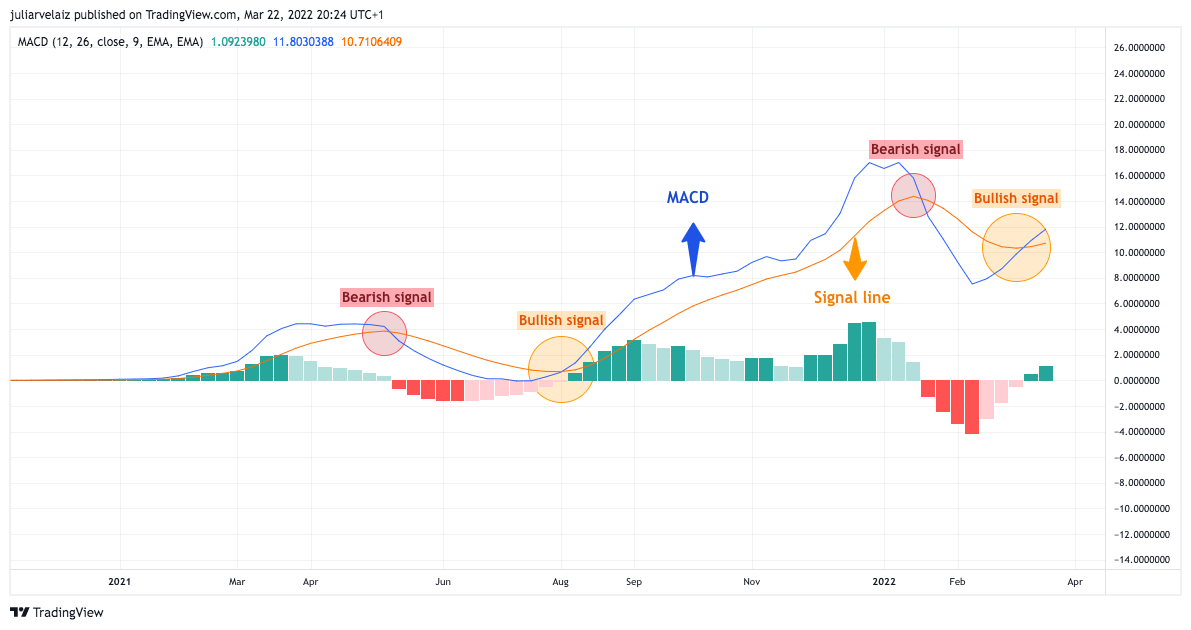
LUNA’s MACD crossovers overtime | LUNAUSD on TradingView.com Another pseudonym trader noted that multiple time frames are looking good for the digital coin, which they think could be because a result of “the massive amount of BTC being bought to help support stable UST or it could be that the whole market is bubbling up”
“1 hour pointing upwards, 4 and 6 hours are about to print bullish twist above the cloud (max bull signal in my mind), 12 hour and daily charts look happy enough and will likely look even nicer as Luna presses to all time highs.”
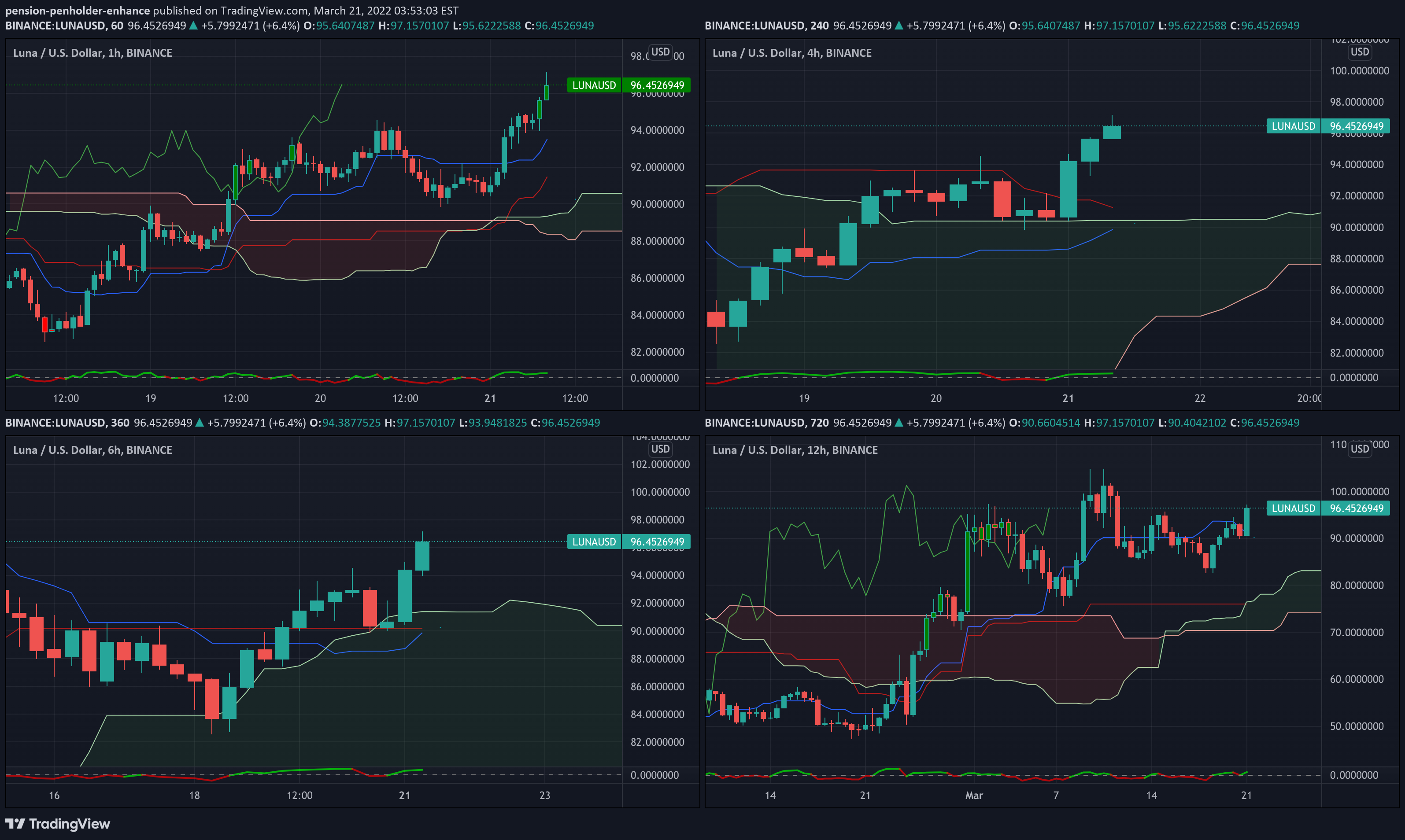
4,36 Sharpe Ratio
The Sharpe Ratio is a risk/return measure highly used in finance. As per Investopedia, the Ratio describes how much excess return you receive for the extra volatility you endure for holding a riskier asset, determining the investment choice that will deliver the highest returns while considering risk.

  • “Usually, any Sharpe ratio greater than 1.0 is considered acceptable to good by investors.
  • A ratio higher than 2.0 is rated as very good.
  • A ratio of 3.0 or higher is considered excellent.
  • A ratio under 1.0 is considered sub-optimal.”

Similarly, a pseudonym crypto analyst explained during a Youtube Video analyzing LUNA’s share ratio that, in general, “If you are [the Sharpe ratio] at one, it is a superb result and it means you are crushing the market, you’re beating everything out there,” and LUNA Sharpe ratio is 4.36.
“It’s off the charts positive. This thing is just a beast and there’s many people calling for a $200 Luna in in the near term, but also potentially, $200 Avalanche, $200 SOL. Either way these three are kind of winners right now.”
However, there are limitations when using Sharpe Ratio, as it can oversimplify risk and treat all volatility as the same. Some inflated Sharpe Ratios can turn out to be misleading if the whole story of the investments was not addressed correctly.
Possible Double-Top
On the other hand, there is a possibility of a double top that could be triggered if the price breaks out from the support level neckline. This would be extremely bearish for LUNA.
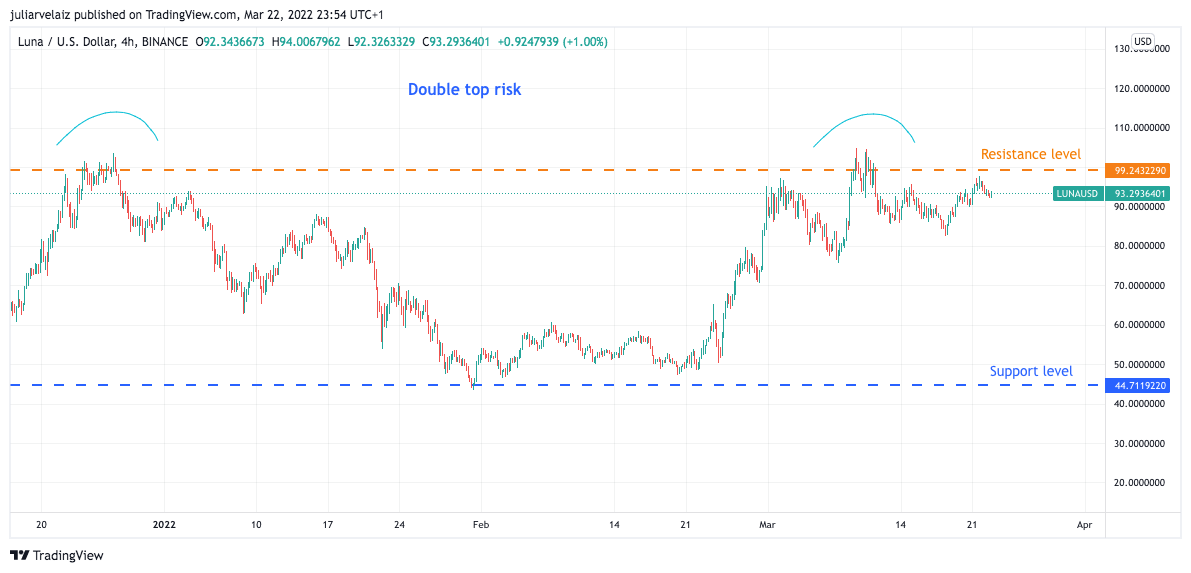
LUNAUSD 4-hour timeframe on TradingView.com There are limitations when spotting a double top, and “Basing a double top solely on the formation of two consecutive peaks could lead to a false reading and cause an early exit from a position,” Investopedia explains.
Because of this reason, this is not a confirmed bearish signal and the following movements will be vital to identify a possible trend. A failed double top could shoot up LUNA’s price proving previous signs right.
In a different analyst’s opinion, he noticed LUNA’s double top but added that it is still showing a bullish mark structure in the 4-hour timeline.
“There’s a lot of high sell volume coming in, and it looks like there is potentially some type of head and shoulders pattern playing out. But I would be careful shorting this one personally just because I think that usually, you don’t want to short stuff that’s super strong in general.”
At the moment, it looks like the coin could go either way: a huge spike or a crash around 50%. Regarding Terra’s ecosystem, it is also important to see how recent developments unfold as they dig into the unknown territory of bitcoin-backed currencies.
At the time of writing, LUNA is down 2.04% in the day to $93,31.

Letture associate

Who Funds the Agents?

**Summary: Who Funds AI Agents?** OpenAI recently shut down a feature allowing AI agents to shop for users, highlighting the challenge of creating a secure and regulated environment for agent-driven transactions. While payment infrastructure exists, a crucial governance layer—defining spending limits, fraud detection, tax handling, and return policies—is largely missing. The potential is enormous: AI agents already processed $73M across 176M transactions last year, with McKinsey forecasting this could grow to $3-5T in global consumer commerce by 2030. The core competition isn't just about processing payments, which can be very cheap (especially with crypto-based settlement), but about controlling the rules that govern agent spending. Key players like Stripe and Coinbase are racing to dominate this governance layer. Stripe's acquisition of wallet provider Privy allows it to set spending policies, identity checks, and human-in-the-loop approvals directly at the wallet level. Similarly, Coinbase's stack, including its x402 protocol and AgentKit, embeds governance rules. This vertical integration across settlement, wallet, and governance layers is becoming the dominant strategy. Control over the governance layer is where significant future value lies. If agents handle trillions in transactions, even a small fee for managing compliance, fraud prevention, and policy enforcement could generate billions in annual revenue. The companies that successfully integrate across the payment stack will capture value from idle agent balances, transaction fees, and governance services, positioning themselves as the foundational banks of the AI agent economy.

marsbit6 min fa

Who Funds the Agents?

marsbit6 min fa

A Nation Blocks Chips, a Giant Buys a Nuclear Power Plant: Why It's Time to Seriously Consider DeAI

**Title: Great Powers Blockade Chips, Giants Buy Nuclear Plants: Why It's Time to Seriously Consider DeAI** In May 2026, the US closed loopholes for Chinese firms to acquire advanced NVIDIA chips via overseas subsidiaries. That same month, Kenya halted a $1B geothermal data center project involving Microsoft, fearing its immense energy consumption. Meanwhile, Huawei announced mass production of its Ascend AI chip. These disparate events underscore a new reality: the competition for computing power ("compute") has escalated beyond the tech industry, becoming a geopolitical and infrastructural battleground. A new era of oligopoly is forming, with control over the AI stack—from GPU chips (NVIDIA) and cloud platforms (AWS, Azure, Google Cloud) to foundational models (OpenAI, Anthropic)—concentrating in a few Western "AI Octopus" corporations. This centralization creates systemic risks: pricing power and platform lock-in for users, infrastructure fragility, and a widening "compute divide" that threatens to marginalize nations without independent AI capacity. An "AI Iron Curtain" is deepening through export controls. In response, some nations like Saudi Arabia and the UAE are investing heavily to buy compute power, aiming to transition from oil to AI economies. The EU seeks to triple its compute capacity by 2030 to reduce dependency. However, the spending gap is vast, with four US tech giants alone planning ~$750B in AI capex for 2026. The race is increasingly constrained by energy, with AI tasks consuming up to 1000x more power than web searches, pushing firms to even acquire nuclear plants. This landscape is fueling interest in Decentralized AI (DeAI). It proposes a third way: using open protocols to coordinate a global network of idle GPUs, independent developers, and data centers, creating an AI infrastructure without a single controlling entity. Leveraging blockchain and cryptographic verification, DeAI aims to break market concentration, disperse energy demands, reduce geopolitical dependencies, and enhance transparency. While still nascent in performance and stability, DeAI's core promise is not immediate superiority but providing a crucial alternative architecture to resist monopoly, censorship, and centralized power. As specialized AI hardware costs fall and open-source models flourish, the window to build this foundation is open. The very existence of such competition serves as a vital check against the inevitable abuse of concentrated power.

marsbit1 h fa

A Nation Blocks Chips, a Giant Buys a Nuclear Power Plant: Why It's Time to Seriously Consider DeAI

marsbit1 h fa

Outpoll Review: A Prediction Market Platform Built for Active Traders

Outpoll Review: A Prediction Market Platform Built for Active Traders In recent years, prediction markets have grown from a niche sector to a mainstream arena, attracting billions in trading volume and institutional capital. However, the user experience and tools for traders have not kept pace. Outpoll, a new global prediction market platform, aims to fill this gap by providing enhanced trading infrastructure for active and professional traders. Built on standard prediction market principles, Outpoll allows users to trade on the outcome of specific events. It uses fully collateralized contracts with USDC settlement, charges a competitive 0.1% fee per trade, and provides clear settlement rules upfront to minimize disputes. A key focus for Outpoll is its professional-grade trading tools. The platform supports limit and market orders, as well as take-profit and stop-loss orders for open positions—features uncommon in prediction markets. For automated trading, Outpoll offers comprehensive REST and WebSocket APIs, enabling portfolio management, price arbitrage, and integration with existing tools. The platform also features a creator-led market model, where approved experts and community leaders can create and manage markets for niche topics under platform supervision. Its integrated interface combines news feeds directly with trading functions, allowing users to monitor events and manage positions seamlessly. Outpoll launched with a native Android app (available on Google Play) and plans an iOS version later this year. In summary, Outpoll distinguishes itself with trader-focused tools, practical APIs, transparent and collateralized markets, integrated news, and an expanding creator program. For active traders, its advanced order types and API access alone make it a platform worth watching. Outpoll is now globally accessible via outpoll.com and Google Play.

marsbit1 h fa

Outpoll Review: A Prediction Market Platform Built for Active Traders

marsbit1 h fa

Trading

Spot
Futures
活动图片