FTX’s new CEO John Ray coldly addresses SBF’s erratic tweets

CointelegraphPubblicato 2022-11-17Pubblicato ultima volta 2022-11-17

Introduzione

The new CEO of FTX gave a curt statement in response to the series of intermittent tweets by former CEO Sam Bankman-Fried.

The new CEO and chief restructuring officer for the bankrupt FTX cryptocurrency exchange, John Ray, has icily responded to the erratic series of tweets from former CEO and founder Sam Bankman-Fried.

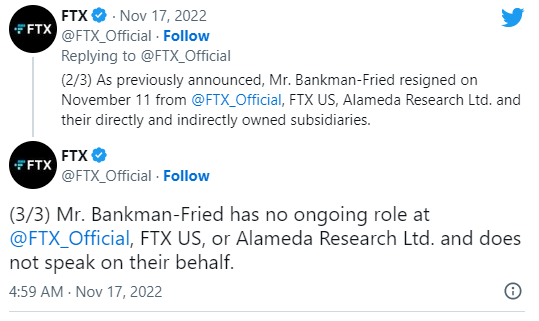
The official Twitter account of FTX on Nov. 16 tweeted a statement from Ray addressing Bankman-Fried’s recent public statements, reiterating he “has no ongoing role at [FTX], FTX US, or Alameda Research Ltd. and does not speak on their behalf.”

On Nov. 14 Bankman-Fried began a strange Twitter thread that — over the course of 40 or so hours — eventually spelled out “What HAPPENED” across nine tweets, he then went on to claim he was meeting with regulators, wanting to “do right by customers.”

Afterward, he began to lay out the finances and leverage of FTX and its sister trading firm Alameda Research on Nov. 16 claiming FTX’s leverage was around $13 billion, not $5 billion as he originally thought.

FTX’s downward spiral kicked off in early November with a series of events eventually leading to the exchange and its roughly 130 global subsidiaries filing for Chapter 11 bankruptcy in the United States on Nov. 11.

John J. Ray III took over as CEO on Nov.11 with FTX’s bankruptcy filings. He has gained notoriety for previously overseeing the bankruptcy of former fraudulent energy giant Enron which had around $63.4 billion in assets and was the largest corporate bankruptcy in U.S. history at the time.


Letture associate

In 2026, Over 60 Cryptocurrency Companies and Projects Ceased Operations Amid Bankruptcies, Bear Market, and Hacker Attacks Tearing the Industry Apart

In 2026, over 60 cryptocurrency companies and projects ceased operations due to bankruptcies, a bear market, and hacker attacks that fragmented the industry. The downturn began after Bitcoin retreated from its October 2025 all-time high, leading to deteriorating finances, widespread layoffs, and stalled funding rounds. Closures affected all sectors, including exchanges, blockchains, wallets, NFT platforms, DeFi protocols, and gaming projects. Reasons cited included security vulnerabilities, failed license applications, unsustainable tokenomics, and simply failing to find a market. Key closures included derivatives exchange BitMEX, institutional platform Blockfills, and miner Poolin filing for bankruptcy. Several Layer 1 and 2 blockchains (e.g., Powerloom, Botanix, Sophon) shut down due to lack of user demand. Major DeFi protocols like Radiant Capital and Carrot Finance halted operations following major hacks. Multiple wallets (Secondfi, Ctrl Wallet) closed after security breaches. NFT marketplace Foundation and several blockchain games also terminated services. Analysis points to three recurring pressures: security vulnerabilities, regulatory hurdles (e.g., MiCA license rejections), and economic unsustainability where products failed to attract sufficient users or revenue despite initial funding. This wave of shutdowns highlights a market-wide consolidation driven by a harsh economic climate and operational failures.

cryptonews.ru6 min fa

In 2026, Over 60 Cryptocurrency Companies and Projects Ceased Operations Amid Bankruptcies, Bear Market, and Hacker Attacks Tearing the Industry Apart

cryptonews.ru6 min fa

Trading

Spot
活动图片