FTX funds on the move: bankruptcy proceedings, insider threat or a hack?

CointelegraphPubblicato 2022-11-12Pubblicato ultima volta 2022-11-12

Introduzione

The wallet address in question received funds from various international and U.S.-based wallets linked to FTX, which amassed over 83,878.63 ETH (worth over $105.3 million) in just two hours.

The recent tensions between the two major crypto exchanges FTX and Binance, which was accompanied by a massive selloff of FTX Token, resulted in the collapse of roughly 130 companies linked to FTX Group — including FTX Trading, FTX US, West Realm Shires Services, and Alameda Research.

""
Following the resignation of FTX CEO Sam Bankman-Fried and the revelation of the company’s intent to file for Chapter 11 bankruptcy, on-chain data hinted at the commencement of bankruptcy proceedings as multiple FTX wallets were found transferring funds over to a common Ethereum wallet address.
""

The wallet address in question received funds from various international and U.S.-based wallets linked to FTX, which amassed over 83,878.63 ETH (worth over $105.3 million) in just two hours starting at 9:20 PM ET on Nov. 11 and continued to see an influx of funds at the time of writing.
""

With all eyes on FTX, the late-night fund transfers on a Friday night raised questions about the company’s intent. While some blockchain investigators saw it as the start of the bankruptcy process, speculations around ill-intent or an external hack surfaced across the crypto ecosystem.
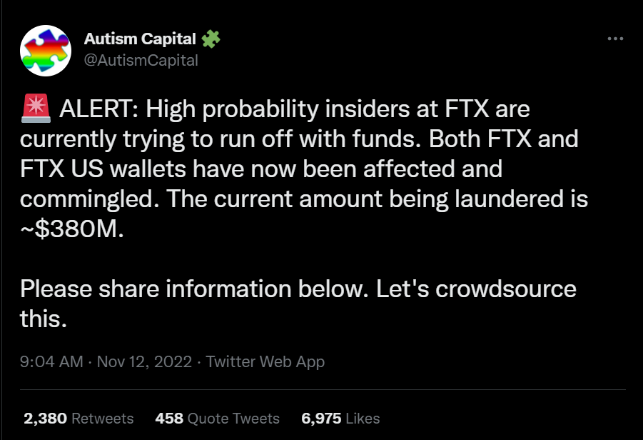
The wallet owner was found swapping $26 million Tether (USDT) to DAI via 1inclh while approving USDP — a Paxos-issued stablecoin — for trade on CoW Protocol. As the situation unfolds, the wallet also approved transfers and sales of other cryptocurrencies, including Chainlink, cUSDT and stETH.
""

The funds coming from FTX wallets were later moved to new addresses, out of which one of them was labeled as FTX on Etherscan, as pointed out by blockchain investigator PeckShield. A subsequent investigation also confirmed that 8,000 ETH was wormholed from Solana to one of the new addresses within the last hour.

The involvement of a hacker, at this time, seems unlikely as they typically would have moved funds from FTX’s wallet to their own wallets. However, many pointed out the possible involvement of an insider.
""

Until the dust settles, the community continues to monitor the movement of funds. However, investors are advised to avoid speculations until confirmed reports set in. FTX has not yet responded to Cointelegraph’s request for comment.
""

Adding to investor’s concerns, FTX sources told Reuters that between $1 billion and $2 billion of client money is unaccounted for in the company’s spreadsheet.
""

The unconfirmed report also suggests that SBF secretly moved $10 billion in funds to Alameda Research while pointing out that the whereabouts of missing funds remain unknown.


Letture associate

Behind the 67,000 Semiconductor Talent Shortage: U.S. Industrial Policy Game and Implications for China

The U.S. push to reshore semiconductor manufacturing faces a core challenge: a significant talent shortage. While over $770 billion in investments are planned across 160 projects, a key hurdle is finding enough people to run the new fabs. According to industry projections, the U.S. could face a shortage of approximately 67,000 technicians, engineers, and computer scientists by 2030. This shortage is multi-faceted. It includes not only high-level chip design engineers requiring advanced degrees but also a substantial need for technicians to operate and maintain fab equipment. Technician roles, while often requiring less formal education, are hard to fill due to factors like shift work, factory locations, and local community infrastructure. Conversely, for high-end engineers, the issue is less about salary—which is already competitive—and more about intense competition for specialized skills from other tech sectors and the long lead time to develop such expertise. The geographic dispersion of new investments complicates recruitment, as fabs need large numbers of local, stable employees. In response, U.S. policy emphasizes building workforce development as critical infrastructure. Strategies include expanding community college programs for technician training, fostering industry-education partnerships, and pursuing immigration reforms for high-skilled talent, aiming to balance immediate needs with long-term domestic pipeline development. For China, the key takeaway is the need to integrate talent supply planning with factory construction from the outset. This involves requiring companies to submit workforce plans, strengthening vocational education aligned with industry needs, and building supportive local ecosystems to retain talent. Ultimately, a sustainable semiconductor industry depends not just on building fabs, but on cultivating a continuous, local talent pipeline capable of keeping them running and advancing.

marsbit56 min fa

Behind the 67,000 Semiconductor Talent Shortage: U.S. Industrial Policy Game and Implications for China

marsbit56 min fa

Trading

Spot
活动图片