Research: In spite of FTX catastrophe, Bitcoin whales lead aggressive accumulation phase

cryptoslatePubblicato 2022-11-12Pubblicato ultima volta 2022-11-12

Introduzione

All Bitcoin cohorts have flipped into buying mode, but whales are accumulating at the most aggressive rate.

The events of the past week have led to significant sell pressure across the crypto market. Since FTX insolvency rumors broke on Nov. 6, peak outflows saw $270 billion leave the market.

”“

Despite the bearish market conditions, on-chain data analyzed by CryptoSlate showed all Bitcoin cohorts have flipped into accumulation mode, with whales buying most aggressively.

”“

Bitcoin Accumulation Trend Score

”“

The Accumulation Trend Score (ATS) looks at the relative size of entities that are actively accumulating, or distributing, in relation to their Bitcoin holdings.

”“

The ATS operates on a scale of 0 to 1. A reading close to 0 indicates distribution or selling. Whereas a reading close to 1 indicates accumulation or buying.

”“

The chart below shows whales accumulated for the first time since August. The current reading comes in at 0.97, indicating an aggressive rate of accumulation and the highest since 2019. For comparison, the previous day’s ATS reading flashed 0.74.

”“

Despite jitters resulting from the collapse of FTX, the market sees value in Bitcoin priced in the teens.
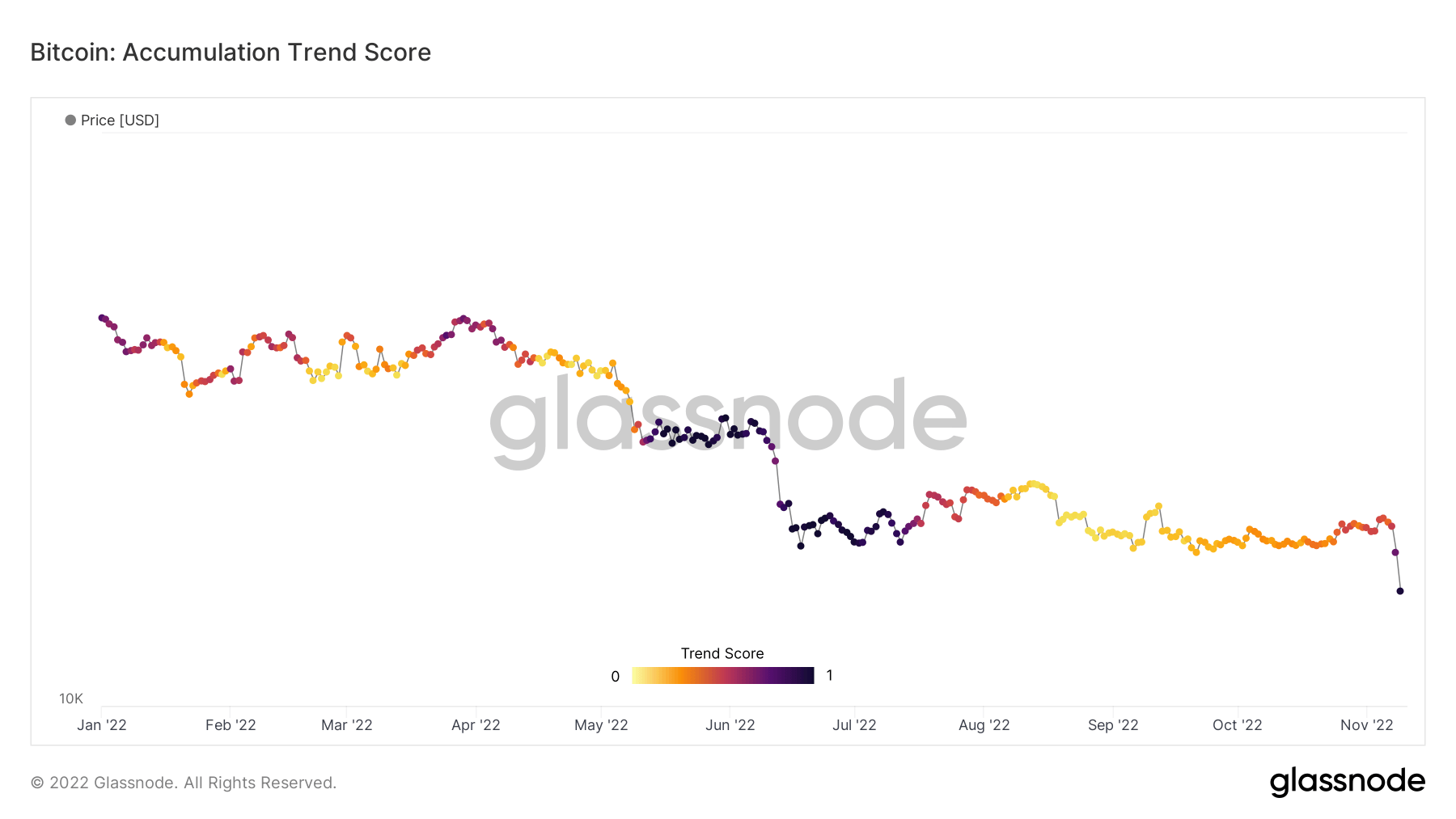
Bitcoin Accumulation Trend Score

Source: Glassnode.com

”“

Cohort analysis

”“

Entities holding between 1,000 and 9,999 Bitcoin are categorized as whales. While 10,000+ BTC holdings refer to super whale status.

”“

In recent days, all cohorts have flashed light blue or darker blue, indicating all cohorts are accumulating in unison — an unprecedented pattern in 2022.

”“

Whales and minnows — entities holding less than 1 BTC — in particular are the cohorts accumulating most aggressively.
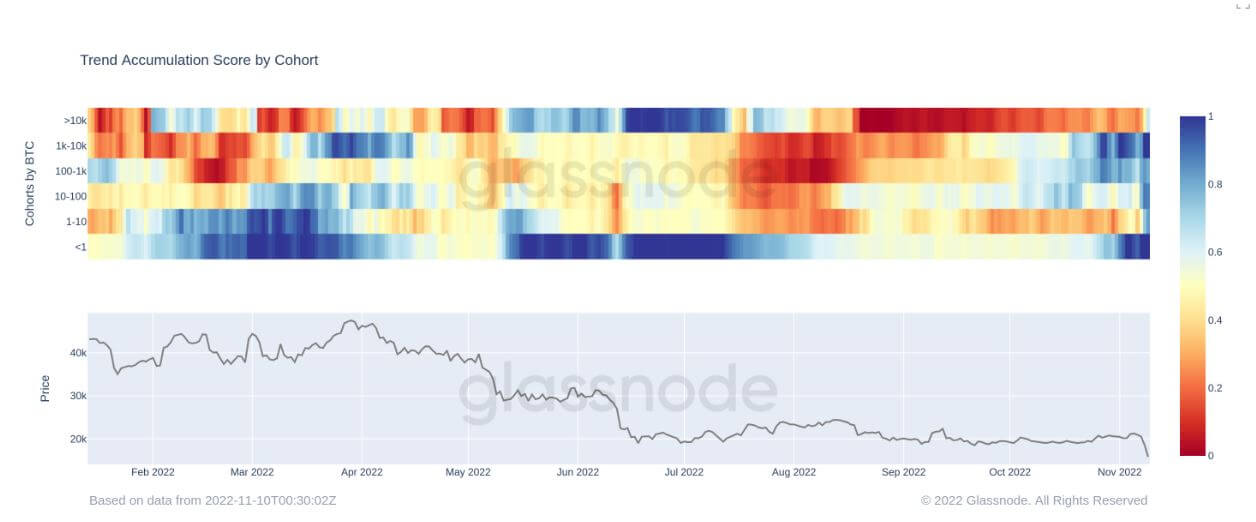
Accumulation Trend Score by cohort

Source: Glassnode.com

”“

On-chain data shows the number of addresses (up to whale status,) bottomed at approximately the time of the $69,000 market top. Since then, an uptrend over 2022 has culminated in a sharp uptick in recent days.
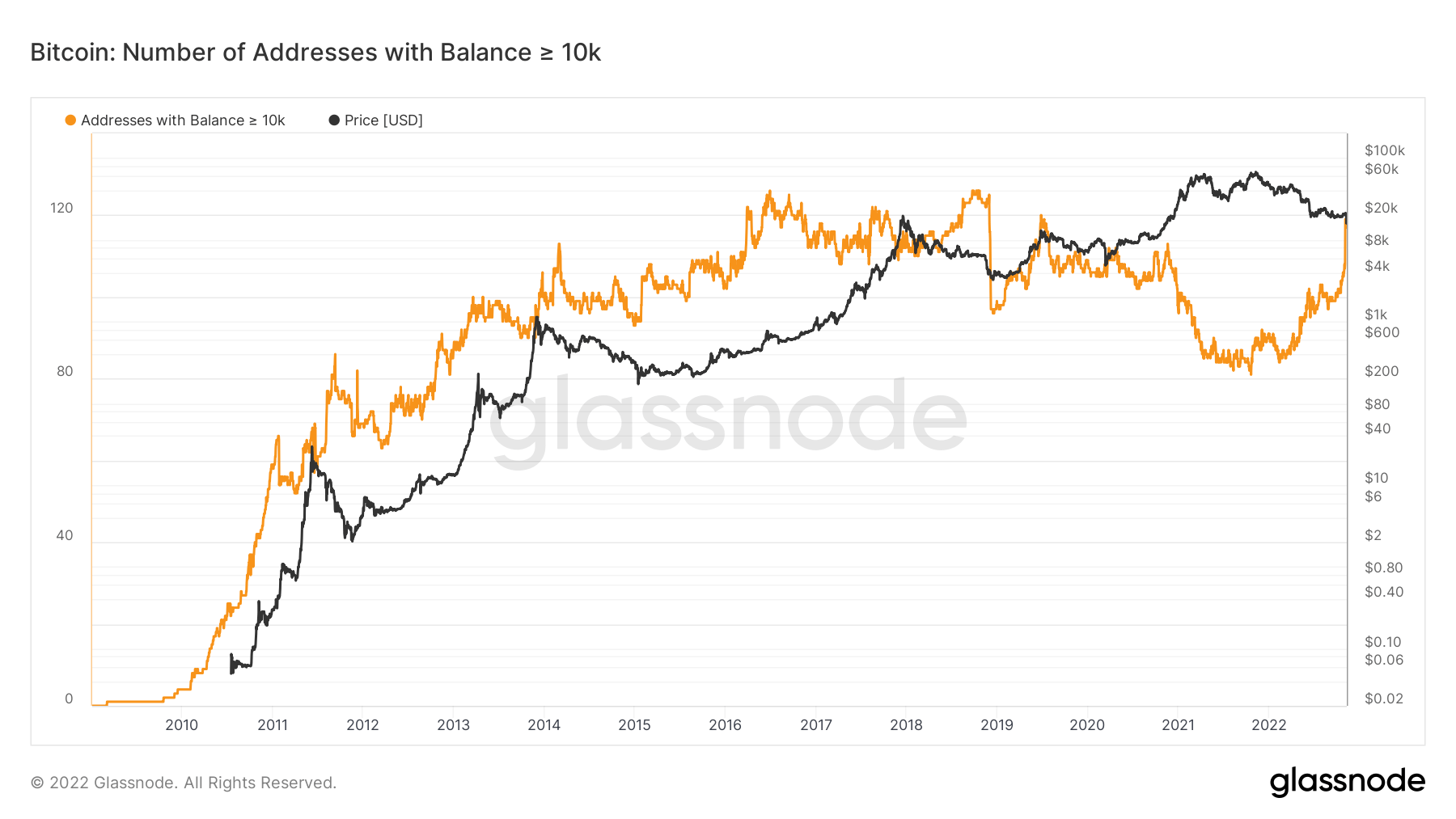
Addresses holding up to 10,000 BTC

Source: Glassnode.com

”“

Whale Exchange Net Position Change

”“

Exchange Net Position Change shows the 30-day change in the Bitcoin supply from exchange wallets. Readings above 0 indicate inflows into exchange wallets, while below 0 show BTC leaving exchange wallets.

”“

The chart below shows this data for whales and super whales. Recent days show exchange whale and super whale holdings have spiked higher. The last time this happened, to a comparable degree of significance, was during August.

”“

Although the primary reason entities send tokens to exchanges is to cash out. The Cumulative Net Whale Exchange Volume shows a macro increase over time, indicating this is not the case for whale holders.
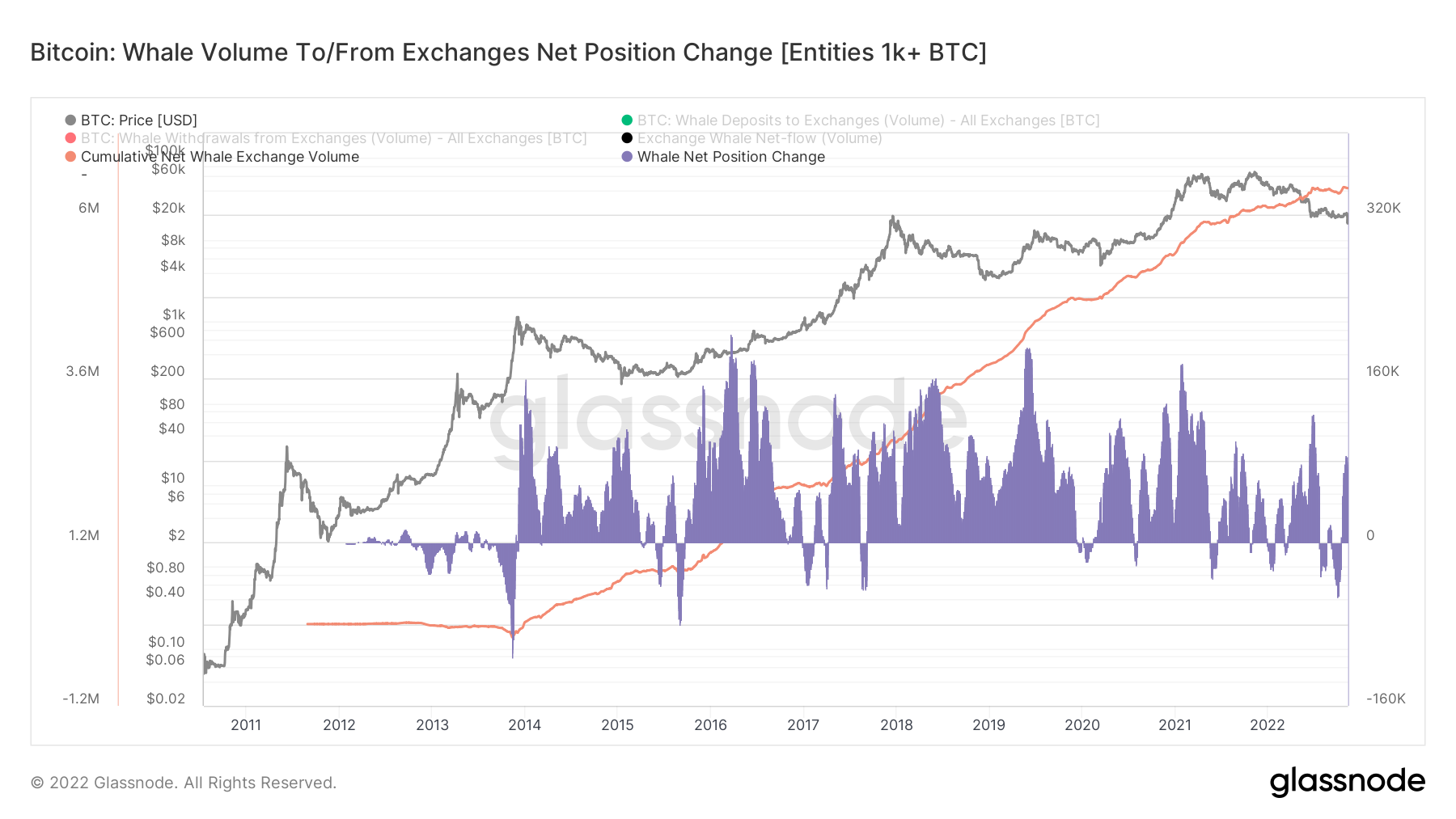
Whale Exchange Net Position Change

Source: Glassnode.com

Letture associate

Bitcoin Trading Strategy Breakdown: Celebrity Predictions and Classic Models All Fail, Only These Four Indicators Remain

Analysis of Bitcoin Trading Strategies: Why Celebrity Forecasts and Classic Models Fail, Leaving Only These Four Reliable Indicators This analysis examines the failure of common Bitcoin prediction methods and identifies four reliable indicators for constructing a trading strategy. The author reviewed all major BTC prediction approaches from 2017-2025, categorizing them into three groups: celebrity price targets (consistently over-optimistic), analytical models like Stock-to-Flow (broken post-2022), and on-chain signals. The key finding is that more data often creates confusion, not clarity. The strategy discards unreliable elements: celebrity predictions (incentivized to be extreme), pure models (invalidated by post-ETF market changes), and the Fear & Greed Index used alone (too many false signals). Four reliable indicators were selected: 1. **MVRV Z-Score:** Accurately identifies cycle bottoms when entering its green zone (e.g., 2018, 2020, 2022). Note: Its ability to call tops is now ineffective post-2024. 2. **SOPR (28-day MA):** Consistently signals bottoms when below 1.0, indicating holders are selling at a loss. 3. **ETF Net Flow:** A crucial post-2024 metric showing institutional momentum (e.g., sustained inflows = buying). 4. **Macro Liquidity (Fed policy & M2):** Sets the overall directional bias (e.g., bullish during easing cycles). The core strategy involves waiting for a multi-signal共振 (resonance). For example, a bottom signal requires MVRV in the green zone + SOPR < 1.0. A top signal requires overheated on-chain data + sustained ETF outflows. Macro policy sets the overall direction. The Fear & Greed Index is only used as a weighted confirmatory signal, never alone. Action is only taken when three or more indicators align. The author automated this into a monitoring system that sends Telegram alerts only when signals trigger. As of the article's date (April 15, 2026), the system showed a strong bottom signal: extreme fear (F&G=12), MVRV in the buy zone, and SOPR < 1.0. The only contrary signal was weak ETF flows. Historically, such triple on-chain共振 has preceded 100%+ returns. The conclusion emphasizes building a personal framework over relying on external predictions, allowing for iterative improvement and customization based on individual risk tolerance.

marsbit27 min fa

Bitcoin Trading Strategy Breakdown: Celebrity Predictions and Classic Models All Fail, Only These Four Indicators Remain

marsbit27 min fa

Trading

Spot
Futures
活动图片