[Key interpretation] BTC financing interest rate hit a new low, with the bottom looking below 14000 dollars

HuobiPubblicato 2022-11-11Pubblicato ultima volta 2022-11-14

Introduzione

The BTC financing interest rate has reached a new low, and the adjustment is in progress.

1. BTC is on the verge of breaking

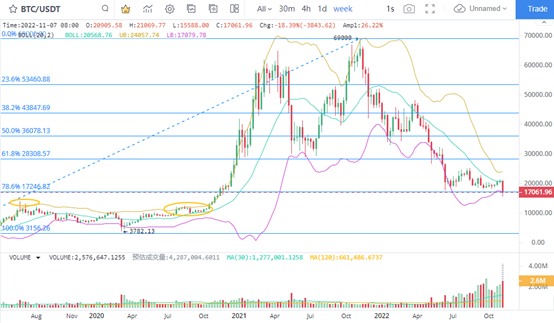
Although the BTC price has dropped significantly recently, reaching the lowest point of 15588 US dollars, the typical support may appear at a lower point. From the price performance since 2019, BTC may test the support effect of the highest US $13970 on June 24, 2019. Or, BTC may seek support from the corresponding US $12000 in September 2020. At present, during the BTC volume shock, the price trend still has great potential for fluctuation, so we can focus on the bottoming process.
2. Low BTC financing interest rate

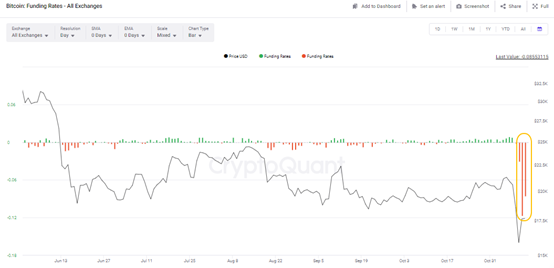
The selling pressure of BTC has increased significantly recently. Judging from the performance of the financing interest rate, it has shown that investors are willing to sell down strongly. Numerically, the BTC financing interest rate since January 9 has been maintained at -0.03, -0.116 and -0.085. This shows that the financing interest rate of BTC has not returned to the normal level in the short term. Therefore, we can continue to pay attention to the downward withdrawal space of BTC and reduce the funds to copy the bottom in order to deal with price shocks.
3. The number of BTC receiving addresses rebounded strongly

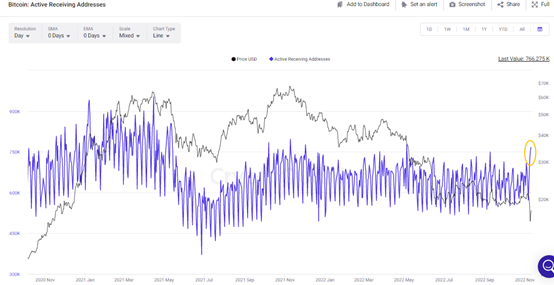
As the number of BTC receiving addresses rises rapidly, it indicates that investors will receive a large number of BTCs sold in the short term. Numerically, the number of BTC receiving addresses rebounded to a peak level of 766000 in November, which is near the highest in the past year. Therefore, at least from the perspective of panic trading, more investors are bargain hunting BTC. It has to be said that BTC price is currently lower than 18000 US dollars, which has attracted more traders to enter the market to seize funds.
4. ETH financing interest rate also fell

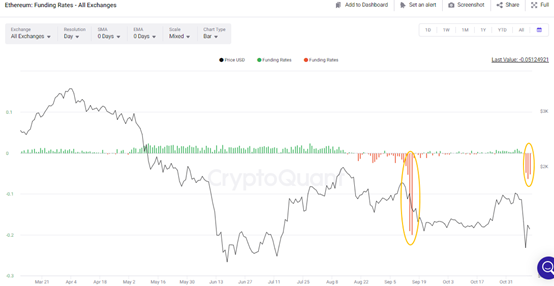
Different from BTC, ETH's recent financing interest rate has been significantly withdrawn, which is the second time in the year. Different from the middle of September in the previous period, the lowest financing interest rate reached around -0.062, much lower than the -0.199 on September 15. Recently, ETH is still being sold by investors rapidly, and the financing interest rate is again low, indicating that the price of ETH continues to be oversold.
5. LTC massive rebound

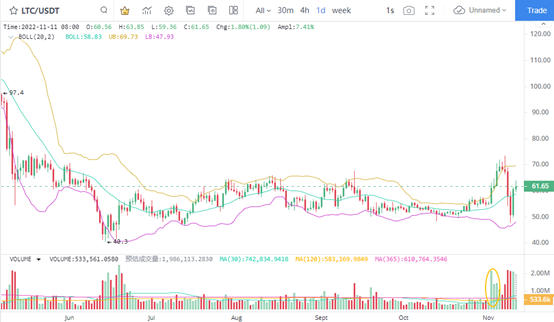
With the enlargement of trading volume, LTC rose in a large scale during the rebound that began on November 2. Despite the recent correction, the trading volume did not shrink. The short-term growth is relatively large, with the largest increase of LTC in three trading days reaching 34%, indicating that the bottom of LTC is getting closer. After the LTC short-term release is completed, it is easier to confirm the bottom signal by normalizing.
Letture associate

13 Business Lines Surpass $100 Million in Annualized Revenue, Robinhood Moves Toward a 'Super Financial App'

Robinhood Q2 2026 Earnings: Record Revenue and a Push Towards a "Super Financial App" Robinhood (HOOD) reported strong Q2 2026 results, with net revenue reaching $1.308 billion, up 32% year-over-year, and net income hitting $561 million, a 45% increase. The company now has 13 distinct business lines each generating over $100 million in annualized revenue. Key drivers included a 44% surge in transaction-based revenue to $776 million, led by a more than 10x growth in "event contracts" (prediction markets) and strong performance in stocks and options. User metrics also grew, with funded accounts rising to 28.4 million and total assets under custody reaching $369 billion. The Robinhood Gold subscription service hit a record 4.8 million users. The report highlights a strategic shift for Robinhood. Moving beyond its core as a zero-commission trading platform for retail investors, it is actively building a broader financial ecosystem. This includes expanding into wealth management (Robinhood Strategies), payments (Robinhood Credit Card), and next-generation infrastructure like AI-powered "Agentic Trading" and its own Ethereum Layer 2 blockchain, Robinhood Chain. The company's goal is to evolve from a trading app into a comprehensive "super financial app," offering a one-stop shop for investing, cash management, and future on-chain finance.

Odaily星球日报30 min fa

13 Business Lines Surpass $100 Million in Annualized Revenue, Robinhood Moves Toward a 'Super Financial App'

Odaily星球日报30 min fa

13 Business Lines Surpass $100 Million in Annualized Revenue, Robinhood Advances Toward a 'Super Financial App'

On July 30th, Robinhood (HOOD) reported its Q2 2026 financial results, showcasing significant growth with record revenue and profits. The company achieved a net revenue of $1.308 billion, a 32% year-over-year (YoY) increase, and a net income of $561 million, up 45% YoY. This strong performance was driven by robust trading activity and expansion into new financial services. A key highlight was the surge in transaction-based revenue, which rose 44% YoY to $776 million. Notably, income from event contracts (prediction markets) skyrocketed over 10x to $156 million, emerging as a major new growth driver alongside strong gains in stock and options trading. However, crypto trading revenue declined by 38%. Beyond trading, Robinhood is successfully diversifying its revenue streams. User assets grew 32% to $369 billion, and the subscription service Robinhood Gold reached a record 4.8 million users. The company revealed that 13 of its business lines now generate over $100 million in annualized revenue, including its new credit card, prediction markets, and Gold subscriptions. Looking forward, Robinhood is strategically investing in AI and blockchain to build a comprehensive financial ecosystem. It has launched AI-powered "Agentic Trading" and the "Robinhood Chain," a layer-2 blockchain network. The company's vision is evolving from a retail trading platform into a "super financial app" that integrates trading, wealth management, payments, and next-generation digital asset services, though regulatory hurdles remain for some new ventures.

marsbit30 min fa

13 Business Lines Surpass $100 Million in Annualized Revenue, Robinhood Advances Toward a 'Super Financial App'

marsbit30 min fa

After R&D Investment Catches Up with the U.S., Is the Sino-U.S. Chip Competition Still Just About Money?

The article examines the significance of recent data showing China's total R&D expenditure, measured by purchasing power parity (PPP), catching up to or slightly surpassing that of the United States in 2024. It argues that while this milestone reflects China's immense capacity to mobilize research resources, the competition in semiconductors now extends far beyond sheer financial input. The analysis highlights key differences: China's R&D is heavily skewed towards experimental development (over 80%), focusing on product engineering and industrialization, whereas the U.S. allocates a proportionally larger share (about 15%) to basic research. Furthermore, leading U.S. semiconductor firms reinvest a significant portion of their substantial global sales revenue into R&D, creating a sustainable commercial innovation cycle that is difficult to replicate. The article emphasizes that semiconductor progress depends on converting R&D into commercially viable products that pass rigorous customer validation and achieve repeat orders, not just on spending levels. It concludes that as China enters the top tier of R&D spenders, the critical challenges shift to improving resource allocation efficiency, fostering long-term basic research, and building effective mechanisms to bridge the gap between laboratory discoveries and reliable, market-ready industrial capabilities.

marsbit1 h fa

After R&D Investment Catches Up with the U.S., Is the Sino-U.S. Chip Competition Still Just About Money?

marsbit1 h fa

Trading

Spot
活动图片