[Key interpretation] Funds drive AR up 70%, and ETH bulls prepare for the bull market

HuobiPubblicato 2022-11-03Pubblicato ultima volta 2022-11-04

Introduzione

The strong return of ETH bulls is brewing to raise prices.

1. BTC discharge shock

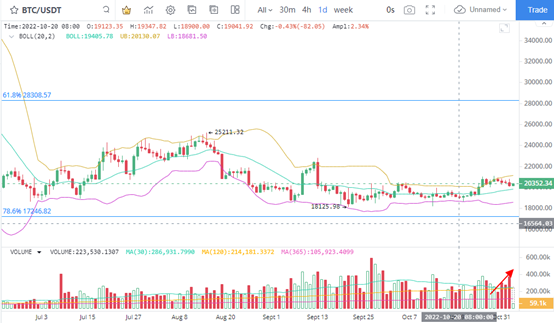
The daily K line chart shows that after BTC retreated for four consecutive trading days, the trading volume has reached its peak in the past month. With the adjustment, the selling pressure also reached its peak on November 2. On the news side, the Federal Reserve raised interest rates again by 0.75 basis points to 3.75% - 4.00%, which is the fourth consecutive meeting of the Federal Reserve to announce a 75 basis point increase in interest rates. Affected by this, the BTC price also experienced a short-term strong earthquake of 3.68%. The performance of volume and price suggests that BTC, an investor, has once again withstood the impact of interest rate hikes. At present, the price is still above the middle track of Bollinger Line.
2. BTC contract position decline

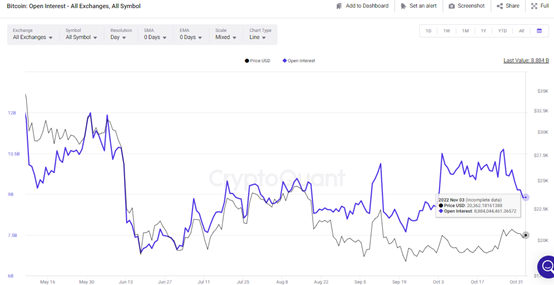
The position of BTC contract showed signs of continuous decline. On November 3, the position of BTC contract fell to 8.89 billion US dollars, a decrease of 1.76 billion US dollars, or 17%, compared with the peak of 10.65 billion US dollars on October 26. The position of BTC contract ushered in the most important decline since October, which means that the price amplitude that contract investors can bear in the near future has increased. At the same time, it means that BTC is easier to choose a breakthrough direction in the near future.
3. ETH ready for lifting

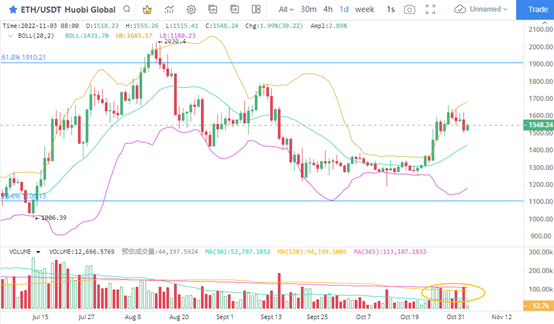
The daily K line chart shows that there is limited room for ETH price to retreat in the short term. As the rebound continues, ETH still maintains a large-scale operation. This shows that the recent ETH price rebound trend is expected to continue. Until the trading heat cools down, investors can absorb the market at a low price. In terms of contracts, the long short ratio of ETH rebounded, further indicating that spot prices will strengthen.
4. ETH long short ratio continues to rise

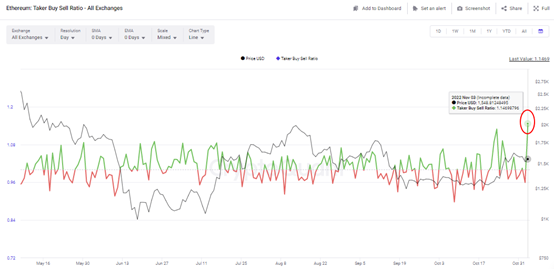
With the rebound of the long short ratio of ETH contracts, the value has reached the peak level of the recent high of 1.146. That is to say, compared with 1.129 on October 23, many parties are more optimistic about the short-term breakthrough performance of ETH price. In terms of trading, attention can be paid to ETH bargain buying opportunities. Considering that the long short ratio has fluctuated less in the past three years and is currently the highest in three years, it has a better effect on the market, further verifying that ETH's market entry trading opportunities are relatively reliable.
5. AR short line volume soars

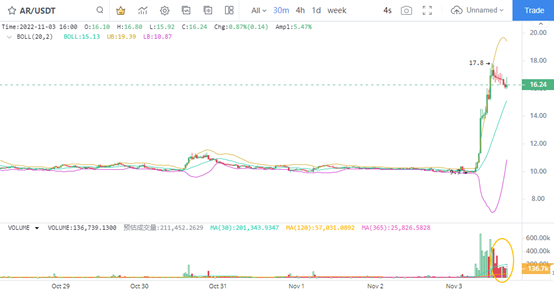
In the short-term surge phase of AR, the trading volume was significantly enlarged, and the volume started on November 3 was the same as that on October 30. The short-term capacity has reached 20 times, and the AR has been continuously pulled up to the K line for 8 times and 30 minutes. In the phase of AR surge and fall, the trading volume shrinks significantly relative to the phase of price rise, indicating that bulls still have the opportunity to raise prices for a second time. The profit taking market did not completely escape, and focused on the rebound opportunity after the withdrawal of AR. From the point of view, pay attention to the low absorption opportunities of AR above $15.

Letture associate

Xiaomi MiMo's 99% Price Cut is Not Marketing! Luo Fuli Posts on X to Refute Critics

The price of Xiaomi's MiMo-V2.5 series API has been permanently reduced by up to 99%, specifically for the "Input (Cache Hit)" cost, which covers users re-reading historical context in long conversations. MiMo's head, Luo Fuli, published a detailed technical blog to clarify that this drastic price cut stems from genuine engineering breakthroughs, not a marketing stunt or a simple price war. The core of the achievement lies in six key engineering optimizations. First, the model architecture adopts a Hybrid Sliding Window Attention (SWA), reducing the memory footprint (KVCache) to 1/7th of a traditional model. Second, a dual-pool memory management system actually utilizes these savings, allowing a single GPU to handle over 5 times more concurrent users. Third, an upgraded prefix caching mechanism achieves a cache hit rate of 93-95% for repeated reads, meaning most such requests bypass GPU computation entirely. Fourth, a self-developed distributed cache (GCache) utilizes idle SSD space on existing GPU servers, eliminating additional storage costs. Fifth, an intelligent scheduling system (LLM-Router) efficiently routes requests to maximize cache reuse and performance. Sixth, Multi-Token Prediction (MTP) accelerates the model's text generation ("output") side. Together, these systemic optimizations dramatically lower the real computational cost per request, enabling the 99% price reduction for cached inputs while reportedly maintaining positive gross margins. Luo Fuli's disclosure aims to shift the narrative from "price war" to a demonstration of substantive AI engineering progress.

marsbit1 h fa

Xiaomi MiMo's 99% Price Cut is Not Marketing! Luo Fuli Posts on X to Refute Critics

marsbit1 h fa

$26 Billion: An 'All-Chinese Team' Backs the World's Highest-Valued AI Programming Company

Cognition AI, the company behind the AI programmer "Devin," has raised over $1 billion in new funding at a valuation of $26 billion, just eight months after reaching a $10.2 billion valuation. The round was led by Lux Capital, General Catalyst, and 8VC. Founded by three young Chinese entrepreneurs with strong competitive programming backgrounds, Cognition initially gained fame with Devin, marketed as the world's first AI software engineer capable of handling tasks from start to finish. While its early demos were impressive, real-world usage revealed reliability and cost-effectiveness issues, leading to a significant price cut for Devin in 2025. A pivotal moment came when Cognition acquired the assets of AI IDE company Windsurf after a failed acquisition by OpenAI. This move gave Cognition a crucial developer-facing tool, allowing it to pursue a two-pronged strategy: Devin for autonomous task execution and Windsurf for integrated, collaborative coding within an IDE. This shift helped the company move away from the controversial "AI replacement" narrative towards a model of augmenting human engineers, particularly for repetitive or maintenance tasks. This strategic pivot is backed by strong commercial metrics. The company reports a 10x increase in enterprise usage this year, with an annual revenue run-rate of $492 million and a 50% month-over-month growth in enterprise Devin usage over the past six months. Its client list now includes major corporations like Goldman Sachs and Mercedes-Benz, as well as government agencies like NASA and the U.S. Army. Investors are betting on Cognition becoming a foundational piece of next-generation software engineering infrastructure, positioning it at the center of a hybrid future where AI agents and human developers work in tandem.

marsbit1 h fa

$26 Billion: An 'All-Chinese Team' Backs the World's Highest-Valued AI Programming Company

marsbit1 h fa

The Hottest 00s Generation on Wall Street

"Wall Street's Hottest '00s Phenom: The 25-Year-Old Fund Manager Who Bet on AI's 'Boring' Backbone" At just 25, Leopold Aschenbrenner, once fired by OpenAI, now runs a hedge fund worth $13.7 billion. His strategy? Betting against the consensus. While others chased AI chips, he invested early in the physical infrastructure powering the AI boom: electricity, data centers, and energy. Expelled from OpenAI's safety team in 2024, Aschenbrenner foresaw the coming bottleneck. He argued that AI progress would be limited not by algorithms, but by power, chip capacity, and space. Acting on this, he founded Situational Awareness LP to go long on these "old economy" assets. His bets have paid off spectacularly. His fund's assets soared from $255 million in late 2024 to $13.7 billion by Q1 2026. His portfolio is a direct reflection of his thesis: major long positions in fuel cell company Bloom Energy and data center/bitcoin mining firms like CleanSpark and Riot Platforms, which control critical land and power resources. Conversely, he holds massive put options against overheated semiconductor giants like NVIDIA and AMD. A notable exception was his bullish bet on storage company SanDisk, which surged ~160% in Q2. Aschenbrenner's vision is materializing. Tech giants like Amazon, Alphabet, and Meta are ramping up colossal capital expenditure on data centers. Global data center power consumption is projected to skyrocket, with AI accounting for over half by 2030. The demand for enabling technologies like optical fiber and modules is also exploding. His story underscores a fundamental truth of the AI era: the ethereal intelligence of algorithms rests on a very physical, heavy, and power-hungry foundation. The future is being built not just in code, but in concrete, copper, and kilowatts.

marsbit3 h fa

The Hottest 00s Generation on Wall Street

marsbit3 h fa

Review of Cathie Wood's Masterstroke Operation on Circle

A Recap of Cathie Wood's Masterful Trading in Circle's IPO This article analyzes the strategic moves made by ARK Invest's Cathie Wood around the IPO of Circle (CRCL). Despite her typical long-term, narrative-driven investment style, Wood executed a textbook "buy low, sell high" trade. Wood secured a core position of approximately 4.49 million shares at the $31 IPO price. The stock debuted at $69, surged to a high of $299 in June 2025 fueled by stablecoin regulatory news (the GENIUS Act), and then entered a prolonged decline. During this rally, ARK systematically sold around 1.7 million shares at an average price near $210, driven partly by internal fund rebalancing rules triggered by the stock's soaring weight. This move locked in substantial profits. As the stock later fell due to lockup expirations, new share issuance, and interest rate concerns—even dipping below $50—Wood began repurchasing shares. Starting in November 2025 around $86, she continued buying on the way down, eventually rebuilding her position to roughly the original size by Q1 2026. Key takeaways include: 1) Having a strong, independent long-term thesis (viewing Circle as critical digital dollar infrastructure). 2) Trading in tranches instead of trying to time exact tops or bottoms. 3) Maintaining strict position-sizing discipline, using rules to force profit-taking and preserve buying power. For most retail investors, chasing the dramatic "pop" at open is dangerous, as the subsequent 83% drawdown showed. Wood's success hinged on pre-IPO access, a clear investment thesis, and disciplined execution.

marsbit5 h fa

Review of Cathie Wood's Masterstroke Operation on Circle

marsbit5 h fa

Sharplink CEO: Ethereum's Future is Unfolding Now

In an article titled "Sharplink CEO: Ethereum's Future is Unfolding," Joseph Chalom, a former BlackRock executive and current Sharplink CEO, argues that the current debates surrounding the Ethereum Foundation (EF) and ETH price miss the bigger picture. He asserts that Ethereum's long-term institutional adoption is secured by its foundational strengths: trust, security, and liquidity. Chalom highlights Ethereum's dominance in settling stablecoin value, tokenizing real-world assets (RWA), and facilitating high-value DeFi transactions as evidence of its winning position. He defends the Ethereum Foundation's focus on rigorous protocol development and a decade-long track record of major upgrades (The Merge, EIP-1559, Dencun, etc.), viewing its upcoming technical roadmap as the most ambitious in the industry. Contrary to critics, Chalom posits that Ethereum's decentralization and reliable neutrality are core strengths for institutional adoption, not weaknesses, as they prevent control by any single entity. Drawing a parallel to Amazon's early days, he suggests that ETH's intrinsic value is tied to the expansion of its network, which is poised for a step-change in transaction volume across stablecoins, RWAs, DeFi, and agentic finance. Chalom advocates for a "be greedy when others are fearful" approach, citing historical examples from Warren Buffett and his own experience at BlackRock during the crypto winter. He concludes that while the EF should remain focused on core protocol attributes (CROPS: Censorship Resistance, Capture Resistance, Open Source, Privacy, Security), there is a leadership gap in market outreach. Chalom calls for ecosystem participants, including Sharplink and other key players, to become more vocal advocates to support the coming institutional adoption supercycle, asserting that "Ethereum's future is unfolding now."

marsbit5 h fa

Sharplink CEO: Ethereum's Future is Unfolding Now

marsbit5 h fa

Trading

Spot
Futures
活动图片