Market Analysts Predict Ether Bearish Continuation That Could Crash Ethereum To $750

zycryptoPubblicato 2022-10-02Pubblicato ultima volta 2022-10-08

Introduzione

Bearish sentiments for Ether (ETH), the native token of the Ethereum blockchain, continues to build up.

Bearish sentiments for Ether (ETH), the native token of the Ethereum blockchain, continues to build up. ETH is currently trading around its July low of around $1,290, a level that analysts expect prices to fall from to between $750-$850 in the coming months.

According to the pseudonymous market analyst ‘CryptoCapo,’ the price of ETH has reached its next support level at the current price. Based on this, the analyst expects the market to show a slight bounce that will test the neckline of the Head & Shoulders (H&S) technical pattern due to a concentration of demand or buying interest.

Following this will be a bearish continuation characterized by a selloff that will dump the price of ETH to the primary target price of between $750-$850, likely to be the local bottom for several months.
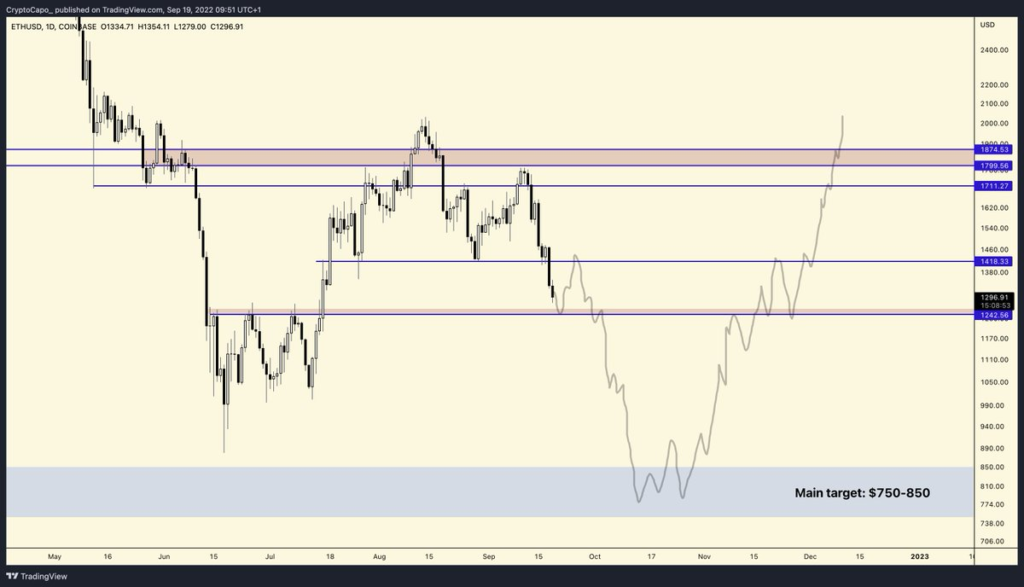
ETHUSD Chart by TradingView via @CryptoCapo_

The analysis is coming after the price of ETH has taken a hit from both a ‘sell-the-news’ and Fed rate hike sell pressures. However, it is not the only bearish price prediction for ETH.

In a TIME report, several analysts also indicated pessimism for the ETH market for several reasons. Venture capitalist Kavita Gupta forecasted a crash to as low as $500 if the broader market sell-off deepens. At the same time, the crypto market analyst Wendy O. also expects ETH to drop to around $750, an 85% drawdown from its all-time of $4800.

ETH bulls still hopeful for an upward breakout in 2022

Ether bulls persist in the market despite the prevailing bearish price trend of the second largest cryptocurrency. In the same TIME report, several analysts disclosed that they expect the price of ETH to close out 2022 to its previous high and even set new highs in 2023.

“I believe ethereum can go to $8,000. Ethereum is the clear leader, but other blockchains are onboarding new users at a faster pace due to ethereum’s high gas fees and low transaction speed,” said Ian Balina, investor and founder of crypto research and media company Token Metrics.

Options data noted by crypto and blockchain analytics company Glassnode indicates that traders are equally optimistic about an upside in the price of ETH. Per Glassnode’s report, despite ‘The Merge‘ – Ethereum blockchain’s transition to proof-of-stake – being completed, traders have yet to close their risk hedging positions in the ETH derivatives market.


Letture associate

Ethereum Is Retracing the Path of the Internet and Linux: No One Yields, and the Neutral Party Ultimately Prevails

This article argues that Ethereum is following the historical path of open, neutral systems like the Internet and Linux, which eventually triumphed over proprietary, centrally-controlled alternatives. Major financial institutions like JPMorgan, Stripe, and Circle are building their own proprietary blockchains or networks (e.g., Tempo, Arc), but will never agree to build on a competitor's controlled infrastructure. This creates the perfect opportunity for Ethereum as the only neutral, credibly neutral settlement layer that no single entity controls. The piece draws parallels to the 1990s, when experts like Bill Gates predicted proprietary networks (from Microsoft, Oracle) would win over the open Internet, and when Sun Microsystems' Unix lost to the open-source "bazaar" development model of Linux. This model, described in Eric Raymond's "The Cathedral and the Bazaar," thrives on permissionless innovation where countless contributors improve the system, outpacing any centralized competitor. Ethereum embodies this through its decentralized development, broad validator distribution, and credible neutrality—rules that are transparent, equally applied, hard to change, and open to all. This has attracted over a million developers and major institutions like Coinbase, BlackRock, and JPMorgan, who choose Ethereum for its security, ecosystem, and sovereignty (the inability of any single party to change the rules). While proprietary chains offer initial speed and control, they inherit the downsides of both centralization and decentralization without the long-term innovation benefits. The article concludes that, just as open systems historically win, Ethereum is poised to become the foundational, neutral settlement layer for global finance.

marsbit10 min fa

Ethereum Is Retracing the Path of the Internet and Linux: No One Yields, and the Neutral Party Ultimately Prevails

marsbit10 min fa

Kalshi's Biggest Rival is Not Polymarket

Kalshi's CEO Tarek Mansour has identified the company's primary competitors not as the crypto-based prediction market Polymarket, but as established financial and gaming giants: CME Group, Robinhood, and DraftKings. This reflects a shift in the prediction market landscape, where the 2026 FIFA World Cup is expected to bring massive new trading volume. Traditional platforms are increasingly integrating prediction markets as a feature within their existing ecosystems. Robinhood has seen rapid growth with its prediction markets, contributing significantly to its "other transaction revenue." Similarly, Interactive Brokers (IBKR) integrates contracts from Kalshi and CME Group, while DraftKings and FanDuel (via CME) have launched their own prediction products. This allows these firms to leverage their vast user bases and infrastructure at low marginal cost, turning prediction markets from standalone apps into embedded functionalities. In response, prediction market platforms are evolving along two paths. First, they are expanding into new event categories like sports (e.g., the World Cup) and financial data to reduce reliance on election cycles. Second, they are moving towards becoming infrastructure and liquidity providers for distribution platforms. Kalshi's lead over Polymarket in trading volume is partly attributed to this channel strategy, integrating with brokers like Robinhood, Coinbase, and Webull. However, this strategy faces a challenge as distributors like Robinhood begin building their own in-house prediction market capabilities (e.g., Rothera), potentially threatening the value of pure infrastructure providers. The situation parallels historical tech battles, such as Zoom competing with Microsoft Teams and Google Meet, where embedded features in larger platforms reshape market dynamics. The future of standalone prediction market leaders like Kalshi and Polymarket will depend on their ability to navigate this new competitive landscape dominated by integrated financial and gaming titans.

链捕手17 min fa

Kalshi's Biggest Rival is Not Polymarket

链捕手17 min fa

Trends in US Stocks (June 22): Strait of Hormuz Agreement Changes Course, Thursday's PCE and Micron to Determine Chip Sector Direction

U.S. Stock Market Outlook (June 22): Strait of Hormuz Deal Falters, Thursday's PCE & Micron to Set Chip Sector Direction. Geopolitical tensions resurged over the weekend as Iran's IRGC announced the closure of the Strait of Hormuz, and its negotiation team walked out after threats from Trump, pausing U.S.-Iran talks. This renewed risk premium is weighing on U.S. equity futures ahead of the open. Last week's market was driven by chip stocks, with the Philly Semiconductor Index hitting a record high. While the Fed's hawkish tone was overshadowed by initial deal optimism, the S&P 500 gained 0.9% for the week. SpaceX debuted strongly but ended with two down days. Key events this week: The status of U.S.-Iran negotiations remains the immediate variable for oil and energy stocks. Monday sees Marvell and Flex added to the S&P 500. Tuesday's MSCI reclassification could benefit South Korean semiconductors and memory stocks. **Thursday, June 25th, is the critical day**, featuring the May Core PCE report and Micron's earnings. Hotter PCE data could solidify expectations for two 2024 rate hikes, while softer data would rapidly reprice rate cut bets. Micron's report is a key test for the AI narrative; the market will scrutinize its 2027 HBM supply visibility, HBM4 progress, and its position in Nvidia's Vera Rubin supply chain. Nvidia's AGM and a potential OpenAI GPT-5.6 release will make Thursday a pivotal 24 hours for AI. Friday concludes with the Russell reconstitution, elevating small-cap volatility. In summary, last week's gains face a true test. The path hinges on two concurrent threads: geopolitical developments with Iran and the AI narrative defined by Micron's guidance and Nvidia's updates. The chip sector's record highs are vulnerable if Thursday brings hot PCE data and conservative guidance from Micron. Conversely, positive outcomes could reaffirm the AI bull case, making this week's volatility a potential entry window.

marsbit1 h fa

Trends in US Stocks (June 22): Strait of Hormuz Agreement Changes Course, Thursday's PCE and Micron to Determine Chip Sector Direction

marsbit1 h fa

Trading

Spot
Futures
活动图片