New Cosmos whitepaper repurposes ATOM token and refines vision

CointelegraphPubblicato 2022-09-27Pubblicato ultima volta 2022-09-27

Introduzione

The new Cosmos whitepaper was released on Monday at the Cosmoverse conference in Medellin, Colombia.

Interoperability-focused blockchain network Cosmos has dropped a new whitepaper proposing a revamped Cosmos Hub aimed at strengthening interoperability and security, along with key changes to its native ATOM token. 
The new Cosmos whitepaper was released on Monday at the Cosmoverse conference in Medellin, Colombia. The upgrades outlined in the whitepaper are still technically in “proposal” status but changes are expected to be made on-chain on Oct. 3.
Cosmos is an ecosystem of blockchains designed to scale and interoperate with each other. Cosmos Hub was the first blockchain to be built on Cosmos, which initially served as an intermediary between other interconnected blockchains.
The ATOM token is used to transact within the Cosmos ecosystem, which can also be used for governance and staking purposes.
Under the proposed changes, Cosmos will become a more interoperable, decentralized, and secure ecosystem.
One of the changes outlined is the reinvention of the Cosmos Hub as the “Interchain” web, which will enable other Cosmos blockchains to borrow the Hub’s validator pool to secure its network rather than having to find their own.
Billy Rennekamp, the Cosmos Hub Product Lead added that the value proposition behind this transition to Interchain Security would also make the Cosmos network “legally, defensibly decentralized.”
According to the whitepaper, Interchain Security will also enable Cosmos Hub to “host a novel category of applications with complementary functionality,” stating:
“Interchain Security gives consumer chains a faster, easier, and cheaper path to market [and] the development platform afforded by Interchain Security allows [...] third parties to utilize the Hub’s essential infrastructure to build commercial applications.”
The whitepaper also proposes a new issuance model for the native ATOM token, with the aim to strike a better balance between ecosystem growth and interchain adoption “while still preserving the security afforded by the original regime,” according to the whitepaper.
The new monetary policy will see two phases: “transition” and “steady state.”
The transition phase will see 10,000,000 ATOM issued in the first month, which will then decrease at a declining rate until it reaches the steady state phase 36 months later.
Cosmos co-founder Ethan Buchman said this new token issuance model would enable other Cosmos blockchains to become more interconnected with the Cosmos Hub and ATOM, noting:
“It gives them direct alignment with Cosmos with the ATOM. It allows them to inherit the security of the ATOM and be part of this sort of economic community being built around the Cosmos blockchain, the ATOM token, and the superior security that that chain provides.”
The whitepaper also outlined a plan to further accrue more value to the ATOM token by enabling leveraged liquid staking.
This will allow ATOM holders to unstake ATOM tokens as easily as they staked them, which will soon be enabled by the Cosmos “liquid staking module."
“The user experience and capital efficiency improvement offered by liquid stalking is so substantial” that it required “full economic integration” into the new Cosmos interchain-oriented ecosystem, according to the whitepaper.
Intern notes on Cosmos’ new 27 page whitepaper

TL;DR
- Secure economic scaling ⛓
- $ATOM as reserve currency
- New economic engine

Definitely worth a read!

(1/2) pic.twitter.com/OseBg1kBYp
— (Delphi, Intern) (@delphiintern) September 26, 2022
The release of the whitepaper comes a few weeks after research and investment firm Delphi Labs announced a shift of its R&D efforts to focus on the Cosmos ecosystem.
The research firm outlined network speed, chain liquidity, sufficient decentralization, and cross-chain interoperability as the key factors behind its decision to provide R&D efforts to help further the growth of Cosmos.

Crypto di tendenza

Letture associate

Annualized Revenue Exceeds $20 Billion, Kalshi Aims to Become the First Prediction Platform IPO?

Kalshi, a leading U.S. prediction markets platform, is reportedly in early, informal discussions for an Initial Public Offering (IPO). The company's annualized revenue now exceeds $2 billion, fueled by its dominance of over 90% of the domestic prediction market activity. This growth stems from a surge in trading volume—reaching a total of $52.7 billion—and an increase in fee rates, largely driven by sports event contracts like the NBA playoffs and the 2026 FIFA World Cup. Monthly active users are approximately 2 million. Kalshi recently raised $1 billion in a funding round led by Coatue Management, valuing the company at $22 billion. It has also expanded its offerings to include Bitcoin perpetual contracts and plans to launch a dedicated trading platform, Kalshi Pro. However, Kalshi's path to an IPO faces significant regulatory hurdles. The core risk involves jurisdictional conflicts, as multiple U.S. states are challenging its operations under local gambling laws. For instance, Arizona has filed criminal charges against the platform, while states like Kentucky have filed lawsuits. Kalshi and the Commodity Futures Trading Commission (CFTC) argue that its event contracts fall under exclusive federal jurisdiction as "swaps." The outcomes of these ongoing legal battles could critically impact Kalshi's core revenue and its IPO timeline. Analysts suggest that while an IPO could theoretically occur by late 2026, a more likely timeframe is late 2027 or 2028, contingent on resolving legal issues and favorable market conditions. If successful, its fundraising could significantly exceed $1 billion, given its current valuation and revenue multiple.

Foresight News10 min fa

Annualized Revenue Exceeds $20 Billion, Kalshi Aims to Become the First Prediction Platform IPO?

Foresight News10 min fa

Financing Weekly Report | 11 Public Financing Events, Stablecoin Payment Infrastructure Company Trace Finance Completes $32 Million Series A Round Led by CoinFund

Financing Weekly Report | 11 public funding events recorded, with a total scale exceeding $264 million. The stablecoin payment infrastructure sector remains a hot spot. Key Deals: - Trace Finance, a stablecoin payment infrastructure firm, raised $32 million in a Series A round led by CoinFund to expand in Latin America and Asia-Pacific. - Galaxy Ventures co-led a $140 million Series A round for Karta, a US credit card provider for global travelers without requiring an SSN. - Instant payment platform Interchecks completed a $50 million Series C round. - Paradigm led a $9 million Series A for Latin American cross-border payment app El Dorado. - Range, a stablecoin compliance startup, raised $8.3 million in an oversubscribed Series A. - RWA infrastructure project Renaiss raised $1.5 million to expand its on-chain collectibles platform. Sector Breakdown: - Infrastructure & Tools: 6 deals, including the above-mentioned Trace Finance, Range, and Renaiss. - Centralized Finance (CeFi): 3 deals, led by Karta's $140 million round. - DeFi: 1 deal – reinsurance protocol Re secured strategic investment from Coinbase Ventures. - Prediction Markets: 1 deal – K25.ai completed a $10 million Pre-A round from NewGen. Other notable transactions include digital asset depository RDC raising $7 million, ad-tech startup EarnOS securing $6 million, and a $1 million strategic investment in LitVM, a ZK Layer 2 for Litecoin. The report highlights sustained investor interest in stablecoin payment infrastructure, compliant on-chain finance, and real-world asset (RWA) tokenization.

marsbit52 min fa

Financing Weekly Report | 11 Public Financing Events, Stablecoin Payment Infrastructure Company Trace Finance Completes $32 Million Series A Round Led by CoinFund

marsbit52 min fa

When Transfers Become Truly Frictionless: How Sui Uses 'Zero Gas' to Become the Underlying Infrastructure for Stablecoin Payments

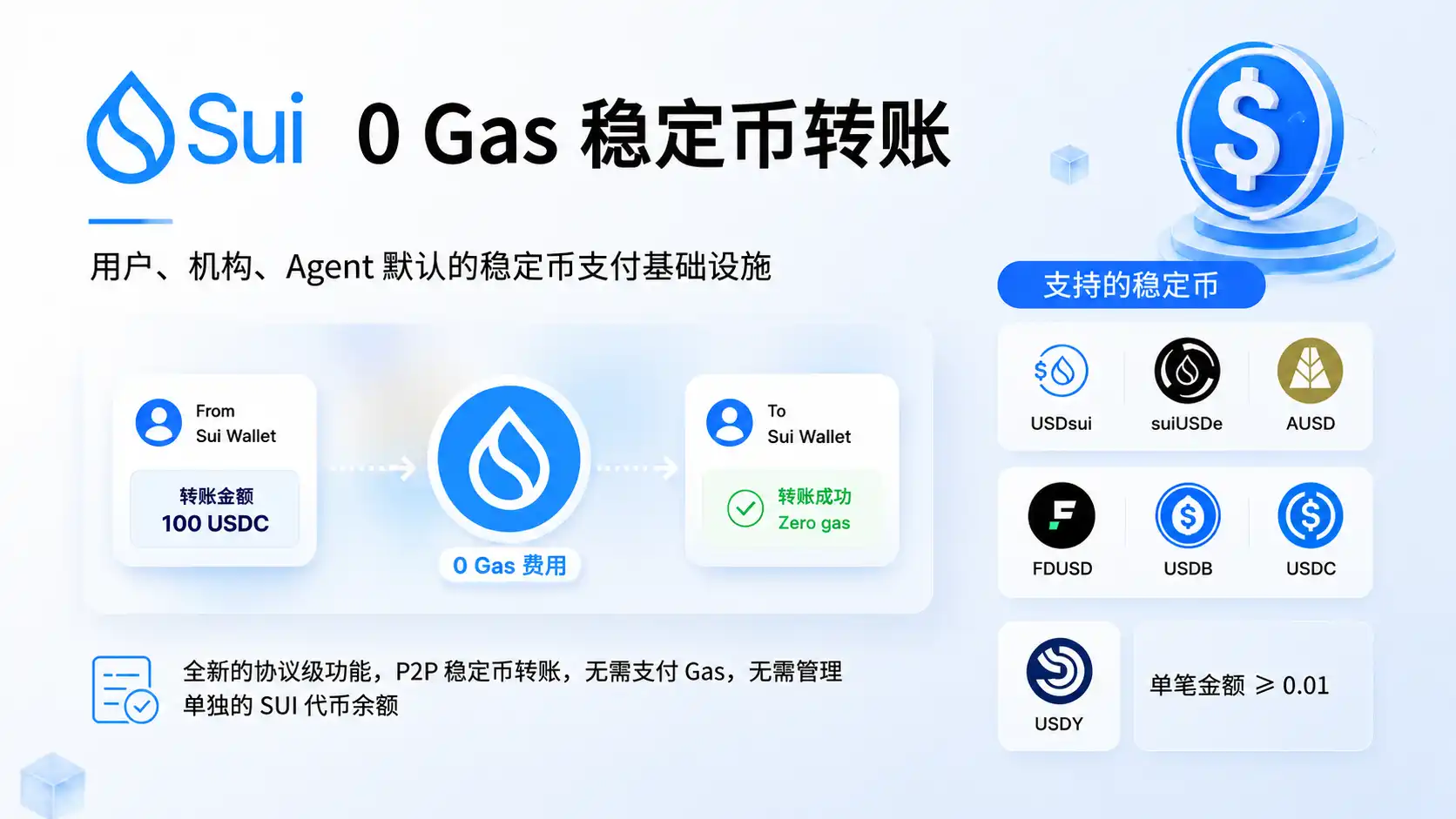
Title: Sui Launches Zero-Gas Stablecoin Transfers to Become the Foundation for Stablecoin Payments Sui has introduced a zero-gas fee feature for peer-to-peer stablecoin transfers, eliminating the need for users or businesses to hold separate SUI tokens to pay transaction costs. This innovation, built on a new underlying account architecture called Address Balances, significantly reduces validator processing costs for eligible transactions. Currently, the feature applies to a whitelist of stablecoins for transfers meeting a minimum amount, effectively preventing spam. This development aims to unlock mainstream payment use cases for stablecoins—such as everyday purchases, remittances, and subscriptions—by removing cost and complexity barriers. It is also positioned to benefit high-frequency micro-payments for AI agents and institutional B2B payments, reducing operational friction. Major custody provider Fireblocks has already announced support. The move follows Sui processing over $1 trillion in stablecoin transfer volume since August 2025. Looking ahead, Sui plans to enhance this infrastructure with protocol-level confidential transactions later in 2026, aiming to provide scalable, free, and privacy-preserving payments. Together, these advancements strengthen Sui's goal of becoming the default settlement layer for stablecoin payments.

marsbit54 min fa

When Transfers Become Truly Frictionless: How Sui Uses 'Zero Gas' to Become the Underlying Infrastructure for Stablecoin Payments

marsbit54 min fa

Ethereum Is Retracing the Path of the Internet and Linux: No One Yields, and the Neutral Party Ultimately Prevails

This article argues that Ethereum is following the historical path of open, neutral systems like the Internet and Linux, which eventually triumphed over proprietary, centrally-controlled alternatives. Major financial institutions like JPMorgan, Stripe, and Circle are building their own proprietary blockchains or networks (e.g., Tempo, Arc), but will never agree to build on a competitor's controlled infrastructure. This creates the perfect opportunity for Ethereum as the only neutral, credibly neutral settlement layer that no single entity controls. The piece draws parallels to the 1990s, when experts like Bill Gates predicted proprietary networks (from Microsoft, Oracle) would win over the open Internet, and when Sun Microsystems' Unix lost to the open-source "bazaar" development model of Linux. This model, described in Eric Raymond's "The Cathedral and the Bazaar," thrives on permissionless innovation where countless contributors improve the system, outpacing any centralized competitor. Ethereum embodies this through its decentralized development, broad validator distribution, and credible neutrality—rules that are transparent, equally applied, hard to change, and open to all. This has attracted over a million developers and major institutions like Coinbase, BlackRock, and JPMorgan, who choose Ethereum for its security, ecosystem, and sovereignty (the inability of any single party to change the rules). While proprietary chains offer initial speed and control, they inherit the downsides of both centralization and decentralization without the long-term innovation benefits. The article concludes that, just as open systems historically win, Ethereum is poised to become the foundational, neutral settlement layer for global finance.

marsbit1 h fa

Ethereum Is Retracing the Path of the Internet and Linux: No One Yields, and the Neutral Party Ultimately Prevails

marsbit1 h fa

Trading

Spot
Futures

Articoli Popolari

Come comprare ATOM

Benvenuto in HTX.com! Abbiamo reso l'acquisto di Cosmos (ATOM) semplice e conveniente. Segui la nostra guida passo passo per intraprendere il tuo viaggio nel mondo delle criptovalute.Step 1: Crea il tuo Account HTXUsa la tua email o numero di telefono per registrarti il tuo account gratuito su HTX. Vivi un'esperienza facile e sblocca tutte le funzionalità,Crea il mio accountStep 2: Vai in Acquista crypto e seleziona il tuo metodo di pagamentoCarta di credito/debito: utilizza la tua Visa o Mastercard per acquistare immediatamente CosmosATOM.Bilancio: Usa i fondi dal bilancio del tuo account HTX per fare trading senza problemi.Terze parti: abbiamo aggiunto metodi di pagamento molto utilizzati come Google Pay e Apple Pay per maggiore comodità.P2P: Fai trading direttamente con altri utenti HTX.Over-the-Counter (OTC): Offriamo servizi su misura e tassi di cambio competitivi per i trader.Step 3: Conserva Cosmos (ATOM)Dopo aver acquistato Cosmos (ATOM), conserva nel tuo account HTX. In alternativa, puoi inviare tramite trasferimento blockchain o scambiare per altre criptovalute.Step 4: Scambia Cosmos (ATOM)Scambia facilmente Cosmos (ATOM) nel mercato spot di HTX. Accedi al tuo account, seleziona la tua coppia di trading, esegui le tue operazioni e monitora in tempo reale. Offriamo un'esperienza user-friendly sia per chi ha appena iniziato che per i trader più esperti.

333 Totale visualizzazioniPubblicato il 2024.12.10Aggiornato il 2026.06.02

Come comprare ATOM

Discussioni

Benvenuto nella Community HTX. Qui puoi rimanere informato sugli ultimi sviluppi della piattaforma e accedere ad approfondimenti esperti sul mercato. Le opinioni degli utenti sul prezzo di ATOM ATOM sono presentate come di seguito.

活动图片