$60B trading giant BlockFills hits ‘pause’ as ‘extreme fear’ takes over market

ambcryptoPubblicato 2026-02-12Pubblicato ultima volta 2026-02-12

Introduzione

BlockFills, a major Chicago-based crypto trading firm that handled over $60 billion in trades last year, has paused all client deposits and withdrawals due to extreme market instability. The decision follows Bitcoin’s sharp decline of nearly 25% to around $60,000, though trading on the platform remains active. The move has heightened investor anxiety, evoking memories of the 2022 crypto collapses. Despite Bitcoin’s slight recovery to $67,490, institutional clients face significant risk. Analysts note parallels to past market crashes but suggest Bitcoin may be oversold and poised for a rebound if key support levels hold. The situation underscores ongoing regulatory uncertainty and fragile market sentiment.

In high-risk crypto trading, BlockFills is a major Chicago-based firm that handled over $60 billion in trades last year. After a difficult week in the market, when Bitcoin [BTC] dropped by nearly 25% to around $60,000, the company decided to take urgent action.

The company has paused all client deposits and withdrawals, saying this is needed because of unstable market and financial conditions.

Even though clients can still trade on the platform, they cannot move money in or out right now. This has made many investors nervous, especially since the industry still remembers the major failures of 2022.

In 2025, the company was doing extremely well. It handled $61.1 billion in trades and worked with more than 2,000 institutional clients around the world.

However, things changed after the “October Crash” of 2025, when Bitcoin fell sharply from its record high of $124,500. Even though Bitcoin has now recovered slightly to about $67,490, the damage to big investors and lenders remains serious.

Community reactions

Needless to say, the crypto community reacted strongly to this incident, as noted by Walter Bloomberg.

“The move echoes past crypto downturns, including the 2022 collapse of FTX and other lenders. Bitcoin’s recent drop below $65,000—down ~45% from October highs—has intensified pressures, while stalled U.S. crypto legislation continues to weigh on the market.”

Usually, small retail traders suffer the most when crypto exchanges go down. On the contrary, the BlockFills situation is different.

This time, it is not about regular users panicking. Instead, it may be a serious problem for large institutions with big money at stake, according to Milk Road’s analysis.

How is this incident acting in favor of Bitcoin?

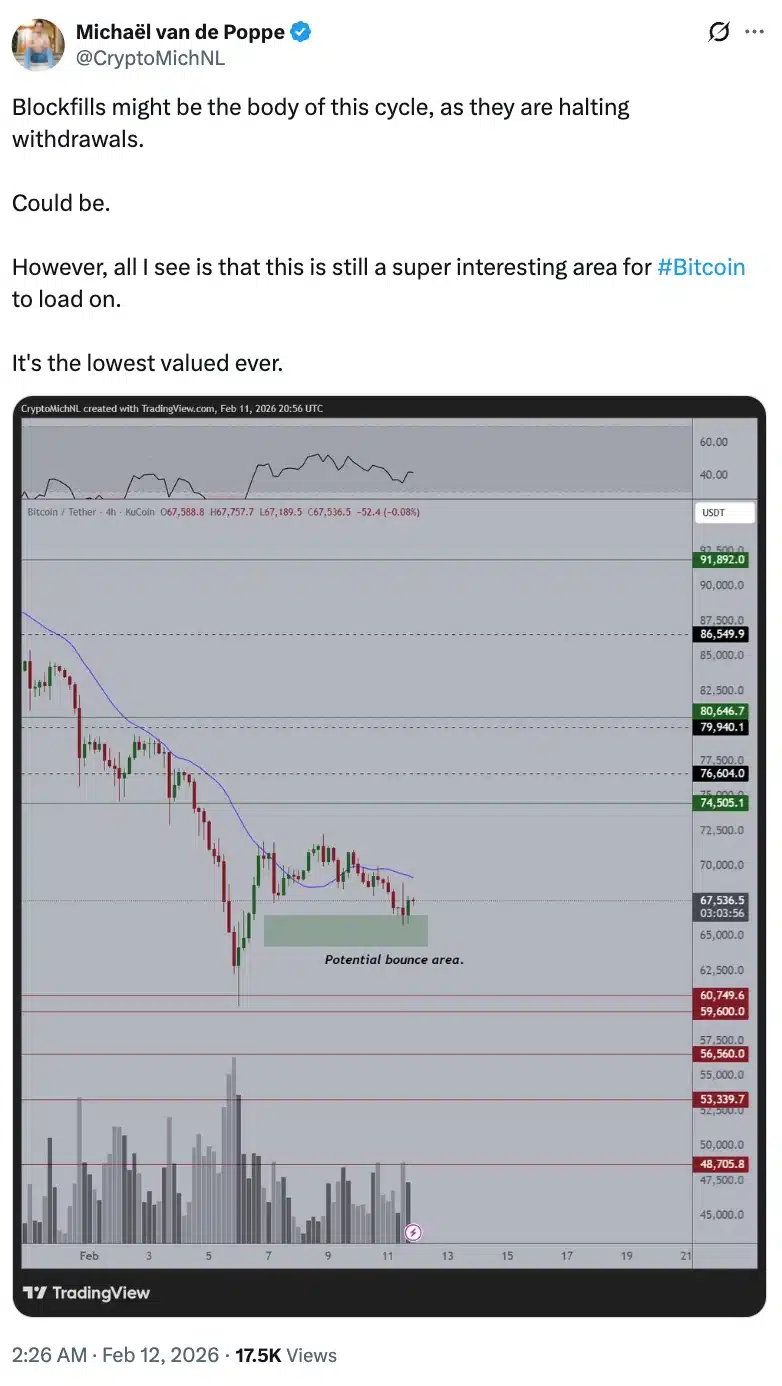
At the same time, there is some positive news due to this incident. Well-known analyst Michaël van de Poppe believes Bitcoin may be close to a strong turning point.

Even though Bitcoin is still around $67,490, he believes that market fear is extremely high right now. Recently, fear levels dropped to just 7 – A sign that many investors are worried.

Van de Poppe compared the current situation to the 2020 COVID crash, when prices fell sharply before recovering. He believes Bitcoin is now oversold and may be ready to bounce back.

If key support levels hold, BTC’s price could still move towards $100,000 in the coming months.

Source: Michaël van de Poppe/X
Former chairman of the National Vocational and Technical Training Commission, Javed Hassan, also weighed in. He noted,

“Thanks to Trump and his bandito family, this latest scam has full institutional respectability. Wall Street has adopted it. Yup, the same bunch of sharks who packaged subprime sh*t under exotic wrappers like: Mortgage-Backed Securities (MBS) , CDO, CDS, etc. Once again there’s the anything goes regulatory shrug.”

Past triggers

The pause in activity at BlockFills brings back memories of Celsius Network and Voyager Digital – Both of which collapsed after freezing user funds.

Binance [BNB] also experienced a similar situation in 2025, when it temporarily restricted withdrawals during market turmoil.

This coincided with recent data from Santiment as retail traders are full of doubt and fear right now. In fact, negative posts on social media are at a four-year high too.

Thus, for now, it is still unclear whether BlockFills is facing a small, temporary cash problem or something more serious. In the coming days, how open the company is with its 2,000+ institutional clients will matter the most.


Final Thoughts

  • Pausing withdrawals may protect the company in the short term, but it has clearly shaken investor confidence.
  • Memories of past failures like Celsius Network and Voyager Digital are making investors extra cautious.


Domande pertinenti

QWhy did BlockFills pause all deposits and withdrawals?

ABlockFills paused all client deposits and withdrawals due to unstable market and financial conditions following a sharp drop in Bitcoin's price.

QHow much trading volume did BlockFills handle in 2025, and how many clients did it serve?

AIn 2025, BlockFills handled $61.1 billion in trades and worked with over 2,000 institutional clients worldwide.

QAccording to analyst Michaël van de Poppe, what does the current market fear level indicate for Bitcoin's price?

AMichaël van de Poppe believes the extreme fear, with levels dropping to just 7, indicates that Bitcoin is oversold and may be close to a strong turning point, potentially bouncing back towards $100,000 if key support levels hold.

QHow does the BlockFills situation differ from typical crypto exchange failures in terms of affected users?

AUnlike typical crypto exchange failures that most severely impact small retail traders, the BlockFills situation is primarily a problem for large institutions with significant money at stake.

QWhich past crypto company failures does the article mention as similar to the current BlockFills incident?

AThe article mentions that the pause in activity at BlockFills brings back memories of the collapses of Celsius Network and Voyager Digital, which also froze user funds before failing.

Letture associate

380,000 Apps Exposed, 2,000+ Apps Leaked Secrets: AI Programming Turns 'Intranet' into Public Internet

Israeli cybersecurity firm RedAccess uncovered a severe data exposure trend linked to "vibe coding" or AI-powered software development tools. Their research found approximately 38,000 publicly accessible web applications built with platforms like Lovable, Base44, Netlify, and Replit. Of these, an estimated 2,000 apps exposed sensitive corporate and personal data, including medical records, financial information, internal strategic documents, and customer chat logs. In some cases, access even granted administrative privileges. The core issue stems from default privacy settings that make applications public by default, combined with a lack of built-in security controls (like authentication) in the AI-generated code. This allows employees without security expertise—"citizen developers"—to easily create and deploy applications that bypass standard corporate security reviews. The exposed apps, often indexed by search engines, are trivially discoverable. While some platform providers (Replit, Lovable, Wix/Base44) argue that security configuration is the user's responsibility and question the validity of some findings, security researchers confirm the widespread reality of such exposures. This pattern, also noted in prior studies, highlights a critical security gap as AI democratizes app creation, potentially leading to massive, unintentional data leaks.

marsbit21 min fa

380,000 Apps Exposed, 2,000+ Apps Leaked Secrets: AI Programming Turns 'Intranet' into Public Internet

marsbit21 min fa

Attracting Global Capital, Asia's New 'Super Cycle' Is Unfolding

Investors are turning to Asia as the next frontier for global equity growth, with a new "super cycle" unfolding across the region. Driven by the AI revolution, Asian markets, particularly South Korea, have seen significant rallies. According to Morgan Stanley analysis, the underlying drivers of Asia's industrial cycle are shifting from traditional sectors like real estate and manufacturing to massive investments in AI infrastructure, energy security and transition, and supply chain resilience. Fixed asset investment in Asia is projected to grow from around $11 trillion in 2025 to $16 trillion by 2030, with a 7% annual growth rate from 2026-2030. The AI wave is a primary catalyst, driving immense capital expenditure for chips, servers, data centers, and power systems. Asia is central to this hardware supply chain. In China, AI investment is focused on building a full-system domestic capability, with the local AI chip market potentially reaching $86 billion by 2030. Beyond AI, China's export story is expanding from EVs and batteries to robotics. The country already captures about half of new global industrial robot demand and over 90% of humanoid robot shipments. This growth phase mirrors the early stages of China's EV export boom. Simultaneously, energy security investments, spurred by AI's massive power needs, are rising, with China benefiting from its leadership in solar, batteries, and EVs. Regional defense spending is also increasing structurally, supporting demand for advanced manufacturing. The main beneficiaries are China, South Korea, and Japan, positioned in core supply chain areas. However, risks remain, including potential overcapacity, profit margin pressures from competition, persistent technological restrictions, geopolitical friction, and workforce displacement due to AI-driven automation. Market volatility is also expected to increase as investor expectations diverge on the realization of these capital investment and export themes.

marsbit21 min fa

Attracting Global Capital, Asia's New 'Super Cycle' Is Unfolding

marsbit21 min fa

Funding Weekly Report | 14 Public Funding Events, Kalshi Completes $10B New Funding Round at $220B Valuation Led by Coatue Management

Weekly Funding Roundup: 14 Deals and $10.49B+ in Total Funding, Led by Kalshi's $1B Round Last week (5.4-5.10) saw 14 notable funding events in the global blockchain ecosystem, raising over $10.49 billion in total. Key highlights include Kalshi, a prediction market platform, securing a $1 billion round led by Coatue Management, reaching a $22 billion valuation. The platform now boasts ~2 million MAUs and $178B in annualized trading volume. In DeFi, regulated on-chain reinsurer OnRe raised $5 million in Series A funding, and Bitcoin-backed credit protocol Saturn Credit completed a $2 million seed round. For Infrastructure & Tools, OpenTrade raised $17 million to expand its stablecoin yield infrastructure, and RWA platform Balcony secured $12.7 million to deploy its property settlement service in the US. Centralized Finance saw one deal: AI-driven trading platform Stockcoin.ai completed a seed round led by Amber Group. In the prediction market sector alongside Kalshi, AI-powered platform Elastics raised $2 million. Other notable deals include SC Ventures' strategic investment in crypto market maker GSR and Centrifuge securing a "seven-figure" investment from Coinbase to become a core RWA partner for Base. On the investor side, Haun Ventures raised a new $1 billion fund targeting crypto and AI, and Multi Investment raised ~$616 million to focus on blockchain and Web3 investments.

marsbit1 h fa

Funding Weekly Report | 14 Public Funding Events, Kalshi Completes $10B New Funding Round at $220B Valuation Led by Coatue Management

marsbit1 h fa

Trading

Spot
Futures
活动图片