Shiba Inu Touches Key Support That Produced 100% Rise in July; What Happens Next

u.todayPubblicato 2022-09-19Pubblicato ultima volta 2022-09-19

Introduzione

Shiba Inu briefly added an extra zero to its price tag on Sept.

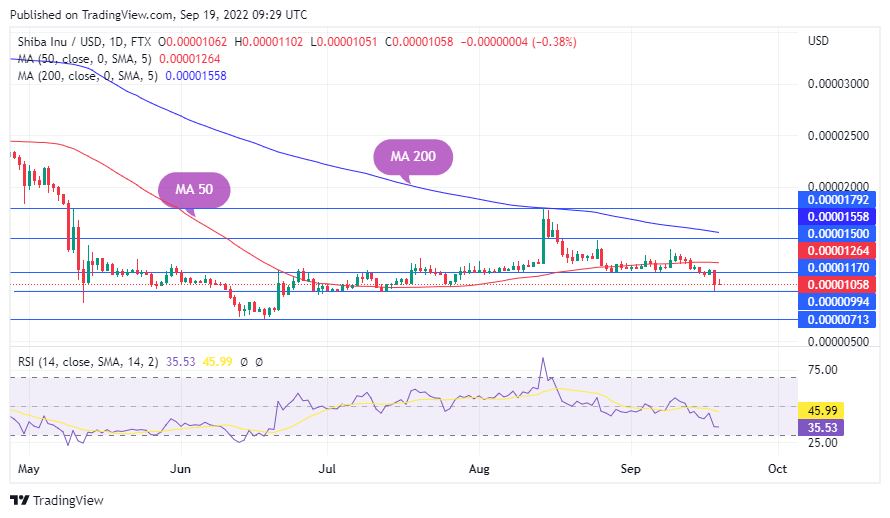
Shiba Inu briefly added an extra zero to its price tag on Sept. 18 as it touched the key support near $0.000009, from where it rallied nearly 100% in July. Shiba Inu gained nearly 100% when it rebounded from July 12 lows of $0.0000098 and reached highs of $0.0000179 on Aug. 14 after a steady climb.
TradingView

SHIB/USD Daily Chart, Courtesy: TradingView At the time of publication, Shiba Inu was down 10% at $0.0000102. Shiba Inu saw a faint rebound after dipping to lows of $0.00000994 the prior day, as bulls lost ground amid the latest price declines on the market. The meme cryptocurrency is dangling around the support at $0.000010, where it trades presently. The next stop might be near the $0.000007 mark if the $0.000009 support falters.
A drop near the $0.000007 level could create a double bottom pattern, which might spur a rise in the short term. To resuscitate SHIB for an uptrend, buyers might have to push the price above the daily MA 50 barrier at $0.0000126 and then the MA 200 barrier at $0.0000155, or the price might return to its current consolidation range. The RSI is approaching oversold levels of 30, which might suggest a relief bounce or at least a dead cat bounce in the short term.
However, given the current macroeconomic uncertainty, the market forecast remains gloomy and, hence, technical indicators might be put to the test.
Crypto market tumbles
Bitcoin and altcoins tumbled as investors weighed the possibility of another 75-basis-point hike from the Fed. Shiba Inu, as well, plunged 10%, mimicking the general market moves.
The two-day meeting of the Fed is scheduled to start on Tuesday, and most market participants anticipate another 75-basis-point increase by the Fed. The Fed could raise interest rates by one full point, or 100 basis points, according to some economists.
It follows an unanticipated increase in inflation in August. Contrary to what economists predicted, the consumer price index climbed by 0.1% for the month and by 8.3% over the previous year. Investors now anticipate that the Fed will maintain higher interest rates for a longer period until prices decline.
As Shiba Inu remains correlated to the general market movement, it might be necessary to watch out for "macro bottoms" to predict SHIB's next price move.


Letture associate

Bitcoin Trading Strategy Breakdown: Celebrity Predictions and Classic Models All Fail, Only These Four Indicators Remain

Analysis of Bitcoin Trading Strategies: Why Celebrity Forecasts and Classic Models Fail, Leaving Only These Four Reliable Indicators This analysis examines the failure of common Bitcoin prediction methods and identifies four reliable indicators for constructing a trading strategy. The author reviewed all major BTC prediction approaches from 2017-2025, categorizing them into three groups: celebrity price targets (consistently over-optimistic), analytical models like Stock-to-Flow (broken post-2022), and on-chain signals. The key finding is that more data often creates confusion, not clarity. The strategy discards unreliable elements: celebrity predictions (incentivized to be extreme), pure models (invalidated by post-ETF market changes), and the Fear & Greed Index used alone (too many false signals). Four reliable indicators were selected: 1. **MVRV Z-Score:** Accurately identifies cycle bottoms when entering its green zone (e.g., 2018, 2020, 2022). Note: Its ability to call tops is now ineffective post-2024. 2. **SOPR (28-day MA):** Consistently signals bottoms when below 1.0, indicating holders are selling at a loss. 3. **ETF Net Flow:** A crucial post-2024 metric showing institutional momentum (e.g., sustained inflows = buying). 4. **Macro Liquidity (Fed policy & M2):** Sets the overall directional bias (e.g., bullish during easing cycles). The core strategy involves waiting for a multi-signal共振 (resonance). For example, a bottom signal requires MVRV in the green zone + SOPR < 1.0. A top signal requires overheated on-chain data + sustained ETF outflows. Macro policy sets the overall direction. The Fear & Greed Index is only used as a weighted confirmatory signal, never alone. Action is only taken when three or more indicators align. The author automated this into a monitoring system that sends Telegram alerts only when signals trigger. As of the article's date (April 15, 2026), the system showed a strong bottom signal: extreme fear (F&G=12), MVRV in the buy zone, and SOPR < 1.0. The only contrary signal was weak ETF flows. Historically, such triple on-chain共振 has preceded 100%+ returns. The conclusion emphasizes building a personal framework over relying on external predictions, allowing for iterative improvement and customization based on individual risk tolerance.

marsbit1 h fa

Bitcoin Trading Strategy Breakdown: Celebrity Predictions and Classic Models All Fail, Only These Four Indicators Remain

marsbit1 h fa

Trading

Spot
Futures
活动图片