$6 Trillion in Assets On-Chain: Why Canton Network is Wall Street's New Darling

比推Pubblicato 2026-01-09Pubblicato ultima volta 2026-01-09

Introduzione

Canton Network is gaining significant traction as a blockchain platform focused on real-world assets, with reported support for over $6 trillion in on-chain assets and a daily transaction volume of $280 billion. Backed by major traditional finance institutions like DTCC and J.P. Morgan, it functions as an interoperability layer connecting independent networks ("cantons"), similar to Cosmos. The network relies on 13 permissioned "Super Validators" for consensus, many of which are operated by early investors. Canton uses a native utility token, Canton Coin (CC), which is burned as gas fees, creating deflationary pressure. Similar to Bitcoin, it employs a programmed halving schedule—the second halving is imminent, potentially reducing supply and impacting short-term token prices. While its privacy-focused, customizable design appeals to institutional players, concerns remain about centralized control and insider advantages, as Super Validators heavily influence token distribution and featured applications. The upcoming halving presents a speculative opportunity, but long-term value depends on sustainable network utility rather than supply shocks alone.

Source: Bankless

Author: Jack Inabinet

Original Title: How Canton Network Works


Canton Network is quickly becoming the latest focus in the cryptocurrency industry. Does this signal a brewing explosive opportunity in a new wave of L1 ecosystems?

This blockchain, focused on real-world assets, recently made headlines for its high-profile integration with traditional finance giants (including the Depository Trust & Clearing Corporation DTCC and JPMorgan Chase), claiming to support over $6 trillion in on-chain real-world assets and a daily trading volume of $280 billion.

Today, we will delve into the technical architecture and token economic model of the Canton Network to better understand the design logic of this groundbreaking network.

Super Validator-Led Technical Architecture

Canton is essentially an interoperability layer connecting independent networks (these networks are also called "cantons"), with a design philosophy similar to the model in the Cosmos ecosystem that allows independent chains to communicate directly.
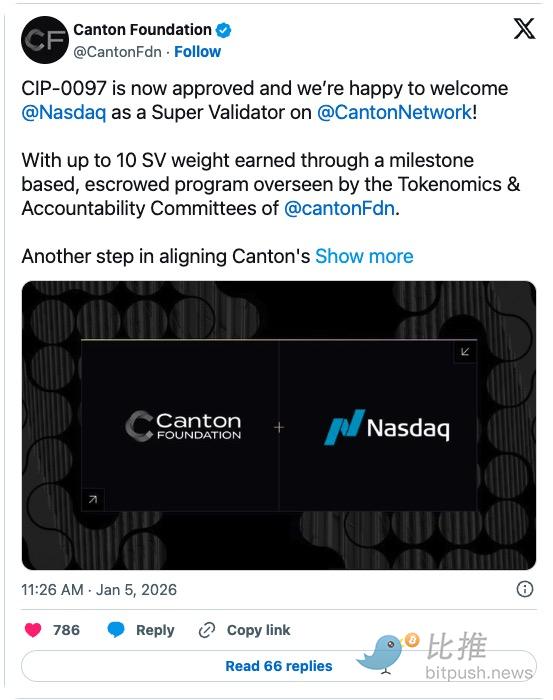
Regarding its consensus mechanism, the Canton Network is validated by an invite-only set of 13 "Super Validator" nodes, many of which are operated by the network's investors. One node is operated by the Canton Foundation, which is composed of early enterprise supporters, brand partners, and investors.

Most activity on the network occurs at the independent "canton" level, similar to how the Osmosis exchange in the Cosmos interoperability ecosystem aggregates the main liquidity and user activity. The validators of these independent cantons are responsible for processing all data on their independent "shard" and enjoy high flexibility in customizing the rules of that independent execution environment, including preferences for gas fees and data sharing.

Due to the inherently opaque design architecture adopted by Canton, the authenticity and sources of its published metrics (such as asset size and transaction volume) are difficult to verify independently.

However, representative independent application cases have emerged in the ecosystem: for example, the recently launched Temple Digital Group exchange, supported by YZi Labs, is operating as an independent Canton sub-network.

Token Economics

The Canton Network is built around its native utility token, Canton Coin (ticker CC), which is designed to "reward actual network usage rather than speculative behavior."

Similar to Ethereum, Canton burns tokens when users pay gas fees, creating deflationary pressure on CC. When the network is used for transactions, settlements, data synchronization, or asset transfers, all fees paid in CC are burned, permanently removed from circulation.

Similar to Bitcoin, Canton employs a programmatic token issuance curve, with regular halving events. New CC tokens can be continuously minted by various network participants by adding "measurable utility" to the network.
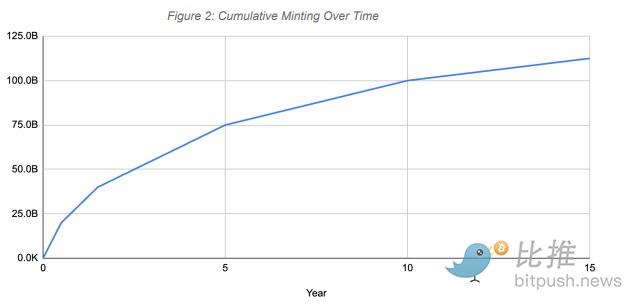
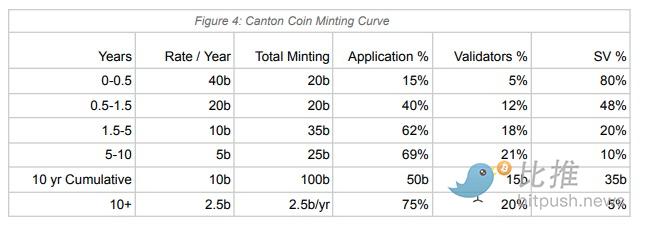
Currently, permitted Canton Super Validators (primarily early investors) are eligible for 48% of the CC issuance as a reward for maintaining global consensus. Validators receive 12% of the total CC supply, allocated mainly based on the value of Canton Coin transfers initiated by their users, and potentially rewarded based on node uptime if the minting cap allows.

Similar to Berachain, Canton also allocates tokens directly to applications in the form of gas fee rebates. "Featured" applications (which can be designated by Super Validators) can mint CC up to 100 times the burned fees, while non-featured applications can mint up to 80% of the burned fees.

It is worth noting that, at the time of writing, CC token minting is still proceeding according to the plan for years 0.5 to 1.5 in the chart below. However, with the second Canton halving scheduled to occur in just three days, the CC minting rate will soon be halved, and its distribution will be adjusted according to the plan for years 1.5 to 5 in the chart below.

For investors seeking trading opportunities, the supply reduction from the CC halving event may, through supply and demand dynamics, push the token price higher in the short term, regardless of the network's fundamental investment thesis.
Conclusion: A Glossy Narrative with Underlying Concerns

Canton undoubtedly presents a compelling investment story, but its potential opportunities are matched by outstanding questions.

Its highly configurable, privacy-focused design holds clear appeal for traditional finance giants, but the network's complex token economic structure and centralized control system introduce significant insider advantages, increasing the risk of imbalanced token distribution.

The permitted Super Validators, through their ability to designate "Featured" applications, continue to wield excessive influence over Canton's issuance. This means the flow of CC tokens will remain heavily controlled by insiders, even though this group's own issuance is set to decrease by approximately 80% within days.

The sudden rise of the Canton Network on the eve of its second halving adds another layer of suspense to the market. In the early halving phases, the supply shock effect is often most pronounced—while the upcoming emission cut for CC creates a clear catalytic opportunity for short-term trading, long-term investors should still view it with caution: the price impact from supply constriction should not be conflated with sustainable fundamental value.


Twitter:https://twitter.com/BitpushNewsCN

Bitpush TG Discussion Group:https://t.me/BitPushCommunity

Bitpush TG Subscription: https://t.me/bitpush

Original link:https://www.bitpush.news/articles/7601459

Domande pertinenti

QWhat is the Canton Network and why is it gaining attention in the cryptocurrency industry?

ACanton Network is a blockchain focused on real-world assets, gaining attention for integrating traditional finance giants like DTCC and JPMorgan, claiming to support over $6 trillion in on-chain real assets and process $280 billion in daily transaction volume.

QHow does Canton Network's technical architecture work, particularly regarding its consensus mechanism?

ACanton Network uses an interoperability layer connecting independent networks called 'cantons', with consensus managed by 13 invitation-only 'Super Validators' nodes, many operated by the network's investors, similar to how Cosmos enables direct communication between independent chains.

QWhat is the role of the native utility token Canton Coin (CC) in the network's economy?

ACanton Coin (CC) is used for paying gas fees, which are burned to create deflationary pressure. It features programmed token issuance with periodic halvings, and new CC can be minted by network participants who add measurable utility, with allocations to validators and featured applications.

QWhat are the potential risks and concerns associated with Canton Network's token economics and control structure?

AConcerns include centralized control by Super Validators who have significant influence over token distribution and featured applications, creating potential insider advantages and risks of imbalanced token allocation, despite the deflationary mechanisms and halving events.

QHow does Canton Network's upcoming halving event impact CC token supply and potential market effects?

AThe upcoming halving will reduce CC issuance by half, potentially creating short-term price increases due to supply shock, but long-term investors should distinguish between supply-driven price effects and sustainable fundamental value.

Letture associate

Stuck Polymarket: The Real Test After Riding the Traffic Boom Has Arrived

Polymarket, a leading prediction market platform, is facing significant technical challenges as its growth outpaces its current infrastructure on Polygon. Users are experiencing laggy transactions, unresponsive orders, and delayed confirmations, severely impacting the trading experience. In response, DeFi Engineering VP Josh Stevens outlined a comprehensive engineering overhaul. The plan includes reducing on-chain data delays, fixing order cancellation issues, rebuilding the central limit order book (CLOB), improving website performance, and developing a unified SDK and API. A major revelation was the ongoing "chain migration," indicating a potential move away from Polygon. The core issue is that Polymarket has evolved from a simple prediction market into a high-frequency trading platform, making Polygon's limitations—such as block space, gas fees, and block time—a ceiling for further growth. The migration is not just a simple chain switch but a fundamental rebuild of its trading system to support more complex products like perpetual contracts (Perps). This announcement has sparked competition among chains like Solana, Sui, and Algorand, all vying to host Polymarket. For Polygon, losing this key application, which contributes significantly to its gas fee revenue, would be a major setback. The real test for Polymarket is no longer attracting users but proving it can provide a stable, reliable trading environment that retains them.

Odaily星球日报10 min fa

Stuck Polymarket: The Real Test After Riding the Traffic Boom Has Arrived

Odaily星球日报10 min fa

Lowering Expectations for BTC's Next Bull Market

The author, Alex Xu, explains his decision to significantly reduce his Bitcoin holdings (from full to ~30% of his portfolio) during the current bull cycle, citing a lowered long-term outlook for BTC's price appreciation in the next cycle. He outlines six key reasons for this reduced expectation: 1. **Diminished Growth Drivers:** The narrative of exponential user adoption has largely played out with institutional ETF adoption. The next major growth phase—adoption by sovereign national reserves or central banks—seems unlikely in the near future. 2. **Personal Opportunity Cost:** More attractive investment opportunities have emerged in other assets, such as undervalued companies. 3. **Industry-Wide Contraction:** The broader crypto industry is struggling, with most Web3 business models (SocialFi, GameFi, DePIN) failing. This overall萧条 (depression) reduces the fundamental demand and consensus for Bitcoin. 4. **Strain on Major Buyer:** MicroStrategy, a major corporate buyer of BTC, faces rising financing expenses for its debt, which could slow its purchasing rate and create significant marginal pressure on the market. 5. **Increased Competition from Gold:** The emergence of "tokenized gold" has closed the functional gap (portability, divisibility) between physical gold and Bitcoin, offering a strong competitor in the non-sovereign store-of-value space. 6. **Security Budget Concerns:** The block reward halving continues to exacerbate the long-standing issue of funding Bitcoin's network security, with new fee source explorations like Ordinals and L2s largely failing. The author's decision to hold a significant (though reduced) position reflects a cautious, not bearish, outlook. He remains open to increasing his exposure if the fundamental reasons for his skepticism change or if new positive catalysts emerge.

marsbit48 min fa

Lowering Expectations for BTC's Next Bull Market

marsbit48 min fa

Can Iran 'Control' the Strait of Hormuz?

Iran has announced a comprehensive plan to assert control over the strategic Strait of Hormuz, a critical global oil shipping chokepoint. The proposed measures include requiring all vessels to obtain Iranian permission for passage, imposing fees for security, environmental protection, and navigation management—preferably paid in Iranian rials—and absolutely banning Israeli ships. Vessels from countries deemed hostile by Iran’s top security bodies may also be barred. Analysts suggest Iran’s motives are multifaceted: increasing pressure on the U.S. and Israel by leveraging control over oil transit to influence global prices and inflation; creating a new revenue stream, potentially exceeding $7.7 billion annually, to counter Western sanctions and support postwar reconstruction; and using transit permissions as bargaining chips in future negotiations, notably with the U.S. However, the plan faces significant practical and diplomatic challenges. Enforcing comprehensive interception and fee collection in the busy waterway, patrolled by international military forces, would be difficult. The U.S. has already countering with a blockade of Iranian ports and threats to intercept any ship paying fees, potentially strangling Iran’s oil exports and fee revenue. Broad international opposition, led by European and Gulf states, and legal controversies further complicate implementation. The proposal may ultimately serve more as a negotiating tactic than a feasible policy, with its execution remaining highly uncertain.

marsbit1 h fa

Can Iran 'Control' the Strait of Hormuz?

marsbit1 h fa

Trading

Spot
Futures
活动图片