$6 Trillion Deposit Drain Theory Sends Banking Industry into Panic

marsbitPubblicato 2026-01-20Pubblicato ultima volta 2026-01-20

Introduzione

The article discusses how the U.S. CLARITY Act, which prohibits crypto exchanges from paying yields on payment stablecoins, is part of a broader effort to protect traditional banks' profitable net interest margins. Large banks like JPMorgan benefit from near-zero deposit rates while earning significantly higher returns by investing in assets like Treasury bills. The banking industry warns that stablecoin yield offerings could lead to $6.6 trillion in deposit outflows, harming lending capacity. However, the article argues that these funds often remain within the traditional financial system, as stablecoin reserves are held in cash and short-term Treasuries. The real concern for banks is competition from higher-yielding alternatives like USDC rewards and DeFi protocols, which force them to offer better rates. This situation mirrors historical debate around Regulation Q and the rise of money market funds in the 1970s. The stablecoin market has grown rapidly, reflecting demand for digital dollars that offer both liquidity and yield. The author suggests that, much like money market funds, stablecoin yields represent a technological shift that benefits consumers and will likely be adopted despite resistance from incumbent institutions.

Written by: Kolten

Compiled by: AididiaoJP, Foresight News

The U.S. CLARITY Act has sparked a discussion about the future of money and banking. A core provision of the bill is: prohibiting digital asset service providers, such as cryptocurrency exchanges, from paying yields to their customers solely for holding "payment stablecoins."

This ban on third-party platforms is actually an extension of the 2025 GENIUS Act, which already prohibited stablecoin issuers themselves from paying interest. The banking industry supports these measures to protect its lucrative "spread" income.

Simply put, the traditional bank model is: attract deposits with low interest rates, then lend or invest in assets like government bonds at higher rates. The difference between the interest earned and the interest paid is the bank's net interest margin (or spread).
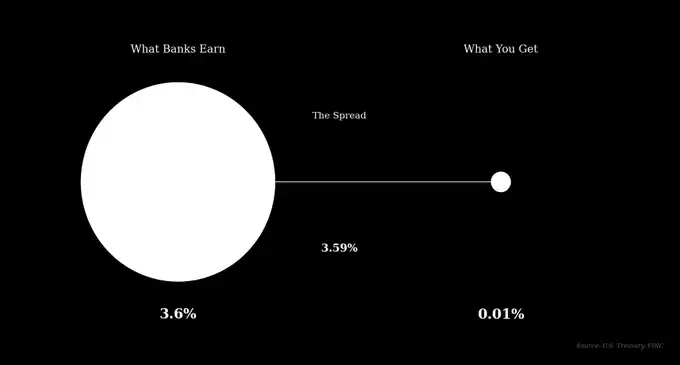
This model is highly profitable. For example, in 2024, JPMorgan Chase reported revenue of $180.6 billion and a net profit of $58.5 billion, with net interest income of $92.6 billion being the primary contributor.
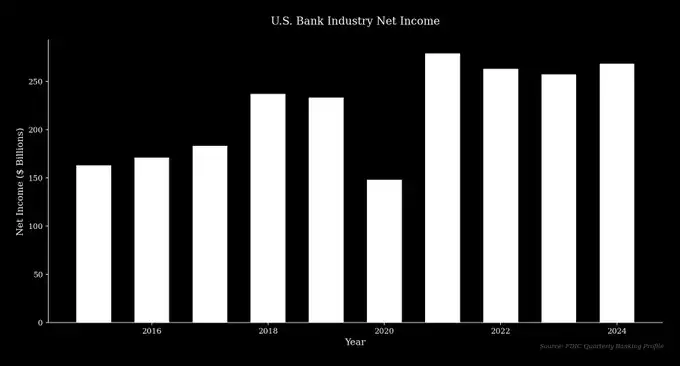
Emerging fintech provides depositors with direct channels to obtain higher yields, introducing competitive pressure that the banking industry has long avoided. Consequently, some large traditional banks are attempting to protect their business models through regulatory means—a strategy that is both logical and has historical precedent.

The Division in Banking

As of early 2026, the average annualized interest rate for U.S. savings accounts was 0.47%, while basic savings account rates at major banks like JPMorgan Chase and Bank of America were only 0.01%. During the same period, the risk-free 3-month U.S. Treasury yield was about 3.6%. This means major banks can absorb deposits, buy Treasuries, and easily earn a spread of over 3.5%.
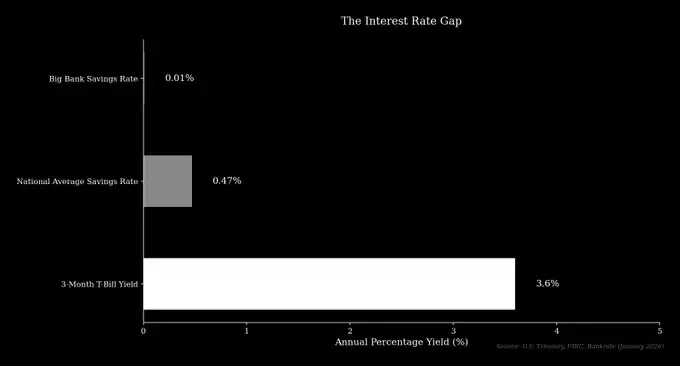
JPMorgan Chase has deposits of approximately $2.4 trillion; theoretically, this spread alone could generate over $85 billion in income. While a simplified calculation, it sufficiently illustrates the point.
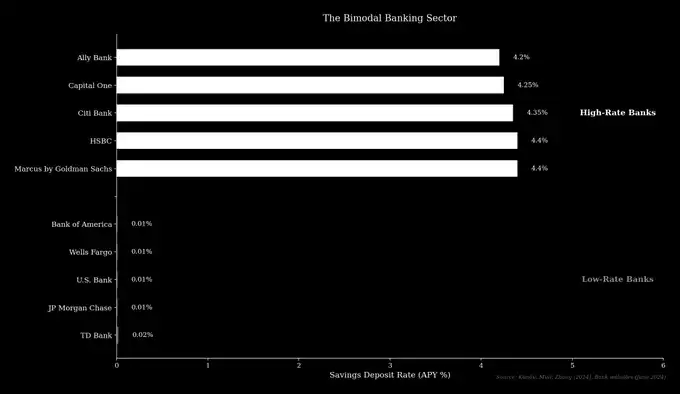
Since the global financial crisis, the banking industry has gradually divided into two types of institutions:

  • Low-rate banks: Typically large traditional banks that attract deposits from rate-insensitive customers through extensive branch networks and brand recognition.
  • High-rate banks: Such as Goldman Sachs' Marcus, Ally Bank, etc., mostly online banks that compete by offering deposit rates close to market levels.

Research shows the deposit rate disparity among the top 25 U.S. banks has widened from 0.70% in 2006 to over 3.5% currently.
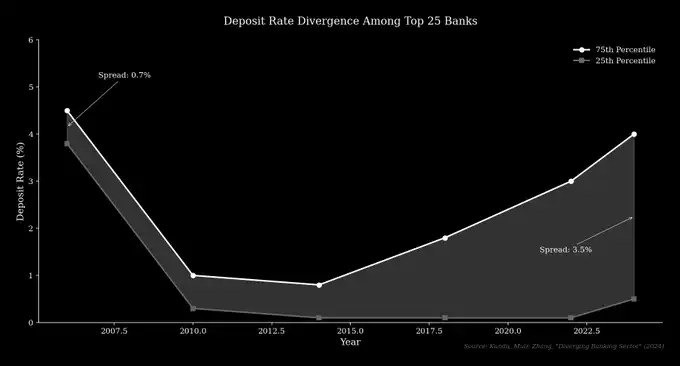
The profitability of low-rate banks is fundamentally based on depositors who do not actively seek higher returns.

The "$6 Trillion Deposit Drain Theory"

Banking groups claim that allowing stablecoins to pay yields could lead to "deposit outflows" of up to $6.6 trillion, draining credit resources from the economy. The CEO of Bank of America stated at a conference in January 2026: "Deposits are not just a conduit for funds; they are a source of credit. Outflows of deposits will weaken banks' lending capacity, forcing them to rely more on costlier wholesale funding."

He argued that small and medium-sized businesses would be the first affected, while Bank of America itself would be "less impacted." This argument equates stablecoins absorbing deposits with funds leaving the banking system, but this is not always the case.

When a customer buys stablecoins, dollars are transferred into the issuer's reserve account. For example, USDC's reserves are managed by BlackRock and held in cash and short-term U.S. Treasuries. These assets remain within the traditional financial system—the total amount of deposits may not decrease, they merely shift from individual accounts to issuer accounts.

The Real Concern

What the banking industry truly fears is: deposits flowing from their own low-interest accounts to higher-yielding alternatives. For example, Coinbase's USDC rewards or DeFi products like Aave offer yields far exceeding those of most banks. For the customer, it's a choice between keeping money at a major bank earning 0.01% or converting to stablecoins earning over 4%—a difference of more than 400 times.

This trend is changing depositor behavior: funds are moving from transactional accounts to interest-bearing accounts, and depositors are becoming more rate-sensitive. A fintech analyst points out: "The real competitor for banks is not stablecoins, but other banks. Stablecoins are merely accelerating competition among banks, ultimately benefiting consumers."

Research also confirms: when market interest rates rise, deposits flow from low-rate banks to high-rate banks. And high-rate banks are expanding their personal and business lending operations—the capital flows brought by stablecoins will likely have a similar effect, directing capital to more competitive institutions.

History Repeats Itself

The current debate over stablecoin yields closely resembles the controversy surrounding "Regulation Q" last century. This regulation set a cap on bank deposit rates, aiming to prevent "excessive competition." In the high-inflation, high-interest environment of the 1970s, market rates far exceeded the cap, harming depositor returns.

In 1971, the first money market fund was created, allowing depositors to earn market returns and support check payments. Similarly, protocols like Aave now allow users to earn yields without going through a bank. Money market fund assets surged from $45 billion in 1979 to $180 billion two years later, and now exceed $8 trillion.

Banks and regulators initially resisted money market funds as well, but the interest rate caps were eventually abolished for being unfair to depositors.

The Rise of Stablecoins

The stablecoin market is also experiencing rapid growth: its total market capitalization soared from $4 billion in early 2020 to over $300 billion in 2026. The largest stablecoin, USDT, saw its market cap surpass $186 billion in 2026. This reflects market demand for "digital dollars that are freely transferable and can earn yield."

The debate over stablecoin yields is essentially a modern version of the money market fund debate. The banks opposing stablecoin yields are primarily the low-rate traditional banks that benefit from the current system. Their goal is to protect their own business model, while this new technology clearly offers more value to consumers.

History shows that technology providing a better solution will eventually be embraced by the market. Regulators need to decide: whether to facilitate this transition or delay its progress.


Domande pertinenti

QWhat is the core provision of the US CLARITY Act mentioned in the article?

AThe core provision of the US CLARITY Act is to prohibit digital asset service providers, such as cryptocurrency exchanges, from paying yields to their customers solely for holding payment stablecoins.

QWhy do traditional banks support the CLARITY Act and the earlier GENIUS Act?

ATraditional banks support these acts to protect their profitable net interest margin (or spread) income. They aim to prevent competition from fintech alternatives that offer customers higher yields, which could cause deposits to flow out of their low-interest accounts.

QWhat is the '6.6 trillion dollar deposit outflow theory' proposed by banking groups?

ABanking groups claim that if stablecoins are allowed to pay yields, it could lead to a massive outflow of up to $6.6 trillion in deposits from the banking system, potentially reducing the availability of credit in the economy.

QHow does the article compare the current debate over stablecoin yields to a historical financial regulation?

AThe article compares it to the debate over Regulation Q, which set caps on bank deposit rates. In the 1970s, money market funds emerged to offer market yields to depositors, similar to how stablecoins and DeFi protocols now offer higher returns, leading to the eventual abolition of those caps.

QWhat has been the growth trend of the stablecoin market since 2020 according to the article?

AThe stablecoin market has experienced rapid growth, with its total market capitalization surging from $4 billion in early 2020 to over $300 billion by 2026, with USDT's market cap alone exceeding $186 billion.

Letture associate

Gensyn AI: Don't Let AI Repeat the Mistakes of the Internet

In recent months, the rapid growth of the AI industry has attracted significant talent from the crypto sector. A persistent question among researchers intersecting both fields is whether blockchain can become a foundational part of AI infrastructure. While many previous AI and Crypto projects focused on application layers (like AI Agents, on-chain reasoning, data markets, and compute rentals), few achieved viable commercial models. Gensyn differentiates itself by targeting the most critical and expensive layer of AI: model training. Gensyn aims to organize globally distributed GPU resources into an open AI training network. Developers can submit training tasks, nodes provide computational power, and the network verifies results while distributing incentives. The core issue addressed is not decentralization for its own sake, but the increasing centralization of compute power among tech giants. In the era of large models, access to GPUs (like the H100) has become a decisive bottleneck, dictating the pace of AI development. Major AI companies are heavily dependent on large cloud providers for compute resources. Gensyn's approach is significant for several reasons: 1) It operates at the core infrastructure layer (model training), the most resource-intensive and technically demanding part of the AI value chain. 2) It proposes a more open, collaborative model for compute, potentially increasing resource utilization by dynamically pooling idle GPUs, similar to early cloud computing logic. 3) Its technical moat lies in solving complex challenges like verifying training results, ensuring node honesty, and maintaining reliability in a distributed environment—making it more of a deep-tech infrastructure company. 4) It targets a validated, high-growth market with genuine demand, rather than pursuing blockchain integration without purpose. Ultimately, the boundaries between Crypto and AI are blurring. AI requires global resource coordination, incentive mechanisms, and collaborative systems—areas where crypto-native solutions excel. Gensyn represents a step toward making advanced training capabilities more accessible and collaborative, moving beyond a niche controlled by a few giants. If successful, it could evolve into a fundamental piece of AI infrastructure, where the most enduring value in the AI era is often created.

marsbit6 h fa

Gensyn AI: Don't Let AI Repeat the Mistakes of the Internet

marsbit6 h fa

Why is China's AI Developing So Fast? The Answer Lies Inside the Labs

A US researcher's visit to China's top AI labs reveals distinct cultural and organizational factors driving China's rapid AI development. While talent, data, and compute are similar to the West, Chinese labs excel through a pragmatic, execution-focused culture: less emphasis on individual stardom and conceptual debate, and more on teamwork, engineering optimization, and mastering the full tech stack. A key advantage is the integration of young students and researchers who approach model-building with fresh perspectives and low ego, prioritizing collective progress over personal credit. This contrasts with the US culture of self-promotion and "star scientist" narratives. Chinese labs also exhibit a strong "build, don't buy" mentality, preferring to develop core capabilities—like data pipelines and environments—in-house rather than relying on external services. The ecosystem feels more collaborative than tribal, with mutual respect among labs. While government support exists, its scale is unclear, and technical decisions appear driven by labs, not state mandates. Chinese companies across sectors, from platforms to consumer tech, are building their own foundational models to control their tech destiny, reflecting a broader cultural drive for technological sovereignty. Demand for AI is emerging, with spending patterns potentially mirroring cloud infrastructure more than traditional SaaS. Despite challenges like a less mature data industry and GPU shortages, Chinese labs are propelled by vast talent, rapid iteration, and deep integration with the open-source community. The competition is evolving beyond a pure model race into a contest of organizational execution, developer ecosystems, and industrial pragmatism.

marsbit8 h fa

Why is China's AI Developing So Fast? The Answer Lies Inside the Labs

marsbit8 h fa

3 Years, 5 Times: The Rebirth of a Century-Old Glass Factory

Corning, a 175-year-old glass company, is experiencing a dramatic revival as a key player in AI infrastructure, driven by surging demand for high-performance optical fiber in data centers. AI data centers require vastly more fiber than traditional ones—5 to 10 times as much per rack—to handle high-speed data transmission between GPUs. This structural demand shift, coupled with supply constraints from the lengthy expansion cycle for fiber preforms, has created a significant supply-demand gap. Nvidia has invested in Corning, along with Lumentum and Coherent, in a $4.5 billion total commitment to secure the optical supply chain for AI. Corning's competitive edge lies in its expertise in producing ultra-low-loss, high-density, and bend-resistant specialty fiber, which is critical for 800G+ and future 1.6T data rates. Its deep involvement in co-packaged optics (CPO) with partners like Nvidia further solidifies its position. While not the largest fiber manufacturer globally, Corning's revenue from enterprise/data center clients now exceeds 40% of its optical communications sales, and it has secured multi-year supply agreements with major hyperscalers including Meta and Nvidia. Financially, Corning's optical communications revenue has surged, doubling from $1.3 billion in 2023 to over $3 billion in 2025. Its stock price has risen nearly 6-fold since late 2023. Key future catalysts include the rollout of Nvidia's CPO products and the scale of undisclosed customer agreements. However, risks include high current valuations and potential disruption from next-generation technologies like hollow-core fiber. The company's long-term bet on light over electricity, maintained even through the telecom bubble crash, is now being validated by the AI boom.

marsbit8 h fa

3 Years, 5 Times: The Rebirth of a Century-Old Glass Factory

marsbit8 h fa

Trading

Spot
Futures
活动图片




