Bitcoin drill drops sharply, and bad news of interest rate increase is still on the way

HuobiPubblicato 2022-09-14Pubblicato ultima volta 2022-09-19

Introduzione

Inflation remains high, the expectation of the Federal Reserve to raise interest rates is enhanced, and bad news is on the way.

1. The Federal Reserve's forecast of interest rate increase is one-sided

On September 13, the US August CPI data showed that the overall CPI rose 0.1% month on month (QoQ), 0.1 percentage points higher than that in July; CPI rose 8.3% year on year (without quarterly adjustment), lower than the 8.5% year-on-year increase in July, but still higher than the market expectation.

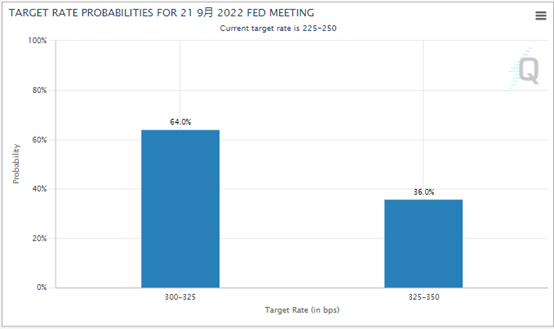
As a result, investors' anticipation of the Federal Reserve's interest rate hike has heated up. According to the "Fed Watch" tool of the Chicago Mercantile Exchange Group (CME), 64% of investors are betting that they will raise interest rates by 75 basis points in July. The proportion of investors betting that the Federal Reserve will raise interest rates by 100 basis points in July was 36%. Judging from the size of investors' bets, there is no doubt that the Federal Reserve will raise interest rates by more than 75% basis points. Compared with the 75 basis points increase on June 16 and July 27, the fact that the Federal Reserve will raise interest rates by 75 basis points for the third time will come next.

To reduce inflation to the benchmark target interest rate of 2%, the Federal Reserve has raised interest rates for four consecutive times this year, and the federal funds rate is currently 2.25% - 2.50%.
2. The US dollar soared and BTC fell to a low level

Affected by the expected rise in interest rates, the overall market shock space has significantly increased.

On September 13, the three major indexes of US stocks opened at a low price and moved at a low price, the biggest drop since June 11, 2020. By the end of the day, the Dow had dropped 3.94%; The S&P 500 index fell 4.32%; The Nasdaq fell 5.16%.

Excluding the initial stage of the epidemic, the Nasdaq and the S&P 500 index fell the most on Tuesday since 2011.

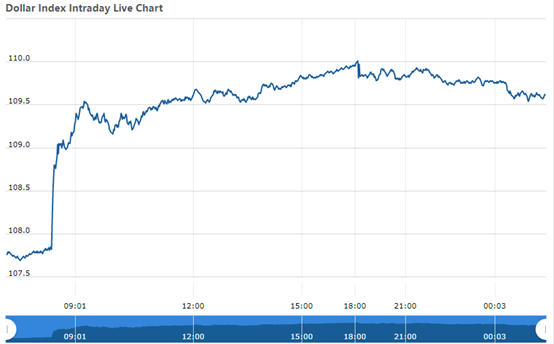
Of course, the most important fluctuation occurred in the change of the US dollar index. The US dollar index, which measures the US dollar against six major currencies, soared 1.52%, reaching a high of 109.97 at the highest level. At the same time, although BTC is not one of the six currencies measured by the dollar index, its withdrawal from the outside still makes investors see the shock effect of financial market linkage.
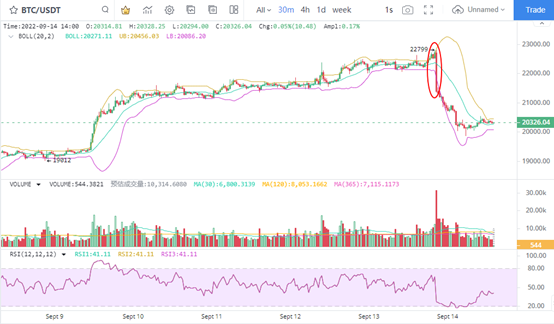
From the 30 minute K line chart of BTC, the fact that the BTC price collapsed instantaneously shows that bad news is imminent, and short-term bearish continues to release investors' worries about interest rate hikes.

BTC linked with the strong shock of the dollar index in the 30 minute K line chart, and the price fell by 5.79% in half an hour, and there was a rare large-scale performance recently. Next, it hit the lowest intraday low of $19860, with a cumulative decline of more than 11%.
3. Price performance of previous interest rate increases

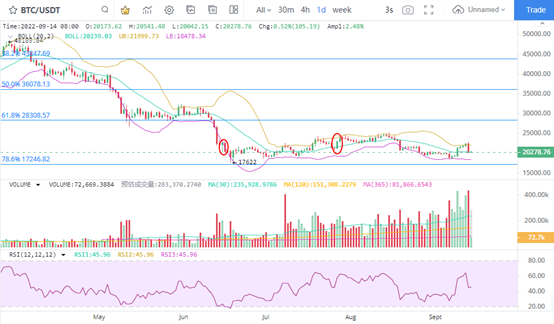
In fact, the adjustment of BTC has not ended since 2022. During the two interest rate hikes by the Federal Reserve in June and June, BTC showed different trend characteristics. The price fell 9.66% on June 16 and rose 7.99% on July 27. Before the interest rate increase on September 22, BTC prices showed a significant large-scale retreat at the daily K-line level, sweeping away the strong price performance of nearly a week. Considering that the fluctuation range of BTC is relatively limited in the past three months, the short-term price retreat may bring the inevitable fact of price decline.
4. Does the market release selling pressure in advance

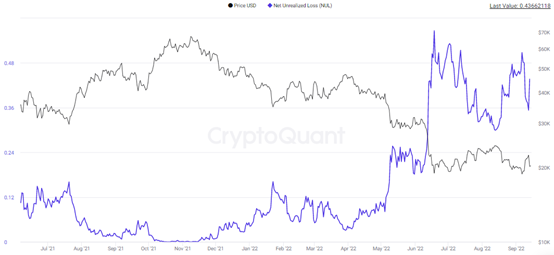
To judge whether BTC will release the selling pressure in a short period of time, we need to pay attention to the size of BTC's hold. In recent years, although BTC has continued to rebound technically, the size of the holding plate has declined rapidly, and the overall proportion is still high. The figures on September 13 showed that there were as many as 43.6% of unrealized losses. Under the negative expectation, it is very difficult for BTC to reduce the size of its hold ups in a short period of time. What's more, the current size of BTC's hold ups is the highest in the past three years.
5. Main selling of BTC spot

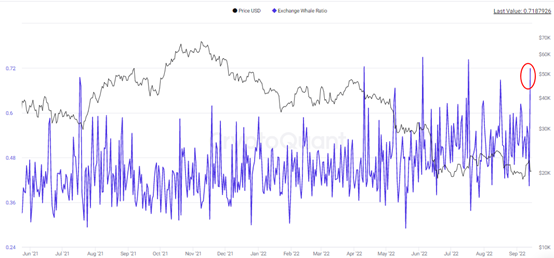
In terms of spot goods, the number of whales sold by BTC has obviously increased. On September 13, the proportion of the number of giant whales sold rose to 0.718, reaching a high level within a year. Specifically, the ratio of the top ten inflows to the total inflows rebounded to 71.8%, which was only lower than 0.723 on April 10, 0.749 on June 4 and 0.742 on July 17.

The selling volume of the giant whale increased significantly, and the selling pressure in the key rebound stage increased, and the market was on the verge of continuous price decline.
6. ETH market performance

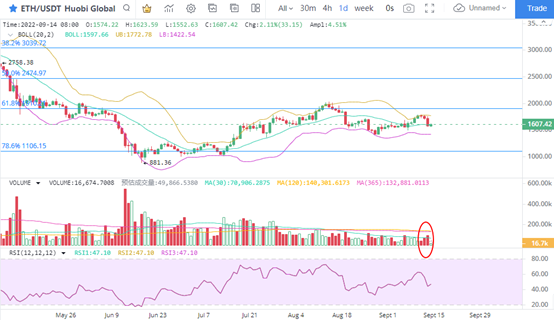
The ETH price continued to retreat in the short term, falling for three consecutive trading days, and the trading volume also rebounded. In terms of decline, the decline reached 12% in three trading days. From the perspective of rebound space, the current ETH price has not reached the previous high of more than $2000, indicating that the recent rebound is not strong enough, and there is an opportunity for the market to change in the weak market. In the shrinking trend, after ETH has dropped in volume for three consecutive trading days, it means that the possibility of price adjustment is still large.
7. A large number of ETH flows into the exchange

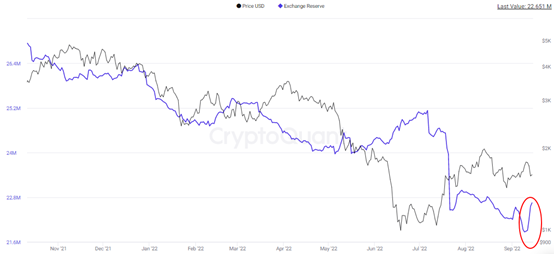
The number of ETHs flowing into the exchange increased significantly, from 21.86 million on September 9 to 22.65 million on September 14, an increase of 790000 ETHs, worth more than 1.3 billion dollars. Judging from the speed of ETH flowing into the exchange, it may be the fastest inflow performance in the year. Therefore, for the growth of selling pressure, investors in short-term trading can pay attention to the pace of price adjustment.
Letture associate

Ethereum Reduced to a Chinese Concept Stock

The article titled "Ethereum Becomes a Chinese Concept Stock" presents a critical analysis of Ethereum's perceived decline in market confidence and its structural parallels to Chinese companies listed on US stock exchanges. It begins by noting significant sell-offs by early investors like Wanxiang and key figures like Bankless's Hoffman in 2026, despite Ethereum's strong fundamental activity. The piece questions the erosion of trust in Vitalik Buterin and the Ethereum Foundation (EF), arguing that while other ecosystems have faced founder controversies, Ethereum's issues stem from its internal governance model. The author draws a direct comparison to "China concept stocks," which are Chinese businesses operating globally but reliant on foreign capital and listings. Similarly, Ethereum, funded early by Chinese capital like Wanxiang, developed a strong institutional framework from its IXO to its PoS transition. The core problem, according to the article, is a leadership vacuum regarding price and direction. Vitalik's move to make the EF smaller and less active is framed as a mistake. While he advocates for ETH as a "commodity," the ecosystem lacks a clear entity to steward its price stability, creating tension within the PoS system, as seen with Lido's challenges. The narrative suggests that excessive abstraction and a hands-off approach from the EF have left the community adrift, contrasting with more proactive foundations like Solana's. The article then examines emerging technical narratives for Ethereum: privacy (ZK-proofs), AI integration, and a refocus on Layer-1. However, it observes a shift from Ethereum leading as a "world computer" to merely adapting to trends like AI, where crypto-native projects are finding success independently of Ethereum. The piece posits that Ethereum's unique value in an increasingly fragmented world may be as a permissionless, global financial testing ground—a neutral platform amid geopolitical tensions. In conclusion, it asserts that Ethereum's fate mirrors that of China concept stocks: an asset born from one region (conceptually "A"), funded by another ("B"), and dependent on "B" for exit liquidity. While Ethereum's "golden age" may be over, and selling pressure from early backers will continue, it remains positioned as a critical linkage point in a divided global landscape, standing at a new, albeit uncertain, starting point.

marsbit18 min fa

Ethereum Reduced to a Chinese Concept Stock

marsbit18 min fa

AI Agents Fundamentally Transform Web3 Gaming: From the Rugpull Bakery Bot Controversy to the New Agent Paradigm in 2026

AI Agents Are Redefining Web3 Gaming: From the Rugpull Bakery Bot Controversy to the 2026 Agentic Paradigm The recent controversy in Rugpull Bakery, a competitive baking game on Abstract chain, highlighted a pivotal shift. Player complaints about unfair bot automation in Season 2 led developers to not ban them, but instead formally integrate AI agents as core gameplay in Season 3, providing official guides (skill.md, agent.json). This move signals Web3 gaming's transition into the "Agentic Gaming" era, where AI agents are sovereign entities with independent strategy and economic rights, moving beyond simple automation. By 2026, AI agent integration has evolved into three core models reshaping the ecosystem: 1. **Autonomous Competitors & Economic Entities:** Agents act as independent players. Examples include TEN Protocol's poker-playing agents, AI Arena's trainable NFT fighters, Satoshi Strike Force's "Digital Athletes" trained on player data, and Somnia's "Agentic L1" blockchain providing native infrastructure for millions of autonomous agents. 2. **Modular Infrastructure & Programmable Environments:** Games like EVE Frontier enable "server-side modding," allowing AI agents to program game world logic directly into structures like smart storage, turrets, and stargates via Smart Assemblies. Coupled with standards like ERC-8183, which enables autonomous job creation and payment between agents, in-game infrastructure gains a "commercial soul." 3. **Hybrid Companions & Dynamic Adaptive Worlds:** This model focuses on human-AI collaboration. In Parallel Colony, players guide highly autonomous AI Avatars with unique personalities and goals. Illuvium plans to use AI to transform NPCs into dynamic, context-aware entities that create personalized, emergent narratives. The conclusion is clear: blocking automation is futile. The future lies in leveraging blockchain's transparency and programmability to empower AI agents as first-class citizens. Web3 gaming is shifting from inefficient human labor to efficient algorithmic interplay and emergent intelligence, creating a "post-human" digital frontier where players become commanders and symbiotic partners in a new socioeconomic experiment.

marsbit19 min fa

AI Agents Fundamentally Transform Web3 Gaming: From the Rugpull Bakery Bot Controversy to the New Agent Paradigm in 2026

marsbit19 min fa

Where Did China's Q1 AI Funding Exceeding 100 Billion RMB Go?

In Q1 2026, China's AI sector raised over 110 billion yuan (approximately $152 billion) across nearly 600 financing deals, a 185.4% year-on-year increase. Major recipients included large model companies and embodied AI firms. Approximately 30-50% of funding was allocated to computing power (GPU procurement and cloud services), highlighting its critical role as a barrier to entry. Significant portions also went to R&D and global talent acquisition. In the large model sector, three key players emerged with distinct strategies: Moonshot AI (valued at $20 billion) pursued an open-source route, achieving rapid commercialization with its Kimi K2.5 model. StepFun (raising billions) focused on a trillion-parameter foundation model and terminal device integration, backed by smartphone supply chain capital. DeepSeek, launching its first funding round at a $45 billion valuation, maintained its open-source, cost-effective approach, now attracting state fund interest. The embodied AI sector saw over 50 deals totaling around 20 billion yuan, creating over 10 unicorns with valuations exceeding 10 billion yuan each. Leading companies like Galaxy General, Qianxun AI, Independent Variable Robotics, and Zhi Jian Power secured major funding, with some beginning initial product deliveries. However, a gap between high valuations and actual revenue poses bubble risks. Key trends identified include: a shift from VC-dominated funding to mixed industrial and state capital; rapidly rising valuations intensifying the "Matthew Effect"; accelerating IPO pipelines; the competitive advantage of open-source strategies; and embodied AI transitioning from proof-of-concept to small-batch delivery. Ultimately, the massive capital influx is pushing China's AI competition into a high-stakes phase where sustaining cash flow and operational endurance may be as decisive as technological breakthroughs.

marsbit29 min fa

Where Did China's Q1 AI Funding Exceeding 100 Billion RMB Go?

marsbit29 min fa

Trading

Spot
Futures
活动图片