Bitcoin (BTC) crashed below $19,000 on Sept. 6, driving the price to its lowest level in 80 days. The movement not only completely erased the entirety of the 32% gains accrued from July until Aug. 15, it also wiped out $246 million worth of leverage long (buy) futures contracts.
⠀
Bitcoin price is down for the year but it’s important to compare its price action against other assets. Oil prices are currently down 23.5% since July, Palantir Technologies (PLTR) has dropped 36.4% in 30 days and Moderna (MRNA), a pharmaceutical and biotechnology company, is down 30.4% in the same period.
⠀
Inflationary pressure and fear of a global recession have driven investors away from riskier assets. By seeking shelter in cash positions, mainly in the dollar itself, this protective movement has caused the U.S. Treasuries' 5-year yield to reach 3.38%, nearing its highest level in 15 years. By demanding a loftier premium to hold government debt, investors are signaling a lack of confidence in the current inflation controls.
⠀
Data released on Sept. 7 shows that China's exports grew 7.1% in August from a year earlier, after increasing by 18% in July. Furthermore, Germany's industrial orders data on Sept. 6 showed a 13.6% contraction in July versus the previous year. Thus, until there's some decoupling from traditional markets, there's not much hope for a sustainable Bitcoin bull run.
⠀
Bears were overly optimistic
⠀
The open interest for the Sept. 9 options expiry is $410 million, but the actual figure will be lower since bears became too overconfident. These traders were not expecting $18,700 to hold because their bets targeted $18,500 and below.
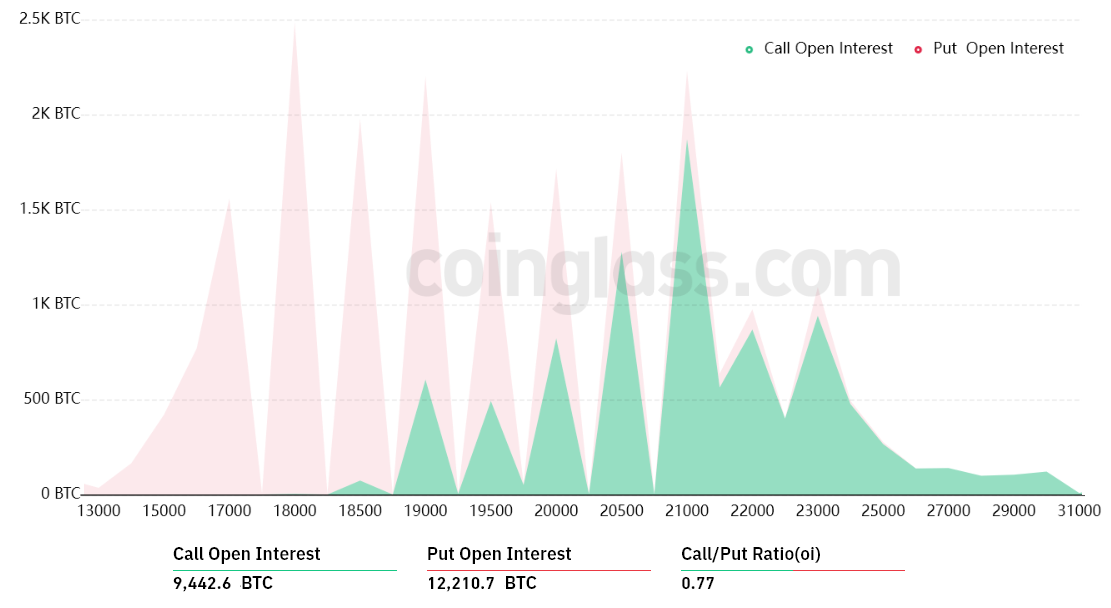
Bitcoin options aggregate open interest for Sept. 9. Source: CoinGlass
⠀
The 0.77 call-to-put ratio reflects the imbalance between the $180 million call (buy) open interest and the $230 million put (sell) options. Currently, Bitcoin stands near $18,900, meaning most bets from both sides will likely become worthless.
⠀
If Bitcoin's price remains below $20,000 at 8:00 am UTC on Sept. 9, only $13 million worth of these call (buy) options will be available. This difference happens because the right to buy Bitcoin at $20,000 is useless if BTC trades below that level on expiry.
⠀
Bears aim for $18,000 to secure a $90 million profit
⠀
Below are the four most likely scenarios based on the current price action. The number of options contracts available on Sept. 9 for call (bull) and put (bear) instruments varies, depending on the expiry price. The imbalance favoring each side constitutes the theoretical profit:
⠀
Between $17,000 and $18,000: 0 calls vs. 4,300 puts. Bears completely dominate, profiting $130 million.
⠀
Between $18,000 and $19,000: 0 calls vs. 5,050 puts. The net result favors the put (bear) instruments by $90 million.
⠀
Between $19,000 and $20,000: 700 calls vs. 1,900 puts. The net result favors the put (bear) instruments by $50 million.
⠀
Between $20,000 and $21,000: 2,050 calls vs. 2,200 puts. The net result is balanced between bulls and bears.
⠀
This crude estimate considers the put options used in bearish bets and the call options exclusively in neutral-to-bullish trades. Even so, this oversimplification disregards more complex investment strategies.
⠀
For example, a trader could have sold a put option, effectively gaining positive exposure to Bitcoin above a specific price, but unfortunately, there's no easy way to estimate this effect.
⠀
Bulls have until Sept. 9 to ease their pain
⠀
Bitcoin bulls need to push the price above $20,000 on Sept. 9 to avoid a potential $130 million loss. On the other hand, the bears' best-case scenario requires a slight push below $18,000 to maximize their gains.
⠀
Bitcoin bulls just had $246 million leverage long positions liquidated in two days, so they might have less margin required to drive the price higher. In other words, bears have a head start to peg BTC below $19,000 ahead of the weekly options expiry.