$50 Million Gone with One 'Confirmation'! The Most Expensive Slip in DeFi History is Born

比推Pubblicato 2026-03-13Pubblicato ultima volta 2026-03-13

Introduzione

An anonymous crypto "whale" accidentally lost nearly $50 million in what is being called DeFi's most expensive "fat-finger" error. The user attempted to swap 50.43 million USDT for AAVE tokens via the Aave mobile app interface. Due to extremely low liquidity for AAVE tokens, the massive trade caused catastrophic slippage of over 99%, resulting in the user receiving only 324 AAVE (worth ~$36,000) instead of the intended amount. Aave's founder Stani Kulechov confirmed the user manually confirmed a risk warning checkbox on the high-slippage transaction before proceeding. The protocol functioned as designed, but the incident sparked intense debate: some argue users bear full responsibility in DeFi, while others criticize the UI/UX for inadequate safeguards for such large transactions. The wallet has been linked by analysts to a Bitcoin whale address holding ~80,000 BTC, suggesting the user may be a wealthy early adopter. Aave has pledged to refund the $600,000 in fees from the trade and improve safety measures like stricter slippage limits. The event highlights critical DeFi challenges: amplified risk from user errors, urgent need for better UX safeguards, MEV exploitation, and user education gaps.

Last night, an incident dubbed the "most absurd fat-finger error in DeFi history" exploded across the crypto community.

The protagonist of the story is an anonymous "whale." Through the app interface of the DeFi lending protocol Aave, he initiated a seemingly simple transaction: exchanging a whopping $50.43 million USDT stablecoin for AAVE tokens.

How large was this transaction? Large enough to instantly "dry up" the liquidity for the vast majority of tokens on the market. Due to the inherently limited trading depth of AAVE tokens, such a massive buy order directly triggered a disastrous slippage. Simply put, slippage is the deviation between the price you expect to trade at and the price you actually get. In this transaction, the slippage was over 99%.

Transaction link: https://etherscan.io/tx/0x9fa9feab3c1989a33424728c23e6de07a40a26a98ff7ff5139f3492ce430801f

What does this mean? When this transaction was finally executed through on-chain routers like CoW Swap, this user received only 324 AAVE tokens, worth about $36,000 at the market price at the time.
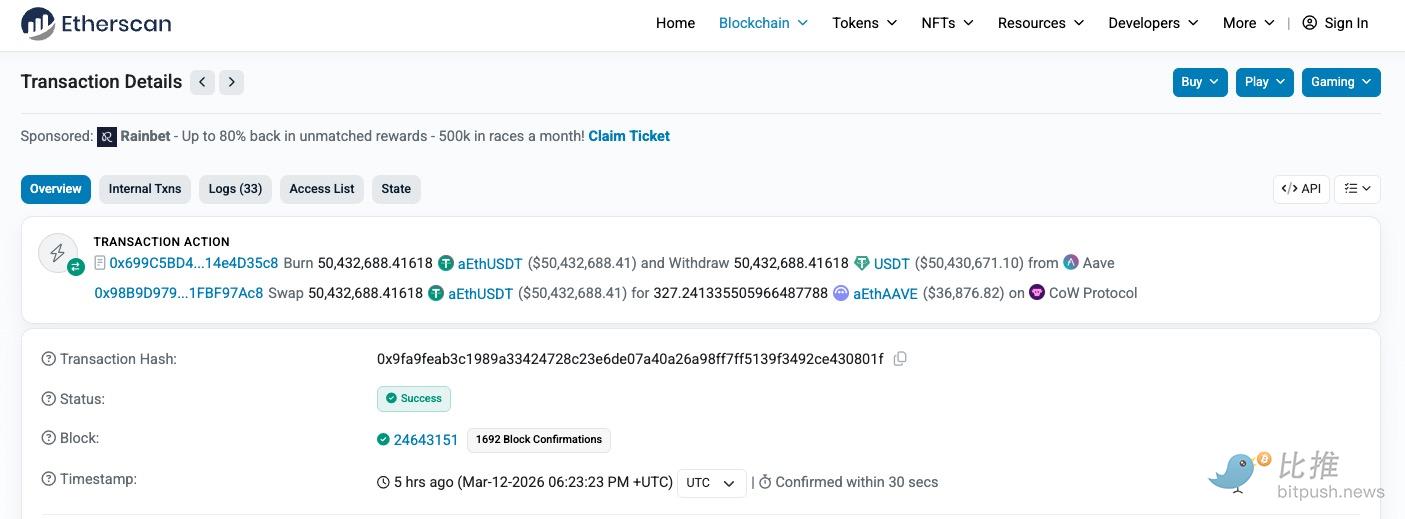
$50.43 million vs. $36,000. One transaction, nearly $50 million evaporated in an instant.

Aave's founder, Stani Kulechov, later explained the incident on social media.
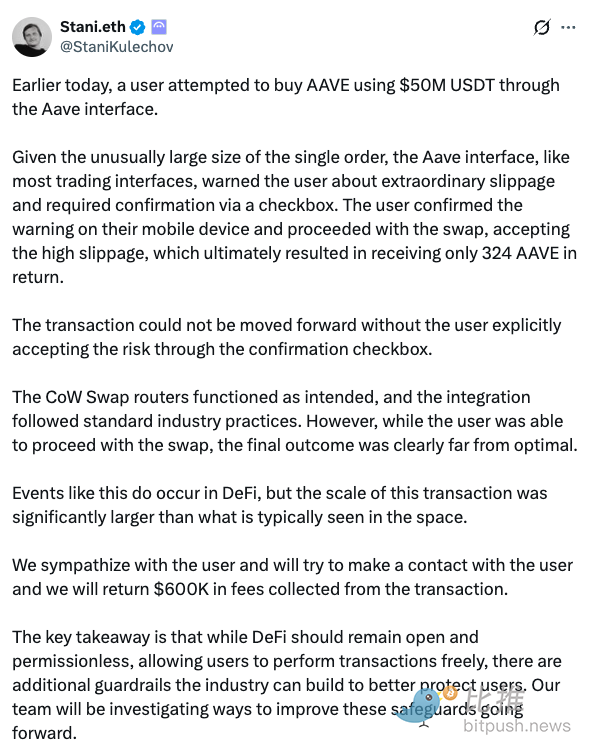
According to his description, the user completed the operation on Aave's mobile app. When the system detected the extreme slippage this massive transaction could cause, the interface popped up a risk warning and required the user to check a confirmation box to indicate they were aware of the risks. On their phone, the user checked that small box and then clicked confirm.
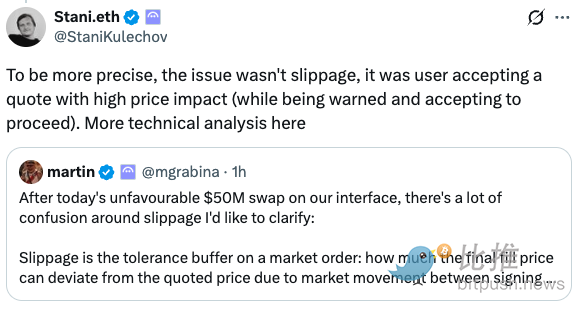
He stated that all procedures were standard and the protocol itself was functioning normally.

The event shocked the entire crypto community, combining elements of the "absurd":

1. Scale: $50 million, even in the crypto world frequented by institutions, is a huge sum of money that many would look up to.

2. Mobile operation, how bold? This was one of the most heated points of discussion in the community. A comment from one netizen received many likes: "Who keeps $50 million on their phone???"

3. Checkbox too 'makeshift'?: The most ironic part of the whole event was that decisive "checkbox." In traditional finance, a multi-million dollar transaction requires layers of approval, multiple reviews, and phone confirmations. In decentralized DeFi, the entire firewall is simplified into a checkbox that can be passed with a simple tap. The community mocked this as the "DeFi version of 'I have read and agree to the terms and conditions'."

The owner of address 0x98b sparked community speculation. Through on-chain tracing, analyst Specter believes this wallet is likely related to the 1011 insider whale Garrett Jin.
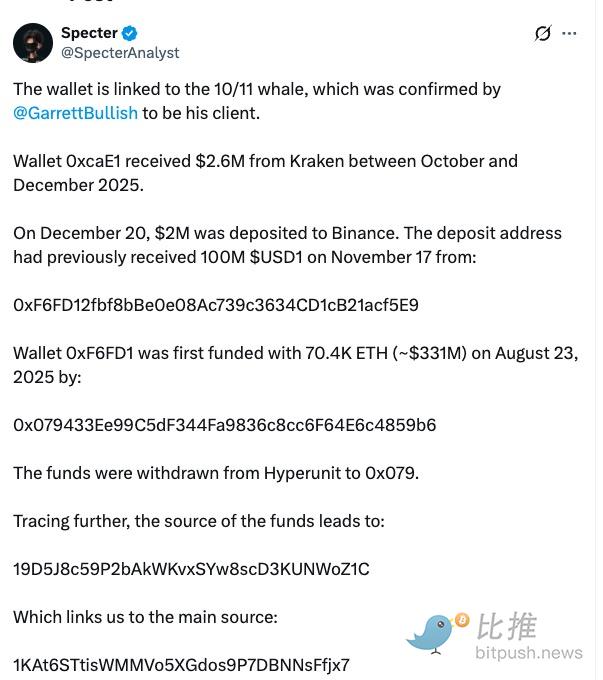
The analyst pointed out that fund flow shows the wallet received about $2.6M from Kraken (Oct-Dec 2025) and was traced back to the Bitcoin address 1KAt6STtisWMMVo5XGdos9P7DBNNsFfjx7—a famous Bitcoin cold wallet holding about 80,000 BTC (worth billions of dollars), often associated with early Bitcoin miners or institutional investors. The community speculates that this "whale" might be a Bitcoin millionaire diversifying into Ethereum, but a operational error led to huge losses.

Of course, there are also conspiracy theorists怀疑ing if this is some form of "money laundering"? But it's just speculation for now, without any solid evidence.

Blame the User, or Blame the Protocol?

The event quickly split into two main camps on social media:

One view holds that the user must be responsible for their own actions. The core spirit of DeFi is "not your keys, not your coins"; you control your assets, so you must pay for every operation you make. In a permissionless financial system, you can't expect someone to save you when you make a mistake.

More people pointed the finger at Aave's interface design. They argued that a UI that uses merely a checkbox to prevent a $50 million loss is itself a failure. Some developers suggested that for such extreme, obviously unreasonable transactions, the interface should impose more "aggressive" friction, such as forcing the user to type a specific phrase like "I confirm I will lose 99.9% of my funds" to proceed, or directly setting an insurmountable slippage上限.

The core of this debate actually touches on the biggest paradox DeFi currently faces: how to provide users with sufficient safety protections while adhering to the core principles of decentralization and permissionlessness?

Aave's team reacted quite quickly. Founder Stani promised to refund the approximately $600,000 in fees collected from this transaction to the victim. More importantly, they announced they would review and improve related protective measures, such as optimizing UI/UX design and setting stricter slippage上限s, to prevent similar tragedies from happening again.

What Does This Incident Leave Us With?

This $50 million "slip" incident, although an extreme case, once again highlights the deep-seated worries of DeFi:

1. DeFi's Risk Amplification Effect: Automation, permissionlessness, and composability—the magic of DeFi—also amplify any tiny user error. One "slip," and the cost could be losing everything.

2. Urgency of UI/UX Optimization: For DeFi to go mainstream, user experience and safety protections must be improved. How to introduce more "smart guardrails" while maintaining the spirit of decentralization, such as multiple confirmations for large transactions, AI-assisted risk assessment, etc., is a topic every protocol needs to consider.

3. Challenges of MEV and Ethereum's Mechanism: The loss being extracted by MEV highlights the "law of the jungle" on the blockchain. This might accelerate the migration to fairer mechanisms, like PBS optimizations or Layer 2 solutions.

4. Lack of User Education: Many users may not fully understand professional concepts like "slippage" and "liquidity depth." If a whale can make such a mistake, let alone the average retail investor? The entire industry needs to invest more resources to help users build necessary risk awareness.

After all, the price of such a "slip" is just too expensive.


Twitter:https://twitter.com/BitpushNewsCN

Bitpush TG Discussion Group:https://t.me/BitPushCommunity

Bitpush TG Subscription: https://t.me/bitpush

Original link:https://www.bitpush.news/articles/7619291

Crypto di tendenza

Domande pertinenti

QWhat was the main cause of the user losing nearly $50 million in the DeFi transaction?

AThe user lost nearly $50 million due to extreme slippage of over 99% caused by attempting to swap a massive amount of 50.43 million USDT for AAVE tokens, which had limited liquidity to handle such a large order.

QHow did the Aave interface attempt to warn the user about the risks of this transaction?

AThe Aave interface detected the extreme slippage risk and displayed a warning popup with a checkbox that the user had to manually select to confirm they understood the risks before proceeding.

QWhat was the community's reaction regarding the use of a simple checkbox for such a large transaction?

AThe community criticized the UI design, calling it a 'DeFi version of 'I have read and agree to the terms'' and argued that a simple checkbox was insufficient protection for a $50 million transaction, suggesting more aggressive safeguards like mandatory phrase confirmation or hard slippage limits.

QWho is suspected to be the owner of the wallet (0x98b) that initiated this transaction, according to on-chain analysts?

AOn-chain analysts, like Specter, suspect the wallet is likely associated with Garrett Jin, an insider whale, with funds traced back to a famous Bitcoin cold wallet holding around 80,000 BTC, potentially belonging to an early Bitcoin miner or institutional investor.

QWhat actions did Aave's founder take in response to this incident?

AAave's founder, Stani Kulechov, promised to refund the approximately $600,000 in protocol fees collected from the transaction to the victim and announced plans to review and improve protective measures, such as optimizing UI/UX design and implementing stricter slippage limits.

Letture associate

As Consensus Accelerates, What Are Young Investors Betting On?

Title: As Consensus Forms Faster, What Are Young Investors Betting On? In the rapid evolution of tech investment, a new generation of young investors is navigating a landscape where AI, robotics, commercial aerospace, and quantum computing are advancing simultaneously. Traditional investment logic based on financial models is giving way to a need for deep technical understanding and the ability to act before industry consensus forms. An analysis of trends from the "WAIC FUTURE TECH" list of young investment leaders reveals key shifts in focus. The first major trend is the movement of AI from the digital screen into the physical world. Investment is shifting from large language models and chatbots towards embodied AI, robotics, AI hardware, and edge computing. While demonstrations generate excitement, the real challenge lies in achieving scalable, reliable, and cost-effective delivery in complex real-world environments like factories and logistics. Success depends not just on algorithms but on the integration of sensors, actuators, and control systems. Second, the competitive focus for large models is moving beyond raw capability toward building an "intelligence flywheel." The goal is to create self-reinforcing systems where user interaction generates data, improving the model, which in turn enhances the user experience and attracts more engagement. Companies that successfully embed AI into workflows to create these closed-loop systems can build lasting value that isn't easily erased by the next model upgrade. Third, facing a potential bottleneck in high-quality human-generated data, investors are looking at new underlying technologies. Reinforcement learning and self-play, as demonstrated by AlphaGo Zero, offer paths for AI to generate its own experience. Scientific foundation models, which aim to build general AI capabilities for fields like life sciences and materials discovery, represent a non-consensus direction that could unlock new frontiers of knowledge and data. Finally, in deep-tech areas like quantum computing, commercial aerospace, and space-based infrastructure, patient capital is essential. These fields have long, uncertain development and validation cycles involving complex engineering, supply chains, and regulations. Investment here requires a long-term view, focusing on foundational team capabilities and the eventual emergence of market demand, even if commercial returns are distant. Collectively, these trends illustrate how young investors are adapting to a new era. They are learning to make earlier, technically-informed judgments, balance hype with real-world viability, and provide the patient capital needed to build the deep-tech foundations of the future.

marsbit27 min fa

As Consensus Accelerates, What Are Young Investors Betting On?

marsbit27 min fa

Can Japan Buy Growth with AI? Will the Bond Market Believe It?

Japan's cabinet has introduced the 2026 Basic Policy on Economic and Fiscal Management and Reform, shifting its primary fiscal target. The new framework moves away from the traditional annual primary balance goal and instead prioritizes a stable reduction of the debt-to-GDP ratio. This change is tied to a strategy of increased "responsible proactive fiscal" spending, aiming to boost long-term growth through investments in strategic sectors like AI, semiconductors, energy, and robotics. The government estimates total public and private investment in 62 key technologies could exceed 370 trillion yen by 2040. The market reaction has been mixed and cautious. While equity markets may respond to policy signals, bond markets are focused on fiscal credibility. Concerns center on whether the weakening of the clear primary balance anchor could lead to looser fiscal discipline. If investors doubt that these strategic investments will generate sufficient productivity gains, tax revenue, and nominal growth to outpace rising interest costs, they may demand higher yields on Japanese Government Bonds (JGBs). Recent volatility in the yen and JGB yields, with the 10-year yield briefly reaching 2.9%, reflects this skepticism. The success of this new framework hinges on two factors: whether Japan can achieve a nominal growth rate consistently higher than its long-term interest rates, and whether future budgets demonstrate disciplined control over bond issuance. The government's narrative is that strategic investment is essential to break Japan's cycle of low growth, aging, and labor shortages. However, the bond market will continuously assess the credibility of this plan, pricing the risk that it may represent fiscal expansion rather than a viable growth strategy.

marsbit1 h fa

Can Japan Buy Growth with AI? Will the Bond Market Believe It?

marsbit1 h fa

Misjudged A-Shares: Resilience, Expectations, and Confidence

China's A-share market recently faced selling pressure, especially in tech sectors, initially triggered by a global tech sell-off that began in South Korea. However, the article argues this is a case of "mistaken injury" and highlights the market's underlying resilience. This resilience stems from three main pillars: **1) Tech Sector Fundamentals:** Unlike Korea's market dominated by a few memory chip stocks, China's tech sector is diversified across computing, communications, electronics, and semiconductors, supported by dual narratives of global AI supply chains and domestic substitution. Core areas like optical modules and fiber optics continue to show strong earnings growth. **2) "National Team" Support:** State-backed institutions and large corporations have made significant market purchases and announced buybacks, providing liquidity and signaling confidence. This is seen as a stabilizing policy signal, often associated with market bottoms. **3) Broader Market Pillars:** Other major sectors are showing endogenous recovery momentum. Consumer stocks benefit from stabilizing CPI and signs of sector recovery (e.g., liquor price hikes). Cyclical sectors like aluminum have high earnings, potential price increases due to tight supply, and low valuations. The financial sector offers stable dividends and low valuations. The conclusion is that the sell-off was driven by external contagion, not a collapse in fundamentals. With strong policy support and recovering momentum across key sectors, the A-share market possesses the toughness to regain stability.

marsbit1 h fa

Misjudged A-Shares: Resilience, Expectations, and Confidence

marsbit1 h fa

Trading

Spot

Articoli Popolari

Come comprare ONE

Benvenuto in HTX.com! Abbiamo reso l'acquisto di Harmony (ONE) semplice e conveniente. Segui la nostra guida passo passo per intraprendere il tuo viaggio nel mondo delle criptovalute.Step 1: Crea il tuo Account HTXUsa la tua email o numero di telefono per registrarti il tuo account gratuito su HTX. Vivi un'esperienza facile e sblocca tutte le funzionalità,Crea il mio accountStep 2: Vai in Acquista crypto e seleziona il tuo metodo di pagamentoCarta di credito/debito: utilizza la tua Visa o Mastercard per acquistare immediatamente HarmonyONE.Bilancio: Usa i fondi dal bilancio del tuo account HTX per fare trading senza problemi.Terze parti: abbiamo aggiunto metodi di pagamento molto utilizzati come Google Pay e Apple Pay per maggiore comodità.P2P: Fai trading direttamente con altri utenti HTX.Over-the-Counter (OTC): Offriamo servizi su misura e tassi di cambio competitivi per i trader.Step 3: Conserva Harmony (ONE)Dopo aver acquistato Harmony (ONE), conserva nel tuo account HTX. In alternativa, puoi inviare tramite trasferimento blockchain o scambiare per altre criptovalute.Step 4: Scambia Harmony (ONE)Scambia facilmente Harmony (ONE) nel mercato spot di HTX. Accedi al tuo account, seleziona la tua coppia di trading, esegui le tue operazioni e monitora in tempo reale. Offriamo un'esperienza user-friendly sia per chi ha appena iniziato che per i trader più esperti.

354 Totale visualizzazioniPubblicato il 2024.12.12Aggiornato il 2026.06.02

Come comprare ONE

Discussioni

Benvenuto nella Community HTX. Qui puoi rimanere informato sugli ultimi sviluppi della piattaforma e accedere ad approfondimenti esperti sul mercato. Le opinioni degli utenti sul prezzo di ONE ONE sono presentate come di seguito.

活动图片













