When 34% of ETH is Staked: In the Era of Native Compounding, How Should You Choose Staking?

marsbitPubblicato 2026-08-28Pubblicato ultima volta 2026-08-28

Introduzione

As Ethereum staking reaches a record 34.7% of the total supply, it is evolving from a niche technical activity into a standardized asset management practice. This article analyzes four primary staking methods for ETH holders, highlighting their core trade-offs between control, convenience, and risk. The foundational method is solo staking, which requires 32 ETH and running one's own validator node. It offers full control and native rewards but demands significant technical expertise and constant maintenance. Non-custodial native staking, like services offered by imToken, provides a middle ground. Users control their withdrawal keys and assets while outsourcing node operation to professional providers. This maintains self-custody but transfers operational risk. For users without 32 ETH or those prioritizing liquidity, liquid staking protocols like Lido are key. Users deposit ETH to receive a liquid staking token (e.g., stETH), enabling continued participation in DeFi. This introduces additional smart contract and protocol risks but solves liquidity constraints. Exchange-based staking offers the lowest barrier to entry, handling all technical complexities and custody. However, it requires full trust in the platform's management of assets, node operations, and reward distribution. The choice depends on individual priorities: control (solo staking), balanced custody (non-custodial native), liquidity (liquid staking), or simplicity (exchange). With developments like Pectra en...

Recently, two very interesting numbers have emerged in Ethereum Staking.

One is 34.7%.

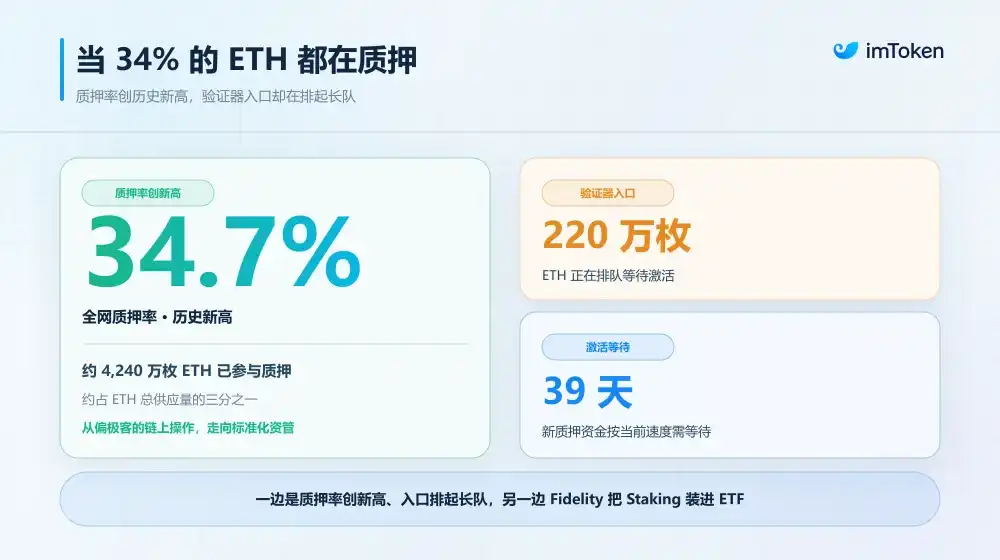
As of late August, approximately 42.4 million ETH have been staked across the Ethereum network, accounting for about 34.7% of the total supply, reaching a record high. Even more striking is that there are still over 2.2 million ETH queued at the validator entry point. At the current rate, new staking funds need to wait nearly 39 days to be formally activated.

Another change comes from traditional finance.

In August, Fidelity further advanced the Staking arrangements for its Ethereum fund, FETH. It has not only signed relevant custody agreements with Anchorage Digital and BitGo but also clearly designed a staking reward distribution mechanism.

These two seemingly unrelated changes are actually a microcosm of a larger trend: in the past six months, Ethereum staking has accelerated its shift from a niche on-chain operation favored by geeks to an increasingly standardized asset management method.

For ordinary ETH holders, a more practical question than "whether to stake" is now emerging:

If you decide to stake, should you run your own node, choose Native Staking, Lido, or simply stake on an exchange?
1. Staking Is No Longer Just About 'Locking Up Assets to Earn Yield'

Let's start with the basics.

After Ethereum completed The Merge, the network no longer relies on miners using computing power to maintain the network. Instead, validator nodes maintain consensus and validate blocks by staking ETH.

The most basic threshold to become an independent validator node is 32 ETH.

Validators receive consensus layer rewards from the Ethereum protocol for staying online, correctly submitting attestations, and participating in block proposals. Conversely, being offline for extended periods incurs penalties, and serious violations like double-signing may lead to Slashing.

From this perspective, staking rewards are not "interest" magically generated out of thin air, but protocol rewards users earn by using their ETH to provide economic security for the Ethereum network.

But over the past few years, there has been a somewhat counterintuitive issue with Staking: rewards don't naturally compound.

In traditional 0x01 validators, even if they earn an extra 0.5 ETH or 1 ETH in consensus layer rewards, any amount exceeding 32 ETH is periodically and automatically withdrawn by the network to the withdrawal address, and does not continue to participate in the next round of staking.

To make this ETH generate rewards again, one would need to gather enough for a new staking amount and deploy it again.

Pectra changes this.

The new 0x02 validator has its maximum effective balance increased to 2048 ETH. Moreover, after exceeding 32 ETH, the balance can continue to gradually increase the effective staking amount according to protocol rules. For long-term stakers, the previous process of "earning rewards -> withdrawing them -> redeploying" can now, for the first time, be automated within the native Ethereum protocol (Extended reading: When 8 Million ETH Starts 'Moving': In the Post-Pectra Era, Staking Undergoes a Structural Transformation?).

If we look at the timeline over the past six months, we find that ETH staking is evolving from a relatively crude early-stage "lock 32 ETH for yield" model into a more sophisticated asset management mechanism.

Fidelity adding staking yield to its ETF addresses the question of "who stakes for me" for traditional finance users; Pectra addresses capital efficiency at the validator level; liquid staking protocols like Lido address liquidity; and professional node operators are beginning to separate operational maintenance from asset control.

Therefore, when comparing staking options today, the focus should no longer be solely on APR, but on comprehensive trade-offs.

2. They're All Staking, But What's the Difference?

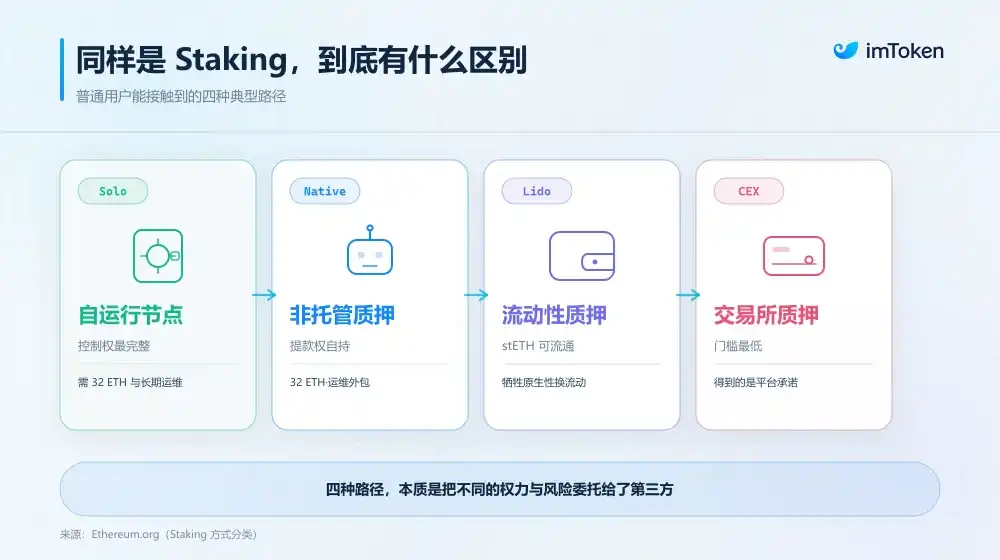
Overall, the typical ETH staking paths accessible to ordinary users today can be broadly categorized into four types.

On the surface, they might seem like just four methods to earn the same yield, but the core difference between these paths lies in which part of the power and risk the user chooses to delegate to a third party.
1. Running Your Own Node: The Most 'Native' Yield, and the Most Complete Control

The purest form of ETH staking is preparing 32 ETH yourself, running execution and consensus layer clients, and maintaining your own validator node.

In this method, everything—from how the node is deployed, which clients are run, to when to exit—is decided by you. The protocol-generated rewards also don't need to be shared with a liquid staking protocol or exchange.

However, the barriers are higher because you need at least 32 ETH, a stably running device, good network conditions, and must continuously maintain client versions, node status, and key security.

Ultimately, running your own node trades the highest level of control and more complete rewards for higher technical and operational costs.

2. Native Staking: Control Your Assets, Outsource the 'Operations'

The second method can be understood as a middle ground between Solo Staking and fully custodial solutions.

The user still uses their own 32 ETH to create an independent validator. The ETH ultimately still enters the native Ethereum staking system and is not exchanged for another token, but the node operation is handled by a professional service provider.

The most important distinction is the separation between withdrawal rights and node operation rights.

The validator itself uses different keys. The Signing Key, used for daily node signatures and block validation, can be managed by a professional node service provider. However, the Withdrawal Credential, which ultimately determines the destination of the principal and rewards, can remain in the hands of the user.

This is also a crucial dividing line between non-custodial Native Staking and custodial exchange staking. For example, imToken's current non-custodial ETH staking service is designed with this concept in mind (Extended reading: What is imToken's Non-Custodial ETH Staking Service?):

Users holding 32 ETH or more can create independent validators. The withdrawal keys are controlled by the user, node operation is handled by professional infrastructure, and different choices like compound validator and auto-withdrawal validator are already available.

This is suitable for users who have at least 32 ETH, want to earn native staking rewards, value self-custody, but don't want to maintain a validator themselves daily.

Of course, "non-custodial" does not mean "no third-party risk." Node operators can still experience downtime, configuration errors, or even Slashing. Therefore, what's transferred here is not asset ownership, but node operational risk.

3. Lido: Sacrifice a Bit of 'Nativity' for Liquidity

If you don't have 32 ETH, or simply don't want your ETH stuck in a validator exit queue for a long time, then liquid staking represents a completely different route.

Lido is the most typical example. Users deposit ETH into Lido, and the protocol allocates the funds to node operators to participate in Ethereum staking, while issuing stETH to the user.

Thus, ETH that was originally staked and couldn't be directly transferred is wrapped into a chain asset that remains liquid. Users can still transfer, trade, and use stETH, or further participate in DeFi scenarios like lending and liquidity provision.

To exit, users can either follow Lido's protocol redemption process to swap back to ETH, or directly sell stETH for ETH on a DEX. The latter doesn't even require waiting for the validator to actually exit, but the trade-off is bearing the current market price and potential slippage.

Simultaneously, stETH continuously reflects the staking rewards earned by the user through mechanisms like Rebase. Therefore, for ordinary users, there's basically no need to handle the issue of "claiming rewards and then re-staking" themselves.

The flip side of convenience is an additional layer of risk. Lido currently charges a protocol fee, distributed among node operators, the DAO Treasury, etc., with users receiving the remainder. More importantly, it introduces additional risks such as Lido's smart contracts, protocol governance, node operator risk, and stETH secondary market liquidity.

It's important to note that there is no forced "1:1 peg" between stETH and ETH like with fiat-backed stablecoins. If the market is eager to sell stETH in the short term, it could very well trade at a discount to ETH. If you then use that stETH to participate in more DeFi protocols, you further layer on new smart contract and liquidation risks.

Currently, imToken's ETH staking portal has also integrated Lido, allowing users to directly participate in liquid staking and hold stETH without needing 32 ETH.

4. Exchange Staking: The Lowest Barrier, But What You Own is a 'Platform Promise'

The last method might be the most familiar for many new users: depositing ETH on an exchange and clicking "Staking."

In terms of user experience, this is undoubtedly the simplest.

No need to have 32 ETH, no need to understand validator nodes, no need to manage Signing Keys or Withdrawal Keys, and no worries about server uptime.

The exchange aggregates ETH from many users to run validators, then credits a portion of the rewards to user accounts according to its own rules.

But precisely because of this, this method requires the most trust. What a user sees as "1 ETH staked" is often first and foremost a record in the exchange's internal accounting system. How validators are deployed at the underlying level, how much asset is actually staked, how rewards are reinvested, what percentage the platform takes, and how liquidity is managed when users request redemption—all depend on the specific platform's product design.

More importantly, the assets themselves are primarily under the custody of a centralized platform. This doesn't necessarily mean exchange staking is "bad." For newcomers who already keep their ETH on an exchange long-term and don't plan to manage an on-chain wallet themselves, it might still be the method with the lowest operational barrier.

It's just that the convenience you gain essentially comes from handing over asset custody, node operation, reward distribution, and even the exit process to the platform.
3. There's No 'Highest Yield' Staking, Only the Right Combination of Risks for You

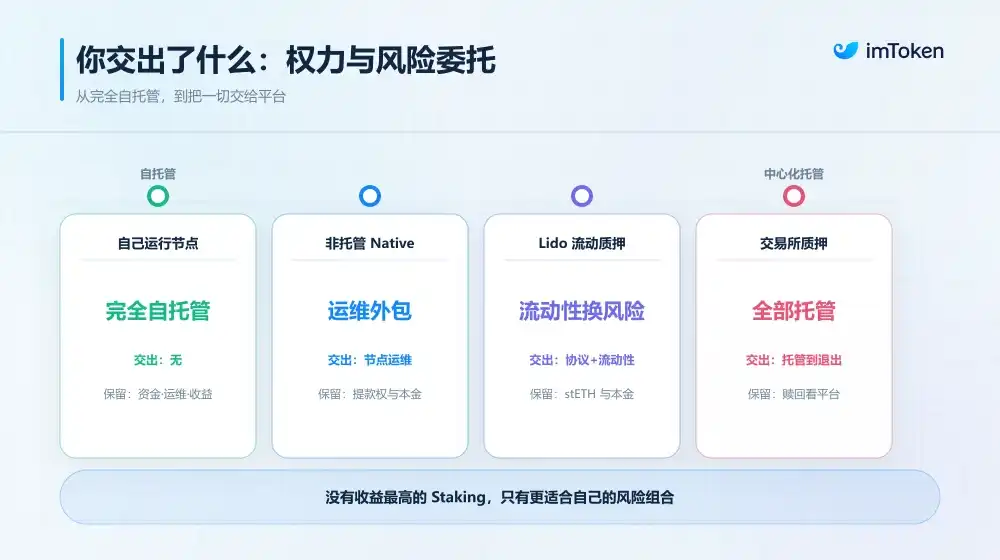
Placing all four methods side by side reveals an interesting phenomenon.

The evolution of Ethereum staking products isn't all solutions converging towards the same endpoint, but rather a continuous process of differentiating the capabilities that different users actually need.

  • Running your own node maximizes control;
  • Native Staking separates "fund ownership" and "node operations";
  • Lido recombines "staking yield" and "fund liquidity";
  • Exchanges further hide complexity, trading centralized custody for the lowest usage barrier;

And Fidelity planning to package Staking into an ETF takes yet another step forward—investors don't even need to hold on-chain ETH or understand how validators work; traditional financial products can handle custody, node operation, yield acquisition, and even final distribution for them.

From this viewpoint, Staking is increasingly resembling a mature financial infrastructure service.

So how should ordinary users choose?

If you have at least 32 ETH, possess some technical skills, highly value self-sovereignty, and wish to directly participate in the Ethereum network, running your own validator is still the choice with the most complete control.

If you also have 32 ETH but don't want to bear the long-term burden of node operation, while still wanting to firmly control withdrawal permissions, non-custodial Native Staking is a natural compromise.

If you hold less than 32 ETH, or have ongoing needs for trading, lending, and other DeFi activities, then Liquid Staking, as represented by Lido, trades an additional layer of protocol risk for significantly greater capital flexibility.

As for exchange Staking, it's more suitable for users who already accept centralized custody and wish to minimize operational barriers, provided they understand that platform risk doesn't disappear just because there's a "Staking" button.
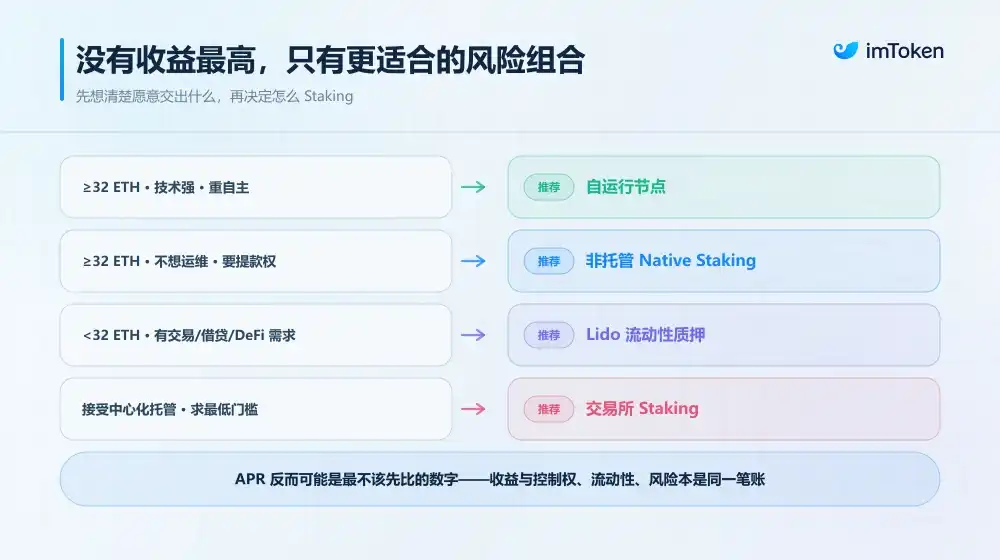
Therefore, looking at Ethereum staking today, APR might actually be the least important number to compare first.

If two products differ by only a few tenths of a percentage point in annualized yield, but one requires handing over assets completely to a third party while the other lets you control withdrawal rights; one requires waiting in the validator exit queue to withdraw, while the other allows selling the LST on the market anytime; one enables native compounding directly, while the other depends on how the platform handles rewards—these differences are often far more significant than the surface-level APR.

After all, staking rewards never exist in isolation.

How much yield you earn, and how much liquidity, control, and additional risk you give up for that yield, are ultimately all part of the same calculation.

Crypto di tendenza

Domande pertinenti

QAccording to the article, what are the two key numbers recently observed in Ethereum Staking, and what do they signify?

AThe first number is 34.7%, indicating that approximately 42.4 million ETH is currently staked, a historical high. The second is that there are over 2.2 million ETH in the validator entry queue, with a waiting period of about 39 days. These numbers signify that Ethereum staking is accelerating from a niche on-chain operation towards becoming a standardized asset management method.

QWhat is the fundamental difference in reward mechanisms between traditional 0x01 validators and the new 0x02 validators introduced with Pectra?

AFor traditional 0x01 validators, any consensus rewards earned above the 32 ETH stake are automatically and periodically withdrawn to the withdrawal address and do not automatically re-stake. With the new 0x02 validators introduced with Pectra, the maximum effective balance is raised to 2048 ETH, and any rewards above 32 ETH can automatically increase the validator's effective staking balance, enabling native compounding within the protocol.

QWhat are the four typical paths for ordinary users to engage in ETH Staking as outlined in the article, and what is the core trade-off they represent?

AThe four paths are: 1) Running your own node (full control, high technical cost). 2) Native Staking with a service provider (self-custody of assets, outsourced node operation). 3) Using a liquid staking protocol like Lido (trades some native protocol purity for liquidity via LSTs). 4) Staking through an exchange (lowest barrier, full custody and operational reliance on the platform). The core trade-off for all paths is the degree of control, liquidity, and risk that users delegate to a third party in exchange for convenience and rewards.

QIn the context of Non-Custodial Native Staking, how is the separation of keys a critical distinction from exchange-based staking?

AIn Non-Custodial Native Staking, the user's withdrawal credential (Withdrawal Key) which controls the principal and final rewards remains in the user's self-custody. The node operational key (Signing Key) can be managed by a professional node operator. This separation creates a crucial boundary, ensuring asset ownership is not surrendered, unlike exchange-based staking where the user entrusts both asset custody and all operational control to the platform.

QAccording to the article's conclusion, why is comparing APR (Annual Percentage Rate) alone insufficient for choosing a Staking method?

AComparing only APR is insufficient because the critical differences lie in other factors such as the level of asset control (self-custody vs. platform custody), liquidity (e.g., via Liquid Staking Tokens), exit flexibility (waiting for validator queue vs. selling on the market), and the specific risks introduced (smart contract, protocol, node operator, or platform risk). The article emphasizes that the trade-offs between the rewards earned and the liquidity, control, and additional risks undertaken are integral parts of the overall staking decision.

Letture associate

Chinese Venture Capital Is Shifting from 'Selecting People' to 'Selecting Cities'

Chinese Venture Capital: Shifting from "Picking Founders" to "Picking Cities" The article discusses a significant shift in China's venture capital (VC) landscape. Historically, VC investments heavily focused on the individual founder's vision, track record, and capability, as seen in early internet-era successes like Wang Xing (Meituan), Li Bin (Nio), and Li Xiang (Li Auto). The belief was that betting on exceptional people was the key to success. However, the rise of hard tech startups—in fields like semiconductors, robotics, AI, and biotech—has changed this calculus. These industries depend heavily on deep, localized ecosystems: specialized talent pools, established supply chains, manufacturing bases, and application scenarios. A city's industrial "resume" now significantly impacts a startup's chances. Examples include Shenzhen's dominance in robotics, Beijing's concentration of AI firms, Suzhou's biotech cluster, and Hefei's successful bet on semiconductor giant ChangXin. This shift is further driven by changes in funding sources. Government-guided funds and state-owned capital now dominate VC limited partners (LPs). These "patient capital" investors prioritize local economic development, job creation, and industrial chain growth alongside financial returns. Their early bets signal viability to other investors. Ultimately, the VC logic remains about managing risk and increasing the odds of success. In the hard tech era, a supportive city ecosystem provides crucial resources—talent, suppliers, R&D, and policy stability—that a single founder cannot easily assemble. The investment due diligence process has thus expanded from evaluating just the founder to also evaluating the founder's city. Consequently, capital is concentrating in a few regions with strong, focused industrial foundations, challenging other cities to build compelling, credible ecosystems to attract investment.

marsbit36 min fa

Chinese Venture Capital Is Shifting from 'Selecting People' to 'Selecting Cities'

marsbit36 min fa

Trading

Spot

Articoli Popolari

Cosa è ETH 3.0

ETH3.0 e $eth 3.0: Un'Analisi Approfondita del Futuro di Ethereum Introduzione Nel panorama in rapida evoluzione delle criptovalute e della tecnologia blockchain, ETH3.0, spesso indicato come $eth 3.0, è emerso come un argomento di considerevole interesse e speculazione. Il termine comprende due concetti principali che warrantono chiarimenti: Ethereum 3.0: Questo rappresenta un potenziale futuro aggiornamento volto ad aumentare le capacità dell'attuale blockchain di Ethereum, concentrandosi principalmente sul miglioramento della scalabilità e delle prestazioni. ETH3.0 Meme Token: Questo progetto di criptovaluta distinto cerca di sfruttare la blockchain di Ethereum per creare un ecosistema incentrato sui meme, promuovendo il coinvolgimento all'interno della comunità delle criptovalute. Comprendere questi aspetti di ETH3.0 è essenziale non solo per gli appassionati di criptovalute, ma anche per coloro che osservano tendenze tecnologiche più ampie nello spazio digitale. Che cos'è ETH3.0? Ethereum 3.0 Ethereum 3.0 è pubblicizzato come un aggiornamento proposto per la rete Ethereum già stabilita, che è stata la spina dorsale di molte applicazioni decentralizzate (dApps) e contratti smart sin dalla sua nascita. I miglioramenti previsti si concentrano principalmente sulla scalabilità, integrando tecnologie avanzate come lo sharding e le prove a conoscenza zero (zk-proofs). Queste innovazioni tecnologiche mirano a facilitare un numero senza precedenti di transazioni al secondo (TPS), potenzialmente raggiungendo milioni, affrontando così una delle limitazioni più significative della tecnologia blockchain attuale. Il miglioramento non è meramente tecnico, ma anche strategico; è volto a preparare la rete Ethereum per un'adozione e un'utilità diffuse in un futuro contrassegnato da un aumento della domanda di soluzioni decentralizzate. ETH3.0 Meme Token Al contrario di Ethereum 3.0, l'ETH3.0 Meme Token si avventura in un dominio più leggero e giocoso, combinando la cultura dei meme di internet con la dinamica delle criptovalute. Questo progetto consente agli utenti di acquistare, vendere e scambiare meme sulla blockchain di Ethereum, fornendo una piattaforma che promuove il coinvolgimento della comunità attraverso la creatività e interessi condivisi. L'ETH3.0 Meme Token mira a dimostrare come la tecnologia blockchain possa intersecarsi con la cultura digitale, creando casi d'uso che siano sia divertenti che finanziariamente praticabili. Chi è il Creatore di ETH3.0? Ethereum 3.0 L'iniziativa verso Ethereum 3.0 è principalmente propulsa da un consorzio di sviluppatori e ricercatori all'interno della comunità di Ethereum, tra cui Justin Drake. Conosciuto per le sue intuizioni e contributi all'evoluzione di Ethereum, Drake è stato una figura di spicco nelle discussioni riguardanti la transizione di Ethereum verso un nuovo livello di consenso, chiamato “Beam Chain.” Questo approccio collaborativo allo sviluppo significa che Ethereum 3.0 non è il prodotto di un creatore singolo, ma piuttosto una manifestazione di ingegno collettivo focalizzato sul progresso della tecnologia blockchain. ETH3.0 Meme Token I dettagli riguardanti il creatore dell'ETH3.0 Meme Token sono attualmente non rintracciabili. La natura dei token meme conduce spesso a una struttura più decentralizzata e guidata dalla comunità, il che potrebbe spiegare la mancanza di attribuzione specifica. Questo si allinea con l'etica della comunità crypto più ampia, dove l'innovazione spesso nasce da sforzi collaborativi piuttosto che individuali. Chi sono gli Investitori di ETH3.0? Ethereum 3.0 Il supporto per Ethereum 3.0 proviene principalmente dalla Ethereum Foundation insieme a una comunità entusiasta di sviluppatori e investitori. Questa associazione fondamentale fornisce un considerevole grado di legittimità e migliora le prospettive di implementazione di successo poiché sfrutta la fiducia e la credibilità costruite nel corso degli anni di operazioni della rete. Nel clima in rapida evoluzione delle criptovalute, il supporto della comunità gioca un ruolo cruciale nello sviluppo e nell'adozione, posizionando Ethereum 3.0 come un serio contenditore per i futuri progressi della blockchain. ETH3.0 Meme Token Sebbene le fonti attualmente disponibili non forniscano informazioni esplicite riguardo ai fondamenti o alle organizzazioni di investimento che sostengono l'ETH3.0 Meme Token, ciò è indicativo del modello di finanziamento tipico per i token meme, che spesso si basa sul supporto di base e sul coinvolgimento della comunità. Gli investitori in tali progetti sono tipicamente individui motivati dal potenziale per innovazioni guidate dalla comunità e dallo spirito di cooperazione trovato all'interno della comunità crypto. Come Funziona ETH3.0? Ethereum 3.0 Le caratteristiche distintive dell'Ethereum 3.0 risiedono nella sua proposta di implementazione della tecnologia di sharding e zk-proof. Lo sharding è un metodo di partizionamento della blockchain in pezzi più piccoli e gestibili o “shard,” che possono elaborare transazioni in modo concorrente piuttosto che sequenziale. Questa decentralizzazione dell'elaborazione aiuta a prevenire la congestione e garantisce che la rete rimanga reattiva anche sotto un carico pesante. La tecnologia delle prove a conoscenza zero (zk-proof) contribuisce con un ulteriore livello di sofisticazione consentendo la validazione delle transazioni senza rivelare i dati sottostanti coinvolti. Questo aspetto non solo migliora la privacy, ma aumenta anche l'efficienza complessiva della rete. Si parla anche di incorporare una macchina virtuale Ethereum a conoscenza zero (zkEVM) in questo aggiornamento, amplificando ulteriormente le capacità e l'utilità della rete. ETH3.0 Meme Token L'ETH3.0 Meme Token si distingue capitalizzando sulla popolarità della cultura dei meme. Stabilisce un mercato per gli utenti che desiderano partecipare al trading di meme, non solo per divertimento, ma anche per potenziale guadagno economico. Integrando funzioni come lo staking, la fornitura di liquidità e meccanismi di governance, il progetto promuove un ambiente che incentiva l'interazione e la partecipazione della comunità. Offrendo una miscela unica di intrattenimento e opportunità economica, l'ETH3.0 Meme Token mira ad attrarre un pubblico variegato, che va dagli appassionati di crypto ai semplici intenditori di meme. Timeline di ETH3.0 Ethereum 3.0 11 Novembre 2024: Justin Drake accenna al prossimo aggiornamento ETH 3.0, incentrato sui miglioramenti della scalabilità. Questo annuncio segna l'inizio delle discussioni formali riguardo l'architettura futura di Ethereum. 12 Novembre 2024: La proposta attesa per Ethereum 3.0 dovrebbe essere svelata a Devcon a Bangkok, preparando il terreno per un feedback più ampio della comunità e potenziali passi successivi nello sviluppo. ETH3.0 Meme Token 21 Marzo 2024: L'ETH3.0 Meme Token viene ufficialmente elencato su CoinMarketCap, segnando il suo ingresso nel dominio pubblico delle criptovalute e aumentando la visibilità per il suo ecosistema basato sui meme. Punti Chiave In conclusione, Ethereum 3.0 rappresenta una significativa evoluzione all'interno della rete Ethereum, concentrandosi sul superamento delle limitazioni riguardanti scalabilità e prestazioni attraverso tecnologie avanzate. I suoi aggiornamenti proposti riflettono un approccio proattivo alle future esigenze e usabilità. D'altra parte, l'ETH3.0 Meme Token incarna l'essenza della cultura guidata dalla comunità nello spazio delle criptovalute, sfruttando la cultura dei meme per creare piattaforme coinvolgenti che incoraggiano la creatività e la partecipazione degli utenti. Comprendere gli scopi e le funzionalità distinte di ETH3.0 e $eth 3.0 è fondamentale per chiunque sia interessato ai continui sviluppi nello spazio crypto. Con entrambe le iniziative che tracciano percorsi unici, esse sottolineano collettivamente la natura dinamica e multifacetica dell'innovazione blockchain.

373 Totale visualizzazioniPubblicato il 2024.04.04Aggiornato il 2024.12.03

Cosa è ETH 3.0

Cosa è ETHEREUM

HarryPotterTrumpHomerSimpson777Inu: Panoramica di un Progetto Crypto Web3 Introduzione Nel mondo in rapida evoluzione delle criptovalute e della finanza decentralizzata, progetti innovativi emergono frequentemente, catturando l'interesse della comunità degli investitori e degli appassionati di crypto. Uno di questi progetti è HarryPotterTrumpHomerSimpson777Inu, una criptovaluta che si trova all'incrocio tra cultura popolare e tecnologia blockchain. Questo token guidato dalla comunità mescola personaggi e figure politiche ben noti, con l'obiettivo di creare una piattaforma coinvolgente e promuovere un'adozione diffusa. Che cos'è HarryPotterTrumpHomerSimpson777Inu? HarryPotterTrumpHomerSimpson777Inu è un token costruito sulla blockchain di Ethereum, progettato per essere accessibile e divertente per un pubblico diversificato. L'unicità di questo progetto deriva dal suo approccio tematico, che intreccia elementi di fantasia, politica e intrattenimento. Sfruttando il fascino nostalgico di personaggi amati, il progetto cerca di creare un'esperienza di criptovaluta coinvolgente, incoraggiando il coinvolgimento e la partecipazione della comunità. L'obiettivo principale di HarryPotterTrumpHomerSimpson777Inu è stabilire un token che risuoni con gli utenti a livello personale, promuovendo sia il divertimento che il coinvolgimento nell'ambito crypto. Questo branding distintivo mira ad attrarre individui che in precedenza potrebbero non essersi interessati alle criptovalute, facilitando un nuovo punto di ingresso per utenti potenziali. Creatore di HarryPotterTrumpHomerSimpson777Inu L'identità del creatore dietro HarryPotterTrumpHomerSimpson777Inu rimane sconosciuta. Questa non è una pratica rara nel dominio delle criptovalute, dove l'anonimato è spesso preferito dai fondatori come mezzo di protezione della privacy e promozione di un ethos decentralizzato. Questa oscurità non diminuisce il valore del progetto; al contrario, riflette una tendenza più ampia all'interno del settore, dove molti progetti di successo sono emersi da origini anonime. Investitori di HarryPotterTrumpHomerSimpson777Inu Le informazioni pubbliche riguardo agli investitori di HarryPotterTrumpHomerSimpson777Inu sono limitate. La natura del progetto, incentrata sul coinvolgimento della comunità, suggerisce una dipendenza da investimenti di piccole dimensioni da parte di singoli appassionati piuttosto che da sostegni sostanziali da fondazioni di investimento consolidate o corporation. Questo livello di trasparenza nel finanziamento è tipico di molti progetti di criptovaluta guidati dalla comunità, dove il supporto spesso proviene da movimenti di base piuttosto che da investitori istituzionali. Come Funziona HarryPotterTrumpHomerSimpson777Inu? Operando sulla blockchain di Ethereum, HarryPotterTrumpHomerSimpson777Inu sfrutta la sua solida infrastruttura per facilitare transazioni e promuovere interazioni tra gli utenti all'interno della comunità. Ciò che distingue questo progetto è il suo posizionamento tematico: canalizzando il carisma di personaggi iconici provenienti da diversi ambiti culturali, crea un'identità di marca distintiva. Questo approccio non solo attrae gli utenti, ma coltiva anche una comunità fedele attorno al token. Le meccaniche operative del progetto si concentrano sul coinvolgimento della comunità. Adotta un modello decentralizzato che incoraggia la partecipazione, consentendo agli utenti di interagire attraverso vari canali mentre promuovono lo scambio di idee e esperienze. Inoltre, il progetto abbraccia i principi del Web3, privilegiando la sovranità degli utenti e la decentralizzazione, che sono i pilastri del futuro di Internet. Timeline di HarryPotterTrumpHomerSimpson777Inu La storia di HarryPotterTrumpHomerSimpson777Inu è segnata da diversi eventi decisivi: 12 agosto 2023: L'inizio di HarryPotterTrumpHomerSimpson777Inu, segnando il suo ingresso nell'ecosistema delle criptovalute. Fase di Sviluppo: Un periodo focalizzato sulla costruzione di una strategia completa per stimolare la crescita guidata dalla comunità e il coinvolgimento degli utenti. Listing sugli Scambi: Sebbene i dettagli specifici di listing non siano stati divulgati, il progetto è stato reso accessibile su vari scambi di criptovalute, migliorando la sua visibilità nel mercato. Coinvolgimento della Comunità: Sforzi continui per coinvolgere attivamente la comunità, stabilendo canali di dialogo e promuovendo la partecipazione attraverso varie attività, tra cui concorsi, discussioni e votazioni comunitarie. Aspetti Chiave di HarryPotterTrumpHomerSimpson777Inu Focus sulla Comunità Un tratto distintivo di HarryPotterTrumpHomerSimpson777Inu è la sua forte enfasi sul coinvolgimento della comunità. Il progetto incoraggia attivamente gli utenti a partecipare a discussioni, condividere idee e contribuire all'evoluzione del progetto. Questa interazione coltiva un senso di appartenenza e di ownership tra i membri della comunità, essenziale per la sostenibilità a lungo termine del token. Utilizzo della Blockchain di Ethereum La scelta di costruire sulla blockchain di Ethereum consente a HarryPotterTrumpHomerSimpson777Inu di sfruttare le sue caratteristiche di sicurezza ben consolidate e architettura decentralizzata. Questa base garantisce affidabilità per le transazioni e fornisce un framework affidabile su cui sviluppare varie funzionalità. Approccio Tematico Unico Fusione di elementi della cultura pop nella sua identità, HarryPotterTrumpHomerSimpson777Inu crea una narrazione coinvolgente che lo differenzia da altre criptovalute. L'amalgama di personaggi e temi genera riconoscimento e intrigo immediati, rendendo il token relazionabile a un'ampia gamma di utenti potenziali. Anonimato nello Sviluppo Il creatore anonimo del progetto rimane una caratteristica ricorrente in molte iniziative di criptovaluta. Questo aspetto evidenzia un ethos di decentralizzazione, introducendo anche un livello di mistero che potrebbe affascinare un segmento della comunità crypto, attirando l'attenzione sul progetto e invitando l'impegno da parte di utenti che supportano l'idea di un'iniziativa decentralizzata e gestita dalla comunità. Conclusione HarryPotterTrumpHomerSimpson777Inu si presenta come un'aggiunta distintiva al panorama delle criptovalute, combinando il fascino della cultura popolare con le meccaniche innovative della tecnologia blockchain. Sebbene i dettagli riguardanti il creatore e gli investitori specifici rimangano non divulgati, il focus del progetto sulla comunità e il suo approccio tematico lo contraddistinguono come un potenziale attore influente nel contesto del Web3 e delle criptovalute. Man mano che l'ecosistema delle criptovalute continua ad espandersi, iniziative come HarryPotterTrumpHomerSimpson777Inu ci ricordano le molteplici modalità in cui la blockchain può connettere le comunità globali attraverso narrazioni e valori condivisi.

1.3k Totale visualizzazioniPubblicato il 2024.04.06Aggiornato il 2024.12.03

Cosa è ETHEREUM

Come comprare ETH

Benvenuto in HTX.com! Abbiamo reso l'acquisto di Ethereum (ETH) semplice e conveniente. Segui la nostra guida passo passo per intraprendere il tuo viaggio nel mondo delle criptovalute.Step 1: Crea il tuo Account HTXUsa la tua email o numero di telefono per registrarti il tuo account gratuito su HTX. Vivi un'esperienza facile e sblocca tutte le funzionalità,Crea il mio accountStep 2: Vai in Acquista crypto e seleziona il tuo metodo di pagamentoCarta di credito/debito: utilizza la tua Visa o Mastercard per acquistare immediatamente EthereumETH.Bilancio: Usa i fondi dal bilancio del tuo account HTX per fare trading senza problemi.Terze parti: abbiamo aggiunto metodi di pagamento molto utilizzati come Google Pay e Apple Pay per maggiore comodità.P2P: Fai trading direttamente con altri utenti HTX.Over-the-Counter (OTC): Offriamo servizi su misura e tassi di cambio competitivi per i trader.Step 3: Conserva Ethereum (ETH)Dopo aver acquistato Ethereum (ETH), conserva nel tuo account HTX. In alternativa, puoi inviare tramite trasferimento blockchain o scambiare per altre criptovalute.Step 4: Scambia Ethereum (ETH)Scambia facilmente Ethereum (ETH) nel mercato spot di HTX. Accedi al tuo account, seleziona la tua coppia di trading, esegui le tue operazioni e monitora in tempo reale. Offriamo un'esperienza user-friendly sia per chi ha appena iniziato che per i trader più esperti.

3.4k Totale visualizzazioniPubblicato il 2024.12.10Aggiornato il 2026.06.02

Come comprare ETH

Discussioni

Benvenuto nella Community HTX. Qui puoi rimanere informato sugli ultimi sviluppi della piattaforma e accedere ad approfondimenti esperti sul mercato. Le opinioni degli utenti sul prezzo di ETH ETH sono presentate come di seguito.

活动图片