WLFI Banking License Sparks Concerns Among Trump Critics

cryptonews.ruPubblicato 2026-08-24Pubblicato ultima volta 2026-08-24

Introduzione

The U.S. Office of the Comptroller of the Currency (OCC) has granted conditional approval to World Liberty Financial ($WLFI), a company linked to former President Donald Trump's family, to launch a trust bank. Final approval requires the firm to hire an external auditor and maintain required capital levels. Three $WLFI investors, including a son of the former president, have agreed to limit their influence over the bank's management. Under the Trump administration, the OCC approved 22 new bank charters in 19 months, a significant increase, with many going to fintech and digital asset firms like Circle and Coinbase. The company claims the federal charter will enhance regulatory oversight and help expand use of its $USD1 stablecoin, which the bank would custody. However, the Trump family connection has drawn criticism from Democrats, with concerns the stablecoin could be used to curry favor with the White House amid perceived lighter regulation. Critics, including a Brookings Institution scholar, warn of risks if the public mistakenly believes the stablecoin is government-backed. A company representative defended the move, stating it subjects the project to continuous OCC supervision, with independent audits of reserves and compliance with anti-money laundering rules.

The Trump family-linked company World Liberty Financial ($WLFI) received conditional approval from the OCC to launch a trust bank in the United States. Bloomberg reports.

The application review took seven months. For final approval, the firm must hire an external auditor and maintain an established capital level. Three investors in $WLFI, including one of the president's sons, have agreed to limit their influence on the future bank's management.

Journalists noted that during the first 19 months of President Donald Trump's second term, the regulator approved 22 applications for banking licenses—more than in the previous five years combined.
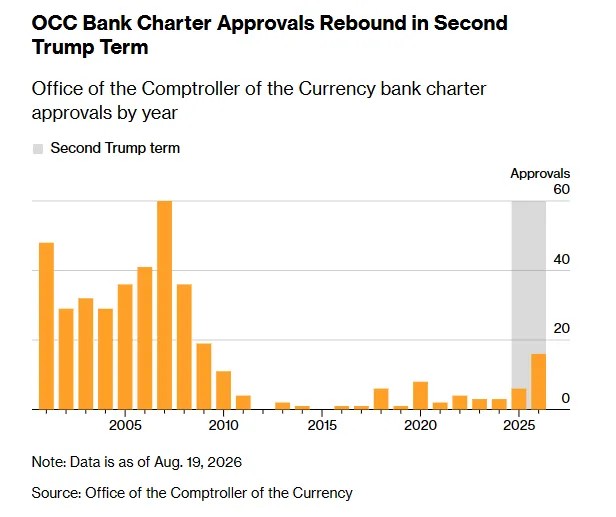
Source: Bloomberg.

Moreover, the majority of new permits went to fintech companies and firms working with digital assets, including Circle and Coinbase.

US Banks to Grant Clients Direct Access to Bitcoin

Earlier in August, representatives of $WLFI stated that a federal charter would strengthen regulatory oversight of the project and help expand the use of the stablecoin $USD1. According to the company, the future bank is intended to hold the assets backing the stablecoin.

The project's connection to the family of US President Donald Trump has raised questions among Democrats. Sources familiar with the matter told Bloomberg that the 'stable coin' could become a tool for gaining favor with the White House amid a more lenient regulatory approach.

According to Aaron Klein, a senior fellow at the Brookings Institution, 'creating the illusion among people that stablecoins are backed by the state raises real concerns.'

In response to the criticism, company representative David Waxman emphasized that the firm is not evading oversight but is transitioning to ongoing OCC supervision. The project must still comply with anti-money laundering and consumer protection requirements, and weekly reports on reserves and operations with $USD1 will undergo independent verification.

Recall that a Reuters poll showed that 63% of Americans found Trump's income from cryptocurrency inappropriate.

Trump Received Over $1.4 Billion from Crypto Projects
end-content

Domande pertinenti

QWhat type of approval did World Liberty Financial ($WLFI) receive from the OCC, and what conditions were attached to it?

AWorld Liberty Financial ($WLFI) received conditional approval from the OCC to launch a trust bank in the United States. To receive final approval, the company must hire an external auditor and maintain a specific level of capital.

QWhat concerns did the article raise regarding the connection between World Liberty Financial ($WLFI) and the Trump family?

AThe article raised concerns that the project's connection to US President Donald Trump's family, including an investor who is one of the president's sons, led to questions from Democrats. Critics suggested the stablecoin $USD1 could be used as a tool to gain favor with the White House, given a perceived softer regulatory approach.

QAccording to the article, how did the number of banking license approvals under Trump's second term compare to the previous period?

AAccording to Bloomberg journalists, in the first 19 months of President Donald Trump's second term, the regulator approved 22 applications for banking licenses. This number is greater than the total approvals granted over the five preceding years combined.

QWhat point did Brookings Institution senior fellow Aaron Klein make about stablecoins in relation to this news?

AAaron Klein, a senior fellow at the Brookings Institution, expressed concern that 'creating the illusion for people that stablecoins are backed by the government raises real concerns.'

QHow did a representative from World Liberty Financial ($WLFI) respond to the criticism about the project's oversight?

ADavid Waxman, a representative of the company, responded by emphasizing that the firm is not avoiding oversight but is transitioning under the permanent supervision of the OCC. He stated that the project must still comply with anti-money laundering and consumer protection requirements, with weekly reports on reserves and $USD1 transactions undergoing independent review.

Letture associate

Altcoin Hacked, Leading to Sharp Price Drop! Also Listed on Major Exchanges!

The price of the NES token plummeted significantly following suspicious activity and large sell-offs detected on the network. Blockchain observers suggested that one wallet minted approximately $55 million worth of NES tokens and began selling them on decentralized exchanges. This selling pressure caused the price of NES to drop by up to 40%. According to the data, the address in question still holds around $18 million worth of NES, indicating that market sell-off pressure may continue. Prior to the incident, it was reported that about $12.35 million worth (62.9 million NES tokens) were transferred to the Ethereum mainnet in the morning (Turkish time), with claims that liquidity was withdrawn and tokens were sold on the market later that evening. However, data regarding the $55 million token mint and the transfer of 62.9 million NES tokens has not been independently confirmed. The NESA team confirmed in a statement that they detected malicious activity exploiting a vulnerability in their Layer 1 network originating from Cosmos EVM. They stated they are working to contain the impact, responded promptly, and will restore services after implementing a software patch and additional measures to ensure secure network operation. Nesa also notified all cryptocurrency exchanges and stated deposit operations will resume after necessary work is completed. The article includes a chart showing the NES price decline following the exploit and concludes with a standard disclaimer that this is not investment advice.

cryptonews.ru2 h fa

Altcoin Hacked, Leading to Sharp Price Drop! Also Listed on Major Exchanges!

cryptonews.ru2 h fa

PeaqOS and World ID Integrate ZK Proofs into Autonomous Robots

The integration of PeaqOS and World ID now allows autonomous machines to verify they are interacting with real, unique individuals without collecting names, photos, or other personal data. This update, available via robotic.sh, enables connected devices to directly request and verify World ID proofs. The system leverages zero-knowledge technology, letting a person prove they are human while maintaining the privacy of their identity. This addresses a key challenge for operators of delivery robots, shared machines, and autonomous systems: how to authenticate a user as genuine without relying on insecure PINs, pickup codes, or traditional identity checks that require personal data collection. Instead of obtaining identifying information, a device receives a cryptographic proof that the user is a real person. PeaqOS acts as a coordination layer, allowing devices to utilize World ID via decentralized identifiers and a device marketplace. A robot can request verification, receive a zero-knowledge proof, and register an auditable record of the interaction—all without exposing underlying personal data. The system also supports uniqueness verification, enabling machines to enforce rules like "one item per person" without maintaining user identity databases. A demonstrated use case involves autonomous medicine delivery: a patient verifies via the World App when placing an order, a pharmacist verifies before loading the medication, and the patient verifies again upon delivery so the robot can confirm the recipient is linked to the order before unlocking the compartment. Similarly, promotional robots could ensure one item per person, and shared vending machines could grant access to verified individuals without requiring accounts or personal data. This integration for PeaqOS-powered robots and devices minimizes the identity information collected or stored while allowing autonomous systems to confirm they are interacting with real humans.

cryptonews.ru3 h fa

PeaqOS and World ID Integrate ZK Proofs into Autonomous Robots

cryptonews.ru3 h fa

Trading

Spot
活动图片