AI 让黑客攻击「平民化」,Bitcoin Red Team 白帽打响竞速攻防赛

marsbitPubblicato 2026-08-24Pubblicato ultima volta 2026-08-24

Introduzione

人工智能的普及使黑客工具变得更易获取,降低了网络攻击的技术门槛,让更多缺乏专业知识的人也能发动攻击。为此,比特币开发者组建了名为“Bitcoin Red Team”的白帽安全团队,旨在主动、抢先发现比特币生态(如钱包、应用等上层软件)中的安全漏洞,以应对由AI辅助催生的日益严峻的安全威胁。 团队指出,比特币底层协议本身安全,但用户日常使用的相关软件风险突出。他们通过接受项目扫描申请和主动排查来寻找漏洞,并将发现反馈给开发者。团队在安全工作中频繁使用中国AI模型,因为美国主流模型往往因内容限制而拒绝协助网络安全任务,实用性不足。 专家警告,AI正在消除软件安全的信息壁垒,使过去依赖技术门槛或隐蔽性的安全模式失效。攻击者已开始利用AI寻找并利用漏洞,且由于加密货币直接关联经济利益,比特币领域将更早、更激烈地面临这场变革。这场由AI驱动的安全攻防升级,未来也可能蔓延至其他行业。

撰文:Jason Nelson

编译:Saoirse,Foresight News

人工智能把威力强大的黑客工具交到了大批缺乏网络安全专业知识的人手上。加密货币开发者被迫开启一场竞速赛跑:必须抢在攻击者之前找到系统漏洞。

Bitcoin Red Team(比特币红队)就是迎接这项挑战的团队。该团队匿名成员、比特币软件开发人员 Calle 称,组建这支队伍,就是为了紧急应对比特币生态内各类由 AI 辅助催生的安全威胁。

「现在,一切只是时间问题。」参与维护开源协议 Cashu 的 Calle 向 Decrypt 表示,「Bitcoin Red Team 之所以成立,就是我们要尽可能跑在攻击者的前面。」

据 Calle 介绍,Bitcoin Red Team 共有 20‐25 名志愿者,其中不少成员选择保持匿名,例如比特币隐私协议开发者 Stu、Talip,以及同样维护 Cashu 的开发者 thesimplekid。团队其他成员还包括比特币开发者 Ben Carmen、Daniela Brozzoni、James O'Beirne,以及 Vinteum 比特币研发中心董事会成员 Bruno Garcia。
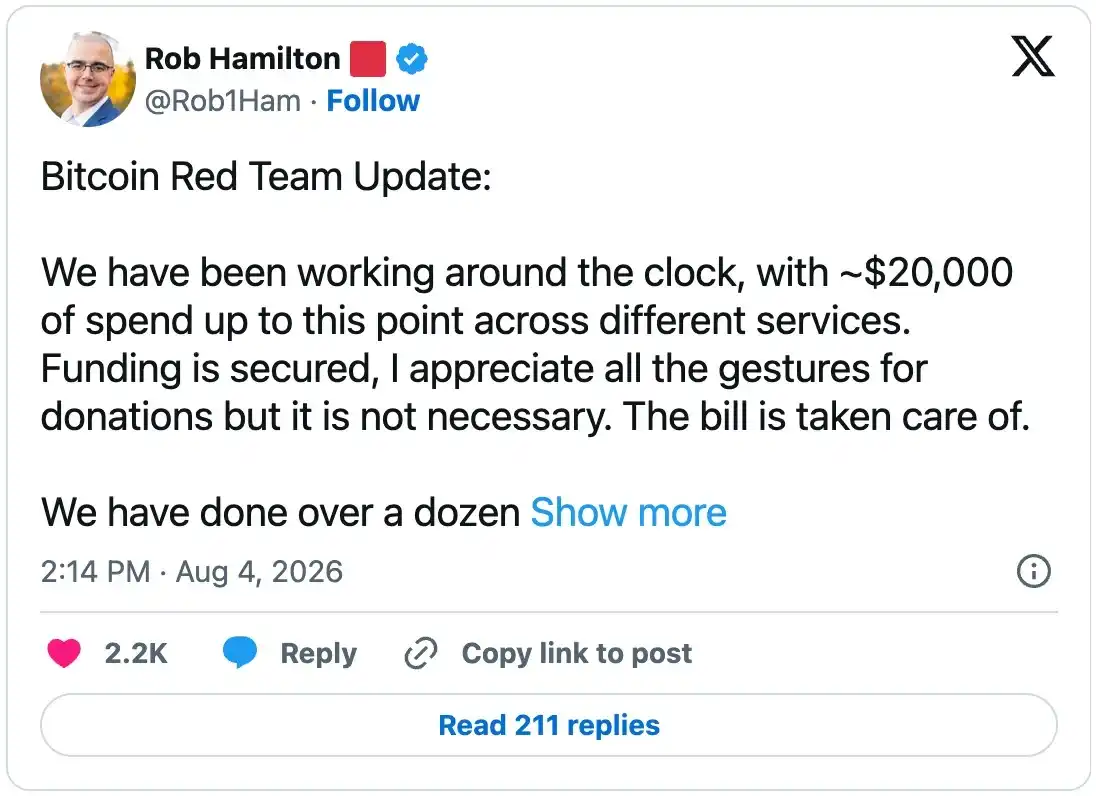
Calle 称,比特币保险企业 AnchorWatch 的首席执行官 Rob Hamilton,在 Coldcard 离线硬件钱包遭到黑客攻击事件发生后,开始着手排查各类比特币项目,Bitcoin Red Team 也在此背景下逐步成型。

Calle 着重说明,团队并未发现比特币底层协议本身存在问题,但风险集中在钱包、各类应用、服务,以及其他搭建在比特币之上的第三方软件。

「比特币底层本身是安全的,但普通人用来进行比特币交易的各类软件未必安全,而绝大多数用户接触的恰恰就是这些上层软件。」Calle 说道。

Coldcard 钱包被攻破、多起比特币相关服务遭遇攻击,再加上性能更强的中国 AI 模型陆续问世,促使 Calle 与其他安全研究人员投身这项工作,加快排查进度。

「我认为 Kimi K3 的问世也给网络安全领域带来大量动荡,它同时赋予攻击者与防御者前所未有的能力。」他表示。

Calle 解释,红队一方面接收比特币项目发来的安全扫描申请,另一方面也会自主主动搜寻漏洞。

「很多项目会主动找上门,希望我们对其开展扫描,但我们也会主动出击。通过自主排查,我们几乎已经覆盖了生态内所有具备重要地位的开源项目。也就是说,就算某个项目才来找我们扫描,说不定我们早已经扫过了。」

团队会将漏洞发现反馈给对应项目开发者,并结合开发者的反馈,优化漏洞分类标准和危险等级评定规则。

中国 AI 模型填补工具缺口

Calle 表示,在团队开展安全相关工作时,中国 AI 模型的使用频次远超美国同类模型,原因是美国模型内置的安全防护机制会拦截网络安全研究相关的任务。

「两者差距非常明显。」他说。

今年 2 月,Anthropic 指责中国 AI 实验室 DeepSeek、Moonshot AI 以及 MiniMax 利用约 24000 个虚假账号,通过模型蒸馏技术,窃取超过 1600 万次 Claude 对话数据。而特朗普政府在 4 月发出警告,称中国相关主体正以「工业化规模」开展同类窃取行为。

Calle 认为,尽管美国前沿大模型综合能力依旧处于领先,但严苛的内容限制,削弱了它们在安全相关工作中的实用性。

「不可否认,美国的顶尖大模型综合智能水平依旧领先全球,但它们都设置了重重防护限制,这限制了模型的用途,在网络安全领域尤其明显。」

加入红队之前,Calle 就切身遭遇过这类限制。他说,美国 AI 模型有时拒绝协助查找漏洞;甚至面对开发者已经确认的漏洞,模型也不愿提供修复帮助,这促使他转而使用中国的人工智能模型。

「比特币正在燃烧」

本月早些时候,Calle 用「比特币正在燃烧」来形容比特币软件面临日益严峻的安全威胁,这里的比特币指代钱包、交易所、闪电网络实现版本,以及所有搭建在比特币之上的周边软件生态。

Calle 相信攻击者已经在利用人工智能寻找并利用漏洞。但为避免给恶意黑客提供攻击思路,他拒绝详细讲解攻击者的具体手段。

他同时警告,过去部分软件漏洞,因信息壁垒,技术不足的攻击者无从下手;而人工智能正在消解这层信息壁垒。

「软件领域已经没有秘密可言。过去依靠信息差实现的安全伪装、依靠不公开细节实现的模糊式安全,这套模式已经行不通,属于它的时代结束了。」Calle 说道。

人工智能也降低了漏洞攻击的技术门槛。

「现在,一个本身不具备相关技术的人,借助 AI 就可以从头到尾完成简单漏洞的攻击利用。AI 赋予普通人的这种能力,彻底改写了攻防博弈格局。」

Calle 认为,加密货币能直接带来经济收益,攻击者有强烈的金钱动机,所以比特币会比其他行业更早遭遇这一变化。

「攻击者首选攻击目标就是互联网数字货币。我们正处在整个计算机行业大变革的开端,我确信未来其他行业,也会遭遇我们当下正在面对的同类安全问题。」

Domande pertinenti

QBitcoin Red Team 成立的主要目的是什么?

ABitcoin Red Team 成立的主要目的是紧急应对比特币生态内由人工智能辅助催生的安全威胁,抢在攻击者之前主动发现并修复系统漏洞。

Q根据文章,人工智能的普及如何改变了网络安全攻防格局?

A人工智能降低了黑客攻击的技术门槛,使得缺乏专业知识的人也能利用AI工具发动攻击,从而消解了信息壁垒,让过去依靠信息差和模糊细节实现的安全模式失效,彻底改写了攻防博弈格局。

Q在安全研究工作中,为什么团队成员 Calle 更倾向于使用中国的 AI 模型而非美国的?

A因为美国的主流AI模型设置了严格的内容安全防护机制,会拦截网络安全研究相关的任务,有时甚至拒绝协助查找或修复漏洞。相比之下,中国的AI模型在这方面限制较少,因此在安全工作中的实用性更强。

Q文章中提到比特币的哪个层面被认为是安全的,而风险主要集中在何处?

A文章认为比特币的底层协议本身是安全的,但风险主要集中在钱包、各类应用、服务,以及其他搭建在比特币之上的第三方软件,这些是普通用户接触最多的层面。

Q为什么 Calle 认为加密货币行业会比其他行业更早遭遇AI带来的安全变革?

A因为加密货币能直接带来经济收益,攻击者有强烈的金钱动机,所以比特币及相关的软件生态会成为攻击者的首选目标,从而更早地面临由AI赋能的黑客攻击所带来的安全问题。

Letture associate

Arthur Hayes Discusses the Sudden Surge in Bitcoin and the Reasons for Bullish Outlook on Ethereum

In a podcast interview, BitMEX co-founder Arthur Hayes discusses the recent surge in Bitcoin and his optimism for Ethereum. He attributes Bitcoin's rise to mounting concerns over the US's $40 trillion debt, unsustainable interest payments, and recent Treasury actions, including doubling its long-term bond buyback program. Hayes argues these measures signal impending "yield curve control" and will inject significant liquidity into the market, benefiting scarce assets like Bitcoin. He sees this as a replay of the 2008 financial crisis dynamics that led to Bitcoin's creation. Hayes expresses particular bullishness on Ethereum (ETH), citing its underperformance relative to its previous all-time high and other major crypto assets. He highlights Ethereum's strengths: the largest and most innovative developer community, the "Lindy effect" from its longevity since 2015, and narratives like asset tokenization (e.g., Robinhood's involvement). He believes Ethereum is well-positioned to outperform in a liquidity-driven bull market and could significantly reduce Bitcoin's current market dominance. Regarding regulation, Hayes downplays the importance of the US "CLARITY Act" for crypto's core value proposition, stating Bitcoin's primary driver is macroeconomic liquidity, not legislation. He identifies war or catastrophic infrastructure failure as the biggest risk to crypto assets. For year-end predictions, Hayes forecasts Bitcoin reaching $126,000, breaking its previous record high. His advice to new traders emphasizes patience, dedication, and continuous learning.

marsbit3 min fa

Arthur Hayes Discusses the Sudden Surge in Bitcoin and the Reasons for Bullish Outlook on Ethereum

marsbit3 min fa

DeFi Sector Rebounds Most Strongly, Which High-Revenue Projects Can Be a Good Opportunity to 'Get On Board'?

**Title: DeFi Sector Leads Market Rebound: High-Revenue Projects to Watch** The recent surge in Bitcoin and Ethereum has revitalized the altcoin market, with DeFi emerging as one of the most active sectors. Beyond chasing price rallies, a key fundamental metric for evaluating DeFi projects is their protocol revenue—the actual income retained after paying liquidity providers. This indicates genuine user demand and sustainable business models. **Top Revenue-Generating DeFi Projects:** * **DEX (Decentralized Exchanges):** * **Uniswap (UNI):** Leads with $7.18M in 30-day revenue. It accrues income from protocol fees, which are now active on multiple chains and used to buy back and burn UNI. * **Solana Ecosystem:** Jupiter ($4.69M), Meteora ($1.67M), and Raydium ($1.13M) are top performers, with substantial revenues driven by Solana's vibrant trading activity. Jupiter and Raydium use a portion of fees for token buybacks, while Meteora has also executed significant buybacks. * **PancakeSwap (CAKE):** Generated $5.16M recently, maintaining a strong position on BNB Chain and other networks. Its token CAKE continues a net deflationary trend through buybacks and burns. * **Aerodrome (AERO):** On Base chain, it earned $4.11M. Its revenue is directly distributed to veAERO holders instead of funding buybacks. * **Lending:** * **World Liberty Financial (WLFI):** Topped the lending sector with $10.47M in 30-day revenue. A proposal to use fees from its proprietary market making for WLFI buybacks passed, but token holders' net income remains zero currently. * **Aave (AAVE):** Earned $4.12M. It had an active buyback program until it was paused in April 2026 following a security incident. * **ETH Staking:** * **ether.fi (ETHFI):** Generated $3.03M. Revenue from eETH withdrawals is fully used to buy back ETHFI, which is then distributed to sETHFI stakers. * **Lido (LDO):** Earned $2.31M. Its recently activated NEST mechanism automatically uses 50% of annual revenue above $40M to buy back LDO. In summary, during the market rebound, several DeFi protocols across DEXs, lending, and staking are demonstrating strong revenue generation. Key models include direct fee collection, token buyback/burn programs, and revenue distribution to governance token stakers, providing fundamental strength amidst market volatility.

Odaily星球日报5 min fa

DeFi Sector Rebounds Most Strongly, Which High-Revenue Projects Can Be a Good Opportunity to 'Get On Board'?

Odaily星球日报5 min fa

HBM at a Crossroads

At Hot Chips 2026, Samsung and SK Hynix outlined diverging strategies for High-Bandwidth Memory (HBM) evolution. The core battlegrounds are base die architecture and advanced packaging. Samsung unveiled a three-phase roadmap for its zHBM technology. The plan transforms the base die from a passive interposer into an active partner. Phase 1 moves the memory controller from the GPU to a logic-node base die, freeing up 5-10% of GPU area for compute and offering potential 10-20% performance gains. Later phases aim to add compute-in-memory capabilities (like attention calculations) and ultimately achieve true 3D integration by stacking DRAM directly on top of the compute die. Samsung claims zHBM could reduce DRAM power by 70% and more than double bandwidth versus HBM4E, with HBM5 targeting 6TB/s bandwidth. SK Hynix is focused on advancing conventional 3D stacking while managing thermal and warpage challenges. It confirmed a 12-layer HBM4 is in production and a 16-layer version is in customer validation. The path to 20+ layers is hybrid bonding, which allows for thicker dies and finer pitches. Its iHBM concept embeds dedicated thermal conduction paths within the stack's hottest areas. However, SK Hynix noted hybrid bonding may not arrive until HBM5, as current thickness limits and manufacturing challenges (like controlling warp in 50-micron thin dies) are being addressed by its Mass Reflow-Molded Underfill (MR-MUF) process. Micron emphasized the growing "memory wall," where AI accelerator compute performance is outpacing HBM bandwidth growth. It detailed HBM's role as a bridge between compute and memory but highlighted the rising complexity and silicon cost (approximately 3x more silicon for equivalent HBM3E capacity vs. DDR5). Key challenges include thermal management, reliability (chip-package interaction, ECC), and the continued push for faster I/O and larger, more advanced system-in-package (SiP) designs. In summary, the HBM market is at a crossroads: Samsung is pursuing a radical architectural shift with active base dies and vertical stacking, SK Hynix is pushing the limits of conventional stacking with advanced thermal solutions, and all players confront significant thermal, packaging, and cost hurdles as they scale bandwidth and capacity for next-generation AI workloads.

marsbit24 min fa

HBM at a Crossroads

marsbit24 min fa

The Eve of the Bull Market: Undervalued/Innovative Narratives Worth Watching

Author: Haotian With a bull market approaching and many unsure where to invest, which niche or innovative narratives that emerged during the bear market—though perhaps ahead of their time—are worth watching now? (Some are already gaining momentum.) **1) Hooks:** Uniswap V4 Hooks are externally customizable smart contracts that allow custom logic to be inserted at key points in an AMM pool's lifecycle, such as initialization, liquidity actions, swaps, donations, and fee handling. (Examples: uPEG, SATO, Slonks) **2) x402:** This initiative revives the long-reserved but rarely used HTTP 402 "Payment Required" status code, proposing it as a foundational layer for AI agent payments. (Examples: PAYAI, dreams) **3) RWAFI (Real-World Assets Finance):** Extending beyond mere asset tokenization, this narrative focuses on composable DeFi applications built on TradFi assets as underlying liquidity or integrating tokenized assets into DeFi protocols. (Examples: Stonkbroker, INDEX) **4) Agentic Economy:** Based on a Google-proposed open protocol, this framework enables AI agents built on different systems to discover, communicate, delegate tasks, and collaborate, serving as a communication layer for an economy of autonomous agents. It opens possibilities for agent-based social platforms, games, and human-task automation. (Example: Moltbook) Additionally, there is a broad range of innovative narratives around AI + Crypto, including infrastructure, applications, and protocols for AI agents. Established areas like Prediction Markets, Perpetual DEXs, and Privacy narratives remain highly active. (Note: Many projects mentioned above are inactive; this is for informational purposes only, not investment advice.) What other interesting narratives are out there? Feel free to share in the comments.

marsbit24 min fa

The Eve of the Bull Market: Undervalued/Innovative Narratives Worth Watching

marsbit24 min fa

Trading

Spot
活动图片