MSX美股每日观察:沃尔玛 FY2027年Q2财报:营收盈利双超预期,美国同店增速创逾六年新低

Odaily星球日报Pubblicato 2026-08-21Pubblicato ultima volta 2026-08-21

Introduzione

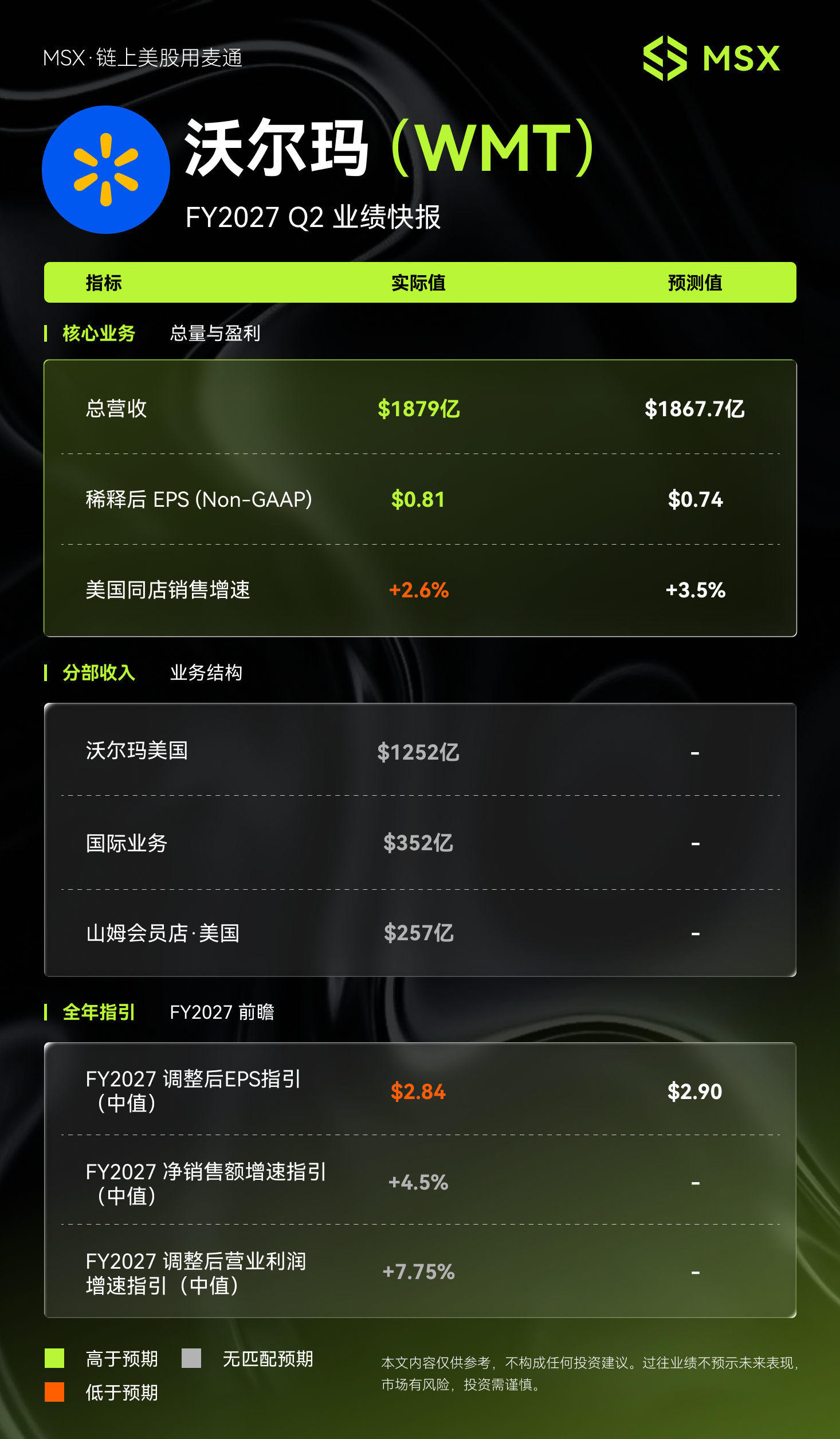
沃尔玛发布FY2027财年第二季度财报。当季总营收达1879.0亿美元,同比增长5.9%,超出市场预期。调整后每股收益为0.81美元,同比增长19%,同样高于预期。 然而,关键的增长指标显示疲软:美国本土同店销售额仅增长2.6%,低于市场预期的3.5%,创下逾六年来的最低增速。公司指出,药房价格通缩拖累了约125个基点的增长。 从业务结构看,高毛利业务表现强劲:全球电商增长23%,全球广告业务增长38%,美国第三方平台销售额增长52%。调整后营业利润同比增长快于营收增速,显示盈利质量提升。 沃尔玛同时上调了全年业绩指引,将净销售额增速预期上调至4.0%-5.0%。但调整后每股收益指引上限为2.87美元,仍略低于市场一致预期的2.90美元。公司表示已开始收到关税退款,并将用于降低商品售价。 报告的核心矛盾在于:尽管当季财务数据普遍超预期,但美国核心零售增速放缓至多年低点,反映了消费者支出趋于谨慎。市场对公司的增长预期已领先于其自身展望,未来增长的关键在于高毛利非零售业务能否持续高速扩张,以抵消核心零售的放缓趋势。

【MSX 研究院·美股RWA 每日观察】 是由领先的RWA交易平台MSX 麦通出品的标志性日报。我们依托强大的宏观研究能力,为您捕捉全球传统美股、流动性变化及 RWA代币化市场的核心脉搏,助您前瞻布局优质资产。

今日观察

沃尔玛本季营收与调整后每股收益双双超预期,但美国本土同店销售增速降至逾六年来最低水平,药房价格通缩是主要拖累。公司同时上调了全年销售额与盈利指引,不过上调后的每股收益指引上限仍低于市场一致预期,增长动能放缓的信号盖过了当季的业绩超额。

数据一分钟

FY2027 Q2总营收1879.0亿美元,同比增长5.9%,高于市场一致预期1867.7亿美元。

调整后每股收益0.81美元,同比增长19%,高于一致预期0.74美元;但GAAP归属净利润63.7亿美元、同比下降9%,两个口径方向相反。

美国同店销售增速仅2.6%,低于市场一致预期3.5%,为逾六年来最低;公司说明药房价格通缩造成约125个基点的拖累。

分部看,沃尔玛美国净销售额1252.0亿美元、同比增长3.5%,国际业务352.0亿美元、同比增长13%,山姆会员店(美国)257.0亿美元、同比增长8.8%,其中不含燃油同店增长4.4%。

高毛利业务维持高增速:全球电商同比增长23%(美国+24%),全球广告业务同比增长38%(Walmart Connect增长43%),美国第三方平台销售额同比增长52%。

调整后营业利润92亿美元,按固定汇率口径同比增长17.4%,快于营收增速。

全年指引全面上调:净销售额增速指引由3.5%-4.5%上调至4.0%-5.0%,调整后每股收益指引由2.80-2.87美元(原2.75-2.85美元)上调,调整后营业利润增速指引为7.0%-8.5%。

但上调后的每股收益指引上限2.87美元,仍低于市场一致预期的2.90美元。公司表示本季已开始收到关税退款,并承诺将这笔资金用于压低商品售价。

MSX View

这份财报的矛盾之处在于,当季的数字几乎每一项都比预期好,问题出在结构和前瞻上。营收、调整后盈利、经营效率三条线都在改善:调整后营业利润增速快于营收增速,广告、第三方平台、电商这些高毛利业务增速全在两位数以上甚至更高,说明沃尔玛的盈利质量在提升。

美国本土同店增速降到2.6%这个逾六年低点,把叙事拉回到最基础的问题上:作为覆盖面最广的美国零售商,它的同店数据本身就是消费端的温度计。药房价格通缩解释了约125个基点,剩下的部分则指向消费者行为的实际变化。交易笔数稳定但单次消费金额下降,意味着人还在来,只是买得更省。

全年指引全面上调却仍不及预期,恰恰说明市场对这家公司的增长预期已经跑在了公司自己的判断前面。后续的关键,是高毛利非零售业务的扩张速度能否持续快到足以抵消核心零售增速的放缓。
关于 MSX 麦通

MSX 是领先的 RWA交易平台,致力于提供安全、高效、透明的全球金融市场准入。作为全球最早的链上美股交易平台之一,MSX 始终走在行业前沿,以持续创新引领市场变革。

平台深度融合区块链技术与合规框架,全面提供近 400 种代币化股票和 IPO 前(Pre-IPO)资产的现货及衍生品交易,完美弥合了传统金融与数字资产行业之间的鸿沟。

围绕“让优质资产自由流通”的核心使命,MSX 目前已构建起涵盖美股现货与永续合约、币币交易、Pre-IPO 和麦通研究院等多元化的数字金融服务体系,旨在为全球投资者提供全时段、高性能的优质资产参与入口。

官方网站: https://msx.com/

华语TG:https://t.me/MSXOfficial

Global TG:https://t.me/MSXGlobal

X:https://x.com/MSX_CN

全球 App Store / Google Play 现已同步上架。
风险提示: 宏观经济及美股市场波动剧烈,本文内容仅供麦通研究院学术与研究观察参考,不构成任何投资建议。

Crypto di tendenza

Domande pertinenti

Q根据财报,沃尔玛本季度营收和调整后每股收益表现如何,是否超出市场预期?

A沃尔玛本季度(FY2027 Q2)总营收为1879.0亿美元,同比增长5.9%,高于市场一致预期的1867.7亿美元。调整后每股收益为0.81美元,同比增长19%,也高于一致预期的0.74美元。因此,营收和调整后每股收益双双超出市场预期。

Q沃尔玛美国同店销售增速创逾六年新低的主要原因是什么?

A沃尔玛美国同店销售增速仅为2.6%,创逾六年新低。公司说明,药房价格通缩对增速造成了大约125个基点的拖累,是主要原因之一。

Q文章提到沃尔玛哪些高毛利业务维持了高速增长?其增速分别是多少?

A沃尔玛的高毛利业务维持高速增长,具体表现为:全球电商业务同比增长23%(其中美国增长24%),全球广告业务同比增长38%(其中Walmart Connect增长43%),美国第三方平台销售额同比增长52%。

Q沃尔玛上调了全年业绩指引,但为何市场可能仍不满意?

A虽然沃尔玛全面上调了全年业绩指引(如净销售额和调整后每股收益指引),但上调后的每股收益指引上限为2.87美元,仍然低于市场一致预期的2.90美元。这表明市场对公司的增长预期已经超过了公司自身的判断,因此市场可能因增长预期未被完全满足而感到不满意。

Q文章如何看待沃尔玛这份财报所呈现的‘矛盾之处’?

A文章认为财报的‘矛盾之处’在于当季的营收、调整后盈利、经营效率(如调整后营业利润增速快于营收)等多项数据都优于预期,显示出良好的盈利质量。但美国本土同店销售增速降至六年多以来的低点,以及上调后的全年每股收益指引上限仍不及市场预期,传递出核心零售增长动能放缓的信号。这表明积极因素与结构性、前瞻性问题并存。

Letture associate

The Biggest Political Economy Question in the AI Era: As Robots Become More Capable, How Do Humans Share the Value?

In the AI era, the most pressing political economy question is: as machines become increasingly capable, how can humanity share in the value they create? An article originally critiquing China's tech focus has sparked a deeper debate on this global challenge. Historically, industrial progress improved efficiency but still relied on human labor for wealth creation and distribution. AI is fundamentally different—it is now replacing cognitive and knowledge work. As AI and robots take over more tasks, economic growth may continue while direct human participation in value creation shrinks, creating a core tension between productivity gains and widespread income generation. The issue is not unique to China. While leading tech companies amass enormous wealth, labor's share of income is declining globally. The core problem is a broken link: technological innovation and corporate profits are not translating into sufficient consumer income and demand. Three potential paths forward are outlined: a traditional capitalist model where profits primarily go to capital owners; a state-capitalist approach with public investment in AI; and more innovative models like digital sovereign wealth funds, universal shareholding, or AI-era basic income schemes to directly distribute AI-generated value. The future competitive advantage may lie not just in technological supremacy, but in which society can build a new, inclusive distribution system for the intelligent economy. The ultimate challenge is ensuring that as AI creates value, humans have a means to obtain income and share in the resulting widespread social benefits.

marsbit9 min fa

The Biggest Political Economy Question in the AI Era: As Robots Become More Capable, How Do Humans Share the Value?

marsbit9 min fa

Generating Profits for Seven Consecutive Quarters, Emerging Markets Carry Trade Outperforms Everything

For the seventh consecutive quarter, dollar-funded emerging market carry trades have delivered positive returns, marking the longest winning streak since 2008. According to Bloomberg's index, this strategy has gained approximately 22% since late 2024, outperforming U.S. Treasuries, emerging market sovereign, and corporate dollar debt. The core of the trade involves borrowing low-interest currencies like the U.S. dollar, euro, or yen to invest in high-yielding emerging market assets, such as Turkish lira bonds offering over 40% returns. Returns were amplified by favorable currency moves, with the dollar weakening against most emerging market currencies and other traditional funding currencies. For instance, the trade gained 48% on the Colombian peso in the past year. A key test came in August 2024 with a historic joint U.S.-Japan currency intervention, which caused only a modest 1% dip in the carry trade risk premium as investors shifted funding from the yen to the euro and Swiss franc. Looking ahead, the primary risk is the timing of Federal Reserve policy changes. While persistent inflation allows the Fed to hold rates, a rapid rise in long-term U.S. yields could threaten the trade. Another concern is crowding, as massive inflows increase vulnerability to a sudden reversal. High interest rates in regions like Latin America and Eastern Europe, supported by external factors like Middle East tensions and energy prices, continue to sustain the opportunity. Major investors remain engaged, favoring currencies like the Mexican peso, South African rand, and Turkish lira.

marsbit24 min fa

Generating Profits for Seven Consecutive Quarters, Emerging Markets Carry Trade Outperforms Everything

marsbit24 min fa

Unpacking the Truth Behind On-chain Assets: Leverage, Liquidity, and Risk

The article analyzes the concept of "real-world asset" (RWA) tokenization, arguing that while tokenizing assets on-chain is a useful step, it is far from transformative on its own. The author compares it to placing a barcode on a shipping container—it enables identification but does not build the necessary market infrastructure. The core argument is that true value emerges not from tokenization, but from integrating these tokens into DeFi systems where they can be valued, financed, hedged, traded, and liquidated under stress. Key challenges identified include: 1. **Multiple Time Clocks**: A fundamental tension exists between blockchain's 24/7 settlement and the slower, business-hour-dependent processes of traditional markets, custody, and redemption. This "duration mismatch" can create dangerous liquidity gaps during crises. 2. **Liquidity Misconceptions**: True liquidity is not measured by Total Value Locked (TVL) or trading pairs, but by the ability to exit a position within a required timeframe at an acceptable price. It requires analyzing multiple exit paths and stress-testing scenarios. 3. **Leverage and Risk**: Leverage unlocks economic utility (e.g., using tokenized assets as collateral) but also introduces fragility. Risk models must account for more than asset volatility, incorporating factors like legal enforceability, oracle freshness, and market structure. Paradoxically, a "safer" asset like tokenized Treasury bonds could require a higher collateral discount than ETH due to slower, less-proven liquidation mechanisms. 4. **A Risk Graph**: RWA risk should be modeled as a network of interconnected dependencies (e.g., issuers, custodians, oracles, stablecoin pools), not a single score. Failures can propagate through this graph, turning operational issues into systemic liquidity crises. The article states that tokenized government bonds are merely an entry point, while more complex frontiers like computing power and energy assets present greater challenges and opportunities. It also examines the interplay and risks between tokenized stocks and perpetual futures contracts. The conclusion is that the future lies not in "tokenizing everything," but in building robust market layers where tokenized rights become resilient financial primitives within a programmable capital system. The token is just the barcode; the market is the machine.

marsbit48 min fa

Unpacking the Truth Behind On-chain Assets: Leverage, Liquidity, and Risk

marsbit48 min fa

Trading

Spot

Articoli Popolari

Come comprare BEAT

Benvenuto in HTX.com! Abbiamo reso l'acquisto di Audiera (BEAT) semplice e conveniente. Segui la nostra guida passo passo per intraprendere il tuo viaggio nel mondo delle criptovalute.Step 1: Crea il tuo Account HTXUsa la tua email o numero di telefono per registrarti il tuo account gratuito su HTX. Vivi un'esperienza facile e sblocca tutte le funzionalità,Crea il mio accountStep 2: Vai in Acquista crypto e seleziona il tuo metodo di pagamentoCarta di credito/debito: utilizza la tua Visa o Mastercard per acquistare immediatamente AudieraBEAT.Bilancio: Usa i fondi dal bilancio del tuo account HTX per fare trading senza problemi.Terze parti: abbiamo aggiunto metodi di pagamento molto utilizzati come Google Pay e Apple Pay per maggiore comodità.P2P: Fai trading direttamente con altri utenti HTX.Over-the-Counter (OTC): Offriamo servizi su misura e tassi di cambio competitivi per i trader.Step 3: Conserva Audiera (BEAT)Dopo aver acquistato Audiera (BEAT), conserva nel tuo account HTX. In alternativa, puoi inviare tramite trasferimento blockchain o scambiare per altre criptovalute.Step 4: Scambia Audiera (BEAT)Scambia facilmente Audiera (BEAT) nel mercato spot di HTX. Accedi al tuo account, seleziona la tua coppia di trading, esegui le tue operazioni e monitora in tempo reale. Offriamo un'esperienza user-friendly sia per chi ha appena iniziato che per i trader più esperti.

375 Totale visualizzazioniPubblicato il 2026.01.22Aggiornato il 2026.06.02

Come comprare BEAT

Discussioni

Benvenuto nella Community HTX. Qui puoi rimanere informato sugli ultimi sviluppi della piattaforma e accedere ad approfondimenti esperti sul mercato. Le opinioni degli utenti sul prezzo di BEAT BEAT sono presentate come di seguito.

活动图片