ACDC phát hiện 556 ví Polymarket, nghi ngờ thuộc về người nội bộ

cryptonews.ruPubblicato 2026-08-20Pubblicato ultima volta 2026-08-20

Introduzione

Tổ chức Anti-Corruption Data Collective (ACDC) đã công bố một báo cáo phát hiện 556 ví Polymarket, được gọi là "Orcas", có dấu hiệu giao dịch nội gián. Những tài khoản này thực hiện các cá cược nhỏ, mục tiêu vào các sự kiện có tỷ lệ cược thấp và thắng với tỷ lệ hơn 75%. Báo cáo phân tích 78.496 lượt cá cược rủi ro cao và xác định bốn nhóm người dùng: Orcas, "cá voi", bot và người chơi nhỏ lẻ. Trong khi chỉ 14% cá cược tỷ lệ cao trên toàn nền tảng là thắng, tỷ lệ này lên tới 52% trên các thị trường sự kiện quân sự. ACDC ước tính riêng các cá cược thắng vào kết quả ít khả năng xảy ra trên thị trường quân sự đã thu về 9,3 triệu USD. Vấn đề nghiêm trọng hơn khi hoạt động của Orcas thường bị bot và "cá voi" bắt chước theo thời gian thực nhờ tính minh bạch của blockchain, có thể vô tình tiết lộ thông tin nội bộ. Điều này tạo ra rủi ro an ninh quốc gia, khi các cơ quan tình báo nước ngoài có thể hành động dựa trên tín hiệu thị trường này. Báo cáo kết luận rằng việc ngăn chặn hoàn toàn các thị trường rủi ro nhất có thể là giải pháp cần thiết. Các vụ việc tương tự trước đây bao gồm một binh sĩ Mỹ và một kỹ sư Google bị buộc tội sử dụng thông tin nội bộ để kiếm lời trên Polymarket. Một phân tích khác từ Bubblemaps cũng theo dõi các tài khoản thắng 2,4 triệu USD từ hơn 80 lượt cá cược về chiến tranh với Iran với xác suất thắng 98%.

Trong báo cáo mới của tổ chức Anti-Corruption Data Collective (ACDC), họ đã xác định 556 tài khoản Polymarket mà tổ chức này gọi là "Orcas"

Theo thông tin có được, các tài khoản này đặt cược nhỏ, có mục tiêu cụ thể vào các sự kiện với tỷ lệ cược thấp và thắng hơn 75% số lần.

ACDC đã tìm hiểu được gì về Polymarket?

Tổ chức Anti-Corruption Data Collective (ACDC) đã công bố một báo cáo có tựa đề "Phân loại rủi ro giao dịch nội gián", trong đó phân tích 78.496 lần đặt cược rủi ro cao được thực hiện từ 12.355 ví trên Polymarket. ACDC định nghĩa cược rủi ro cao là cược trên 2500 đô la với giá 35 cent hoặc thấp hơn, nghĩa là xác suất kết quả là 35% hoặc thấp hơn.

Từ mẫu này, các nhà nghiên cứu đã xác định bốn nhóm: orca, cá voi, bot và "cá nhỏ". Có 556 ví thuộc về nhóm orca đã được ghi nhận, những ví này chỉ đặt cược vào một vài thị trường và chủ đề nhưng lại có tỷ lệ thắng rất cao - hơn 75%.
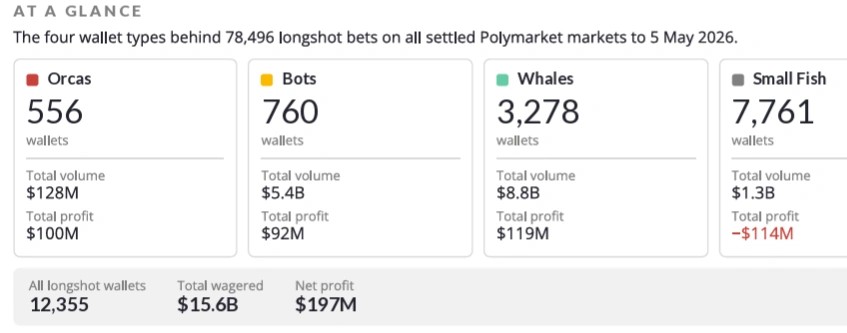
Tỷ lệ phần trăm thắng cược với tỷ lệ cược cao trong các nhóm người chơi khác nhau. Nguồn: ACDC.

Các người chơi lớn, sở hữu 3278 ví, giao dịch với khối lượng lớn trên nhiều thị trường. Bot, có 760 cái dường như được tự động hóa một phần, và 7761 tài khoản còn lại là những người chơi nhỏ.

Trong báo cáo trước đó vào tháng 4, ACDC phát hiện ra rằng trên toàn bộ nền tảng Polymarket, chỉ có 14% các lần đặt cược với tỷ lệ cao là thắng, nhưng trên các thị trường chính trị, con số này tăng lên 25%, và trên thị trường hàng hóa quân sự và quốc phòng lên đến 52%.

Michelle Kendler-Kretsch và David Szakonyi, các tác giả của báo cáo, ước tính rằng chỉ riêng trên các thị trường quân sự, các lần đặt cược thắng vào các kết quả bất ngờ đã thu về 9,3 triệu đô la.

Tại sao giao dịch nội gián trên Polymarket lại là vấn đề an ninh quốc gia?

ACDC phát hiện ra rằng khi đặt cược vào các sự kiện quân sự lớn, nhóm orca thường đặt cược đầu tiên, sau đó là nhóm cá voi và bot, tương tự như cách các nhà giao dịch có kinh nghiệm theo dõi blockchain công khai và sao chép hành động của người nội bộ theo thời gian thực.

Loại hình giao dịch "bắt chước" này là hợp pháp, nhưng nó có thể truyền tải thông tin về hoạt động của người nội bộ ra toàn thế giới.

Ví dụ, khi một orca đặt cược vào hành động quân sự của Mỹ ở Iran vài giờ trước các cuộc tấn công vào tháng 6 năm 2025, một bot và một cá voi đã đặt cược tương tự với số tiền lần lượt là 200.000 và 100.000 đô la.

Chính tính minh bạch của blockchain cho phép thực hiện các hoạt động giao dịch bắt chước cũng sẽ cho phép các lực lượng quân sự và tình báo nước ngoài hành động dựa trên tín hiệu thị trường.

Việc truy vết một tài khoản Orca cụ thể đến một con người cụ thể là khó khăn, vì dấu vết tiền tệ là ẩn danh, và để có được bất kỳ thông tin nào, cần phải yêu cầu thông tin từ các sàn giao dịch lưu trữ tiền của hàng nghìn khách hàng.

ACDC kết luận rằng giải pháp duy nhất là cấm hoàn toàn các danh mục thị trường rủi ro nhất.

Đã có một số vụ việc khác liên quan đến giao dịch nội gián trên các nền tảng dự đoán. Vào tháng 4, Bộ Tư pháp Mỹ đã buộc tội một binh sĩ quân đội Hoa Kỳ tên Gannon Ken Van Dyke, cáo buộc anh ta đã đặt cược khoảng 33.034 đô la để theo dõi một cuộc đột kích sử dụng thông tin bí mật, dẫn đến việc bắt giữ Nicolas Maduro, và sau đó thu về khoảng 409.881 đô la.

Vào tháng 5, công tố viên của Quận Nam New York đã buộc tội kỹ sư Google Michelle Spagnolo vì sử dụng dữ liệu nội bộ của công ty để kiếm được 1,2 triệu đô la trên Polymarket.

Công ty Bubblemaps cũng gần đây tuyên bố trong chương trình "60 Phút" trên CBS rằng họ đã theo dõi các tài khoản có liên quan, những tài khoản này đã thắng tổng cộng hơn 2,4 triệu đô la trong hơn 80 lần đặt cược vào chiến tranh với Iran với xác suất thắng 98%.

"Những con số này không thể giải thích chỉ bằng may mắn," Giám đốc điều hành của Bubblemaps Nicolas Vaiman tuyên bố.


Crypto di tendenza

Domande pertinenti

QTổ chức ACDC phát hiện bao nhiêu ví Polymarket được cho là thuộc về người có thông tin nội bộ (Orcas)?

ATổ chức ACDC đã phát hiện 556 ví Polymarket, được họ gọi là 'Orcas', có khả năng thuộc về người có thông tin nội bộ.

QCác tài khoản 'Orca' được đặc trưng bởi điều gì trong báo cáo của ACDC?

ACác tài khoản 'Orca' đặt cược nhỏ, có mục tiêu vào các sự kiện với tỷ lệ cược thấp và có tỷ lệ thắng trên 75%. Họ chỉ đặt cược trên một vài thị trường và chủ đề nhất định.

QACDC định nghĩa thế nào là một vụ cược có rủi ro cao trên Polymarket?

AACDC định nghĩa một vụ cược có rủi ro cao là vụ cược trên 2.500 USD với giá 35 cent hoặc thấp hơn, tương ứng với xác suất kết quả là 35% hoặc thấp hơn.

QTheo ACDC, tại sao giao dịch nội gián trên Polymarket có thể là vấn đề an ninh quốc gia?

ATính minh bạch của blockchain cho phép các tổ chức quân sự và tình báo nước ngoài hành động dựa trên tín hiệu thị trường. Ví dụ, các 'Orca' đặt cược trước về hành động quân sự, và những người chơi lớn khác (Whale, Bot) có thể bắt chước, vô tình truyền tải thông tin của người có nội gián ra toàn cầu.

QGiải pháp chính mà ACDC đề xuất để giải quyết vấn đề này là gì?

AACDC kết luận rằng giải pháp duy nhất là cấm hoàn toàn các danh mục thị trường có rủi ro cao nhất.

Letture associate

Is RWA Still Meaningful Without DeFi?

The article "Would RWA Still Matter Without DeFi?" argues that tokenizing real-world assets (RWA) alone, like putting a barcode on a container, is not transformative. True value emerges when these tokenized assets are integrated into decentralized finance (DeFi) ecosystems, enabling valuation, financing, hedging, trading, and loss management in a programmable, automated manner. Tokenization provides digital representation, but DeFi provides utility through leverage, liquidity, and composability. The core challenge lies in aligning the different "time clocks" of blockchain (fast, 24/7), traditional markets (limited hours), and asset redemption (slow processes), which creates liquidation risks and gaps. Effective RWA integration requires more than a token; it needs a full stack: legally enforceable rights, reliable data oracles, clear transfer rules, executable secondary liquidity, appropriate collateral parameters, and credible loss resolution paths. Liquidity is defined not by total value locked (TVL) but by the ability to exit a position under stress within a required timeframe. Risk management for RWAs must be modeled as a dependency graph, monitoring interconnected nodes like issuers, custodians, oracles, and liquidity pools for early warning signs beyond just price data. While tokenized government bonds serve as an initial "ping test," the future lies in more complex assets like computing power and energy, which require bespoke risk models. Tokenized stocks paired with perpetual futures present a major test, combining global equity ownership with crypto-native leverage, necessitating robust architectural safeguards like isolation and dynamic collateral rules. The conclusion is that without DeFi, RWA tokenization offers limited value—improving distribution and transparency. The significant opportunity arises when tokenized assets become functional components within open, programmable capital markets, where they can be used as collateral and facilitate complex financial strategies. The token is merely the barcode; the market operating system is the real machine.

marsbit5 min fa

Is RWA Still Meaningful Without DeFi?

marsbit5 min fa

Government Intervention in the Bond Market: What Does It Mean?

On August 19, 2026, the U.S. Treasury unexpectedly announced it would at least double the size of its long-term Treasury buyback operations, starting September 9. The move triggered an immediate market reaction, with the 30-year yield falling 9 basis points. This intervention came against a backdrop of the 30-year yield hitting a 19-year high of 5.34% the previous day, driven by persistent inflation, high oil prices, deteriorating U.S. fiscal health with public debt surpassing $40 trillion, and a global "buyers' strike" for long-dated bonds. Treasury buybacks involve the government repurchasing older, less liquid bonds from the market via reverse auctions to improve market functioning, not to reduce overall debt. While the action provided tactical relief and signaled the Treasury's willingness to intervene, analysts caution it does not address core structural issues: massive fiscal deficits, high borrowing needs, and fading demand from traditional buyers like foreign central banks. For investors, the announcement offered short-term support for long-duration bond ETFs and boosted assets like gold, which rose 2.7%. However, it's unlikely to significantly lower mortgage rates or alter the challenging environment for long-term bonds. The key takeaway is the distinction between a tactical market operation and the unresolved structural pressures that continue to push yields higher, requiring close monitoring of upcoming economic data, Treasury auctions, and potential signals of more aggressive policy measures.

marsbit9 min fa

Government Intervention in the Bond Market: What Does It Mean?

marsbit9 min fa

After 'Bessent Put', How Far Is the U.S. from Restarting QE?

Following an unscheduled announcement from the U.S. Treasury Department on August 19th, investor discussions have intensified regarding the potential for future policy interventions in long-term bond markets. The Treasury increased the maximum size of its regular buyback operations for 10-to-30 year bonds from $2 billion to $4 billion, citing a desire to improve liquidity. This move came shortly after a surge in long-term yields, with the 30-year Treasury yield briefly touching 5.34%. Market analysts, rather than focusing on the modest operational size, have interpreted the timing—outside the normal quarterly communication window—as a significant signal. The move has been dubbed the "Bessent Put," implying the market's growing expectation that Treasury officials, led by Deputy Secretary Josh Bessent, may act to prevent a disorderly rise in long-term borrowing costs. This perception represents a potential shift in the market's view of the government's "policy reaction function." The underlying pressures on long-term bonds are multifaceted, including large fiscal deficits, increased Treasury supply, a rise in corporate debt issuance for AI infrastructure (creating a "crowding out" effect), and uncertainty around foreign holdings, particularly from Japan. Geopolitical risks in the Middle East further complicate the policy landscape, potentially creating conflicting pressures between fighting inflation and managing financing costs. However, the article clarifies that this Treasury buyback program is distinct from Quantitative Easing (QE). It is a debt management operation, not a Federal Reserve balance sheet expansion. While the announcement opens the door for market speculation about more forceful tools like Yield Curve Control (YCC) or a return to QE, analysts note that conditions would need to deteriorate significantly for such measures to be implemented. For now, the "Bessent Put" reflects a change in market expectations about possible policy boundaries, not an imminent launch of new monetary stimulus.

marsbit10 min fa

After 'Bessent Put', How Far Is the U.S. from Restarting QE?

marsbit10 min fa

Is Stablecoin Really Necessary for Cross-border Payments?

"Is Stablecoin Truly Necessary for Cross-Border Payments? While stablecoins are often praised as superior for cross-border transfers—especially if the recipient desires crypto—their advantage is less clear in traditional cross-currency scenarios (e.g., USD to Mexican Peso). The existing correspondent banking system is slow and costly (≈15% fees) due to multiple intermediaries. Modern fintech solutions like Wise have dramatically improved this by using a netting model: they hold local currency pools and settle payments domestically, avoiding actual cross-border fund movement. This offers near-instant transfers with low, transparent fees (averaging ~0.52%). The 'stablecoin sandwich' model (convert fiat to stablecoin, transfer on-chain, convert to local fiat) offers similar user experience but doesn't inherently provide major cost or speed advantages over fintech. Its on-chain transfer is cheap, but fiat conversion spreads remain. Stablecoin's real innovation is 'unbundling' the cross-border payment stack. Instead of requiring a proprietary global network like Wise, businesses only need reliable on- and off-ramps in specific corridors. This lowers market entry barriers, fosters competition among local providers, and can drive down costs, particularly for niche or underserved corridors (e.g., US to Africa). While vertical integration may reoccur, the open, permissionless nature of the underlying blockchain layer makes monopolistic pricing difficult. The long-term benefit is the potential redistribution of value—previously captured as intermediary rents—to consumers through lower costs."

marsbit14 min fa

Is Stablecoin Really Necessary for Cross-border Payments?

marsbit14 min fa

Ethereum Finally 'Bounces Back'! ETH Returns to the Golden Line, What's Different About This Rally?

Ethereum has surged above $2,300, a level not seen in over three months, marking a significant recovery and technical breakthrough by reclaiming key resistance levels, including the weekly EMA50 for the first time in the current bear market. The rally has been fueled by a combination of factors: improved market risk appetite, positive regulatory sentiment, and a major short squeeze where over 88% of recent ETH liquidations were short positions. The ETH/BTC ratio has also broken its long-term downtrend, indicating renewed strength for Ethereum relative to Bitcoin. Fundamentally, Ethereum spot ETFs have shown strong inflows, outperforming their Bitcoin counterparts in recent months. Wall Street institutions like Morgan Stanley and JPMorgan have notably increased their ETH exposure, while several banks have added or expanded positions in ETH ETFs. On-chain fundamentals remain robust, with the proportion of staked ETH reaching a new all-time high of nearly 33.7%. Data indicates long-term holding sentiment, as small wallet holdings increased while large outflows were often directed towards staking or contracts, not selling. However, potential headwinds include declining staking yields and community debate over proposals to adjust staking rewards at high participation levels. The upcoming Glamsterdam upgrade, featuring improvements to validator exit efficiency, could enhance liquidity and further attract institutional stakers. While the rebound is supported by sentiment, capital flows, and fundamentals, its sustainability hinges on continued positive developments.

marsbit14 min fa

Ethereum Finally 'Bounces Back'! ETH Returns to the Golden Line, What's Different About This Rally?

marsbit14 min fa

Trading

Spot

Articoli Popolari

Come comprare DATA

Benvenuto in HTX.com! Abbiamo reso l'acquisto di DATA Network (DATA) semplice e conveniente. Segui la nostra guida passo passo per intraprendere il tuo viaggio nel mondo delle criptovalute.Step 1: Crea il tuo Account HTXUsa la tua email o numero di telefono per registrarti il tuo account gratuito su HTX. Vivi un'esperienza facile e sblocca tutte le funzionalità,Crea il mio accountStep 2: Vai in Acquista crypto e seleziona il tuo metodo di pagamentoCarta di credito/debito: utilizza la tua Visa o Mastercard per acquistare immediatamente DATA NetworkDATA.Bilancio: Usa i fondi dal bilancio del tuo account HTX per fare trading senza problemi.Terze parti: abbiamo aggiunto metodi di pagamento molto utilizzati come Google Pay e Apple Pay per maggiore comodità.P2P: Fai trading direttamente con altri utenti HTX.Over-the-Counter (OTC): Offriamo servizi su misura e tassi di cambio competitivi per i trader.Step 3: Conserva DATA Network (DATA)Dopo aver acquistato DATA Network (DATA), conserva nel tuo account HTX. In alternativa, puoi inviare tramite trasferimento blockchain o scambiare per altre criptovalute.Step 4: Scambia DATA Network (DATA)Scambia facilmente DATA Network (DATA) nel mercato spot di HTX. Accedi al tuo account, seleziona la tua coppia di trading, esegui le tue operazioni e monitora in tempo reale. Offriamo un'esperienza user-friendly sia per chi ha appena iniziato che per i trader più esperti.

624 Totale visualizzazioniPubblicato il 2026.07.01Aggiornato il 2026.07.01

Come comprare DATA

Discussioni

Benvenuto nella Community HTX. Qui puoi rimanere informato sugli ultimi sviluppi della piattaforma e accedere ad approfondimenti esperti sul mercato. Le opinioni degli utenti sul prezzo di DATA DATA sono presentate come di seguito.

活动图片