Hang Seng TECH Index Launches Largest Reform in History

marsbitPubblicato 2026-08-12Pubblicato ultima volta 2026-08-12

Introduzione

The Hang Seng Tech Index is undergoing its most significant reform since its launch in 2020. In a consultation paper, Hang Seng Indexes proposed major changes to enhance the index's market representation, reflecting the evolution of Hong Kong's tech sector. Key proposed revisions include completely removing industry classification restrictions, updating six key technology themes (e.g., Digital Platforms, AI, Advanced Hardware), and implementing a dual-track selection mechanism. This new mechanism will pick 40 constituents based on market capitalization and 10 based on revenue growth, expanding the total number of constituents from 30 to 50. The reform aims to address the index's historical concentration in large internet platforms like Tencent and Alibaba, which has caused it to miss gains from newer, high-growth tech areas such as AI and semiconductors. Many of these newer companies are smaller in market cap but show stronger revenue growth. The proposed changes would significantly increase exposure to themes like Advanced Hardware (from 5 to 15 simulated constituents) and AI (from 3 to 6). Simulated results show the reform would slightly reduce the index's concentration in its top ten holdings, diversify its thematic exposure, and incorporate faster-growing companies. The "revenue growth" subset of new constituents shows a median growth rate of 82%, far exceeding the current index's 13.8%. Final revisions are expected by late September, with changes taking effect in Dec...

The Hang Seng TECH Index is actively embracing hard technology.

On the evening of August 10, Hang Seng Indexes Company issued a consultation paper stating that the composition of Hong Kong's technology sector continues to expand, with faster-growing revenue companies often having smaller market capitalizations. To enhance the market representation of the Hang Seng TECH Index, they are seeking market opinions on the index revision proposal.

The key points of this reform include: fully removing industry restrictions; revising six technology themes; introducing a dual-track stock selection mechanism based on market capitalization and revenue growth; and expanding the number of constituent stocks from 30 to 50.

"The Hang Seng Index has been under significant pressure over the past six months, missing out on the gains brought by the global AI (Artificial Intelligence) surge," a source close to Hang Seng Indexes Company told Caijing. "This is just the first step of the reform, starting with the consultation paper. We will see how the market responds next."

According to simulation calculations by Hang Seng Indexes Company, among the 50 constituent stocks of the revised Hang Seng TECH Index, the number of stocks related to advanced hardware and artificial intelligence would increase from the current 5 and 3 to 15 and 6, respectively.

The results of this revision are expected to be announced by the end of September, with changes to the constituent stocks taking effect on the official index adjustment date in December. If the plan is ultimately approved, this would be the most significant and systematic structural reform of the Hang Seng TECH Index since its launch in 2020.

As of the end of June 2026, the global fund assets tracking this index have reached US$40.4 billion. Any changes to the constituent list and weights will trigger large-scale passive fund rebalancing, and its impact on Hong Kong's technology sector extends far beyond technical adjustments to index compilation.

1

Changes in Hong Kong's Tech Ecosystem

Looking back to July 2020, the Hang Seng TECH Index was officially launched, with the original intention of providing global investors with a tool to track the overall performance of Hong Kong-listed technology companies, selecting the 30 largest technology firms by market capitalization. Today, the Hang Seng TECH Index has grown into one of the most influential flagship indices in the Hong Kong stock market, with tracking assets increasing from an initial US$1.5 billion to US$40.4 billion, a nearly 26-fold increase.

Although the index's market status has grown, its representative capacity has not kept pace with the dramatic changes in Hong Kong's technology ecosystem. In the past, because the Hang Seng TECH Index has been highly concentrated in the Network and E-commerce themes since its inception, the weights of internet platform companies such as Tencent, Meituan, and Alibaba have long dominated. The index's fluctuations were largely tied to the outcomes of food delivery subsidy wars, e-commerce promotional season data, and even the approval rhythm of game licenses.

The scope of technology investment in Hong Kong continues to expand. Over the past few years, Hong Kong has welcomed a batch of companies in artificial intelligence, semiconductors, robotics, and specialized technology, with enterprises listed under the HKEX's new Chapter 18C rules also increasing. However, these companies generally have short listing histories and small market capitalizations, systematically excluded by the market capitalization threshold.

According to Hang Seng Indexes Company data, at the end of 2021, the Network theme had the highest share among Hong Kong tech stocks, accounting for 37.3%. By the first half of 2026, Network's share had dropped to 25.0%, surpassed by Intelligent Transformation at 32.1%.

Furthermore, within Hong Kong's technology sector, companies with stronger revenue growth tend to have smaller market capitalizations. Hang Seng Indexes Company data shows that the median revenue growth of current Hang Seng TECH Index constituents is significantly lower than that of smaller-cap, non-constituent companies.

Currently, the Hang Seng TECH Index has included two major AI listed companies, but this has not impacted the heavyweight stocks. The latest Hang Seng TECH Index changes effective on June 8 included MiniMax and Zhipu AI, with a combined weighting of less than 1%.

2

What Impact Will the Two Major Revision Proposals Have?

The revision proposals for the Hang Seng TECH Index involve structural adjustments around two dimensions.

The first is expanding the coverage of technology themes. Specific suggestions include: removing industry requirements, as technological innovation has integrated into all industries and is not limited by traditional sector classifications; revising six major technology themes to cover Digital Platforms & Solutions, Artificial Intelligence, Advanced Hardware, Robotics & Automation, Cloud, and Frontier Technology. Additionally, expanding the number of technology sub-themes under the six major themes from 16 to 24.
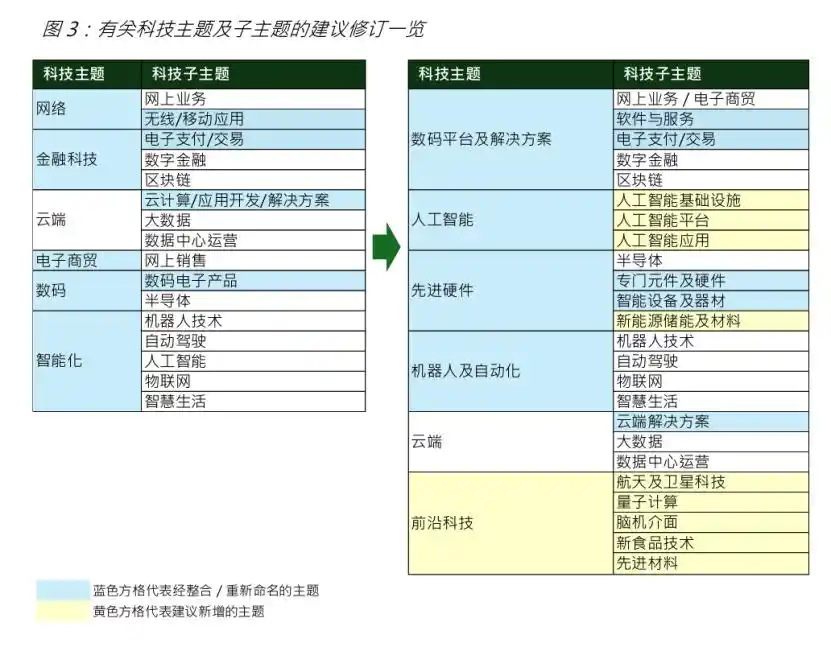
Source: Hang Seng Indexes Company website

The second is introducing a grouping selection mechanism. Hang Seng Indexes Company proposes that the stock selection scope for the Hang Seng TECH Index be limited to constituents of the Hang Seng Composite LargeCap & MidCap Index, while introducing a grouping selection mechanism. Selection will proceed via a dual-track system based on "Market Capitalization Group" and "Revenue Growth Group," and the number of constituent stocks will increase from 30 to 50. Specifically, the top 40 will be selected by market capitalization ranking, and the top 10 will be selected by revenue growth ranking.
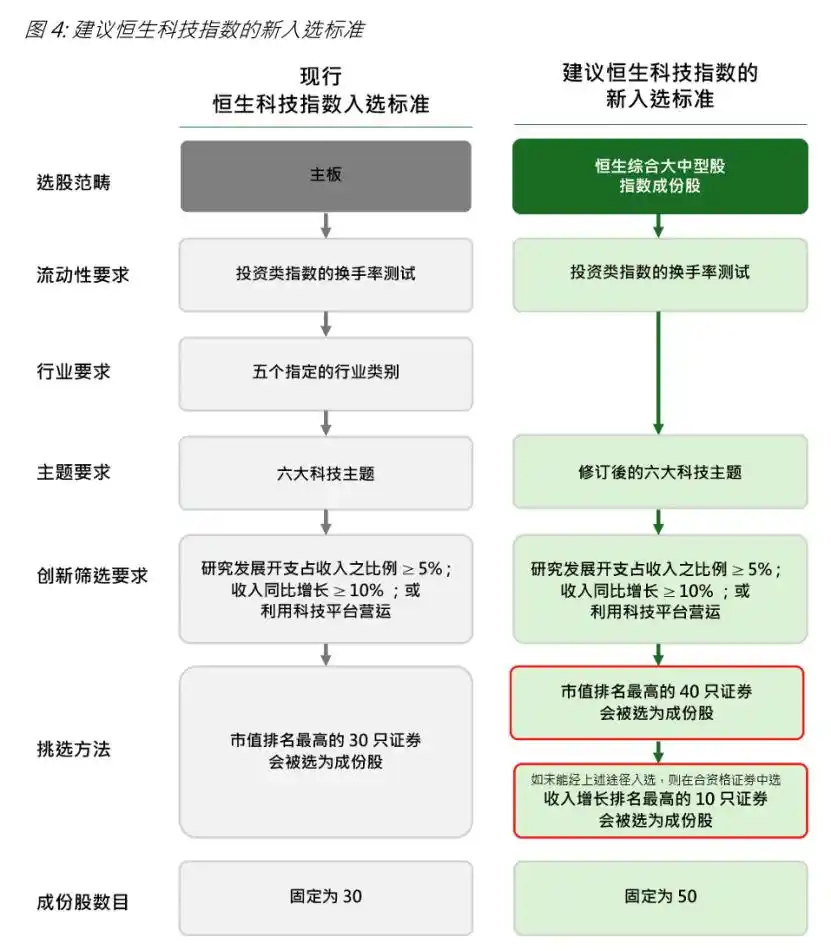
Source: Hang Seng Indexes Company website

According to simulation results released by Hang Seng Indexes Company, the revision will bring three major impacts on index characteristics.

First, index concentration will decrease slightly. Hang Seng Indexes Company simulation results show that the weight of the top ten constituents will drop from the current 70.6% to 66.3%, dispersing the index's exposure to leading companies somewhat.

Second, the distribution of technology themes will become more diverse. Under the new thematic framework, the number of constituents related to "Advanced Hardware" will increase from 5 to 15, and those related to "Artificial Intelligence" will increase from 3 to 6. Newly added themes like "Frontier Technology" will also gain inclusion space, significantly broadening the index's coverage of technology attributes.

Finally, the Revenue Growth Group will introduce high-growth targets. Simulation results show that the 10 new constituent stocks added via the "Revenue Growth Group" have a median revenue growth rate as high as 82%, higher than the 23.4% for those added via the "Market Capitalization Group," and far exceeding the 13.8% revenue growth rate of existing constituents.

This article is from the WeChat public account "Read One Insight" (ID: dushuyizhi007), author: Cheng Mengqi, editor: Guo Nan.


Crypto di tendenza

Domande pertinenti

QWhat are the main objectives of the proposed reforms to the Hang Seng TECH Index?

AThe main objectives are to enhance the index's market representation by adapting to the evolving Hong Kong tech ecosystem. Key changes include removing industry restrictions, revising the six tech themes, introducing a dual-track selection mechanism based on market cap and revenue growth, and expanding the number of constituent stocks from 30 to 50.

QHow does the proposed dual-track selection mechanism for the Hang Seng TECH Index work?

AThe dual-track selection mechanism involves selecting constituents based on two criteria: market capitalization and revenue growth. The top 40 stocks will be chosen by market cap ranking, and the top 10 stocks will be chosen by revenue growth ranking, resulting in a total of 50 constituent companies.

QWhat changes are expected in the thematic composition of the Hang Seng TECH Index based on the reform proposal?

AThe thematic composition will become more diversified. The number of constituents related to 'Advanced Hardware' is projected to increase from 5 to 15, and those related to 'Artificial Intelligence' from 3 to 6. New themes like 'Frontier Technology' will also gain representation.

QAccording to the article, how has the focus of Hong Kong's listed tech stocks shifted between 2021 and 2026?

AThe focus has shifted from internet-centric to intelligence-centric. In 2021, the 'Network' theme comprised 37.3% of listed tech stocks. By H1 2026, its share had fallen to 25.0%, while the 'Intelligent Implementation' theme had become the largest, accounting for 32.1%.

QWhat is the significance of the Hang Seng TECH Index's asset under management (AUM) growth mentioned in the article?

AThe article highlights that the global assets tracking the Hang Seng TECH Index have grown from $1.5 billion at launch to $40.4 billion as of June 2026. This 26-fold increase signifies the index's status as a major flagship index. Consequently, any changes to its constituents or weights will trigger significant passive fund reallocations, impacting the broader Hong Kong tech sector.

Letture associate

Foreign Capital Sells Off $29 Billion in Short-Term US Treasuries, Why is the US Betting on Stablecoins to "Take Over"?

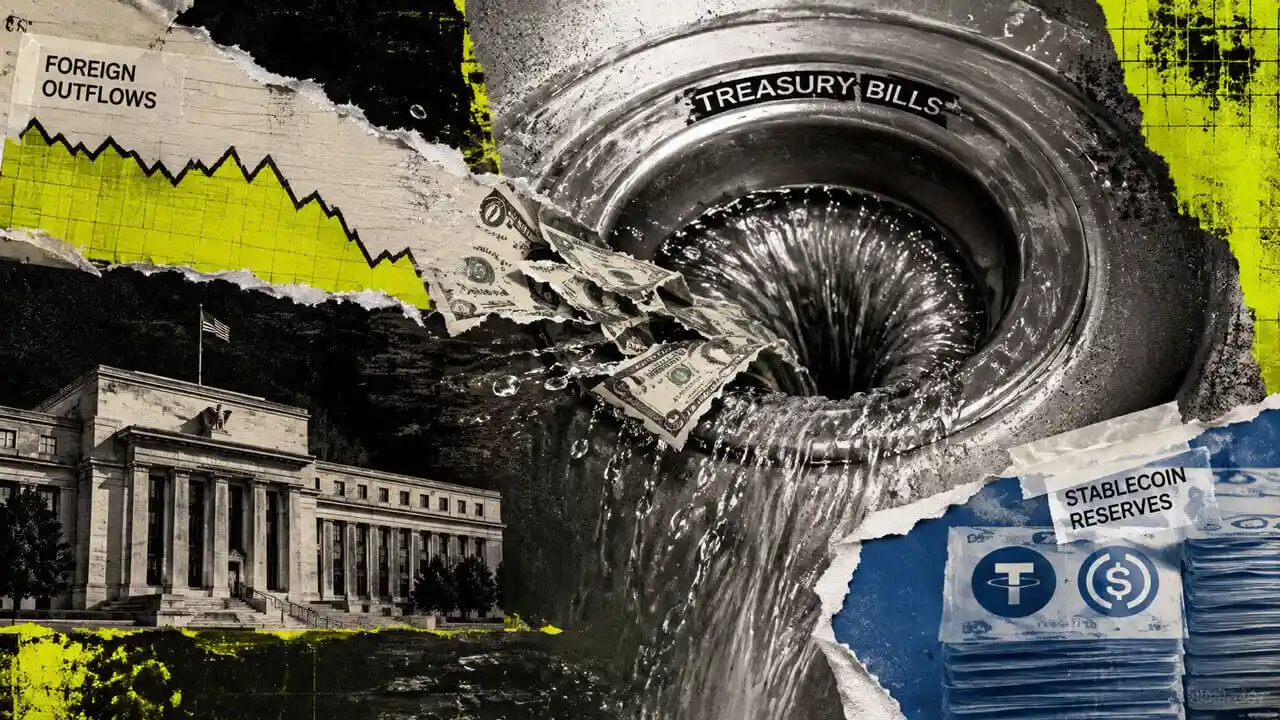
In June, foreign investors netted $133.5 billion into U.S. financial markets but simultaneously sold $29 billion in short-term U.S. Treasury bills. This divergence highlights a strong preference for U.S. equities over government debt. While overseas buyers purchased $181.4 billion in stocks, demand for Treasuries weakened significantly. This trend explains why the U.S. is looking to stablecoins as a potential new source of demand for its debt. Stablecoin issuers like Tether and Circle back their tokens primarily with highly liquid assets, including short-term Treasuries. As users buy stablecoins, issuers convert that dollar demand into Treasury purchases. Recent U.S. legislative efforts, such as the proposed rules under the *GENIUS Act*, formalize this by mandating stablecoin reserves be held in assets like cash and short-term Treasuries. Currently, stablecoins represent a substantial existing buyer base. For instance, Tether alone held nearly $115 billion in direct T-bill exposure in Q2. However, recent stablecoin supply growth has been minimal and does not account for the $29 billion sell-off by foreign investors in June. For stablecoins to act as a meaningful counterbalance to waning foreign demand, their circulating supply would need to expand significantly. The next TIC report will be crucial to monitor whether foreign selling continues and if stablecoin growth begins to fill the demand gap. Ultimately, the U.S. is strategically positioning the regulated stablecoin sector as a potential new pillar of demand for its government debt.

marsbit1 min fa

Foreign Capital Sells Off $29 Billion in Short-Term US Treasuries, Why is the US Betting on Stablecoins to "Take Over"?

marsbit1 min fa

Unitree Investors Jointly Heavy Bet on an Embodied Team

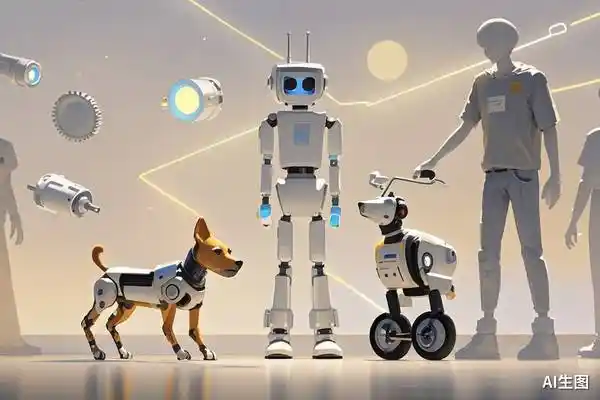
Unibot's early investors, including Meituan, Sequoia Capital, and Matrix Partners, have jointly invested in MiaoDong Technology, another humanoid robotics startup. Founded by former DJI employees—CEO Gao Jianrong, a 9-year DJI veteran who led multiple core business units, and CTO Yang Shuo, who previously worked in Tesla's Optimus team—MiaoDong is known for its combined expertise in hardware productization and advanced robotics cognition. Their core strategy centers on in-house motor R&D and full-stack software-hardware capabilities. The company recently made headlines with its first product, Beni, a wheel-legged "camera robot" designed for low-angle, ground-level filming and personal companionship. Successfully launched on Kickstarter, Beni set a record for the highest fundraising amount in the platform's robotics category. It received a perfect 10/10 rating from influential tech reviewer Marques Brownlee (MKBHD). Beni features capabilities like autonomous obstacle avoidance, the ability to jump 25cm, and self-righting after a fall. MiaoDong plans to leverage the technological and user data feedback from Beni's consumer launch to inform the development of future home-use humanoid robots. The company emphasizes a product-first, user-centric approach, prioritizing real-world applications and reliability over rapid, demo-focused scaling. With Beni set for global release in October and an internal target to sell millions of units, MiaoDong aims to establish itself as a significant player in the embodied AI space through steady, product-driven growth.

marsbit15 min fa

Unitree Investors Jointly Heavy Bet on an Embodied Team

marsbit15 min fa

Trading

Spot

Articoli Popolari

Cosa è ₿O₿

Bitcoin Bob ($₿o₿): Pionieristico DeFi Centrato su Bitcoin Attraverso Innovazione Ibrida Layer-2 In un'era in cui l'economia digitale sta evolvendo rapidamente, Bitcoin Bob ($₿o₿) emerge come un progetto rivoluzionario volto a migliorare l'utilità di Bitcoin nel settore della finanza decentralizzata (DeFi). Lanciato ufficialmente a maggio 2024, Bitcoin Bob, noto anche come Build on Bitcoin (BOB), rappresenta una soluzione blockchain ibrida Layer-2 che fonde la rinomata sicurezza e immutabilità di Bitcoin con la programmabilità di Ethereum. Questa iniziativa cerca di colmare un'importante lacuna nell'ecosistema di Bitcoin facilitando l'integrazione di smart contract e applicazioni decentralizzate, mantenendo al contempo i principi fondamentali di fiducia e sicurezza insiti in Bitcoin. Con un sostegno significativo da parte di importanti investitori di venture capital, Bitcoin Bob è posizionato per ridefinire il ruolo di Bitcoin nel panorama DeFi, rendendolo una pietra miliare delle operazioni finanziarie decentralizzate a livello globale. Cos'è Bitcoin Bob, $₿o₿? Alla sua base, Bitcoin Bob è una soluzione blockchain ibrida progettata per migliorare la funzionalità di Bitcoin. L'obiettivo principale del progetto è abilitare la finanza decentralizzata su Bitcoin, facilitando transazioni rapide e senza soluzione di continuità, garantendo al contempo elevati livelli di sicurezza. Bitcoin Bob utilizza tecnologie avanzate, in particolare un'architettura ibrida layer-2 che combina le caratteristiche di sicurezza di Bitcoin con la programmabilità e la flessibilità della Ethereum Virtual Machine (EVM). Questo approccio pragmatico consente al progetto di operare efficacemente senza compromettere i valori fondamentali di Bitcoin, rappresentando un passo monumentale nel colmare il divario tra i tradizionali detentori di Bitcoin e l'emergente ecosistema DeFi. Una delle caratteristiche distintive di Bitcoin Bob è il suo ruolo nel fornire un ambiente a fiducia minimizzata attraverso meccanismi innovativi, come gli optimistic rollups inizialmente basati su Ethereum, che si evolveranno infine verso un'integrazione completa con Bitcoin. Questo sistema ibrido è progettato per garantire che la vasta liquidità presente in Bitcoin non solo venga preservata, ma anche utilizzata efficacemente in vari protocolli DeFi. Chi è il Creatore di Bitcoin Bob, $₿o₿? La forza creativa dietro Bitcoin Bob è il co-fondatore e CEO Alexei Zamyatin, che porta con sé una vasta esperienza e conoscenza dal suo ampio background nel settore delle criptovalute. Zamyatin ha conseguito un dottorato in Informatica ed è stato attivamente coinvolto nello sviluppo di Bitcoin dal 2015. La sua profonda comprensione degli ecosistemi di Bitcoin ed Ethereum gioca un ruolo cruciale nel plasmare la visione e le basi tecnologiche di Bitcoin Bob. Insieme a Zamyatin c'è il co-fondatore Dominik Harz, che ricopre il ruolo di Chief Technology Officer (CTO). Insieme, i due hanno coltivato un team di talenti con una passione condivisa per spingere i confini della tecnologia blockchain, assicurando la posizione innovativa di Bitcoin Bob nel mercato. Chi Sono gli Investitori di Bitcoin Bob, $₿o₿? Bitcoin Bob ha ottenuto con successo il supporto di una serie di importanti investitori e società di venture capital che riconoscono il suo potenziale di trasformare il panorama di Bitcoin. A marzo 2024, il progetto ha completato un robusto round di finanziamento seed da 10 milioni di dollari, guidato da Castle Island Ventures, con una partecipazione notevole da parte di aziende come Coinbase Ventures e Bankless Ventures. Poco dopo, a luglio 2024, Bitcoin Bob ha ottenuto un ulteriore finanziamento strategico di 1,6 milioni di dollari. Questo round è stato co-guidato da Ledger Ventures e ha visto la partecipazione di angel investor provenienti da varie aziende di spicco come BlackRock, Aave e Curve. Il forte sostegno finanziario riflette un riconoscimento a livello di settore dell'approccio innovativo di Bitcoin Bob per sbloccare il potenziale di Bitcoin nello spazio DeFi. Questo finanziamento è cruciale non solo per lo sviluppo continuo del progetto, ma anche per stabilire un incubatore per promuovere applicazioni decentralizzate (dApps) native di Bitcoin, mirate specificamente a soddisfare le esigenze di una base utenti in crescita. Come Funziona Bitcoin Bob, $₿o₿? Le meccaniche operative di Bitcoin Bob sono radicate nella sua architettura ibrida rollup, progettata per combinare i benefici della sicurezza di Bitcoin con la versatilità dell'EVM di Ethereum. Il progetto utilizza un modello di sicurezza a fasi che delinea la sua interazione con utenti e sviluppatori nel seguente modo: Fase 1 – La fase iniziale opera come un optimistic rollup su Ethereum, in cui le transazioni vengono elaborate con una promettente aspettativa di validità, aprendo la strada a futuri sviluppi su Bitcoin. Fase 2 – Man mano che il progetto si evolve, integrerà la finalità di Bitcoin attraverso il Bitcoin Staking, sfruttando il Babylon Network per migliorare la sicurezza. Questo meccanismo richiede ai validatori di bloccare Bitcoin, verificando così le transazioni BOB, il che non solo migliora la sicurezza ma crea anche opportunità di rendimento per i partecipanti. Fase 3 – La visione prospettica per Bitcoin Bob è quella di integrarsi completamente con Bitcoin, utilizzando tecnologie innovative come BitVM e prove a conoscenza zero per facilitare il calcolo off-chain mantenendo l'integrità della sicurezza di Bitcoin. Innovazioni chiave come BitVM2, un protocollo di bridge a fiducia minimizzata co-autore di Zamyatin, sono fondamentali per la funzionalità del progetto, consentendo depositi e prelievi di Bitcoin senza la necessità di una dipendenza estesa dalla rete. Questo consente all'ecosistema di connettersi in modo efficiente con Ethereum e altre catene compatibili, creando un modello di interazione snello ed efficace per utenti e sviluppatori. Cronologia di Bitcoin Bob, $₿o₿ Comprendere l'evoluzione di Bitcoin Bob implica seguire le sue tappe importanti: 2019: Alexei Zamyatin e Dominik Harz fondano una società di ricerca focalizzata su soluzioni blockchain, ponendo le basi per progetti futuri. Marzo 2024: Bitcoin Bob raccoglie con successo 10 milioni di dollari in un round di finanziamento seed, segnando il suo ingresso nel competitivo panorama blockchain. 1 Maggio 2024: Si svolge il lancio ufficiale della mainnet, mostrando le capacità del progetto con una significativa adozione da parte degli utenti e un valore totale bloccato (TVL). Luglio 2024: Il progetto attira un ulteriore 1,6 milioni di dollari in finanziamento strategico per stabilire il suo incubatore, mirato a promuovere innovazioni guidate da Bitcoin. Ottobre 2024: Bitcoin Bob rilascia un “Vision Paper”, dettagliando il suo design ibrido layer-2 e le strategie prospettiche. 2025: Si prevede il lancio delle funzionalità della Fase 2, focalizzandosi sulla finalità di Bitcoin e sui bridge BitVM mirati a migliorare la funzionalità complessiva. Conclusione: Ridefinire il Ruolo di Bitcoin nella Finanza Decentralizzata Bitcoin Bob ($₿o₿) non è solo un altro progetto blockchain; rappresenta un cambiamento di paradigma nel modo in cui Bitcoin può interagire con applicazioni finanziarie più ampie. Combinando meticolosamente la sicurezza di Bitcoin con la flessibilità di Ethereum, Bitcoin Bob mira a rimodellare il panorama DeFi, colmando il divario tra valuta digitale e applicazioni decentralizzate. Con un robusto framework tecnologico, una forte leadership e finanziamenti strategici, Bitcoin Bob è ben posizionato per affermarsi come un attore fondamentale nell'ecosistema delle criptovalute, sbloccando nuove dimensioni di liquidità e utilità per Bitcoin. Man mano che il progetto continua a evolversi ed espandersi, promette di inaugurare una nuova era di innovazione, dimostrando che il potenziale di Bitcoin si estende ben oltre essere un semplice deposito di valore, ma piuttosto come una pietra angolare del futuro panorama finanziario. Mentre il progetto avanza attraverso le sue fasi anticipate, tutti gli occhi saranno puntati su Bitcoin Bob, in particolare riguardo al suo impegno per incorporare principi decentralizzati e garantire che gli utenti possano godere dei pieni benefici di DeFi ancorati a Bitcoin.

105 Totale visualizzazioniPubblicato il 2025.06.30Aggiornato il 2025.06.30

Cosa è ₿O₿

Come comprare O

Benvenuto in HTX.com! Abbiamo reso l'acquisto di O1 exchange (O) semplice e conveniente. Segui la nostra guida passo passo per intraprendere il tuo viaggio nel mondo delle criptovalute.Step 1: Crea il tuo Account HTXUsa la tua email o numero di telefono per registrarti il tuo account gratuito su HTX. Vivi un'esperienza facile e sblocca tutte le funzionalità,Crea il mio accountStep 2: Vai in Acquista crypto e seleziona il tuo metodo di pagamentoCarta di credito/debito: utilizza la tua Visa o Mastercard per acquistare immediatamente O1 exchangeO.Bilancio: Usa i fondi dal bilancio del tuo account HTX per fare trading senza problemi.Terze parti: abbiamo aggiunto metodi di pagamento molto utilizzati come Google Pay e Apple Pay per maggiore comodità.P2P: Fai trading direttamente con altri utenti HTX.Over-the-Counter (OTC): Offriamo servizi su misura e tassi di cambio competitivi per i trader.Step 3: Conserva O1 exchange (O)Dopo aver acquistato O1 exchange (O), conserva nel tuo account HTX. In alternativa, puoi inviare tramite trasferimento blockchain o scambiare per altre criptovalute.Step 4: Scambia O1 exchange (O)Scambia facilmente O1 exchange (O) nel mercato spot di HTX. Accedi al tuo account, seleziona la tua coppia di trading, esegui le tue operazioni e monitora in tempo reale. Offriamo un'esperienza user-friendly sia per chi ha appena iniziato che per i trader più esperti.

808 Totale visualizzazioniPubblicato il 2026.06.19Aggiornato il 2026.06.29

Come comprare O

Discussioni

Benvenuto nella Community HTX. Qui puoi rimanere informato sugli ultimi sviluppi della piattaforma e accedere ad approfondimenti esperti sul mercato. Le opinioni degli utenti sul prezzo di O O sono presentate come di seguito.

活动图片