Impermanent loss challenges the claim that DeFi is the ‘future of France’

CointelegraphPubblicato 2022-03-06Pubblicato ultima volta 2022-03-06

Introduzione

Impermanent loss is one of the most recognized risks that investors have to contend with when providing liquidity to an automated market maker (AMM) in the decentralized finance (DeFi) sector.

Impermanent loss is one of the most recognized risks that investors have to contend with when providing liquidity to an automated market maker (AMM) in the decentralized finance (DeFi) sector. Although it is not an actual loss incurred from the liquidity provider’s (LP) position — rather an opportunity cost that occurs when compared with simply buying and holding the same assets — the possibility of getting less value back at withdrawal is enough to keep many investors away from DeFi.
Impermanent loss is driven by the volatility between the two assets in the equal-ratio pool — the more one asset moves up or down relative to the other asset, the more impermanent loss is incurred. Providing liquidity to stablecoins, or simply avoiding volatile asset pairs, is an easy way to reduce impermanent loss. However, the yields from these strategies might not be as attractive.
So, the question is: Are there ways to participate in a high-yield LP pool and at the same time reduce as much impermanent loss as possible?
Fortunately for retail investors, the answer is yes, as new innovations continue to solve the existing problems in the DeFi world, providing many ways for traders to avoid impermanent loss.
Uneven liquidity pools help reduce impermanent loss
When talking about impermanent loss, people often refer to the traditional 50%/50% equal-ratio two-asset pool — i.e., investors have to provide liquidity to two assets at the same value. As DeFi protocols evolve, uneven liquidity pools have come into the picture to help reduce impermanent loss.
As shown in the graph below, the downside magnitude from an equal-ratio pool is much larger than an uneven pool. Given the same relative price change — e.g., Ether (ETH) increases or decreases by 10% relative to USD Coin (USDC) — the more uneven the ratio of the two assets, the less the impermanent loss.
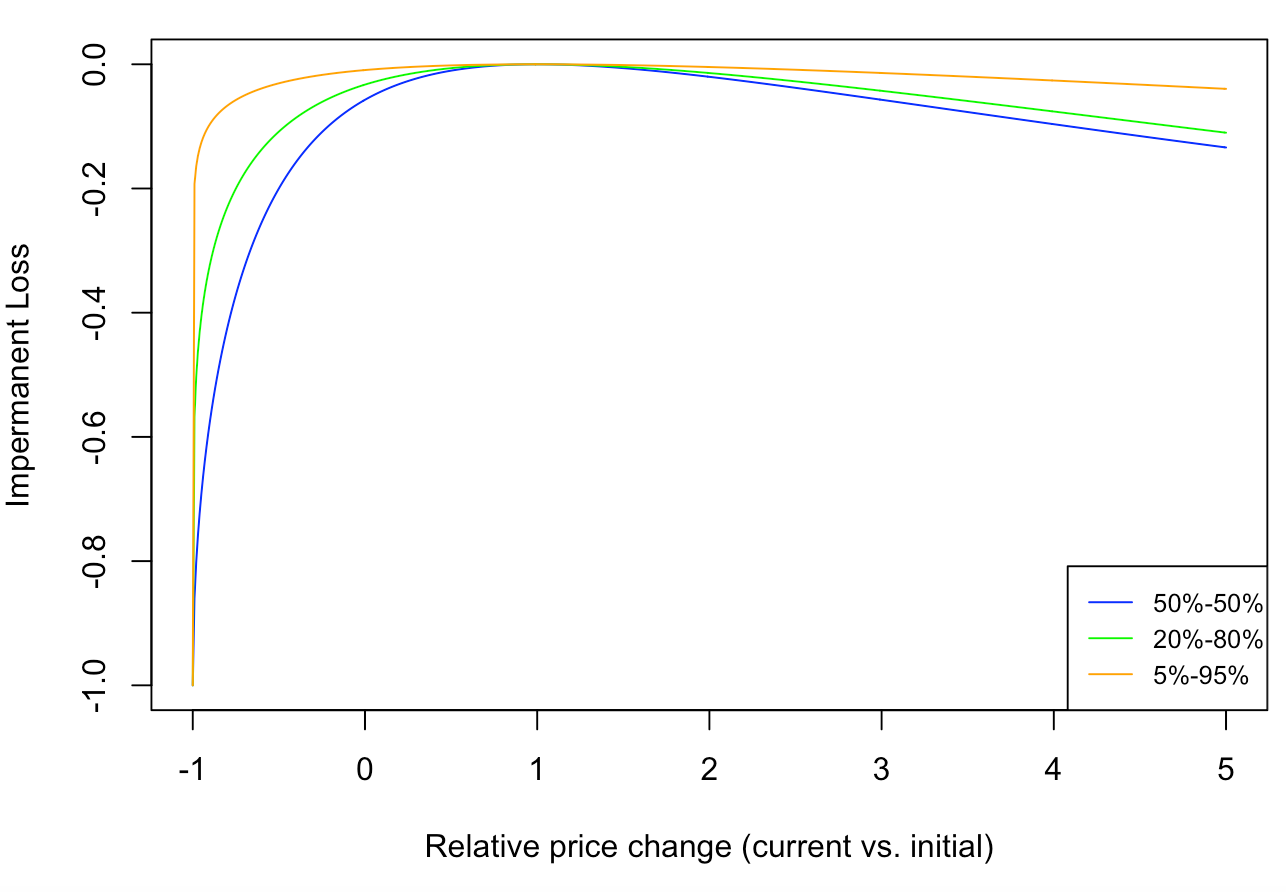
Impermanent loss from even and uneven liquidity pools. Source: Elaine HuDeFi protocols such as Balancer have made uneven liquidity pools available since as early as the beginning of 2021. Investors can explore a variety of uneven pools to seek out the best option.
Multi-asset liquidity pools are a step forward
In addition to uneven liquidity pools, multi-asset liquidity pools can also help reduce impermanent loss. By simply adding more assets to the pool, the diversification effects come into play. For example, given the same price movement in Wrapped Bitcoin (WBTC), the USDC-WBTC-USDT equal-ratio tri-pool has a lower impermanent loss than the USDC-WBTC equal-ratio pool, as shown below.
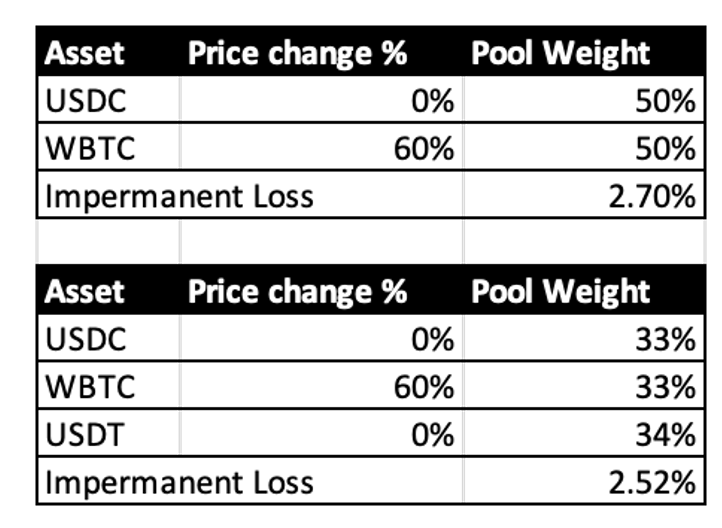
Two-asset vs. three-asset liquidity pool. Source: Topaze.blue/BancorSimilar to the two-asset liquidity pool, the more correlated the assets are in the multi-asset pool, the more the impermanent loss, and vice versa. The 3D graphs below display the impermanent loss in a tri-pool given different levels of the price change of Token 1 and Token 2 relative to the stablecoin, assuming one stablecoin is in the pool.
When the relative price change of Token 1 to the stablecoin (294%) is very close to the relative price change of Token 2 (291%), the impermanent loss is also low (-4%).
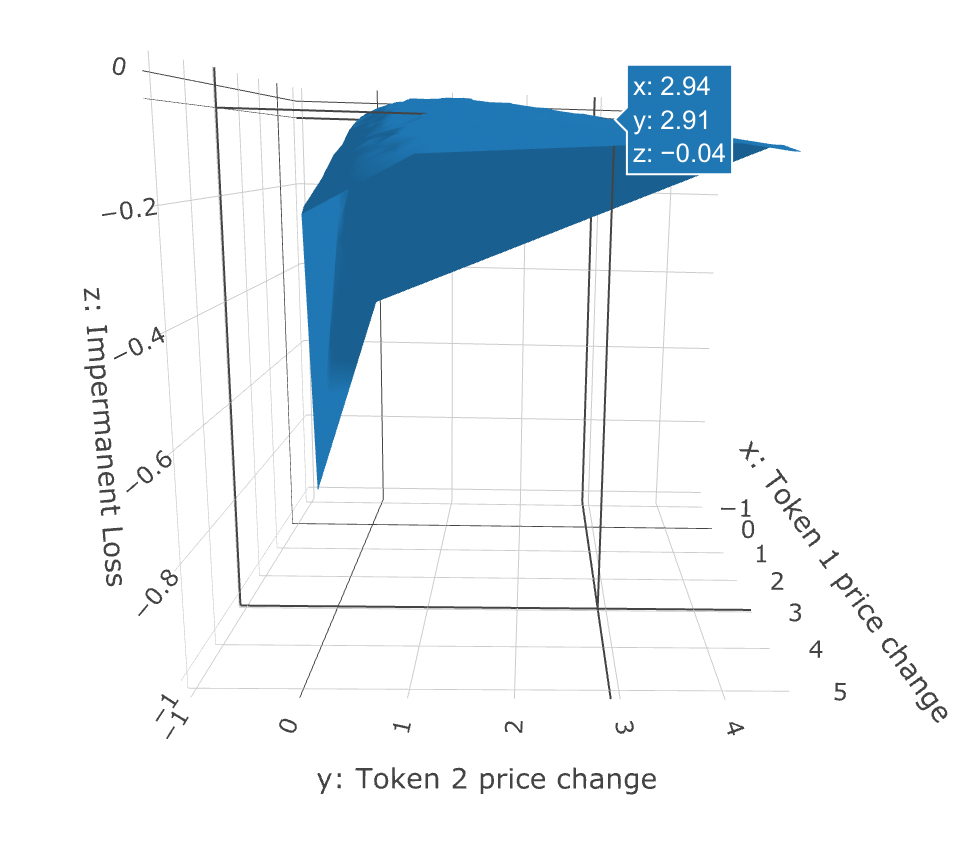
Simulation of impermanent loss from a tri-pool. Source: Elaine HuWhen the relative price change of Token 1 to stablecoin (483%) is very different and far away from the relative price change of Token 2 to stablecoin (8%), the impermanent loss becomes noticeably larger (-50%).
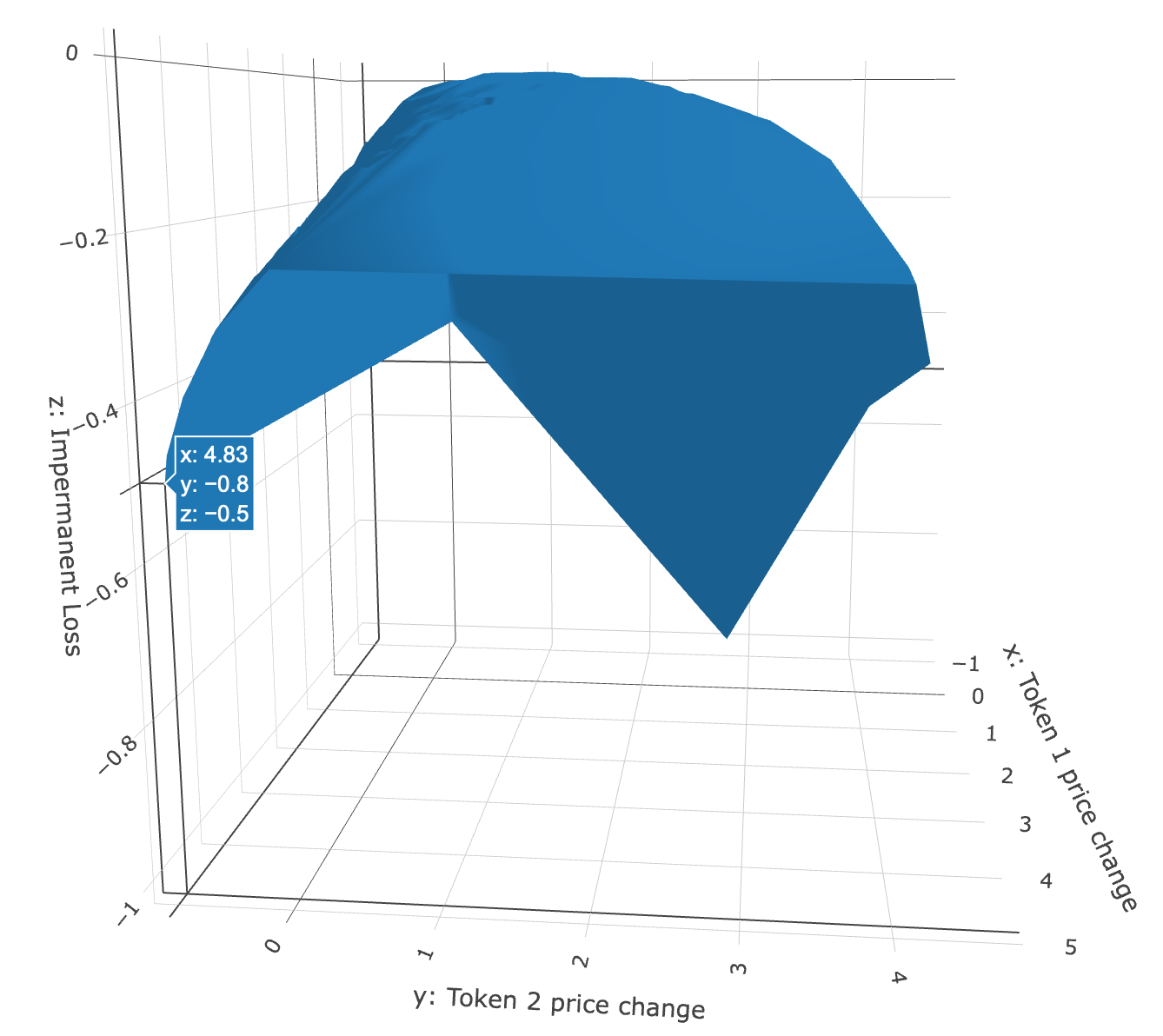
Simulation of impermanent loss from a tri-pool. Source: Elaine HuSingle-sided liquidity pools are the best option
Although the uneven liquidity pool and multi-asset pool both help reduce impermanent loss from the LP position, they do not eliminate it completely. If investors do not want to worry about impermanent loss at all, there are also other DeFi protocols that allow investors to provide only one side of the liquidity through a single-sided liquidity pool.
One might wonder where the risk of impermanent loss is transferred if investors do not bear the risk. One solution provided by Tokemak is to use the protocol’s native token, TOKE, to absorb this risk. Investors only need to supply liquidity such as Ether to one side, and TOKE holders will provide TOKE on the other side to pair up with Ether to create the ETH-TOKE pool. Any impermanent loss caused by the price movements in Ether relative to TOKE will be absorbed by the TOKE holder. In return, TOKE holders take all swap fees from the LP pool.
Since TOKE holders also have the power to vote for the next five pools the liquidity will be directed to, they also get bribed by protocols who want them to vote for their liquidity pools. In the end, TOKE holders bear the impermanent loss from the pool and are compensated by the swap fees and bribe rewards in TOKE.
Another solution is to separate risks into different tranches so that risk-averse investors are protected from impermanent loss and that risk-seeking investors who bear the risk will be compensated with a high-yield product. Protocols such as Ondo offer a senior fixed tranche where impermanent loss is mitigated and a variable tranche where impermanent loss is absorbed but higher yields are offered.
Automated LP manager can reduce investors’ headaches
If all of the above seems too complicated, investors can still stick to the most common 50%/50% equal-ratio pool and use an automated LP manager to actively manage and dynamically rebalance the LP position. This is especially useful in Uniswap v3, where investors need to specify a range to which they want to provide concentrated liquidity.
Automated LP managers conduct rebalancing strategies to help investors maximize LP fees and minimize impermanent loss by charging a management fee. There are two main strategies: passive rebalancing and active rebalancing. The difference is that the active rebalancing method swaps tokens to achieve the amount required at the time of rebalancing, whereas passive rebalancing does not and only swaps gradually when the pre-set price of the token is hit (similar to a limit order).
In a volatile market where prices are constantly moving sideways, a passive rebalancing strategy works well because it doesn’t need to rebalance frequently and pay large amounts of swap fees. But in a trending market where price continues to move in one direction, active rebalancing works better because the passive rebalancing strategy could miss the boat and sit outside the LP range for a long time and fail to collect any LP fees.
To choose the right automated LP manager, investors need to find the one that suits their risk appetite. There are passive rebalancing strategies such as Charm Finance that aim to earn a stable return by using a wide LP range to reduce impermanent loss. There are also passive managers such as Visor Finance that use a very narrow LP range to earn high LP fees, but are also exposed to more potential impermanent loss. Investors need to select automated LP managers based on not only their risk appetite but also their long-term investment goals.
Although traditional equal-ratio LP profits could be eroded by impermanent loss when the underlying tokens move in very different directions, there are alternative products and strategies available for investors to reduce or completely avoid impermanent loss. Investors just need to find the right trade-off between risk and return to find the best-suited LP strategy.

Crypto di tendenza

Letture associate

The CEO of MARA Holdings Compares AI Operations to Bitcoin Mining! Which is More Profitable?

Fred Thiel, CEO of MARA Holdings (a major Bitcoin mining company), states that the rapid growth of the artificial intelligence (AI) sector is transforming mining companies' business models. He claims that powering data centers for AI is significantly more profitable than Bitcoin mining. In a recent interview, Thiel explained why many mining firms are diversifying into AI infrastructure. According to Thiel, the energy demands of data centers are surging, especially due to the spread of generative AI applications. This creates new revenue opportunities for Bitcoin mining companies with robust power infrastructure. MARA Holdings is among those monitoring this shift and aims to develop its energy and infrastructure services for AI data centers. Thiel emphasized that this move toward AI does not mean the end of Bitcoin mining. He stated that Bitcoin mining remains a sustainable business model, especially for miners in regions with low electricity costs, and it is still a crucial field for utilizing excess or idle power capacity. In recent years, many Bitcoin mining companies have begun using their energy-intensive infrastructure not just for block production but also for high-performance computing (HPC) and AI applications. This strategy aims to diversify revenue sources and increase resilience against cryptocurrency market volatility. Analysts note that the growing energy demand in the AI sector presents significant transformation opportunities for mining companies. The need for high-power, uninterrupted electricity supply, particularly for large data centers, gives Bitcoin miners with existing energy infrastructure expertise a considerable advantage.

cryptonews.ru11 min fa

The CEO of MARA Holdings Compares AI Operations to Bitcoin Mining! Which is More Profitable?

cryptonews.ru11 min fa

Ratio's CEO Says Multi-Currency Stablecoins Could Eliminate Costly FX Conversions in Asia

The CEO of Ratio, John Cho, argues that multi-currency stablecoins could save Asia billions by eliminating costly foreign exchange conversions in regional trade. While USD stablecoins like USDT and USDC work for global settlements, local Asian trade is conducted in local currencies like the Korean won or Singapore dollar. Forcing these transactions through USD intermediaries creates unnecessary costs and currency risk. Cho envisions a complementary ecosystem where local-currency stablecoins work alongside USD stablecoins, enabling seamless cross-border settlements without conversion friction. A key pain point in traditional banking is the need for pre-funded Nostro and Vostro accounts, which lock up vast amounts of working capital. Blockchain-based settlement layers like Ratio offer a 24/7 alternative, using on-chain liquidity to enable instant execution even when traditional channels are closed. Modern Web3 infrastructure providers are focusing on pragmatic integration with existing corporate systems like ERPs, allowing businesses to gradually shift volumes to digital channels for better speed, cost, and reduced slippage. Clear regulation is cited as the critical catalyst for widespread institutional adoption. As jurisdictions like the U.S. advance legislation (e.g., the CLARITY Act) and Asian countries are expected to pass their own stablecoin laws within 12-24 months, regulatory uncertainty is receding. The ultimate vision is for regulated stablecoins to become an invisible settlement layer integrated into national payment systems, where payments simply happen on-chain, erasing the boundary between traditional banking and digital assets.

cryptonews.ru30 min fa

Ratio's CEO Says Multi-Currency Stablecoins Could Eliminate Costly FX Conversions in Asia

cryptonews.ru30 min fa

Huang Xiaoming, Li Bin, Lei Jun, Liang Wenfeng... Who Are the Biggest Winners in the CXMT IPO Feast?

Changxin Technology, a leading Chinese memory chip manufacturer, successfully listed on the Shanghai Stock Exchange's STAR Market (科创板) on July 8, 2026. Its share price surged from the IPO price of 8.66 yuan to close at 49 yuan on the first day, catapulting its market capitalization to 3.28 trillion yuan, making it the most valuable A-share company and triggering a massive wealth creation event. The biggest winners were the company's founder, Zhu Yiming, and its employees. Zhu Yiming's family wealth skyrocketed nearly 300% to approximately $13.9 billion, with his direct stake in Changxin valued at around 80 billion yuan. Additionally, over 6700 employees benefited from stock ownership plans, creating at least 237 new millionaires (in CNY). Zhu also pledged to donate 768 million shares, worth over 37.6 billion yuan, for future employee incentives over a ten-year period. Several prominent investors and corporate clients also reaped significant paper gains from the IPO. Notable figures include: * **Liang Wenfeng**, founder of DeepSeek, whose funds netted a paper profit of approximately 827 million yuan. * **Kong Jianping**, founder of Nano Labs, saw his indirect holdings valued at roughly 940 million yuan. * **Li Bin**, founder of Nio, whose company's strategic investment of 158 million yuan is now worth about 740 million yuan. * **Lei Jun**, founder of Xiaomi, whose subsidiary holds shares currently showing a paper gain of over 736 million yuan. Xiaomi clarified this is a corporate investment, not direct personal wealth. The article notes that while this IPO created immense wealth for insiders and large investors, retail investors who were lucky enough to win an allotment in the lottery typically profited by around 20,000 yuan. The listing solidifies Changxin's position as China's premier domestic memory chipmaker.

marsbit41 min fa

Huang Xiaoming, Li Bin, Lei Jun, Liang Wenfeng... Who Are the Biggest Winners in the CXMT IPO Feast?

marsbit41 min fa

IOSG: From Hot Storage to Cold Memory – Decentralized Storage in the AI Era's Storage Boom

This article explores the stark contrast between the booming AI storage sector and the currently undervalued decentralized storage market. It argues their core value propositions differ fundamentally: AI storage is a "hot data efficiency" system designed to maximize computational throughput, GPU utilization, and business monetization by accelerating data flow into processors. In contrast, decentralized storage represents a "cold data trust" system, prioritizing data immutability, censorship resistance, and the preservation of long-term human memory. The analysis details the multi-layered AI storage architecture, from high-bandwidth memory (HBM) and enterprise SSDs for high-performance needs to data lakes for capacity. It highlights how AI has repositioned storage from a cost center to a critical efficiency engine. Decentralized storage, exemplified by Filecoin and Arweave, is examined for its distinct philosophies and current challenges, including product-market fit, retrieval latency, and enterprise adoption hurdles. Despite its current quiet phase, the article posits that decentralized storage holds unique future value for AI data provenance, public dataset archiving, compliance, and safeguarding civilizational records against censorship. The conclusion suggests that while the market currently rewards efficiency, the need for trusted, permanent data layers may eventually lead to a revaluation of decentralized storage's role.

marsbit45 min fa

IOSG: From Hot Storage to Cold Memory – Decentralized Storage in the AI Era's Storage Boom

marsbit45 min fa

Trading

Spot

Articoli Popolari

Come comprare GRT

Benvenuto in HTX.com! Abbiamo reso l'acquisto di The Graph (GRT) semplice e conveniente. Segui la nostra guida passo passo per intraprendere il tuo viaggio nel mondo delle criptovalute.Step 1: Crea il tuo Account HTXUsa la tua email o numero di telefono per registrarti il tuo account gratuito su HTX. Vivi un'esperienza facile e sblocca tutte le funzionalità,Crea il mio accountStep 2: Vai in Acquista crypto e seleziona il tuo metodo di pagamentoCarta di credito/debito: utilizza la tua Visa o Mastercard per acquistare immediatamente The GraphGRT.Bilancio: Usa i fondi dal bilancio del tuo account HTX per fare trading senza problemi.Terze parti: abbiamo aggiunto metodi di pagamento molto utilizzati come Google Pay e Apple Pay per maggiore comodità.P2P: Fai trading direttamente con altri utenti HTX.Over-the-Counter (OTC): Offriamo servizi su misura e tassi di cambio competitivi per i trader.Step 3: Conserva The Graph (GRT)Dopo aver acquistato The Graph (GRT), conserva nel tuo account HTX. In alternativa, puoi inviare tramite trasferimento blockchain o scambiare per altre criptovalute.Step 4: Scambia The Graph (GRT)Scambia facilmente The Graph (GRT) nel mercato spot di HTX. Accedi al tuo account, seleziona la tua coppia di trading, esegui le tue operazioni e monitora in tempo reale. Offriamo un'esperienza user-friendly sia per chi ha appena iniziato che per i trader più esperti.

190 Totale visualizzazioniPubblicato il 2024.12.10Aggiornato il 2026.06.02

Come comprare GRT

Discussioni

Benvenuto nella Community HTX. Qui puoi rimanere informato sugli ultimi sviluppi della piattaforma e accedere ad approfondimenti esperti sul mercato. Le opinioni degli utenti sul prezzo di GRT GRT sono presentate come di seguito.

活动图片