SUI Stands on the Brink of a New Breakthrough as Bulls Target a Surge to $20

cryptonews.ruPubblicato 2026-08-01Pubblicato ultima volta 2026-08-01

Introduzione

SUI token unlocked approximately 13.72 million tokens on August 1st, valued at around $9.9 million, representing 0.34% of its circulating supply. The release was part of a larger weekly token unlock wave. Sui utilizes a continuous daily vesting model to distribute selling pressure, unlike one-time "cliff" unlocks. Analyst CryptoPatel identifies the recent price range as a high-timeframe accumulation structure, suggesting a buy zone between $0.50 and $0.70 with long-term targets of $5, $10, and $20. However, the token has recently fallen over 5%, underperforming the broader crypto market, and social sentiment has turned slightly bearish near the $0.71-$0.73 support zone. Fundamentally, network activity remains strong. Mubadala Capital launched a $75 million tokenized private markets fund on Sui, and the network has seen the launch of a Bitcoin-collateral testnet and free stablecoin transfers. The price decline appears driven by the token unlock and general market conditions, not by network issues, highlighting a common industry gap between network growth and short-term token price performance.

The token unlock on August 1st released approximately 13.72 million $SUI into circulation, distributed among three groups: 4 million to the community reserve, 7.65 million to early participants, and 2.07 million to the Mysten Labs treasury. At current prices, the volume of released tokens amounted to roughly $9.9 million, or about 0.34% of the total circulating token supply.

Bitcoin.com News reported on this release in a July 29th report, noting it was part of a broader wave of weekly token unlocks on the market totaling $81 million, led by the artist token platform Audiera ($BEAT). Unlike the "cliff" release of $BEAT, Sui distributes tokens through continuous daily vesting—a scheme analysts say spreads out selling pressure rather than dumping a significant portion of supply in a single day, as can happen with "cliff" token unlocks like EIGEN from EigenLayer or KITE from Kite AI.

Sui is a Layer 1 blockchain created by Mysten Labs, a startup founded in 2021 by five former Meta engineers after working on the company's abandoned Novi wallet and Diem stablecoin projects. The network positions itself as a high-throughput, low-fee platform; out of a maximum supply of 10 billion tokens, approximately 4.05 billion are already in circulation, representing about 40% of the eventual total.

"Bulls Call This a Buy Zone"

Popular trader CryptoPatel stated this morning that $SUI's recent price range represents a high-timeframe accumulation structure rather than a warning signal. He pointed to an entry zone between $0.50 and $0.70 with target levels of $5, $10, and ultimately $20, calling this pattern "too clean to ignore."
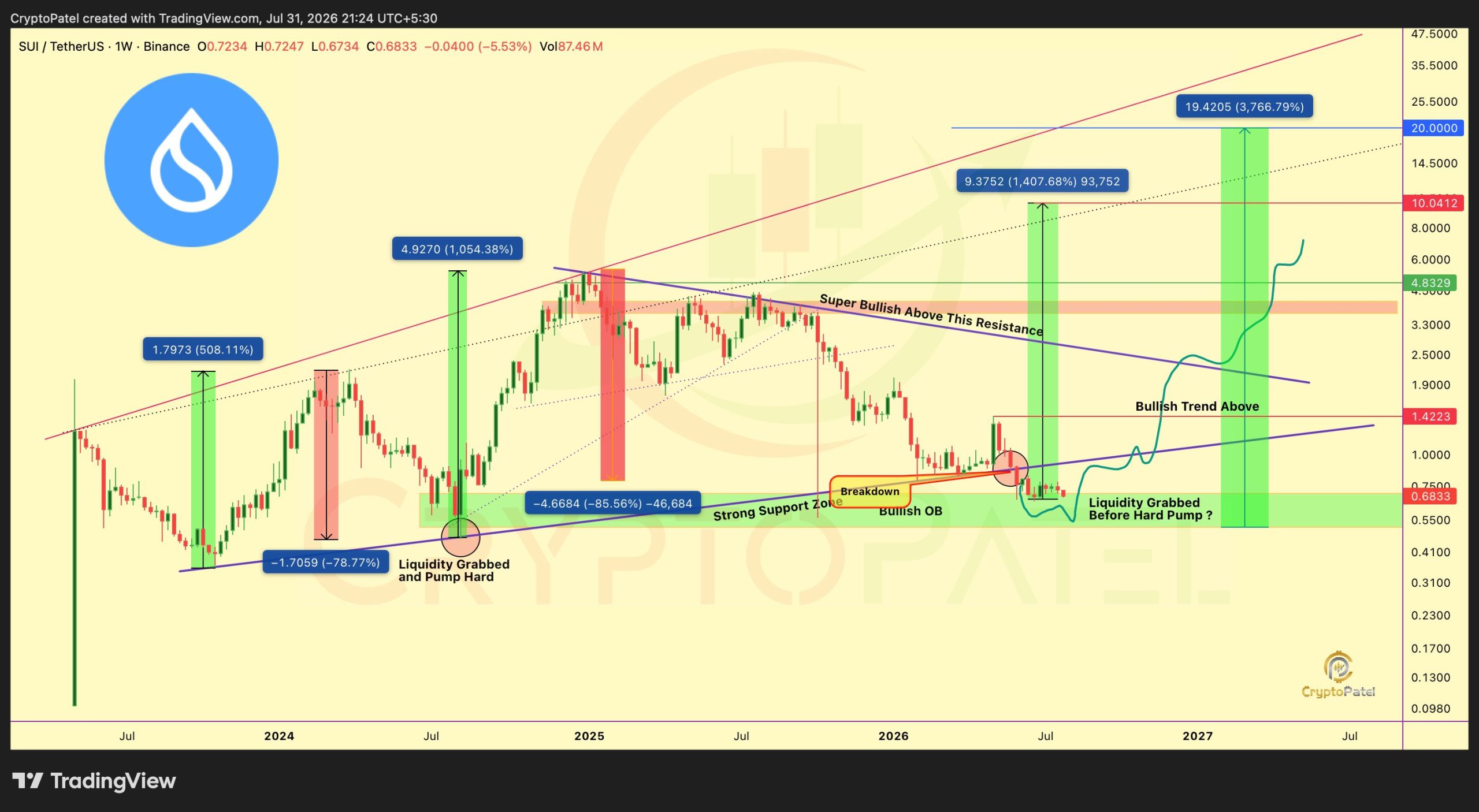
The actual trading price of $SUI at $0.68 sits right inside the mentioned entry zone, although the overall picture looks less "clean" than the chart pattern alone suggests. Over the last few trading sessions, the token has depreciated by more than 5%, while the total crypto market cap declined by about 2.3%, and the altcoin market cap fell by nearly 2%.

Social sentiment toward $SUI has turned slightly bearish, with short-term traders shifting to a cautious stance near the support range of $0.71 to $0.73; meanwhile, some technical analysts warn that a failure to hold this zone could open the door for further declines.

Fundamental Factors Influencing the Price

Activity on the Sui network tells a very different story than the price action. Currently, Abu Dhabi's Mubadala Capital launched a tokenized version of its $75 million private markets fund on July 23rd, available on the Solana, Base, and Sui platforms. The fund utilizes tokenization infrastructure from KAIO and requires a minimum investment of approximately $100,000 from qualified investors, making the offering institutionally, rather than retail, focused.

Additionally, the Sui network saw the launch of the Hashi testnet, designed for Bitcoin collateral use cases by institutional investors, alongside the ongoing adoption of free stablecoin transfers on the network. Finally, there have been no credible reports of network outages, vulnerabilities, or other protocol-level issues, meaning this week's price decline is driven by increased supply from the token unlock and general market conditions, rather than any problems with the Sui network itself.

This gap between network activity and token price is a typical industry picture: new integrations and institutional partnerships often take months to reflect in trading volumes or price, while token unlocks increase supply on a fixed, widely-known schedule.

end-content

Crypto di tendenza

Domande pertinenti

QWhat was the amount of $SUI tokens unlocked on August 1st and what were the recipient groups?

AApproximately 13.72 million $SUI tokens were unlocked on August 1st. They were distributed among three groups: 4 million to the community reserve, 7.65 million to early contributors, and 2.07 million to the Mysten Labs treasury.

QWhat is Sui, and what are some of its key claimed features?

ASui is a Layer-1 blockchain created by Mysten Labs, a startup founded in 2021 by five former Meta engineers. It positions itself as a platform with high transaction throughput and low fees.

QAccording to trader CryptoPatel, what is the identified accumulation range and long-term price targets for $SUI?

ATrader CryptoPatel identified an accumulation pattern within the $0.50 to $0.70 range, with long-term price targets of $5, $10, and ultimately $20 for $SUI.

QWhat recent institutional initiative involved the Sui network, as mentioned in the article?

AOn July 23rd, Mubadala Capital from Abu Dhabi launched a $75 million tokenized version of its private markets fund, which is accessible on the Sui network alongside Solana and Base, using KAIO's tokenization infrastructure.

QHow does the article describe the current discrepancy between Sui's network activity and its token price?

AThe article states there is a gap where Sui's network activity is strong with new integrations and partnerships, but the token price has declined. This is attributed to the token unlock increasing supply and general market conditions, noting that fundamental developments often take months to impact price while supply increases have an immediate effect.

Letture associate

Annual Salary of Millions Competing for Electricians, Meta Rushes to Open Its Own Technical School

The AI boom is facing an unexpected bottleneck: a severe shortage of skilled construction workers and electricians. As tech giants like Meta, OpenAI, and Alphabet race to build massive data centers—such as OpenAI's $16 billion "Stargate" project—they are hitting a critical labor wall. The U.S. needs an estimated 130,000 more electricians, 240,000 construction workers, and 150,000 supervisors by 2030 for AI infrastructure alone, but tens of thousands of electrician jobs go unfilled each year. While AI companies offer high premiums, with electricians earning up to $280,000 annually, worker scarcity still causes massive losses—delays on a single project can cost $14.2 million per month. The complexity of building AI data centers, which require immense power (equivalent to powering hundreds of thousands of homes), sophisticated electrical systems, and advanced liquid cooling solutions, demands highly skilled technicians who are in short supply. To combat this, companies are investing heavily in training. Meta has committed $115 million to a free training school offering tuition, housing, and stipends, targeting 5,000 new workers. OpenAI is partnering with unions to secure skilled labor. These efforts are paying off, with a significant rise in Gen Z interest in trade schools over college. However, the power demands are staggering. AI data centers are driving a rapid surge in electricity consumption, projected to account for up to 12% of U.S. power use by 2028 and raising costs for consumers. Furthermore, the construction boom is project-based, leading to a potential future glut of trained workers once building peaks, which could depress wages industry-wide. The race for AI supremacy now depends as much on skilled hands as on advanced chips.

marsbit1 h fa

Annual Salary of Millions Competing for Electricians, Meta Rushes to Open Its Own Technical School

marsbit1 h fa

OpenAI No Longer Sells Its Most Expensive Model for Profit

OpenAI is shifting its business strategy away from promoting its most expensive, flagship models for every task. Recent price cuts—80% for GPT-5.6 Luna and 20% for Terra—signal a deeper change: the company now actively advises users that many tasks don't require the most powerful model. Instead, OpenAI recommends a tiered approach: use the high-end GPT-5.6 Sol for complex planning and analysis, then delegate execution to cheaper models like Luna. This mirrors moves by Anthropic, which recently launched Claude Opus 5 at half the price of its top model, Fable 5. Both companies are de-emphasizing flagship models as primary revenue drivers, using them instead for brand prestige and technological showcases. The industry is entering a "mass-market" phase, similar to automotive, where high-volume, cost-effective models handle daily operations and drive scale. OpenAI's price reductions are partly enabled by AI models themselves optimizing underlying code and infrastructure, creating a self-reinforcing cycle of efficiency gains and cost reduction. Competition is shifting from "who is smartest" to "who offers the best value." The goal is no longer selling individual models but fostering widespread API adoption and ecosystem lock-in. By making AI calls cheap and ubiquitous, companies like OpenAI aim to become the indispensable, utility-like infrastructure powering automated workflows—the "water and electricity" of software, quietly embedded everywhere.

marsbit1 h fa

OpenAI No Longer Sells Its Most Expensive Model for Profit

marsbit1 h fa

Trading

Spot

Articoli Popolari

Come comprare SUI

Benvenuto in HTX.com! Abbiamo reso l'acquisto di SUI Network (SUI) semplice e conveniente. Segui la nostra guida passo passo per intraprendere il tuo viaggio nel mondo delle criptovalute.Step 1: Crea il tuo Account HTXUsa la tua email o numero di telefono per registrarti il tuo account gratuito su HTX. Vivi un'esperienza facile e sblocca tutte le funzionalità,Crea il mio accountStep 2: Vai in Acquista crypto e seleziona il tuo metodo di pagamentoCarta di credito/debito: utilizza la tua Visa o Mastercard per acquistare immediatamente SUI NetworkSUI.Bilancio: Usa i fondi dal bilancio del tuo account HTX per fare trading senza problemi.Terze parti: abbiamo aggiunto metodi di pagamento molto utilizzati come Google Pay e Apple Pay per maggiore comodità.P2P: Fai trading direttamente con altri utenti HTX.Over-the-Counter (OTC): Offriamo servizi su misura e tassi di cambio competitivi per i trader.Step 3: Conserva SUI Network (SUI)Dopo aver acquistato SUI Network (SUI), conserva nel tuo account HTX. In alternativa, puoi inviare tramite trasferimento blockchain o scambiare per altre criptovalute.Step 4: Scambia SUI Network (SUI)Scambia facilmente SUI Network (SUI) nel mercato spot di HTX. Accedi al tuo account, seleziona la tua coppia di trading, esegui le tue operazioni e monitora in tempo reale. Offriamo un'esperienza user-friendly sia per chi ha appena iniziato che per i trader più esperti.

606 Totale visualizzazioniPubblicato il 2024.12.12Aggiornato il 2026.06.02

Come comprare SUI

Discussioni

Benvenuto nella Community HTX. Qui puoi rimanere informato sugli ultimi sviluppi della piattaforma e accedere ad approfondimenti esperti sul mercato. Le opinioni degli utenti sul prezzo di SUI SUI sono presentate come di seguito.

活动图片












