Blackrock hỗ trợ phục hồi Bitcoin-ETF 32 triệu USD sau 4 ngày suy giảm

cryptonews.ruPubblicato 2026-07-30Pubblicato ultima volta 2026-07-30

Introduzione

Thị trường ETF tiền mã hóa đã có sự phục hồi vào ngày 29/7. ETF Bitcoin đã chấm dứt chuỗi 4 ngày có dòng tiền ròng rút ra, ghi nhận dòng tiền ròng chảy vào 32,11 triệu USD, chủ yếu nhờ vào đóng góp 89,83 triệu USD từ quỹ IBIT của Blackrock. Tổng khối lượng giao dịch đạt 1,88 tỷ USD. Trong khi đó, ETF Ethereum lại quay trở lại trạng thái dòng tiền ròng rút ra với 18,65 triệu USD, bất chấp một số quỹ mới như MSSE của Morgan Stanley thu hút vốn. ETF Solana đã phục hồi mạnh mẽ với dòng tiền chảy vào 19,06 triệu USD, bù đắp cho khoản rút ra từ phiên trước đó, trong đó quỹ MSOL mới của Morgan Stanley thu hút toàn bộ lượng vốn này. ETF XRP cũng ghi nhận dòng tiền vào nhỏ. Ngược lại, ETF HYPE tiếp tục chịu áp lực bán với khoản rút ra 8,78 triệu USD, là ngày thứ 5 liên tiếp. Dữ liệu cho thấy thị trường vẫn sẵn sàng chấp nhận rủi ro với tiền mã hóa nhưng đang trở nên chọn lọc hơn, với Bitcoin và Solana được hỗ trợ, các sản phẩm staking thu hút sự quan tâm, trong khi Ethereum và HYPE phải đối mặt với áp lực bán.

Thị trường quỹ giao dịch trao đổi (ETF) tiền mã hóa một lần nữa đổi chiều vào thứ Tư, ngày 29 tháng 7. Bitcoin đã tìm được người mua sau bốn phiên liên tiếp đặc trưng bởi dòng tiền rút ra, trong khi Solana bù đắp khoản thua lỗ lớn của ngày hôm trước bằng một dòng tiền vào gần như tương đương.

Các quỹ Ethereum kém may mắn hơn. Sau hai phiên tăng trưởng, họ một lần nữa chuyển sang dòng tiền rút ra, trong khi các quỹ ETF $HYPE kéo dài chuỗi thua lỗ của mình lên năm ngày.

Blackrock hỗ trợ Bitcoin giữa lúc các quỹ Ethereum điều chỉnh giảm

ETF IBIT của Blackrock trở thành động lực chính cho sự phục hồi của các ETF Bitcoin, thu hút dòng tiền vào trị giá 89,83 triệu USD. Mức tăng này đã bù đắp dòng tiền rút ra 43,08 triệu USD từ FBTC của Fidelity và 14,64 triệu USD từ ARKB của ARK 21Shares. Kết quả là, danh mục này kết thúc kỳ với dòng tiền vào ròng là 32,11 triệu USD.

Tổng khối lượng giao dịch cho các ETF Bitcoin đạt 1,88 tỷ USD và tổng tài sản ròng vào cuối ngày là 77,46 tỷ USD.
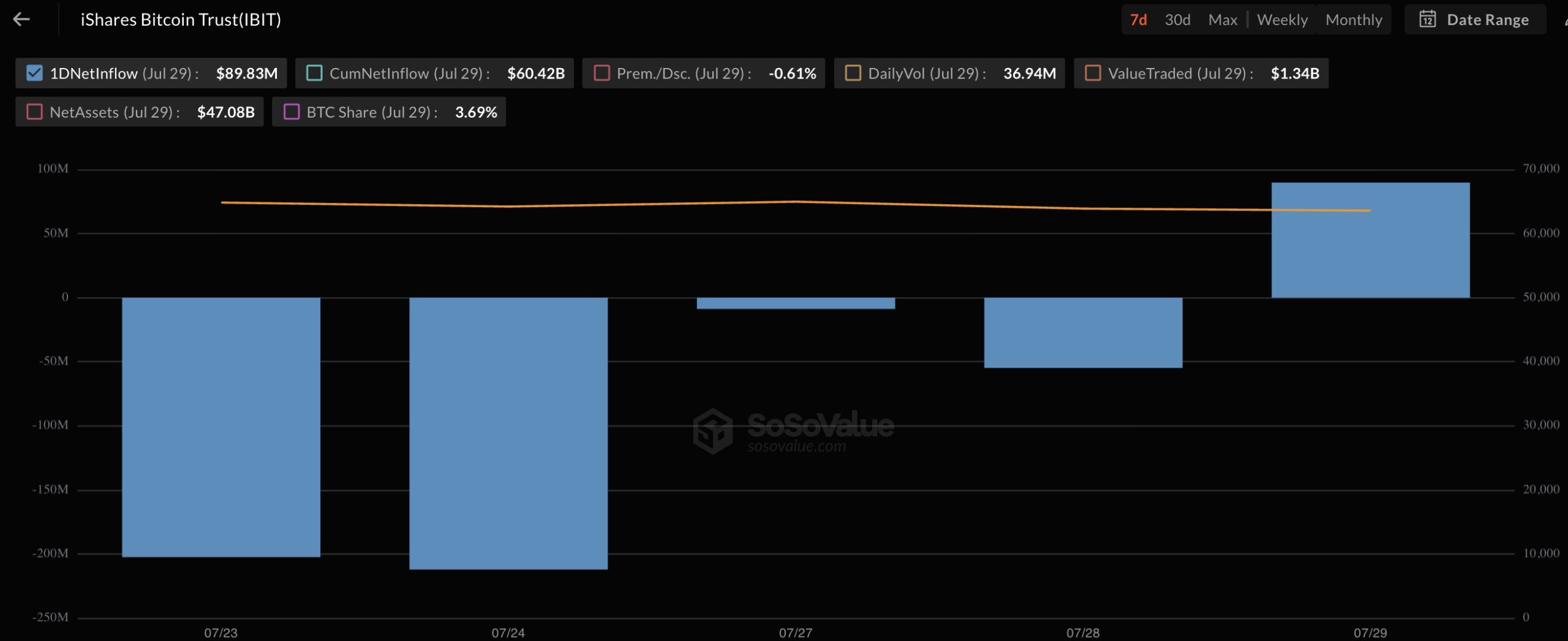
Dòng tiền vào/ra của các ETF Bitcoin dường như chủ yếu được quyết định bởi quỹ IBIT của Blackrock, với lãi/lỗ ròng của ETF Bitcoin phản ánh biến động dòng tiền của IBIT. Nguồn: Sosovalue

Các ETF Ethereum thể hiện động thái hỗn hợp hơn. Quỹ staking MSSE mới ra mắt của Morgan Stanley đã thu hút 14,30 triệu USD, trong khi ETF ETHA của Blackrock thu hút 5,16 triệu USD.

Các dòng tiền vào này đã bị lấn át bởi việc bán ra từ năm sản phẩm. Quỹ FETH của Fidelity mất 16,07 triệu USD. Các quỹ ETHE và Ether Mini Trust của Grayscale ghi nhận dòng tiền rút ra lần lượt là 9,74 triệu và 8,09 triệu USD.

Quỹ TETH của 21Shares mất 2,85 triệu USD và ETHW của Bitwise mất 1,36 triệu USD. Kết quả là, danh mục này ghi nhận dòng tiền rút ròng là 18,65 triệu USD. Khối lượng giao dịch của ETF Ethereum là 563,79 triệu USD và tài sản ròng vào thời điểm đóng cửa là 10,37 tỷ USD.

Solana phục hồi giữa đà bán tháo gia tăng liên quan đến hype

Các ETF Solana đã thu hút 19,06 triệu USD, bù đắp dòng tiền rút ra 18,07 triệu USD được ghi nhận trong phiên trước đó.

Toàn bộ vốn mới đổ vào ETF MSOL mới ra mắt của Morgan Stanley – một ETF Solana hỗ trợ staking. Tổng khối lượng giao dịch đạt 60,21 triệu USD và tài sản ròng tăng lên 862,98 triệu USD.

Nhu cầu đối với các sản phẩm staking mới của Morgan Stanley là đáng chú ý. Quỹ MSSE đã thu hút 19,45 triệu USD trong hai ngày và MSOL thu hút 19 triệu USD ngay trong ngày đầu tiên có dòng tiền vào, điều này cho thấy nhà đầu tư đang phản ứng tích cực với các sản phẩm kết hợp đầu tư token với thu nhập từ staking.

Các ETF $XRP cũng quay trở lại vùng tăng, mặc dù mức tăng khiêm tốn. XRPZ của Franklin Templeton thu hút 584.710 USD, đưa tổng tài sản của danh mục lên 988,70 triệu USD. Khối lượng giao dịch đạt 10,35 triệu USD.

Các quỹ ETF $HYPE vẫn tiếp tục chịu áp lực. Quỹ BHYP của Bitwise ghi nhận dòng tiền rút ra 8,78 triệu USD, đánh dấu ngày giảm thứ năm liên tiếp cho danh mục này. Khối lượng giao dịch của các quỹ ETF $HYPE là 6,92 triệu USD và tài sản ròng giảm xuống còn 252,38 triệu USD.

Dữ liệu mới nhất về dòng tiền cho thấy thị trường vẫn sẵn sàng chấp nhận rủi ro tiền mã hóa, nhưng đồng thời cũng ngày càng trở nên chọn lọc hơn. Bitcoin đã lấy lại được hỗ trợ, Solana đã bật tăng trở lại và các sản phẩm staking đã thu hút được sự quan tâm. Tuy nhiên, Ethereum và $HYPE lại phải đối mặt với một làn sóng bán ra khác.

end-content


Crypto di tendenza

Domande pertinenti

QĐiều gì đã thúc đẩy sự phục hồi của ETF Bitcoin vào ngày 29 tháng 7?

AQuỹ ETF IBIT của Blackrock đã thu hút dòng tiền ròng vào 89,83 triệu USD, bù đắp dòng tiền ra từ các quỹ khác và giúp toàn ngành ghi nhận dòng tiền ròng vào 32,11 triệu USD.

QBiến động của ETF Ethereum trong ngày đó như thế nào?

AETF Ethereum có diễn biến trái chiều. Mặc dù một số quỹ như MSSE của Morgan Stanley và ETHA của Blackrock ghi nhận dòng tiền vào, nhưng tổng thể ngành bị dòng tiền ròng ra 18,65 triệu USD do áp lực bán từ các quỹ lớn như FETH của Fidelity.

QETF Solana đã thể hiện ra sao sau phiên thua lỗ trước đó?

AETF Solana đã phục hồi, thu hút tổng cộng 19,06 triệu USD dòng tiền ròng, chủ yếu là vào quỹ MSOL mới ra mắt của Morgan Stanley, bù đắp cho khoản thua lỗ 18,07 triệu USD của phiên trước đó.

QSản phẩm mới nào của Morgan Stanley thu hút sự quan tâm và vì sao?

ACác sản phẩm mới của Morgan Stanley kết hợp đầu tư token và staking, cụ thể là quỹ MSSE (cho Ethereum) và MSOL (cho Solana), đã thu hút sự quan tâm đáng kể. MSOL thu hút 19 triệu USD ngay trong ngày đầu tiên, cho thấy nhà đầu tư tích cực với các sản phẩm mang lại thu nhập từ staking.

QETF $HYPE và XRP thể hiện như thế nào trong báo cáo?

AETF $HYPE tiếp tục chịu áp lực bán với dòng tiền ra 8,78 triệu USD, đánh dấu ngày thứ 5 liên tiếp sụt giảm. Trong khi đó, ETF XRP có dòng tiền vào khiêm tốn 584.710 USD vào quỹ XRPZ của Franklin Templeton.

Letture associate

a16z: From Companies to DAOs, DUNA May Become the Next Generation Organizational Form

This article, "From Companies to DAOs: How DUNA Could Become the Next Organizational Form," traces the 500-year evolution of business collaboration. It begins with medieval structures like the *commenda* and Florentine *compagnia*, which exposed partners to personal risk. The modern corporation, exemplified by the Dutch East India Company (VOC), was a revolutionary leap, enabling large-scale, capital-intensive ventures by offering limited liability and reducing coordination costs. However, corporations introduced new challenges like principal-agent problems and bureaucratic overhead. The piece argues that software and internet-native protocols are now reducing these traditional overheads. Decentralized Autonomous Organizations (DAOs) emerged as a new model for coordination without centralized management. Yet, DAOs face a significant legal vacuum: they lack legal recognition, leaving members exposed to unlimited personal liability, and their tokens are vulnerable to being classified as securities under unclear regulations (e.g., the Howey Test). This has forced projects into suboptimal workarounds like offshore foundations. The article identifies the Decentralized Unincorporated Nonprofit Association (DUNA) as a potential solution. Recently legalized in states like Wyoming, the DUNA provides a legal wrapper for decentralized networks. It grants key protections—legal personality, limited liability, and perpetual existence—to a group without imposing a traditional hierarchical management structure. This allows token-holder communities to govern, hold assets, and contract as a single legal entity, aligning with their decentralized nature. While DUNA doesn't solve all governance challenges or magically resolve securities law questions, it represents a crucial step. It fills the legal recognition gap, offering a native legal form for internet-scale, decentralized collaboration and extending the separation of personal risk from organizational venture into a new domain.

marsbit11 min fa

a16z: From Companies to DAOs, DUNA May Become the Next Generation Organizational Form

marsbit11 min fa

2026 Mid-Year Report On-Chain RWA: Tokenized Stock Market Cap Doubles in a Year, But 90% of Rights Are Hollow Shells

The 2026 Mid-Year Report on On-Chain RWA highlights a significant growth in tokenized stock market capitalization, which nearly doubled from $951 million in March to $1.89 billion by July. However, the report reveals a fundamental contradiction in this "layer 2.5" ecosystem: products with the strongest legal foundation (like regulated U.S. infrastructure) lack liquidity and distribution, while freely tradable offshored wrapper products often lack substantive ownership rights. The increase is driven largely by a few products (SECZ, FGRS, STRCx) and platforms (Ondo, xStocks, Securitize collectively hold over 85% share). While distributed value across networks like Ethereum, Solana, and BNB Chain has grown, the market remains fragmented. Products referencing the same underlying asset (e.g., Apple stock) are distinct legal liabilities with different intermediaries and jurisdictional rules, offering varying degrees of legal claim. The report cautions that headline numbers are misleading, as they reflect changes in distributed token value—driven by issuance, conversions, and price movements—not pure investor inflows. True "canonical shares" with legal ownership, wide wallet distribution, institutional liquidity, and independent on-chain price discovery do not yet exist at scale. Tokenized treasuries show stronger product-market fit, and ETFs may be easier to scale than single stocks. The core takeaway is a trade-off: legal certainty versus liquidity and composability.

marsbit1 h fa

2026 Mid-Year Report On-Chain RWA: Tokenized Stock Market Cap Doubles in a Year, But 90% of Rights Are Hollow Shells

marsbit1 h fa

Coldcard Hardware Wallet Hacked: 594 Bitcoin Withdrawn in 25 Minutes

The Coldcard hardware wallet has been compromised, with hackers stealing approximately 594.5 Bitcoin (~$40 million) from 500 addresses in just 25 minutes. The root cause was a critical software bug, undetected for five years, which disabled the device's secure chip for generating true random numbers. This led to the creation of private keys based on predictable data like the processor's serial number, drastically reducing cryptographic security. The attackers exploited this offline by brute-forcing possible seed phrases, finding active addresses on the public ledger, and signing transactions. Initially, Coinkite (Coldcard's maker) claimed only older models were at risk but later admitted all devices running the compromised firmware were vulnerable. CEO Rodolphe Novak (NVK) apologized but ruled out financial compensation for affected users. To secure funds, owners must urgently update their firmware to specific safe versions, generate a completely new seed phrase on the updated device, and transfer all assets to new addresses created with that new seed. While a BIP-39 passphrase can help, it does not replace this migration process. Other Coinkite products like TAPSIGNER were not affected. This incident underscores that even specialized hardware requires rigorous, independent code audits, especially for cryptographic functions. It parallels past failures, like a 2006 OpenSSL bug in Debian, and raises questions about whether automated code analysis can ever fully replace human scrutiny in critical security areas.

cryptonews.ru3 h fa

Coldcard Hardware Wallet Hacked: 594 Bitcoin Withdrawn in 25 Minutes

cryptonews.ru3 h fa

Trading

Spot

Articoli Popolari

Come comprare 4

Benvenuto in HTX.com! Abbiamo reso l'acquisto di 4 (4) semplice e conveniente. Segui la nostra guida passo passo per intraprendere il tuo viaggio nel mondo delle criptovalute.Step 1: Crea il tuo Account HTXUsa la tua email o numero di telefono per registrarti il tuo account gratuito su HTX. Vivi un'esperienza facile e sblocca tutte le funzionalità,Crea il mio accountStep 2: Vai in Acquista crypto e seleziona il tuo metodo di pagamentoCarta di credito/debito: utilizza la tua Visa o Mastercard per acquistare immediatamente 44.Bilancio: Usa i fondi dal bilancio del tuo account HTX per fare trading senza problemi.Terze parti: abbiamo aggiunto metodi di pagamento molto utilizzati come Google Pay e Apple Pay per maggiore comodità.P2P: Fai trading direttamente con altri utenti HTX.Over-the-Counter (OTC): Offriamo servizi su misura e tassi di cambio competitivi per i trader.Step 3: Conserva 4 (4)Dopo aver acquistato 4 (4), conserva nel tuo account HTX. In alternativa, puoi inviare tramite trasferimento blockchain o scambiare per altre criptovalute.Step 4: Scambia 4 (4)Scambia facilmente 4 (4) nel mercato spot di HTX. Accedi al tuo account, seleziona la tua coppia di trading, esegui le tue operazioni e monitora in tempo reale. Offriamo un'esperienza user-friendly sia per chi ha appena iniziato che per i trader più esperti.

429 Totale visualizzazioniPubblicato il 2025.10.20Aggiornato il 2026.06.02

Come comprare 4

Discussioni

Benvenuto nella Community HTX. Qui puoi rimanere informato sugli ultimi sviluppi della piattaforma e accedere ad approfondimenti esperti sul mercato. Le opinioni degli utenti sul prezzo di 4 4 sono presentate come di seguito.

活动图片