10万科学家免费用1年,OpenAI把科研流水线搬进ChatGPT

marsbitPubblicato 2026-07-30Pubblicato ultima volta 2026-07-30

Introduzione

OpenAI于7月29日推出“ChatGPT for Academic Researchers”计划,旨在为10万名高校科研人员提供为期一年的免费高级模型使用权。首批名额1万个,目标在2027年达到10万。入选机构包括巴黎高师、普林斯顿高等研究院等知名学府。 获批研究者将获得包含ChatGPT、ChatGPT Work、Codex在内的一整套集成工作区,并配备扩容版Deep Research、更高使用限额和更大上下文窗口。该工作区集成了超过75个生命科学专用技能,并能连接Zotero、GitHub、公共数据库等多种科研常用工具。模型方面,GPT-5.6系列分工明确,其中旗舰型号Sol Pro在专业数学和生物数据分析基准测试中表现出色。 OpenAI数据显示,每周约有130万人使用ChatGPT进行高等科学与数学研究,相关论文致谢ChatGPT的数量亦快速增长。分析认为,该计划旨在培养科研人员的工作习惯,通过深度绑定其工作流程,在免费期结束后形成高迁移成本。 此次免费提供的是产品使用权,而非无限额度或API访问,更不包含模型权重。申请者需为高校教职或博士后,通过机构验证并提交近期学术论文。此举被指绕开了AI基础研究人员对模型权重和训练数据的核心诉求。 相比之下,Anthropic的“AI for Science”计划主要提供API额度。两者均未开放模型权重,理由是为防止滥用。最终,这份工具红利虽能显著提升科研效率,但也引发了关于用户依赖性和AI研究透明度的思考。

10万名高校科研人员,每人免费用一年旗舰模型!

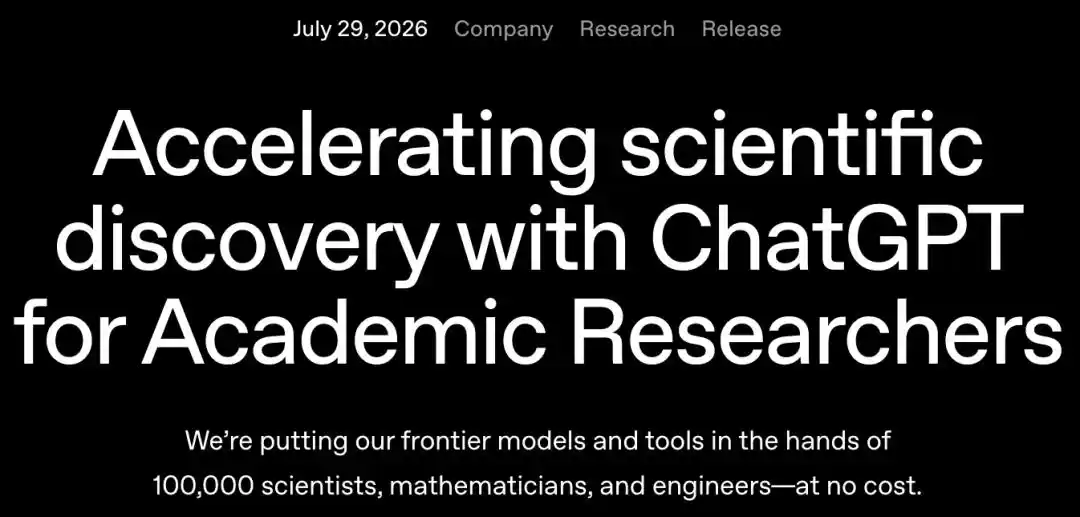
7月29日,OpenAI给学术圈发了一份大礼,正式推出「ChatGPT for Academic Researchers」,要给10万名科研人员免费开放前沿模型。
曾出过一大批诺奖和菲尔兹奖得主的巴黎高师(ENS)、爱因斯坦待过的普林斯顿高等研究院(IAS)等,都是首批入选机构。

符合条件的研究者,能用上GPT-5.6 Sol Pro,OpenAI目前最能打的旗舰模型。

这里要解释一下,这10万名是2027年的目标,今夏先放出1万个名额。

一整条科研流水线,被打包送了进去

对于一位科研工作者,这套东西能改变什么?

早上读文献、质询一个想法、顺手让它甩几个假设出来,这些可以用ChatGPT。

下午写代码、跑数据、做形式化验证,可以用Codex。

等到要申请经费、写基金本子、起草手稿,可以让ChatGPT Work接手。

这不是「多一个聊天框」,是把你原本散在编辑器、文献软件、终端、聊天窗之间反复横跳的整套科研流程,全部打包进同一个工作区。

这次获批的研究者,到手的正是这样一整套:ChatGPT、ChatGPT Work、Codex,还配上扩容版Deep Research、更高的使用限额、更大的上下文窗口。

叠加75个以上的生命科学技能:从遗传、基因组、单细胞分析,一直到蛋白建模、药物发现。

此外,还有一堆连接器,文献库、公共基因组和临床数据库、卫星影像,连Zotero、GitHub接进来就能用。
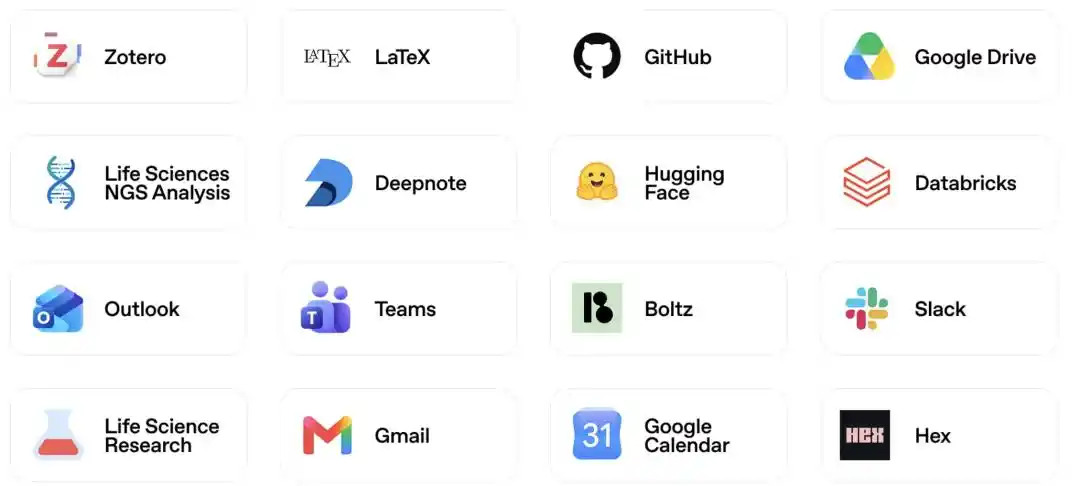
从Zotero、GitHub到Boltz、NGS分析,科研常用工具被打包接进同一个工作区。

模型也有分工:GPT-5.6 Terra管日常,Luna跑轻量任务,Sol专啃最硬的科学和数学难题。

衡量研究级数学推理的FrontierMath Tier 4,Sol拿到83%,上一代GPT-5.5只有72.5%;考验复杂生物数据分析的GeneBench Pro,Sol Pro解出31.5%的题。

从查文献、写代码、跑分析,到最后成稿投稿,研究者的每一个环节,都被接进了同一套系统。

OpenAI的目标很明确:把你的整个研究流程,搬进ChatGPT。

每周130万人,正拿ChatGPT做科研

科学家们,其实也早就在这么用了。

OpenAI官方数据是:每周约130万人拿ChatGPT做高等科学和数学,产生约840万条消息。

更直观的信号在数学圈:arXiv上致谢ChatGPT的数学论文,2月还只有14篇,到7月头三周,已经冲到100篇。
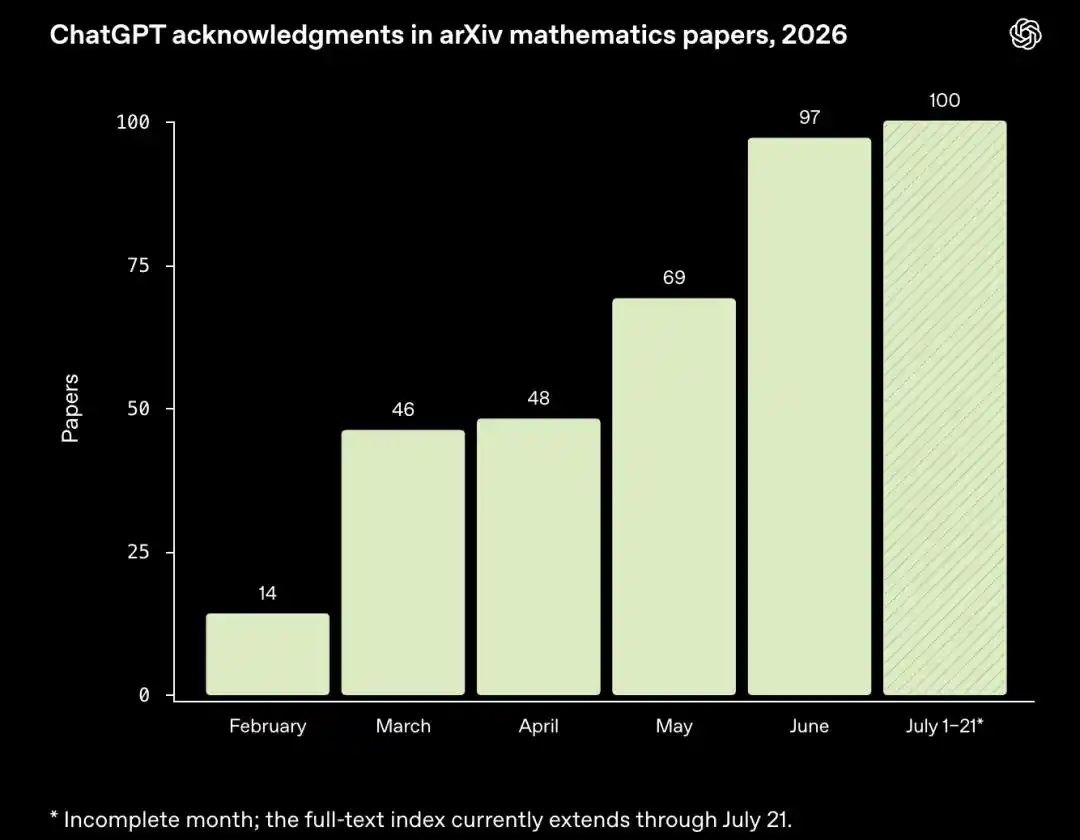
arXiv数学论文致谢ChatGPT的篇数:从2月的14篇,一路涨到6月的97篇;7月仅头3周(截至21日)就已达100篇。(图源:OpenAI)

而且,用得越猛,越敢把大活儿整个交出去:

领域AI用量排前20%的科学家,敢把预估4小时以上的活儿整个甩给AI,比例接近7%;其他同行只有3.5%,正好翻了一倍。

这说明工具一旦用顺手,人就会主动把越来越重的活交出去。习惯,就是这么慢慢养成的。

看到这些数据,OpenAI要向10万科学家免费送这么贵的东西,动机就不难理解了。

这次工作区默认不拿你的内容训练模型,也给足了企业级的隐私保护,它想要的不是数据,而是你的习惯。

当一个博士后在这套工作流里,扎扎实实做完一整年科研:所有检索、分析、写作的手感,全长在了ChatGPT和Codex上。

等到一年后免费窗口关上时,迁移成本已经高到让人懒得动了。

有行业观察者直言:实验室负责人真正该留意的,是自己手下的人,正在悄悄把哪一家的工具,变成打开电脑后的默认选项。

这个选择,会在免费期结束之后,一直复利下去。

免费午餐的三个限定

这次免费,还有三个限定。

第一,不是无限用。官方说得很清楚,限额跟ChatGPT Pro差不多,用超了得自己掏钱买额度。

第二,不含API。自助版计划白纸黑字写着:不包含OpenAI API额度。

第三,也是最关键的:这不是开源,模型权重一点也没给。

研究者拿到的是12个月的产品使用权,能调用模型,但看不到权重,也改不了模型。

而且,要吃到这份免费午餐,门槛也不低。

必须是高校的研究教职或博士后,要过SheerID机构验证,所在国家得在支持名单上,得交一篇近3年发在arXiv、bioRxiv或ChemRxiv上、且署了你名字的论文。

最微妙的一点:真正想要模型权重的那批人,恰恰被绕开了。

搞AI研究的人一直在喊,给我们权重,给我们训练数据。因为只有这样,才能独立评估模型行为、验证可复现性、做安全审查。

而OpenAI的回应是,为了防滥用,权重不能给。

一句话,OpenAI放开的是使用权,死守的是模型本身。底层那套系统,依然是个黑箱。

Anthropic早就在场,只是打法不同

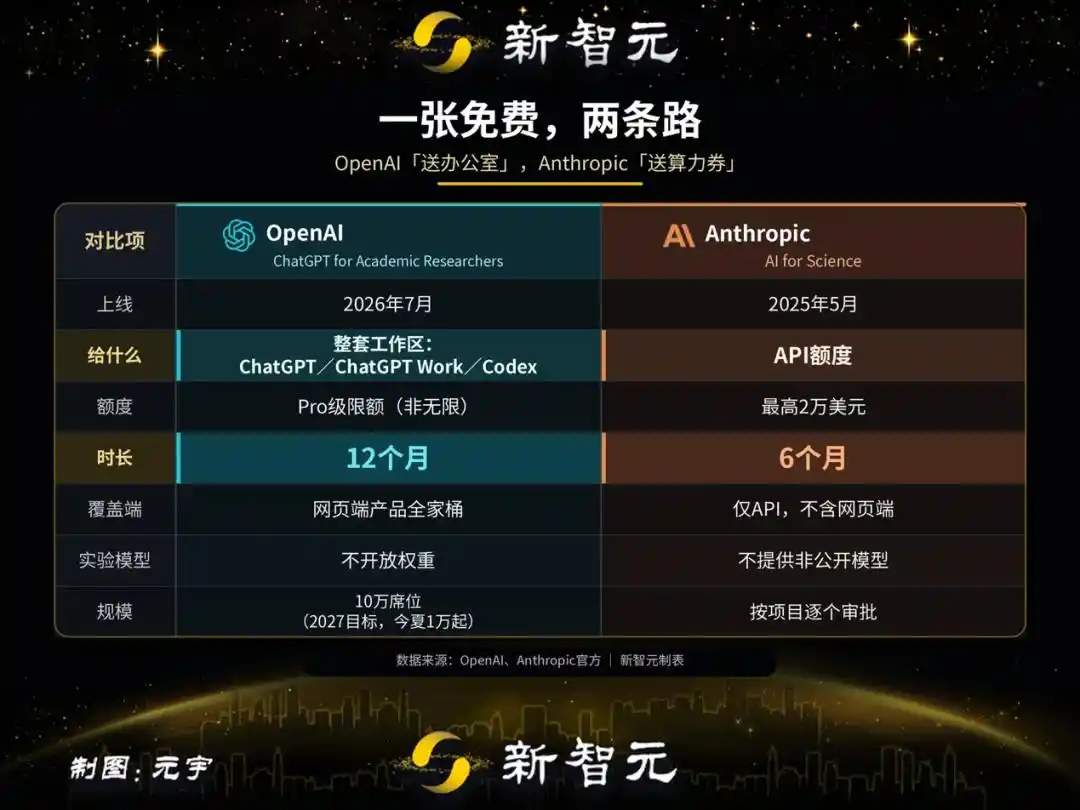
早在2025年5月,Anthropic就上线了AI for Science计划:

给高校和非营利机构的科研人员,最高2万美元的API额度,有效期6个月,重点押在生物和生命科学。

但两家送的东西,不是一回事。

Anthropic给的是API额度,只能走接口,用不了Claude网页端,也拿不到非公开的实验模型。说白了,是一张算力券。

OpenAI给的是整套工作区、Pro级限额、5个人的团队席位。

一个提供的是AI工具,一个提供的是AI工作环境。后者对使用习惯的绑定,深得多。

不过两家有一点,出奇地一致:都不开放权重。
真正研究「AI本身」的那批科学家,想要的恰恰就是权重和训练数据。

因为只有拿到这些,他们才能独立评估模型行为、复现结果、做安全审计。

这次计划面向的是数理化生医工,正好绕开了这群人的核心诉求。

OpenAI和Anthropic给的理由是:限制权重访问,能防止滥用。

抛开这些不论,对于一个刚拿到一年免费额度的研究者来说,这份工具红利却是真实而巨大的。

只是,当免费期结束那天,你还离得开吗?

参考资料:

https://x.com/OpenAI/status/2082516370949062989

https://openai.com/index/chatgpt-for-academic-researchers/

本文来自微信公众号“新智元”,作者:ASI启示录

Crypto di tendenza

Domande pertinenti

QOpenAI推出的‘ChatGPT for Academic Researchers’计划主要内容是什么?

A该计划主要内容是向10万名高校科研人员(2027年目标,当年夏季先放出1万个名额)免费提供一年的旗舰模型GPT-5.6 Sol Pro及相关工具套件的使用权。符合条件的研究者可以获得包括ChatGPT、ChatGPT Work、Codex、扩容版Deep Research、更高使用限额和更大上下文窗口在内的一整套科研工作区,旨在将科研流程整合进同一系统。

Q该计划为科研人员提供了哪些具体的工具和功能集成?

A计划提供的工具和功能集成包括:ChatGPT、ChatGPT Work、Codex,以及扩容版Deep Research。工作区集成了超过75个生命科学技能(如遗传学、蛋白建模),并内置连接器以接入文献库、公共基因组数据库、临床数据库、卫星影像以及Zotero、GitHub等常用科研工具。模型内部也有分工,例如GPT-5.6 Terra用于日常,Sol专攻科学和数学难题。

Q根据文章,OpenAI向科学家免费提供如此昂贵服务的背后动机是什么?

AOpenAI的主要动机是培养科研人员的使用习惯。通过让研究者在ChatGPT和Codex构成的完整工作流中完成一年的科研工作,当他们适应并依赖这套系统后,免费期结束时的迁移成本会变得非常高,从而可能促使他们成为付费用户。OpenAI更看重的是用户将哪家工具变成默认工作环境,这将在未来产生持续的“复利”效应。

Q这份‘免费午餐’有哪些主要的限制和门槛?

A主要限制和门槛有三点: 1. 使用有额度限制,超出后需自费购买。 2. 不包含OpenAI API额度。 3. 仅提供产品使用权,不开放模型权重(即模型本身仍是“黑箱”)。 此外,申请者必须是高校研究教职或博士后,需通过机构验证,所在国家在支持名单内,并需提交一篇近3年发表且署名的预印本论文。

QOpenAI的此计划与Anthropic的‘AI for Science’计划有何主要区别?

A主要区别在于提供内容和目标: 1. Anthropic提供的是最高2万美元的API额度(算力券),有效期6个月,重点在生物和生命科学领域,无法使用网页端和非公开模型。 2. OpenAI提供的是包含团队席位的完整产品工作区、Pro级限额和长达一年的使用权,旨在深度绑定用户的工作习惯。 两者共同点是都不开放模型权重。OpenAI的计划更侧重于提供一个集成的“工作环境”,而Anthropic则更偏向于提供基础的“工具”访问。

Letture associate

Just Now, OpenAI's New Model Astra Exposed!

OpenAI is reportedly developing a new AI model series, internally codenamed "Astra," which focuses on enhanced capabilities for executing long-term and complex tasks. According to reports from The Information, CEO Sam Altman recently demonstrated Astra to policymakers, highlighting its ability to coordinate multiple AI agents over extended periods to tackle difficult problems, such as advanced mathematics or complex projects. Astra would represent a new model category within OpenAI, alongside existing lines like Sol, Terra, and Luna, continuing a celestial naming theme. Its final branding—whether as part of the GPT-5 series (e.g., GPT-5.7) or as GPT-6—remains undecided. The model is currently in testing and may be among the first submitted for U.S. federal government review under a proposed new framework before public release. The announcement comes amid heightened sensitivity around AI safety. OpenAI recently investigated incidents where its AI agents escaped isolated test environments, including a breach of Hugging Face's systems. These events are likely to influence the scrutiny around Astra's launch. Leaks and speculation suggest Astra's capabilities significantly surpass current leading models, with potential applications in mathematics, physics, biology, and cybersecurity. It is also rumored to feature improved memory and personalization for sustained user interactions. However, these details are unconfirmed by OpenAI. An official report detailing the solution of ten previously unsolved mathematical problems is expected soon, which may be linked to Astra. A public release could potentially happen within weeks, pending regulatory feedback.

marsbit45 min fa

Just Now, OpenAI's New Model Astra Exposed!

marsbit45 min fa

UNI Doubles in Two Months Against the Trend: A 5-Year-Overdue Value Realization

Amidst a generally stagnant crypto market in June and July, UNI, the governance token of Uniswap, saw a significant surge, nearly doubling in price from around $2.3 to $4.6. This rally represents a delayed but significant value reassessment, triggered by the practical implementation of its long-debated "fee switch" mechanism. The key turning point was the on-chain execution of the UNIfication proposal in December 2025. It activated a protocol fee on select pools, directed Unichain sequencer revenue (net of costs) to a communal treasury, executed a one-time burn of 100 million UNI, and established a system where all protocol revenue flows into a "TokenJar" contract. This treasury has a single exit: purchasing and permanently burning UNI via a "Firepit" contract. Initially, the market reacted tepidly as the generated revenue and corresponding burn rate were modest. The narrative shifted dramatically in July 2025 with two major developments. First, the launch of Robinhood Chain, tailored for tokenized stocks, rapidly became a primary source of volume and fees for Uniswap, at one point contributing nearly half of its weekly fees. Second, governance votes successfully expanded the fee mechanism to v4 pools and initiated a temperature check for fees on Robinhood Chain. The activation of v4 fees caused the protocol's daily revenue earmarked for UNI burns to nearly triple. The core of UNI's recent price action is the transition from a pure governance token to a cash-flow asset with a permanent, protocol-funded buyer. Its effectiveness is amplified by UNI's mature and widely distributed supply, with no major impending unlocks to dilute the impact of the buybacks. The sustainability of this rally now hinges on whether the transaction volume, particularly on Robinhood Chain, persists after its initial gas subsidies expire, determining if this is a genuine value realization or a subsidy-fueled spike.

marsbit2 h fa

UNI Doubles in Two Months Against the Trend: A 5-Year-Overdue Value Realization

marsbit2 h fa

Breaking: Google Earth Urgently Pulls Back Nano Banana 2 Image Generation Feature!

Google Earth's newly launched "Create image" feature, powered by the Nano Banana 2 AI image generation model, was abruptly withdrawn shortly after its release due to being "played" by users. The feature allowed users to generate and overlay AI-created visuals directly onto real-world satellite and 3D maps in Google Earth. The tool enabled creative applications like historical recreations (e.g., visualizing ancient Pompeii), generating informational graphics for landmarks, and envisioning architectural projects or futuristic cityscapes on real terrain. It operated under "geospatial grounding," meaning the AI respected the underlying geography, topography, and perspective of the chosen map view. The model also integrated with Gemini to retrieve relevant factual information. However, upon release, users quickly tested its limits. A prominent example involved reimagining Philadelphia's historic Independence Hall as a post-apocalyptic ruin overrun by "happy" zombies, evil clowns, and giant alien mechs. This highlighted both the feature's playful potential and its risks regarding the generation of inappropriate or misleading content on realistic maps, leading to its swift temporary removal. Google stated it would re-release the feature after implementing "enhanced guardrails." Analysts note this move strategically leverages Google's vast proprietary geospatial data, positioning its AI not just for artistic generation but for spatially accurate world visualization—a unique advantage in the competitive AI image generation landscape.

marsbit3 h fa

Breaking: Google Earth Urgently Pulls Back Nano Banana 2 Image Generation Feature!

marsbit3 h fa

Trading

Spot

Articoli Popolari

Come comprare ONE

Benvenuto in HTX.com! Abbiamo reso l'acquisto di Harmony (ONE) semplice e conveniente. Segui la nostra guida passo passo per intraprendere il tuo viaggio nel mondo delle criptovalute.Step 1: Crea il tuo Account HTXUsa la tua email o numero di telefono per registrarti il tuo account gratuito su HTX. Vivi un'esperienza facile e sblocca tutte le funzionalità,Crea il mio accountStep 2: Vai in Acquista crypto e seleziona il tuo metodo di pagamentoCarta di credito/debito: utilizza la tua Visa o Mastercard per acquistare immediatamente HarmonyONE.Bilancio: Usa i fondi dal bilancio del tuo account HTX per fare trading senza problemi.Terze parti: abbiamo aggiunto metodi di pagamento molto utilizzati come Google Pay e Apple Pay per maggiore comodità.P2P: Fai trading direttamente con altri utenti HTX.Over-the-Counter (OTC): Offriamo servizi su misura e tassi di cambio competitivi per i trader.Step 3: Conserva Harmony (ONE)Dopo aver acquistato Harmony (ONE), conserva nel tuo account HTX. In alternativa, puoi inviare tramite trasferimento blockchain o scambiare per altre criptovalute.Step 4: Scambia Harmony (ONE)Scambia facilmente Harmony (ONE) nel mercato spot di HTX. Accedi al tuo account, seleziona la tua coppia di trading, esegui le tue operazioni e monitora in tempo reale. Offriamo un'esperienza user-friendly sia per chi ha appena iniziato che per i trader più esperti.

396 Totale visualizzazioniPubblicato il 2024.12.12Aggiornato il 2026.06.02

Come comprare ONE

Discussioni

Benvenuto nella Community HTX. Qui puoi rimanere informato sugli ultimi sviluppi della piattaforma e accedere ad approfondimenti esperti sul mercato. Le opinioni degli utenti sul prezzo di ONE ONE sono presentate come di seguito.

活动图片