Japanese and Korean Stock Markets Crashed! Nikkei Plummets Over 4%, KOSPI Plunges 8%, Market Panics Ahead of AI Giants' Earnings Week

marsbitPubblicato 2026-07-28Pubblicato ultima volta 2026-07-28

Introduzione

Japanese and South Korean stock markets plunged sharply in early Tuesday trading, with the Nikkei 225 down over 4% and the KOSPI index tumbling 8%, triggering a circuit breaker. The sell-off was led by semiconductor and equipment stocks like Tokyo Electron, Kioxia, Samsung Electronics, and SK Hynix, the latter dropping as much as 30%. The primary driver is mounting investor concern over the sustainability of the AI boom. Worries intensified following news related to Nvidia's major AI supply agreements and rising debt insurance costs. Analysts point to fears over excessive capital expenditure, crowded trades in AI-related stocks, and high corporate debt levels. Market sentiment has soured ahead of key earnings reports from major tech firms, including Meta and SK Hynix. While SK Hynix is expected to post record results, its recent 38% price drop from June highs reflects deep skepticism about whether AI infrastructure spending can maintain its pace and deliver returns. The sell-off appears more driven by a sharp deterioration in sentiment than by immediate fundamental changes.

On Tuesday morning, dragged down by concerns related to Nvidia's (NVDA.O) significant AI supply agreements and intensifying market competition, investor sentiment was hit, causing Japanese and Korean stock markets to open lower and extend losses.

As of the time of writing, the Nikkei 225 Index had plunged over 4% intraday, hitting its lowest level since May 22; the TOPIX Index saw its biggest drop of 2.7%. South Korea's KOSPI Index widened its losses to 8%, triggering a trading halt for 20 minutes. The Korea Exchange had also earlier activated the KOSPI sidecar mechanism, temporarily suspending program sell orders on the KOSPI.

Semiconductor and equipment stocks like Tokyo Electron, Kioxia, Samsung Electronics, and SK Hynix led the declines, all falling more than 9%. Among them, SK Hynix's stock price plummeted as much as 30%, marking its biggest single-day drop in history; Kioxia's stock price fell up to 18%, its largest decline since last November. As the global sell-off in semiconductor stocks intensified, investor sentiment regarding the sustainability of the AI boom continued to deteriorate.

Amid a wave of AI-related deals totaling over $750 billion, the cost of debt default insurance for Nvidia surged, triggering a decline in tech stocks. Hideyuki Ishiguro, Chief Strategist at Nomura Asset Management, stated that following reports on Nvidia's significant investment deals, the rise in its credit risk is being viewed by investors as a negative signal.

Additionally, Ishiguro pointed out that China's progress in the semiconductor manufacturing equipment sector poses a threat to Japanese suppliers—who have long held a competitive advantage in this field.
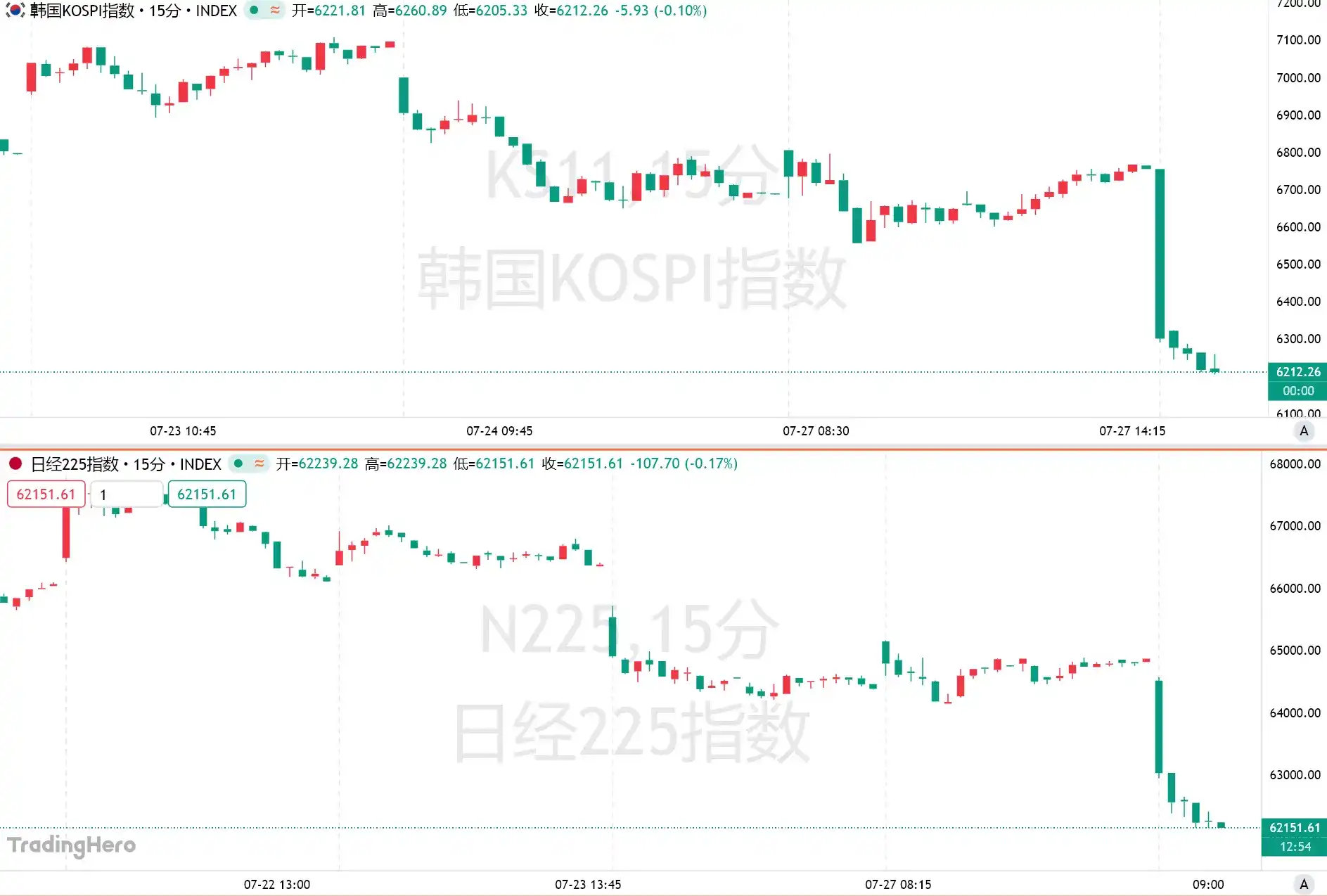
These declines point to deepening concerns in the market regarding crowded stock positioning and rising corporate debt levels as AI infrastructure development advances.

"The recent sell-off in semiconductor stocks seems to be driven more by sharply deteriorating market sentiment than by any immediate change in fundamentals," said Jung In Yun, CEO of Fibonacci Asset Management Global. "Investors are increasingly questioning whether the pace of AI infrastructure spending can be sustained."

Chris Larkin of Morgan Stanley E*Trade said: "This week is packed with potential surprises, both good and bad. Geopolitics and oil prices could be the biggest variables, but an optimistic reaction to strong earnings from the Magnificent Seven is not a given, especially if AI spending levels continue to surprise."

Kyle Rodda, Senior Analyst at Capital.com, wrote in a note to clients: "These companies embody the key themes currently affecting market sentiment—excessive capital expenditure and spending by AI companies, which investors worry will erode returns."

This week, several top tech companies, including Meta Platforms Inc. (META), are set to release key earnings. News earlier this month that Meta planned to sell excess AI computing capacity had already sparked concerns about demand. Apple Inc. (AAPL) has issued warnings about cost pressures, and reports indicate it is lobbying for approval to purchase memory components from competitors.

Investors are also awaiting the full results for Samsung Electronics' June quarter. Kim Minji, a portfolio manager at Seoul's Must Asset Management, said the world's largest traditional memory chipmaker is catching up to SK Hynix in the HBM field.

Furthermore, although SK Hynix is expected to announce another quarter of record-breaking earnings on Wednesday, investor sentiment has clearly weakened. The core market concern is that continuously rising memory prices may force customers to reduce purchases and seek lower-cost alternatives.

Since hitting a historic high in June, SK Hynix's stock price has cumulatively fallen 38%, with market worries about overcrowded trading and leverage amplifying price volatility. In this round of adjustment, the company's market capitalization shrinkage is second only to SpaceX (SPCX) globally.

In just over a month, approximately $470 billion in market value has evaporated from SK Hynix. The South Korean memory chipmaker, once seen as one of the world's hottest AI trades, is now becoming one of the most contentious holdings in investor portfolios.

Shawn Oh, Head of Korea Cash Equities Business at NH Investment & Securities, stated in a research report that, considering the current attractive valuation and the ongoing deleveraging by Korean retail investors, SK Hynix remains "an extremely attractive buying opportunity." However, he also noted that the market is reducing stock positions ahead of the U.S. tech company earnings season.

The market expects SK Hynix's June quarter sales to more than double year-on-year, reaching about $57 billion; operating profit is projected to increase sixfold year-on-year. But James Ooi, a market strategist at Tiger Brokers, said the significance of SK Hynix's earnings may transcend the company itself.

"SK Hynix's performance could also become a sentiment barometer for the global AI hardware sector," he said, adding that market expectations have largely been priced in already, so "even a slight miss could trigger a sharp reaction."

Hebe Chen, Senior Market Analyst at Vantage Global Prime, said: "The recent sell-off in chipmakers shows that doubts about spending, returns, and valuations are deepening, not subsiding. With several major catalysts approaching, the hesitation to buy the dip suggests investors are waiting for stronger evidence before rebuilding risk exposure."


Crypto di tendenza

Domande pertinenti

QWhat were the main factors cited as causing the sharp decline in Japanese and South Korean stock markets on Tuesday morning?

AThe main factors were investor concerns about NVIDIA's major AI supply agreement and increasing market competition, which negatively impacted sentiment. Specific triggers included a surge in NVIDIA's debt default insurance costs within the large AI-related deal wave and worries about competition from China in semiconductor manufacturing equipment for Japanese firms.

QWhat specific market mechanisms were triggered in the South Korean market due to the sell-off, and for what key stock index?

AFor the South Korean KOSPI index, the decline widened to 8%, triggering a market-wide circuit breaker which halted trading for 20 minutes. The Korea Exchange also initiated a sidecar mechanism for the KOSPI, temporarily suspending program selling.

QWhich semiconductor and equipment stocks were mentioned as leading the declines, and what were some of their significant losses?

ATokyo Electron, Kioxia, Samsung Electronics, and SK Hynix were mentioned as leading the declines. Specific notable losses included SK Hynix's stock plunging as much as 30% (its biggest-ever daily drop) and Kioxia's stock falling up to 18% (its largest drop since November of the previous year).

QAccording to analysts cited in the article, what is the core investor worry regarding the current AI boom that is driving the market sell-off?

AThe core investor worry, as stated by analysts, is skepticism about the sustainability of AI infrastructure spending and capital expenditure. Investors are increasingly questioning whether the pace of AI-related spending can continue, fearing it will erode company returns. The sell-off reflects deepening concerns over crowded stock positions and rising corporate debt levels in the AI build-out.

QWhy is SK Hynix's upcoming earnings report considered significant beyond the company's own performance, and what potential market reaction is anticipated?

ASK Hynix's earnings report is seen as a potential sentiment barometer for the global AI hardware sector. The market has largely priced in high expectations, so even a slight miss in earnings could trigger a significant and volatile negative reaction across related stocks. Its performance is being watched for clues about the broader health and trajectory of AI demand.

Letture associate

Stock Trading Has Become 'Crypto Trading', Welcome Back to the Native Home

"Stock Trading Becomes 'Coin Trading': A Market's Bizarre Reversal" The global stock market, particularly in tech sectors, is undergoing a radical transformation, increasingly mirroring the volatile, narrative-driven mechanics of the cryptocurrency world. This shift was starkly illustrated by the dramatic crash of South Korea's KOSPI index in July 2026, where leveraged ETFs tied to stocks like SK Hynix triggered massive, rapid liquidations, devastating hundreds of thousands of retail investors, many of them young. This "crypto-fication" of equities began as disillusioned cryptocurrency traders migrated to stock markets, bringing with them their speculative playbook: chasing high-beta narratives like AI and semiconductor cycles, relying on social media for investment cues, and employing heavy leverage. Ironically, while these traders sought the perceived safety of stocks with fundamentals, their methods turned parts of the equity market—especially in Korea, the US, and Japan—into arenas of extreme speculation. Stocks like SK Hynix experienced price collapses ("halving") in just over a month, a pace even faster than Bitcoin's historical crashes. The core of this change is the primacy of narrative over traditional valuation. Complex company analysis is reduced to viral slogans about AI's infinite demand, driving concentrated inflows into thematic sectors. This is amplified by leverage, particularly through risky single-stock leveraged ETFs, which create vicious cycles of forced selling during downturns. Meanwhile, social media algorithms promote stories of overnight riches, drawing in inexperienced investors. In a paradoxical twist, Bitcoin, through institutional adoption and ETFs, is becoming relatively more stable, with its volatility now sometimes lower than major tech stocks. The market has reached an absurd crossover: stocks are acting like speculative crypto assets, while crypto strives for the legitimacy of traditional finance. The article concludes that this represents a "degeneration" of market rationality, where trading a story's heat has supplanted investing in future profits, leaving a trail of financial wreckage in its wake.

marsbit26 min fa

Stock Trading Has Become 'Crypto Trading', Welcome Back to the Native Home

marsbit26 min fa

Santander Bank Announces It Holds a $4.3 Million Position in U.S. Spot Bitcoin ETFs

Spanish banking giant Banco Santander disclosed in regulatory filings that it holds approximately $4.3 million in US spot Bitcoin ETFs. While this amount is small relative to the bank's over $1 trillion in assets under management, it signifies a growing trend of traditional financial institutions increasing Bitcoin exposure through regulated channels. Santander, scoring around 35% on a 2026 Bitcoin Adoption Index for banks, is categorized at a "medium level" of integration, similar to Société Générale but behind more crypto-focused firms. The bank's interest in cryptocurrencies is not new; CEO Ana Botín has discussed Bitcoin-related products since 2021. Santander has been developing crypto custody and digital asset services across Europe for years, with its digital arm, Openbank, beginning to offer crypto trading in Germany in September 2025, with plans to expand to Spain. This investment comes as institutional crypto adoption accelerates in Europe. Santander is actively involved in crypto custody initiatives across the continent and appears to be positioning itself to strengthen its role in the sector, especially as regulations like MiCA become clearer. The industry is watching whether the bank's medium integration level reflects caution or structural limitations, as banks with higher adoption may gain an edge in attracting crypto-interested wealthy clients.

cryptonews.ru32 min fa

Santander Bank Announces It Holds a $4.3 Million Position in U.S. Spot Bitcoin ETFs

cryptonews.ru32 min fa

Trading

Spot

Articoli Popolari

Come comprare 4

Benvenuto in HTX.com! Abbiamo reso l'acquisto di 4 (4) semplice e conveniente. Segui la nostra guida passo passo per intraprendere il tuo viaggio nel mondo delle criptovalute.Step 1: Crea il tuo Account HTXUsa la tua email o numero di telefono per registrarti il tuo account gratuito su HTX. Vivi un'esperienza facile e sblocca tutte le funzionalità,Crea il mio accountStep 2: Vai in Acquista crypto e seleziona il tuo metodo di pagamentoCarta di credito/debito: utilizza la tua Visa o Mastercard per acquistare immediatamente 44.Bilancio: Usa i fondi dal bilancio del tuo account HTX per fare trading senza problemi.Terze parti: abbiamo aggiunto metodi di pagamento molto utilizzati come Google Pay e Apple Pay per maggiore comodità.P2P: Fai trading direttamente con altri utenti HTX.Over-the-Counter (OTC): Offriamo servizi su misura e tassi di cambio competitivi per i trader.Step 3: Conserva 4 (4)Dopo aver acquistato 4 (4), conserva nel tuo account HTX. In alternativa, puoi inviare tramite trasferimento blockchain o scambiare per altre criptovalute.Step 4: Scambia 4 (4)Scambia facilmente 4 (4) nel mercato spot di HTX. Accedi al tuo account, seleziona la tua coppia di trading, esegui le tue operazioni e monitora in tempo reale. Offriamo un'esperienza user-friendly sia per chi ha appena iniziato che per i trader più esperti.

397 Totale visualizzazioniPubblicato il 2025.10.20Aggiornato il 2026.06.02

Come comprare 4

Discussioni

Benvenuto nella Community HTX. Qui puoi rimanere informato sugli ultimi sviluppi della piattaforma e accedere ad approfondimenti esperti sul mercato. Le opinioni degli utenti sul prezzo di 4 4 sono presentate come di seguito.

活动图片