Written by: ChandlerZ, Foresight News
Storj Labs, the parent company of the decentralized cloud storage platform Storj, filed for Chapter 11 bankruptcy protection in the U.S. Bankruptcy Court for the Northern District of West Virginia on July 26.
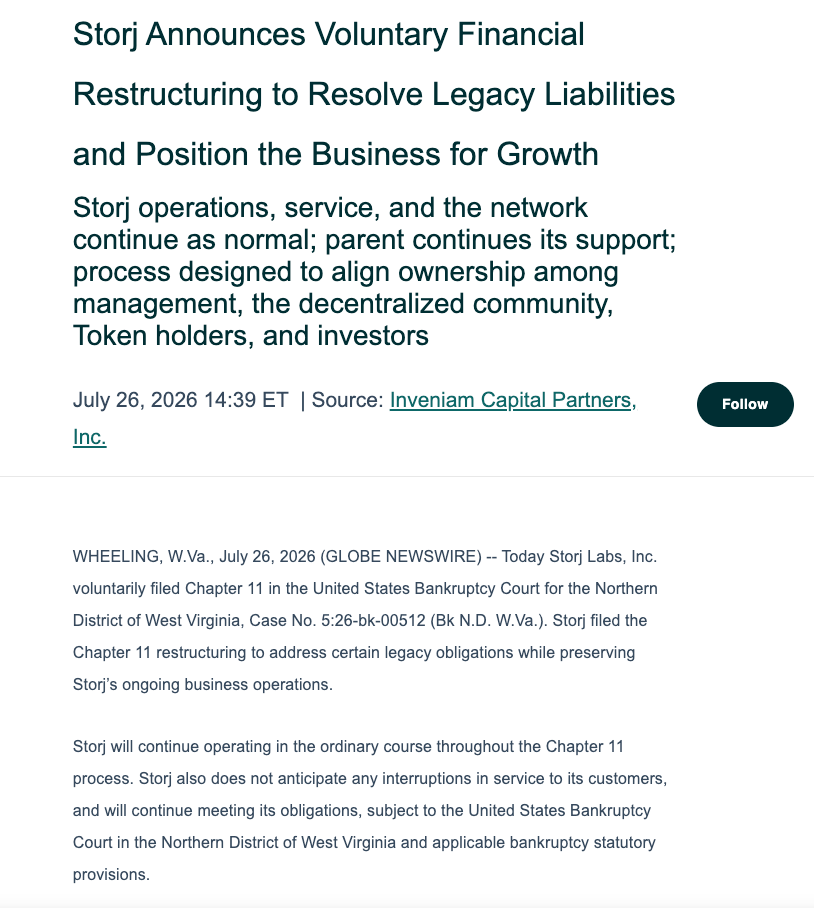
Storj stated that the network will continue to operate normally, token functionality will remain unaffected, and it plans to include in its reorganization plan a path for STORJ token holders to obtain equity in the restructured company. This proposed token-to-equity swap is unprecedented in the crypto industry, and its implementation hinges on whether there is residual value after creditors are repaid.
Bankruptcy Within a Year of Acquisition
Storj was founded in 2014 and is one of the earliest decentralized infrastructure projects in the crypto industry. Its core business is building a distributed cloud storage network via blockchain incentive mechanisms, encouraging global node operators to contribute idle hard drive space as an alternative to centralized storage services like Amazon S3. Users pay for storage and bandwidth with the STORJ token, and node operators are rewarded in STORJ.
In its early stages, the project received seed funding from Google Ventures, Qualcomm Ventures, and Techstars. It raised approximately $30 million through a token sale in 2017. In 2024, Storj achieved a 7x growth in Annual Recurring Revenue (ARR), reaching about $30 million, with a team size of 81 people. That same year, Storj also acquired GPU computing company Valdi, expanding its business from pure storage to compute power leasing.
In October 2025, Inveniam Capital Partners, focused on data assetization, acquired Storj through a reverse triangular merger. CEO Colby Winegar remained in his position, and Executive Chairman Ben Golub joined the Inveniam board. On the day the acquisition was announced, the STORJ token fell by 18%. Less than a year later, the merged entity entered bankruptcy proceedings.
In a public letter, Storj attributed the bankruptcy to historical debts, stating that the liabilities primarily stemmed from previous operations and acquisitions, predating the current business strategy, and were too large to be naturally absorbed through business growth. The company claimed its current operations are streamlined, but the burdens of the past can only be resolved through a court-supervised reorganization. The company also stated it would divest non-core businesses brought in by previous acquisitions during the restructuring to refocus on its core decentralized storage business.
The GPU computing company Valdi, acquired in July 2024, is the most likely asset to be divested. Valdi brought Storj a compute network of over 16,000 GPUs globally, originally the core of Storj's expansion into AI computing. However, from a bankruptcy restructuring perspective, this acquisition itself may be one of the sources of increased debt. Divesting Valdi means Storj will return to the pure storage track, abandoning its previous positioning as a full-stack distributed cloud platform.
Token-to-Equity Swap: Promise or Empty Promise?
The most notable proposal in the official public letter is providing a path for token holders to company equity. Storj management indicated plans to propose a mechanism in the reorganization plan allowing token holders to participate in the equity distribution of the restructured company, realigning company ownership among management, the decentralized community, token holders, and investors.
Kaloyan Raev, Director of Software Engineering at Storj, was quite measured in his wording in the public letter, stating the company would give users a seat and sincere intent, not a guaranteed outcome. The company has not yet disclosed eligibility criteria (whether a token snapshot or lock-up is required), the proportion of equity available for distribution, or the specific participation mechanisms. All terms need to be formulated during the reorganization process and approved by the court.
The core obstacle to this proposal lies in the priority rules of bankruptcy law. In Chapter 11 reorganization, creditor repayment takes precedence over equity holders. Token holders are legally closest to the position of equity holders, at the very end of the repayment sequence. Only after creditors are fully or proportionally repaid can residual value potentially flow to token holders.
There is no bankruptcy precedent in the crypto industry for a token-to-equity swap. In the WTT lawsuit involving crypto miner Giga Watt's bankruptcy after raising about $22 million via an ICO, the court ruled that utility token holders did not qualify as members of the company. This means token holders cannot automatically gain equity status; separate rights must be created through the reorganization plan. The FTX bankruptcy case set precedents in crypto asset valuation but dealt with creditor claims, which is entirely different from the token-to-equity path proposed by Storj.
Another noteworthy variable is the concentration of token holdings. The total STORJ supply is 425 million tokens, with approximately 30% (about 130 million) still held by Storj Labs. If the company's own token holdings also participate in the equity conversion, there is a potential conflict of interest between management and external token holders.
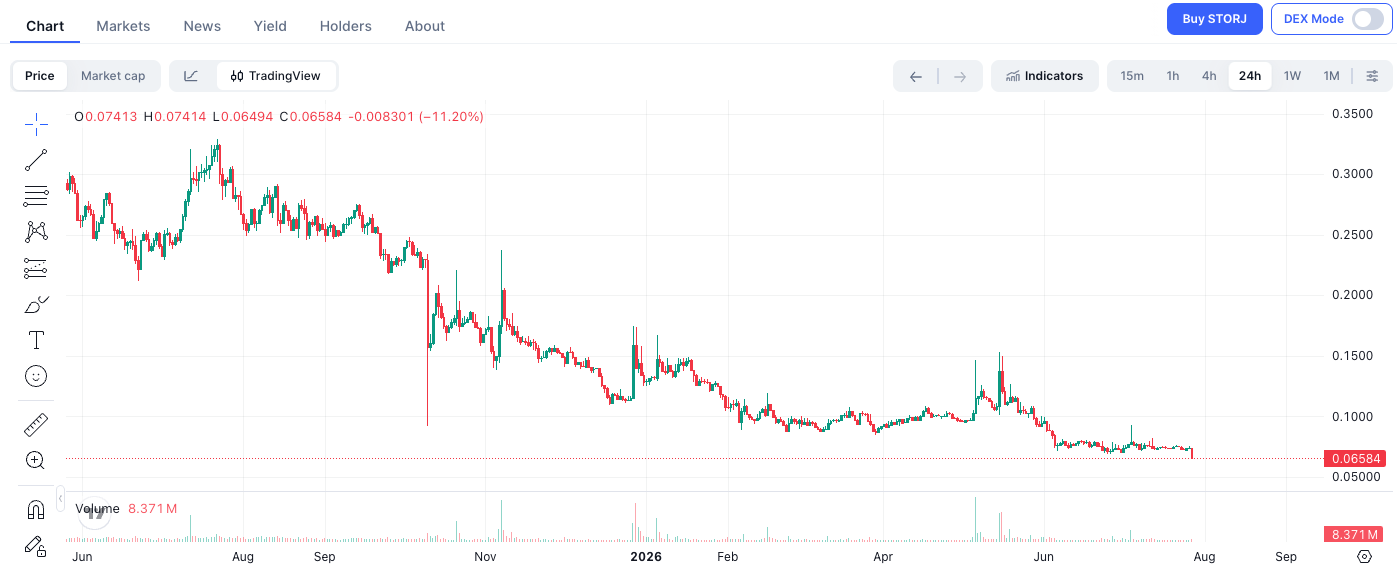
The STORJ token is currently priced around $0.06584, with a total market capitalization of approximately $27.97 million. The price fell 11.2% in the 24 hours following the news announcement.
A Marginal Player in the Decentralized Storage Race
Storj's scale in the decentralized storage sector is far smaller than its top competitors. Filecoin's current market capitalization is approximately $607 million, nearly 20 times that of STORJ, with a network capacity exceeding 1.8 EiB. In early 2026, Filecoin officially launched its Onchain Cloud roadmap, supporting automated data repair, perpetual renewals, and liquid staking of storage power via the Filecoin Virtual Machine (FVM), positioning itself as a decentralized alternative to AWS. Arweave follows another path, capturing the market for NFT metadata and blockchain historical state storage with its one-time payment for permanent storage model.
In comparison, Storj's advantage lies in retrieval speed. Storj uses Erasure Coding to split files into over 80 fragments distributed across global nodes, requiring only 29 fragments to reconstruct a file, achieving millisecond-level retrieval latency, performance close to that of centralized cloud providers. This gives Storj some competitiveness in hot data storage (video streaming, application data), but its market share is far behind Filecoin's.
During bankruptcy restructuring, whether node operators and enterprise clients will migrate to Filecoin or Arweave due to uncertainty is a real risk for the Storj network. For STORJ token holders, the key variables to monitor include: the specific terms of the token-to-equity swap in the reorganization plan and court approval progress, how the company's 30% token holdings will be handled, and whether the post-Valdi-divestiture business can support valuation.