Claude Doesn't Submit Code Directly After Writing It: Runs 4 Skills for Self-Check, Fixes Issues, Then Comes Back to You

marsbitPubblicato 2026-07-27Pubblicato ultima volta 2026-07-27

Introduzione

Claude No Longer Submits Code Directly: 4 Self-Check Skills to Run Before Coming Back to You AI already writes code, but the burden of reviewing it still falls on you. To address this, Anthropic has built a "verification loop" into Claude Code. After writing code, Claude now runs four self-check skills before delivering the work: * `/code-review`: Finds potential bugs and provides review feedback. * `/simplify`: Cleans up the diff, removing redundant or over-complex implementations to reduce future maintenance costs. * `/verify`: Performs end-to-end validation, actually running the application to confirm the feature works, not just appears to. * `/design`: Used only for UI changes; cross-references the implementation against the project's DESIGN.md file. This loop extends the AI agent's workflow from "gather context → execute" to "gather context → execute → auto-verify → fix → re-verify." It tackles the new bottleneck in AI-assisted development: the speed of verifying code now outpaces human review. These skills are built on Claude Code's existing verification foundation (like running apps and using linters). Teams can create their own custom verification skills by documenting their repetitive manual checks in plain language as Markdown files. Verification can be triggered at four levels: manually (Standalone), embedded in a task, chained with other skills, or automatically on every PR (On every PR). The shift signifies that competition in AI programming is movin...

AI has taken over the task of writing code. But the job of acceptance still falls on you.

Whether a piece of code is written correctly or not is not AI's responsibility; ultimately, you still have to go through it line by line. This hurdle has stumped many people.

Recently, Anthropic has also integrated AI acceptance into the loop.

They made Claude, after writing code, not immediately hand it over. Instead, it runs four checks itself first:

/code-review to root out bugs, /simplify to clean up redundant implementations, /verify to perform end-to-end verification, and if the UI was touched this time, use /design to cross-check against the visual specifications in DESIGN.md.

Only after running through all four does it count as delivered.

On July 22nd, the Claude Code team publicly shared this internal "verification loop."

In other words, after Claude writes code, it first finds and fixes errors on its own before coming back to you.

This signifies AI evolving from "being able to write code" to "being able to check the code it wrote."

Agent Work Loop Gains an Extra Verification Step

Anthropic gave this system a name: the verification loop.

The official definition is simple: it's an iterative process where Claude checks and attempts to fix its own work.

What it changes is the agent's work cycle.

Previously, it was "gather context → execute action → manual check." The final step rested on humans: the AI hands over the work, and you have to review it line by line.

Now this line is extended to "gather context → execute action → automatic verification → fix → verify again." Checking and fixing are placed back inside the loop.
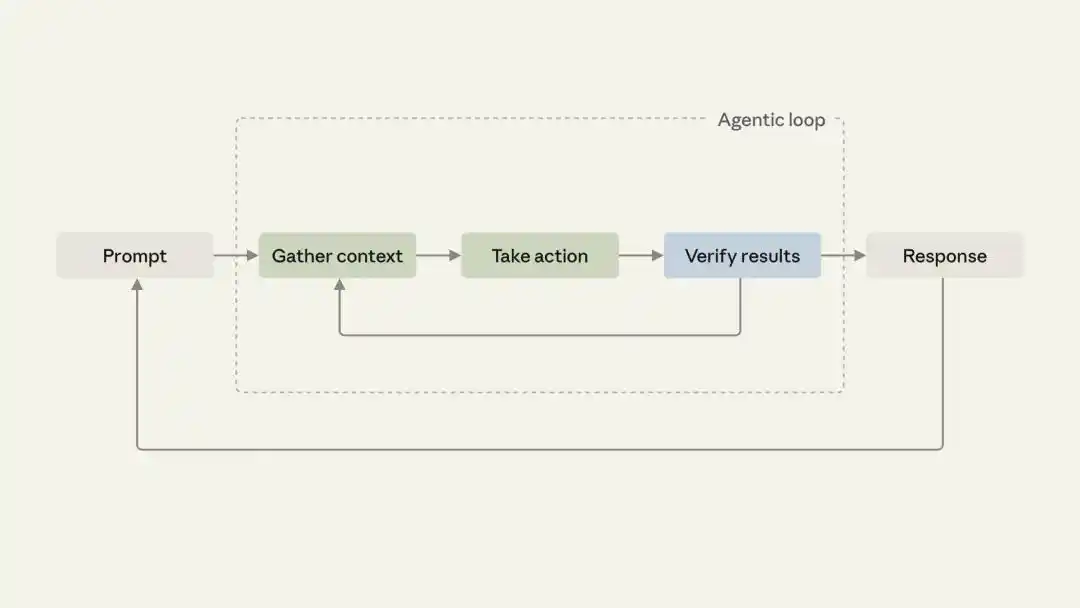
Anthropic's official agent cycle diagram: after a prompt comes in, Claude gathers context, executes actions, verifies results. If verification fails, it loops back; only when it passes does it return.

Some checks Claude already knows how to do. Deterministic signals in the codebase, like type checker, linter, running tests, runtime errors—it can read these and will fix them as it goes.

The real trouble lies with another category: whether the UI changes are correct, whether the user flow is smooth, whether this change has buried unseen pitfalls...

In the past, these could only be caught by humans watching, performing the same checks dozens or hundreds of times.

Anthropic's solution is to write down each of those manual checks you perform every time, package them into Skills, and have Claude execute them automatically for each task.

For decades, all software engineering processes—writing requirements, planning, layer upon layer of reviews, endless meetings—were essentially because: writing code was too slow, and engineers' time was too valuable.

But when AI makes the act of writing code faster and cheaper, this premise disappears.

The Claude Code team's own assessment is: the bottleneck hasn't vanished; it has merely shifted: from "writing code" to verification, code review, security, and other such stages.

Code is generated too quickly. The new problem becomes: are these codes correct, who will maintain them, can people keep up with the pace of reviewing code.

Faced with this new bottleneck, the Claude Code team first experimented on themselves.

The 4 Self-Check Skills the Claude Code Team Uses Daily

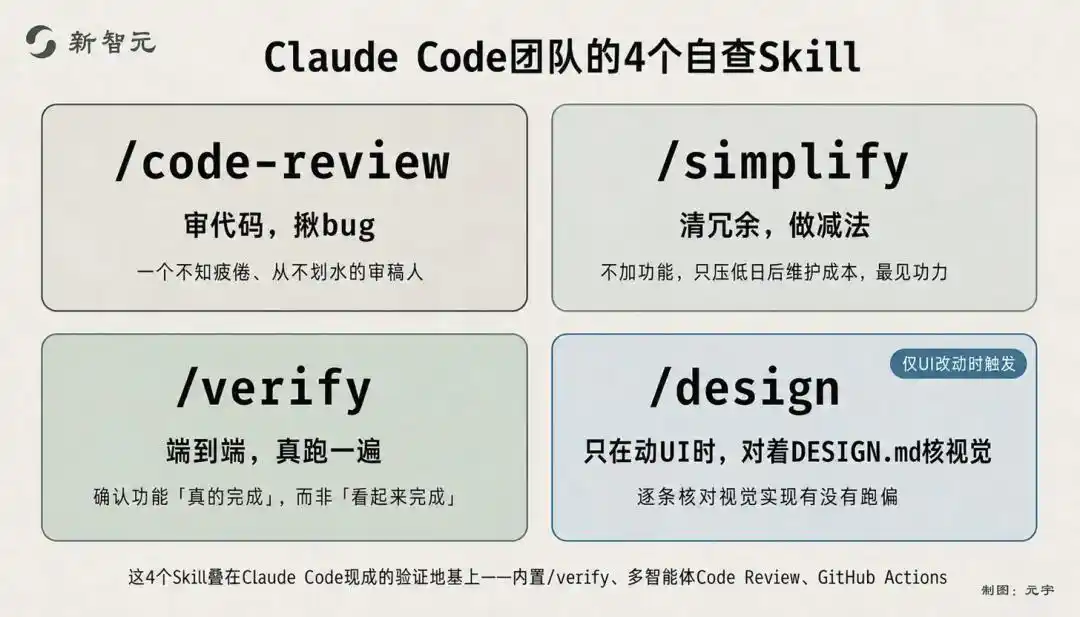
Internally, the Claude Code team uses these four self-check Skills every day.

/code-review, specialized in reviewing code changes, rooting out potential bugs, and providing review comments along the way.

This is like having a tireless reviewer on standby.

/simplify, cleans up the diff for this change, removing convoluted, complex implementations to make the structure simpler.

It doesn't add features for you; instead, it removes redundancy, simplifies implementation, pushing down future maintenance costs.

This point is crucial and requires real skill. Most people write code by adding more; tools that proactively simplify are particularly valuable.

/verify, performs end-to-end verification, actually running things to confirm the feature is truly complete, not just "looks complete."

/design, only comes into play when the UI is touched. It cross-checks against the DESIGN.md in the repository, verifying point by point if your visual implementation has deviated.

These 4 Skills didn't appear out of thin air.

Underlying them, Claude Code has already laid a foundation of existing verification support:

The built-in /verify can run the application to observe changes; you specify the build and test commands in CLAUDE.md, and it follows them. There's also Code Review specifically for multi-agent reviews on PRs, and GitHub Actions that automatically trigger on every commit.

The team's 4 Skills are like adding their own layer of process on top of this general foundation.
How to Write Your Own Verification Skill?

Anthropic's method is also simple:

Write down that manual step you always perform in plain language, as if you were explaining precautions to a new colleague on their first day.

If you're even stuck on how to describe this check step, you can first ask Claude to provide a version of general best practices and then modify it.

Your version will likely differ from the generic approach at a few key points, and those differences are precisely the things most worth documenting.

Checks don't necessarily have to be vague judgments like "feels right or not."

For example: any change that deletes a database field without an accompanying data migration step should be rejected. This is a "local rule" that a generic linter will never catch but is specific to your project.

Any rule you've only been able to enforce by manually watching like a hawk is worth writing into a loop.

What to do after writing it?

Throw it to skill-creator to have it interview you back, or simply drop a Markdown file into .claude/skills/.

The simplest verification Skill is a few lines of instructions plus a body paragraph. Then test it once on a new task to confirm this check step actually runs. If not, fix it.

For Skills you can't modify, like built-in ones or those hosted by plugins, there's a workaround: write a wrapper Skill that first calls the original, then calls your verification. A detour, but it still embeds the check.

Verification Isn't One-Size-Fits-All; It Has 4 Levels

After packaging checks into Skills, the next question is: when should this thing trigger?

Anthropic provides 4 levels of automation, from loose to tight.

Standalone: You remember to manually invoke it.

Embedded: Embedded into a specific task flow, running alongside it.

Chained: Several verification Skills strung into a chain, automatically running one after another.

On every PR: The strictest level, automatically running on every code commit.

The official term for the middle layer transition is "from habit to contract."

What was "I always remember to run /verify after /simplify" as a personal habit becomes "automatically call /verify after /simplify runs" as a fixed contract once chained.

The entire chain completes the development loop on its own, only coming back to you when your approval is needed.

The longer the chain, the higher the reliability, but the official team specifically cautioned: chained verification will genuinely burn through tokens.

So don't immediately set all checks as PR gates that block every commit. The right approach is to first see if it's stable, then gradually add more.

Behind the 4 Skills: AI Programming is Changing Tracks

Behind the 4 Skills, the competition in AI programming is shifting from generation to verification.

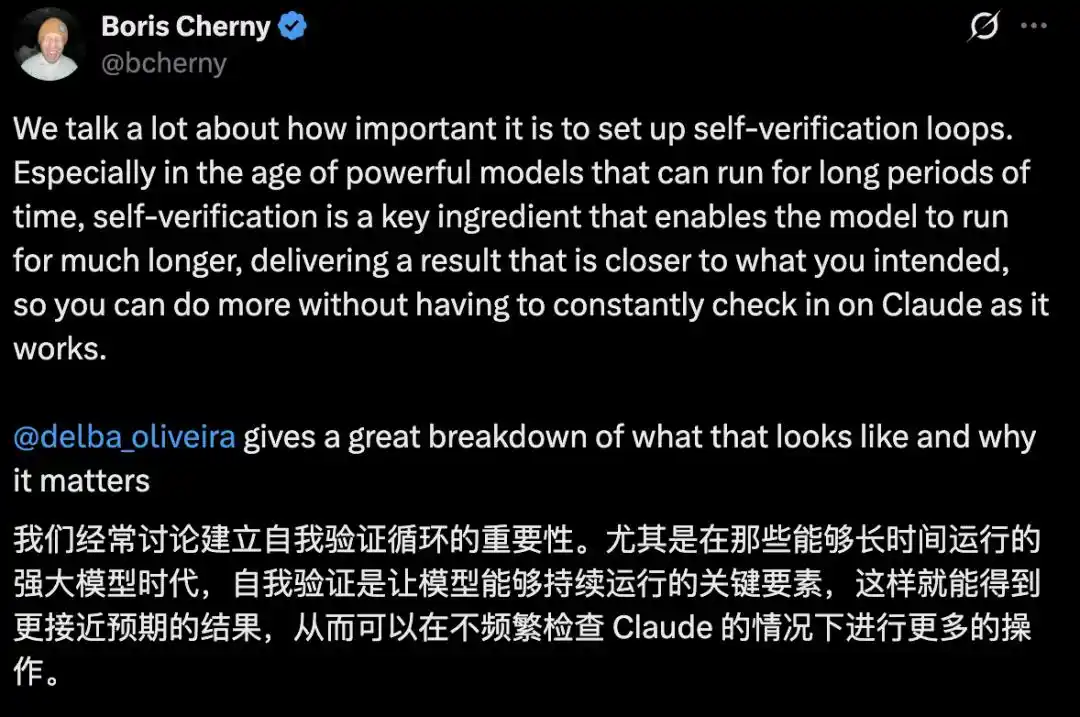
The creator of Claude Code has given the same assessment.

On June 9th of this year, he tweeted: In an era where powerful models can run autonomously for long periods, self-verification is key to letting models run longer and produce results closer to your expectations. You don't have to watch Claude frequently to hand over more work.

Simply put, the more solid the verification, the more confidently an agent can run; the longer it runs, the less hassle for humans.
In the past, we relied on prompts, but they have a ceiling too: they only solve the task at hand; next time you start from scratch.

Let's first correct a common misunderstanding: A Skill is not a piece of Markdown prompt.

It's a capability module containing instructions, file structure, scripts, tool calls, configuration, and an entire workflow. It's about solidifying a team's check steps, design norms, and lessons learned into a package readily available for Claude to reference when needed.

More crucially, Skills are evolving from a feature of Claude Code into an open standard across vendors.

According to industry analysis, GitHub Copilot, Cursor, OpenAI Codex, and Gemini CLI have already adopted the same format.

This means the Skills you solidify for your team won't be locked into one specific tool. They will encapsulate your team's experience, norms, and check processes, turning into reusable capabilities.

This also highlights a stark reality: the same Claude might yield efficiency differences of several times between different teams. This gap isn't due to the model but rather the workflow:

Have you written checks into Skills? Have you set up verification loops? Have you enabled the agent to run its own feedback loop to completion?

Ultimately, an agent's capability is an addition problem: model, plus tools, plus verification mechanisms, plus workflow.

The model aspect is becoming more similar across vendors. What truly creates distance are the latter three items, all of which are in the user's hands.

Of course, what this blog post demonstrates is the process optimization of AI-assisted development, not "AI can already write software independently." It still requires engineers and cannot handle production-grade delivery without humans.

Therefore, it's not about agents coming to take human engineers' jobs, but the direction is already clear.

In the past, we've been teaching AI how to write code. Now we need to start teaching it to verify if what it wrote is correct.

For someone who uses AI to write code every day, the day when "having to manually review everything before leaving work" can finally be entrusted to AI with peace of mind is the day it truly starts carrying the load for you.

References:

https://claude.com/blog/building-verification-loops-in-claude-code-with-skills

https://claude.com/blog/getting-started-with-loops?utm_source=chatgpt.com

This article is from the WeChat public account "New Zhiyuan", author: ASI Revelation

Crypto di tendenza

Domande pertinenti

QWhat is the core innovation described in the article regarding Claude's code generation?

AThe core innovation is the introduction of a 'verification loop' where Claude, after writing code, automatically runs it through four specialized Skill checks (code-review, simplify, verify, design) to find and fix errors before delivering the final code to the user.

QWhat are the four primary verification Skills used by the Claude Code team internally?

AThe four primary Skills are: /code-review (to catch potential bugs and provide review comments), /simplify (to clean up and streamline the implementation), /verify (to perform end-to-end functional verification), and /design (to ensure UI changes align with a project's DESIGN.md file).

QWhat is the key difference between a traditional AI coding workflow and the new 'verification loop' workflow?

AThe traditional workflow is: 'collect context -> execute action -> human review'. The new 'verification loop' workflow extends this to: 'collect context -> execute action -> automatic verification -> repair -> re-verify', embedding the review and repair steps back into an automated loop before returning to the user.

QAccording to the article, what is the main 'bottleneck' that has shifted as AI code generation becomes faster?

AThe main bottleneck has shifted from 'writing code' to the verification, code review, and security aspects. The article states that the new problem is ensuring the rapidly generated code is correct, maintainable, and can be reviewed at the required pace.

QHow does the article describe the nature and importance of 'Skills' compared to simple prompts?

AA Skill is described not as a simple prompt, but as a modular capability package. It contains instructions, file structures, scripts, tool calls, configurations, and workflows. It is a way to encapsulate a team's review steps, design standards, and learned lessons into a reusable asset that Claude can access autonomously.

Letture associate

Goldman Sachs: July Smashes Through Crowded Trades, U.S. Stock Bull Market Not Broken but Harder to Navigate

Goldman Sachs: July Sees Crowded Trades Unwound, U.S. Bull Market Intact but Getting Tougher. The U.S. stock market in July did not see an index-level crash, but rather a significant unwinding of speculative positions. While the S&P 500 remained stable—trading within a narrow 3.5% range and staying within 2% of its high—underlying market dynamics were volatile. Heavily crowded trades, particularly in high-momentum tech, AI-linked stocks, and Asian strategies, faced severe pressure and forced deleveraging. Data indicates this was a meaningful cleanse, not a minor adjustment. Global tech exposure saw its largest sell-off in over five years, leverage in Korean equity ETFs plummeted, and Goldman's prime brokerage recorded the largest gross exposure reduction since late 2022. Leverage on momentum factors among fundamental long/short clients fell to the 28th percentile of its one-year range. The AI trade narrative shifted from pure potential to a focus on tangible returns. While Meta failed to show clear AI monetization, Microsoft and Amazon provided evidence that massive capital expenditure is translating into scalable revenue and product growth, preventing a blanket sell-off of the AI sector. The Federal Reserve's more opaque communication style and volatility in long-end Treasury yields have introduced new friction, particularly for rate-sensitive growth and tech stocks. The broader outlook for U.S. equities remains favorable, supported by a strong economy, robust earnings, and substantial AI capital expenditure. However, risk/reward is no longer cheap, and the market's upward elasticity has weakened. The Nasdaq 100's trajectory—up 12% year-to-date despite significant pullbacks—illustrates that the bull trend persists but the path is becoming more difficult. The key lesson from July is that the market no longer rewards crowded, highly leveraged trades, requiring more disciplined and liquid portfolio approaches.

marsbit20 min fa

Goldman Sachs: July Smashes Through Crowded Trades, U.S. Stock Bull Market Not Broken but Harder to Navigate

marsbit20 min fa

Interview with Robinhood Executive: Meme + Tokenized US Stocks as "Barbell" Customer Acquisition Strategy, All Business Lines Achieve Hundreds of Millions in Revenue

Interview with Robinhood executive Johann Kerbrat reveals the company's "barbell" customer acquisition strategy for its new Robinhood Chain, combining meme tokens with tokenized stocks. Three weeks after mainnet launch, the chain has seen over $3B in weekly DEX volume and 105M transactions. Kerbrat explains the logic behind the permissionless chain: meme tokens attract DeFi users, while tokenized real-world assets (RWA), currently over 90 US stocks and ETFs accessible in 120+ countries, serve global users. The goal is to bring Robinhood's 27 million funded accounts on-chain by simplifying DeFi with a user-friendly interface, exemplified by features like Robinhood Earn which offers yield without requiring wallet management. Built on Arbitrum's technology stack for its speed, low cost, and Ethereum's security, the chain focuses on financial products like Earn, spot trading, and perpetuals. Kerbrat downplays direct competition with platforms like Base, emphasizing the goal of expanding the overall market for on-chain assets. He details selective partnerships (e.g., Morpho, Lighter) based on compliance, unique UX, and differentiation. While regulatory clarity is pending for US perpetuals, the expansion continues via Bitstamp in Europe. Finally, Kerbrat positions Robinhood as a "super app" integrating stocks, options, crypto, banking, and AI trading, with all major business lines generating hundreds of millions in revenue. For the chain, current priority is driving adoption over maximizing gas fee revenue.

marsbit2 h fa

Interview with Robinhood Executive: Meme + Tokenized US Stocks as "Barbell" Customer Acquisition Strategy, All Business Lines Achieve Hundreds of Millions in Revenue

marsbit2 h fa

Fidelity Q3 Report: BTC, ETH, and SOL Continue to Build Bottoms; How Much Further Will This Crypto Bear Market Go?

Fidelity's Q3 Crypto Signal Report analyzes the current bear market, noting Bitcoin (BTC), Ethereum (ETH), and Solana (SOL) are in a prolonged bottoming phase. Key indicators like the weighted Net Unrealized Profit/Loss (NUPL) have turned negative (-0.01), signaling the market is slightly below its aggregate cost basis, with BTC acting as the primary stabilizing asset. BTC's dominance has risen to 68%, indicating a lack of capital rotation to other digital assets. Performance has been weak across the board, with BTC, ETH, and SOL down significantly year-to-date. Market sentiment is depressed, exacerbated by substantial outflows from spot ETPs and a challenging macro environment. The report compares the current ~203-day downtrend to historical ~300-day bottoming cycles, suggesting the process may be two-thirds complete, with late 2026 as a potential timeframe to monitor. For Bitcoin, NUPL at 0.09 indicates cautious sentiment, while momentum signals remain negative. The Yardstick metric points to potential undervaluation relative to network security (hashrate). Ethereum's NUPL is deep in the "capitulation" zone at -0.43, a historically positive signal for future returns, though its momentum and network fee revenue are negative. Solana shows the deepest NUPL at -0.72 but demonstrates relative resilience in on-chain activity and stablecoin transfer volume. The report concludes that while several metrics are near historical capitulation levels, a definitive market bottom has not yet been established. The path forward likely involves continued consolidation, with BTC's relative strength and fundamental on-chain usage for ETH and SOL providing key areas for investor observation.

marsbit2 h fa

Fidelity Q3 Report: BTC, ETH, and SOL Continue to Build Bottoms; How Much Further Will This Crypto Bear Market Go?

marsbit2 h fa

Trading

Spot

Articoli Popolari

Come comprare 4

Benvenuto in HTX.com! Abbiamo reso l'acquisto di 4 (4) semplice e conveniente. Segui la nostra guida passo passo per intraprendere il tuo viaggio nel mondo delle criptovalute.Step 1: Crea il tuo Account HTXUsa la tua email o numero di telefono per registrarti il tuo account gratuito su HTX. Vivi un'esperienza facile e sblocca tutte le funzionalità,Crea il mio accountStep 2: Vai in Acquista crypto e seleziona il tuo metodo di pagamentoCarta di credito/debito: utilizza la tua Visa o Mastercard per acquistare immediatamente 44.Bilancio: Usa i fondi dal bilancio del tuo account HTX per fare trading senza problemi.Terze parti: abbiamo aggiunto metodi di pagamento molto utilizzati come Google Pay e Apple Pay per maggiore comodità.P2P: Fai trading direttamente con altri utenti HTX.Over-the-Counter (OTC): Offriamo servizi su misura e tassi di cambio competitivi per i trader.Step 3: Conserva 4 (4)Dopo aver acquistato 4 (4), conserva nel tuo account HTX. In alternativa, puoi inviare tramite trasferimento blockchain o scambiare per altre criptovalute.Step 4: Scambia 4 (4)Scambia facilmente 4 (4) nel mercato spot di HTX. Accedi al tuo account, seleziona la tua coppia di trading, esegui le tue operazioni e monitora in tempo reale. Offriamo un'esperienza user-friendly sia per chi ha appena iniziato che per i trader più esperti.

431 Totale visualizzazioniPubblicato il 2025.10.20Aggiornato il 2026.06.02

Come comprare 4

Discussioni

Benvenuto nella Community HTX. Qui puoi rimanere informato sugli ultimi sviluppi della piattaforma e accedere ad approfondimenti esperti sul mercato. Le opinioni degli utenti sul prezzo di 4 4 sono presentate come di seguito.

活动图片