SHIB burns soar 350% as whales accumulate: Is a breakout next?

ambcryptoPubblicato 2026-07-20Pubblicato ultima volta 2026-07-20

Introduzione

Shiba Inu's daily token burn rate surged over 350%, removing 12.47 million SHIB, while weekly burns increased by 32.63%. This reinforces its long-term deflationary narrative, though price action remains muted. Exchange outflows of approximately $175,000 indicate reduced immediate selling pressure as tokens move to private wallets. Concurrently, whale activity has increased, with large investors accumulating SHIB despite the subdued market. Technically, SHIB is holding key support near $0.00000409 within a descending channel. The MACD shows improving conditions, but a confirmed bullish crossover is pending. For a sustained recovery, SHIB needs to break above resistance levels at $0.00000450 and then $0.00000500. The combination of aggressive burning, accumulation by large holders, and improving technicals creates a more constructive setup, though a decisive price breakout is still required to confirm a trend reversal.

Shiba Inu [SHIB] strengthened its long-term deflationary narrative after its burn rate climbed sharply over the past day.

Shibburn data showed that 12.47 million SHIB left circulation during the previous 24 hours, representing a 350.29% increase in daily burns.

The network also removed 481,463 SHIB during the last hour, while the seven-day burn total reached 44.23 million SHIB, reflecting a 32.63% weekly increase.

Those figures highlighted sustained efforts to reduce the token’s circulating supply despite relatively muted price action.

However, the shrinking supply alone did not immediately translate into stronger price appreciation.

Instead, the burn activity reinforced SHIB’s longer-term scarcity narrative, leaving traders focused on whether demand would strengthen enough to capitalize on the declining token supply.

Exchange outflows eased immediate selling pressure

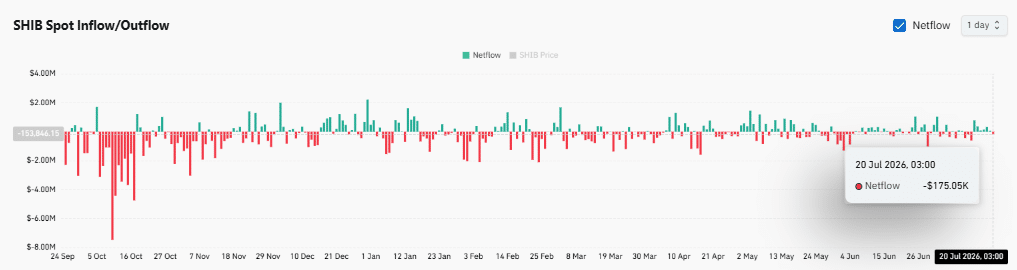
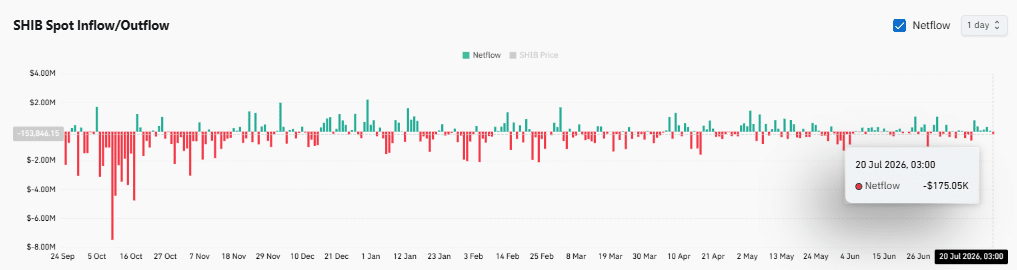
Spot flow data revealed that capital continued leaving exchanges instead of moving onto them.

SHIB recorded a negative spot netflow of approximately $175,050, indicating that more tokens exited exchanges than entered during the latest session.

Negative netflows typically indicate reduced immediate selling pressure, as investors move tokens off exchanges rather than preparing them for sale.

Even so, the relatively modest size of the outflow suggested that conviction remained measured instead of aggressive.

Market participants continued reducing available exchange liquidity without triggering a broad buying wave.

As a result, the outflow data complemented the improving burn statistics and suggested that holders preferred accumulation over distribution.

However, stronger demand would still need to emerge before SHIB could sustain a larger recovery.
Source: CoinGlass

Whale activity quietly returned to the market

Large investors became increasingly active across SHIB’s spot market despite the subdued price environment.

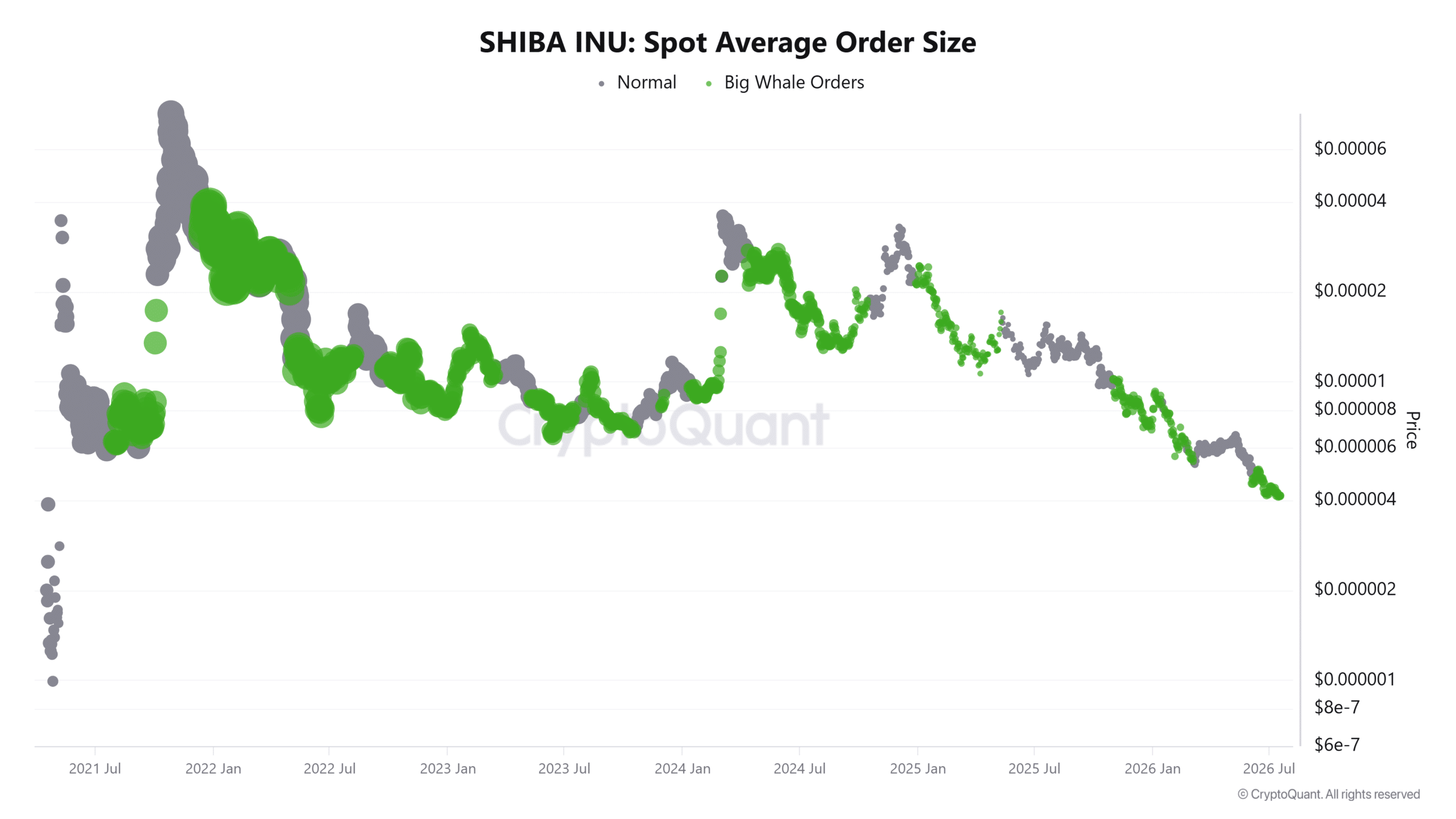
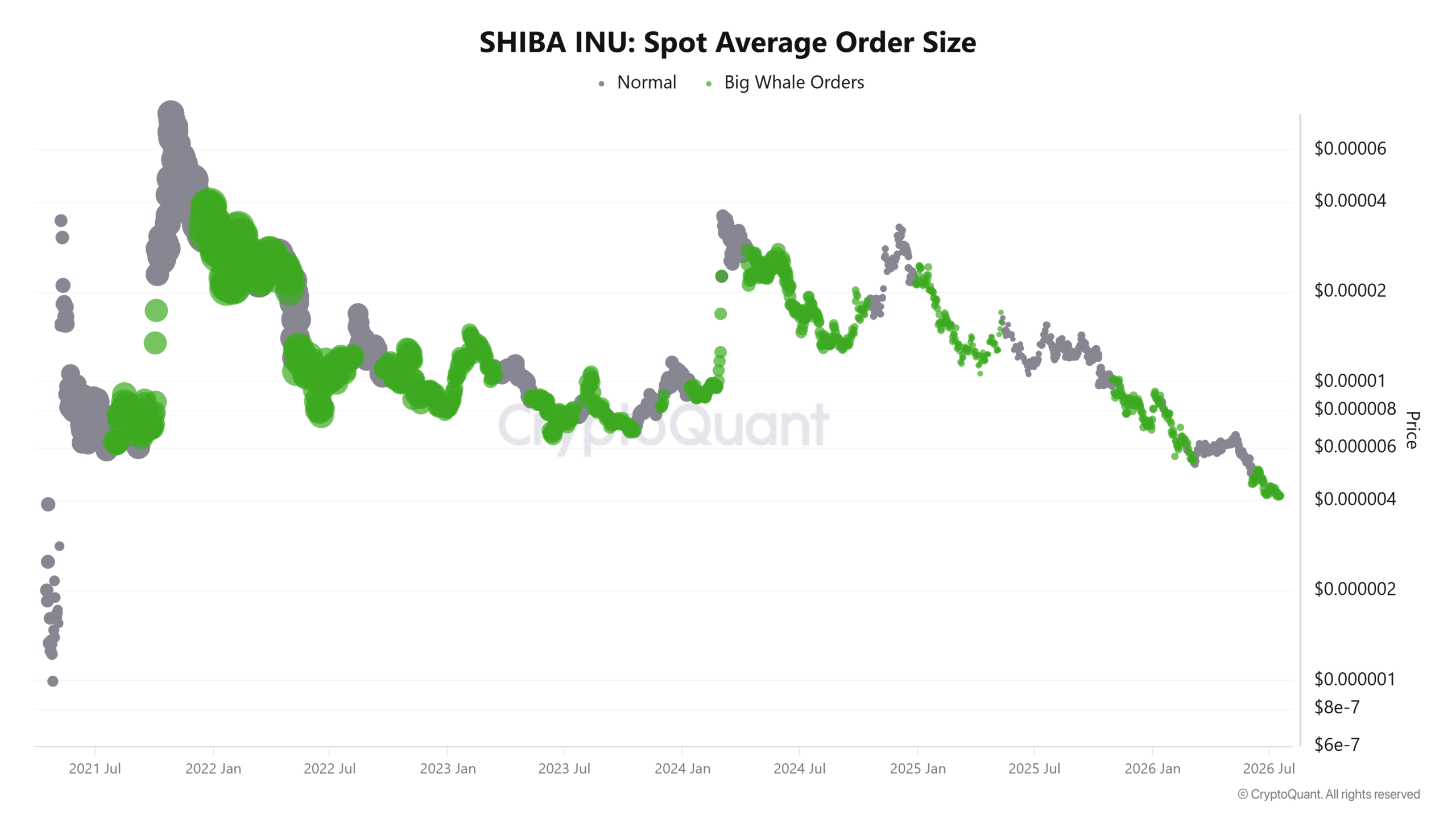
The Spot Average Order Size indicator continued flashing “Big Whale Orders,” showing that larger transactions accounted for a greater share of executed trades.

That pattern often reflected institutional or high-net-worth participation rather than retail-driven activity.

Even though the market lacked a decisive breakout, whales continued absorbing liquidity while exchange balances gradually declined.

This combination may indicate that larger participants are positioning for a longer-term move despite near-term uncertainty.

Retail participation remained relatively restrained, yet growing whale-sized orders hinted that sophisticated investors had started positioning ahead of a potential directional move instead of waiting for confirmation after a breakout.
Source: CryptoQuant

SHIB held key support as MACD improved

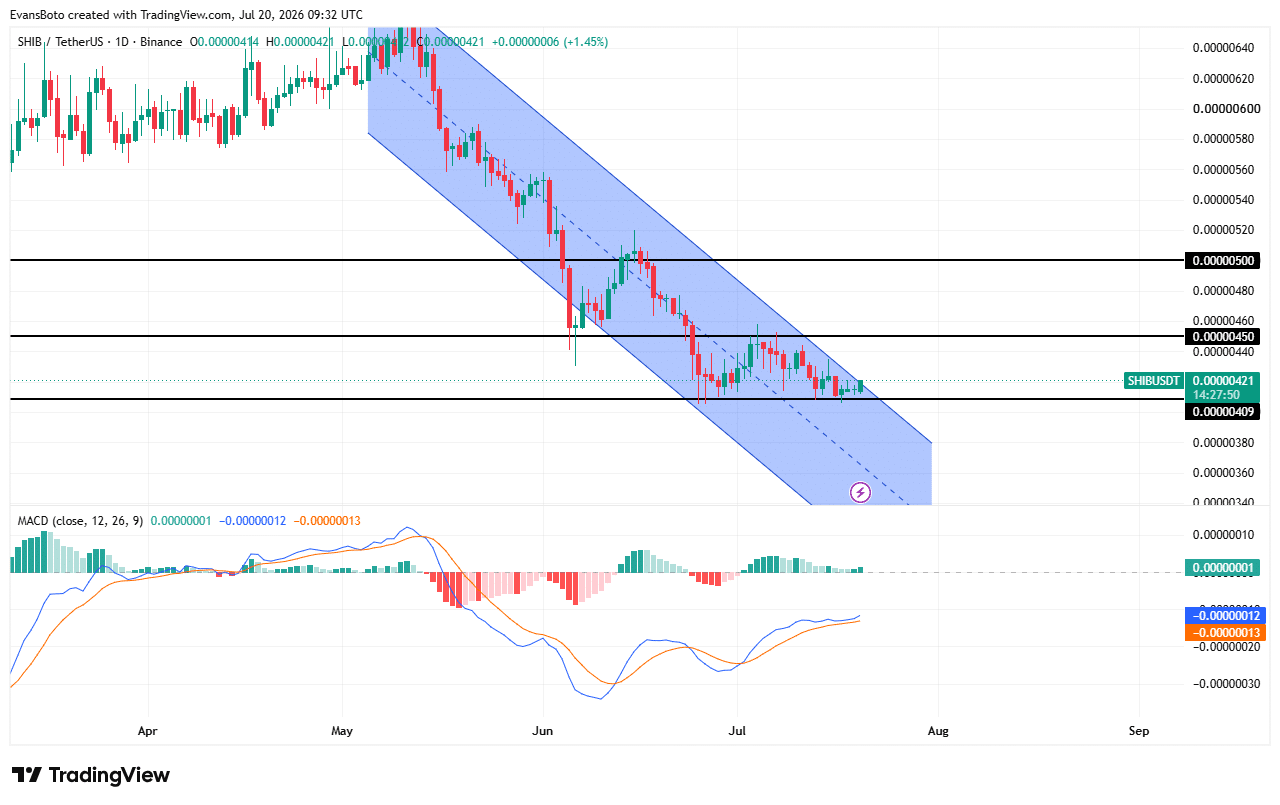
SHIB continued trading inside a descending channel after several weeks of lower highs and lower lows.

However, the price defended the $0.00000409 support area while attempting to stabilize above it, preventing another breakdown toward the channel’s lower boundary.

Immediate resistance remained near $0.00000450, while a stronger barrier stood around $0.00000500, both aligning with previous rejection zones.

The MACD reflected improving market conditions because the blue MACD line climbed above the signal line while the histogram shifted closer to the neutral level.

Although a confirmed bullish crossover had not yet appeared, selling pressure had continued fading throughout July.

If buyers maintain control above current support and the MACD completed a bullish crossover, SHIB could challenge $0.00000450 first.

A successful breakout above that level would likely expose $0.00000500. However, losing $0.00000409 could invite another decline within the descending channel.
Source: TradingView

Shiba Inu combined stronger burn activity, continued exchange outflows, and increasing whale participation into a more constructive market structure.

Together, these on-chain metrics point to improving market conditions, although SHIB still needs a confirmed breakout to validate a broader trend reversal.

If buyers sustain current support and technical conditions continue improving, SHIB could attempt a move toward $0.00000450 before targeting $0.00000500.


Final Summary

  • SHIB’s daily burn rate jumped more than 350% as exchange outflows continued to ease near-term selling pressure.
  • Growing whale-sized orders and improving momentum indicators point to strengthening sentiment, but a breakout above resistance is still needed.


Crypto di tendenza

Domande pertinenti

QWhat was the percentage increase in SHIB's daily burn rate, and how many tokens were burned?

ASHIB's daily burn rate increased by 350.29%, with 12.47 million tokens burned in the previous 24 hours.

QWhat does a negative spot netflow for SHIB typically indicate about market pressure?

AA negative spot netflow typically indicates reduced immediate selling pressure, as it shows more tokens are being moved off exchanges rather than onto them for potential sale.

QWhat does the presence of 'Big Whale Orders' in SHIB's spot market suggest about investor activity?

AThe presence of 'Big Whale Orders' suggests increased activity from institutional or high-net-worth investors, indicating they may be positioning for a longer-term move despite near-term price uncertainty.

QWhat are the key resistance levels that SHIB needs to break for a potential price recovery, according to the technical analysis?

AAccording to the technical analysis, the key immediate resistance level is near $0.00000450, with a stronger barrier around $0.00000500.

QWhat three on-chain metrics does the article say point to a more constructive market structure for SHIB?

AThe three on-chain metrics are stronger burn activity, continued exchange outflows, and increasing whale participation.

Letture associate

The Clarity Act's Journey Through Congress: The Thorny Path of Bipartisan Compromise in the U.S.

The U.S. Congress is struggling to advance the crypto market structure bill known as the Clarity Act, with bipartisan compromise proving difficult. Key hurdles include unresolved disputes over "yield" products and, more critically, the inclusion of strong ethics provisions for elected officials—a non-negotiable demand for many Democrats. While a compromise on yield was reached in May, securing only limited Democratic support in committee, the separate Senate Agriculture Committee version later passed with no Democratic votes due to the ethics impasse. As Republicans push for a full Senate vote in July, demands for ethics rules have expanded, and other contentious issues like developer protections and concerns from law enforcement and large banks further complicate negotiations. Despite consensus on the need for legislation, the path forward is unclear. Recent discussions between senators and White House officials aim to find acceptable ethics language. Some lawmakers question whether a compromise text can garner enough bipartisan support, with one Democrat stating the current proposal lacks the strong ethics provisions required for their vote. Potential short-term goals for the crypto community include symbolic Senate action before the August recess, a longer-term aim for passage by 2026, or establishing a detailed framework that addresses ethics and other compromises. The process remains arduous, relying on the traditional, vote-by-vote effort to build bipartisan support.

marsbit11 min fa

The Clarity Act's Journey Through Congress: The Thorny Path of Bipartisan Compromise in the U.S.

marsbit11 min fa

Are Kalshi and Polymarket Founders at Odds? This Business Rivalry Is More Brutal Than You Think

"The Rivalry Between Kalshi and Polymarket Founders Turns Bitter and Litigious" The intense feud between Tarek Mansour, CEO of Kalshi, and Shayne Coplan, founder of Polymarket, has escalated far beyond typical business competition into personal animosity and regulatory battles. Both lead billion-dollar prediction market platforms, but their approaches differ sharply. Kalshi positions itself as the compliant operator, securing U.S. regulatory approval before launching. In contrast, Polymarket initially operated offshore, allowing U.S. users to access its platform via VPN, which drew regulatory scrutiny. The conflict reached a peak in November 2024 when FBI agents raided Coplan's New York apartment. While Coplan publicly blamed political motives, his team privately suspected Kalshi was involved. According to sources, Kalshi's lawyers had previously reported Polymarket's operations to federal prosecutors, highlighting its accessibility to U.S. users despite a ban. This incident fueled mutual accusations and underhanded tactics, including social media smear campaigns and attempts to sabotage each other's major business deals. Their rivalry also played out in Washington, influencing regulatory debates. Kalshi actively lobbied against Polymarket's practices, framing them as illegal and unethical. Polymarket, after facing a CFTC fine and investigation, later acquired a licensed U.S. firm to launch a domestic app, regaining a foothold. Despite the hostility, both companies have seen massive growth, with combined trading volumes soaring. However, increased regulatory scrutiny, particularly around insider trading on Polymarket's platform, continues to pose challenges. The founders' deep-seated mutual disdain ensures their battle for market dominance remains as much a personal vendetta as a commercial one.

marsbit20 min fa

Are Kalshi and Polymarket Founders at Odds? This Business Rivalry Is More Brutal Than You Think

marsbit20 min fa

Bank of America Quietly Positions: Could $6 Trillion in Bank Deposits Flow into Stablecoins?

Bank of America (BofA) is making strategic moves in digital assets, appointing senior leaders to advance a platform covering stablecoins, tokenized deposits, custody, and crypto settlement. This comes amid a broader discussion about the potential migration of trillions in bank deposits to stablecoins. A cited TBAC report estimated up to $6.6 trillion in transactional deposits could be at risk of moving to stablecoins long-term, a point BofA's CEO previously conditioned on stablecoins being allowed to pay interest. The regulatory landscape is evolving, with the GENIUS Act setting a final implementation deadline for January 2027. Major banks, however, are not waiting; JPMorgan, Citi, BofA, and others are already developing tokenized deposit networks and services. Industry observers note that while retail crypto trading is sluggish, institutional adoption of stablecoins for real-world use cases is driving growth. Despite the activity, some analysts remain cautious, noting banks have a long history of blockchain announcements and that true structural change is slow. The stablecoin market itself has seen a recent dip from its peak. Optimistic projections, however, foresee significant growth, with stablecoin settlement volume already reaching $33 trillion in 2025. The race is on for the post-January 2027 landscape, where regulatory clarity is expected to accelerate the fusion of traditional finance and crypto.

marsbit25 min fa

Bank of America Quietly Positions: Could $6 Trillion in Bank Deposits Flow into Stablecoins?

marsbit25 min fa

Trading

Spot

Articoli Popolari

Come comprare SHIB

Benvenuto in HTX.com! Abbiamo reso l'acquisto di SHIBA INU (SHIB) semplice e conveniente. Segui la nostra guida passo passo per intraprendere il tuo viaggio nel mondo delle criptovalute.Step 1: Crea il tuo Account HTXUsa la tua email o numero di telefono per registrarti il tuo account gratuito su HTX. Vivi un'esperienza facile e sblocca tutte le funzionalità,Crea il mio accountStep 2: Vai in Acquista crypto e seleziona il tuo metodo di pagamentoCarta di credito/debito: utilizza la tua Visa o Mastercard per acquistare immediatamente SHIBA INUSHIB.Bilancio: Usa i fondi dal bilancio del tuo account HTX per fare trading senza problemi.Terze parti: abbiamo aggiunto metodi di pagamento molto utilizzati come Google Pay e Apple Pay per maggiore comodità.P2P: Fai trading direttamente con altri utenti HTX.Over-the-Counter (OTC): Offriamo servizi su misura e tassi di cambio competitivi per i trader.Step 3: Conserva SHIBA INU (SHIB)Dopo aver acquistato SHIBA INU (SHIB), conserva nel tuo account HTX. In alternativa, puoi inviare tramite trasferimento blockchain o scambiare per altre criptovalute.Step 4: Scambia SHIBA INU (SHIB)Scambia facilmente SHIBA INU (SHIB) nel mercato spot di HTX. Accedi al tuo account, seleziona la tua coppia di trading, esegui le tue operazioni e monitora in tempo reale. Offriamo un'esperienza user-friendly sia per chi ha appena iniziato che per i trader più esperti.

518 Totale visualizzazioniPubblicato il 2024.12.11Aggiornato il 2026.06.02

Come comprare SHIB

Discussioni

Benvenuto nella Community HTX. Qui puoi rimanere informato sugli ultimi sviluppi della piattaforma e accedere ad approfondimenti esperti sul mercato. Le opinioni degli utenti sul prezzo di SHIB SHIB sono presentate come di seguito.

活动图片