¡USDC recibe un gran impulso bancario de Standard Chartered – ¡Los detalles!

ambcryptoPubblicato 2026-07-03Pubblicato ultima volta 2026-07-03

Introduzione

Standard Chartered y Circle han anunciado una asociación para que los clientes institucionales puedan acuñar y canjear USD Coin (USDC), la segunda stablecoin más grande del mercado, directamente a través de la plataforma bancaria de Standard Chartered. Este servicio integrado, el primero ofrecido por un Banco de Importancia Sistémica Global, combina servicios bancarios tradicionales, custodia y activos digitales en una sola oferta. La implementación inicial se llevará a cabo en el Centro Financiero Internacional de Dubái (DIFC), con planes de expansión a otros mercados. El servicio también admitirá casos de uso relacionados con pagos en el futuro. Este movimiento se produce en un momento en que el mercado de stablecoins ha crecido significativamente, duplicando su oferta hasta aproximadamente 300.000 millones de dólares en los últimos 24 meses. Aunque USDT (Tether) sigue siendo líder, USDC mantiene una oferta estable de entre 70.000 y 80.000 millones de dólares. La asociación facilita el acceso institucional a una stablecoin ya consolidada y de gran escala a través de los canales bancarios tradicionales.

Standard Chartered y Circle están acercando USD Coin [USDC] a la banca tradicional. Esta nueva asociación ayudará a las instituciones a emitir y canjear USDC a través de canales liderados por bancos, comenzando en el DIFC de Dubái.

La emisión de USDC se traslada a la plataforma bancaria de Standard Chartered

Standard Chartered y Circle han creado un método para que los clientes institucionales emitan y canjeen USDC a través de un proceso liderado por un banco. Esto sería en lugar de configurar cuentas separadas directamente con Circle.

El gigante financiero ha declarado que es el primer Banco de Importancia Sistémica Global en ofrecer este tipo de servicio de USDC. Según su declaración, la empresa anunció:

PUBLICIDAD

Al integrar el acceso a USDC directamente dentro de la oferta institucional de Standard Chartered, Standard Chartered reunirá servicios bancarios, de custodia y de activos digitales en una oferta integrada...

El primer despliegue ocurrirá a través del Centro Financiero Internacional de Dubái, con planes de expansión a otros mercados. Se dice que el servicio también admitirá casos de uso relacionados con pagos más adelante.

Su escala lo hace aún más importante

Este desarrollo llega en un buen momento, especialmente porque las stablecoins ya no son un producto de nicho. De hecho, Artemis mostró que la oferta de stablecoins vinculadas al USD casi se ha duplicado en los últimos 24 meses. Pasamos de unos 160 mil millones de dólares a alrededor de 300 mil millones de dólares para julio de 2026.
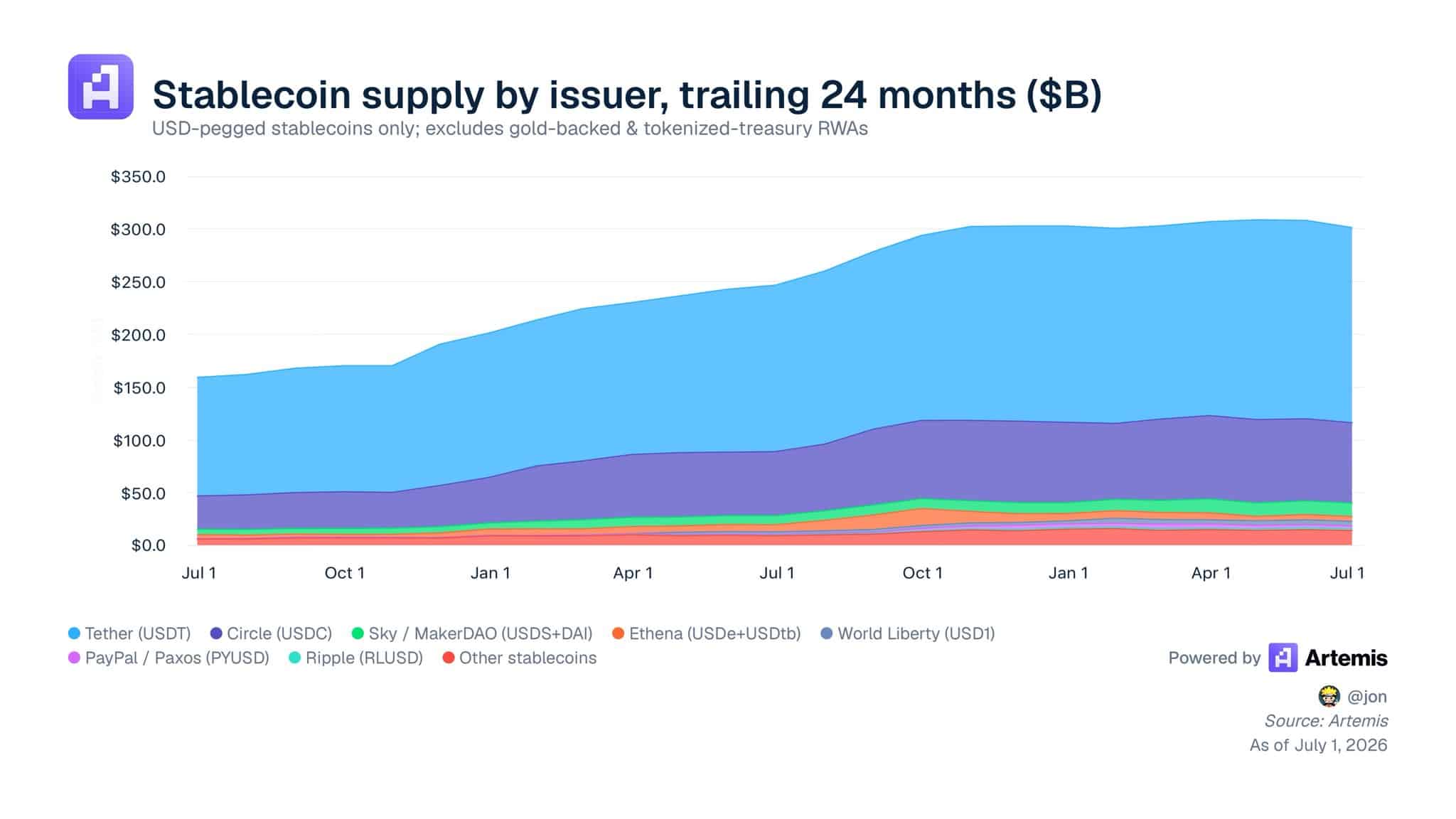
Fuente: Artemis

Si bien USDT [Tether] aún lidera el mercado, USDC de Circle sigue siendo la segunda stablecoin más grande. También es una de las principales apuestas corporativas en el espacio. Esto se vuelve importante cuando piensas en el movimiento de Standard Chartered, con el banco construyendo acceso en torno a una stablecoin que ya tiene escala.

La oferta de USDC se ha mantenido en el rango de 70 mil millones a 80 mil millones de dólares en los últimos meses, por lo que la demanda se ha mantenido incluso con nuevos emisores ingresando al mercado. Por lo tanto, aunque las stablecoins puedan tener múltiples ganadores a largo plazo, Circle sigue siendo uno de los nombres con los que es más probable que trabajen las instituciones.


Resumen Final

  • Standard Chartered y Circle permitirán a las instituciones emitir y canjear USDC.
  • USDC es la segunda stablecoin más grande, con una oferta de 70.000M-$80.000M.

Crypto di tendenza

ctr
CitreaCTR
wstusdt
wrapped stUSDTWSTUSDT
apr
aPrioriAPR
ctx
Cryptex FinanceCTX
audio
AudiusAUDIO
mantra
MantraMANTRA
xvs
VenusXVS
waxl
AxelarWAXL
bill
Billions NetworkBILL
pyth
PYTH (Pyth)PYTH
rune
THORChainRUNE
velodrome
Velodrome FinanceVELODROME
brev
BrevisBREV
cake
PancakeSwapCAKE
jst
JUSTJST

Domande pertinenti

Q¿Qué están haciendo Standard Chartered y Circle con respecto a USDC?

AStandard Chartered y Circle han creado una forma para que los clientes institucionales emitan y canjeen USDC a través de un proceso dirigido por un banco, empezando en el Centro Financiero Internacional de Dubái (DIFC).

Q¿Por qué es importante esta asociación para el acceso institucional a USDC?

AEsta asociación permite a las instituciones acceder a los servicios de USDC a través de las infraestructuras bancarias de Standard Chartered, integrando la banca, custodia y servicios de activos digitales en una oferta única, lo que simplifica el proceso en lugar de tener cuentas separadas directamente con Circle.

Q¿Cómo ha evolucionado la oferta de stablecoins en los últimos 24 meses según la información del artículo?

ASegún Artemis, la oferta de stablecoins vinculadas al dólar estadounidense casi se ha duplicado en los últimos 24 meses, pasando de unos 160 mil millones a alrededor de 300 mil millones de dólares para julio de 2026.

Q¿Cuál es la posición de USDC en el mercado de stablecoins y cuál es su oferta actual?

AUSDC es el segundo stablecoin más grande del mercado, después de USDT (Tether). Su oferta se ha mantenido en el rango de 70 a 80 mil millones de dólares en los últimos meses.

Q¿Qué convierte esta movida de Standard Chartered en algo significativo para Circle?

AEl movimiento de Standard Chartered es significativo porque construye acceso en torno a un stablecoin que ya tiene escala (USDC). Esto refuerza la posición de Circle como uno de los emisores con los que las instituciones tienen mayor probabilidad de trabajar, dado su volumen y enfoque corporativo.

Letture associate

AI Folding: Fable 5 and GPT-5.6 Are Becoming the Privilege of a Few

【AI Accessibility Gap Widens: Elite Tools Like Fable 5 and GPT-5.6 Are Becoming Privileged】 We are witnessing a growing "AI divide." A stark reality is emerging: a tiny fraction of elites, primarily in tech, are using powerful next-generation models like Fable 5 or the upcoming GPT-5.6, while the vast majority of the public only has access to "toys" - free, limited models equivalent to ChatGPT's basic versions (8B to 30B parameters). This creates a massive experiential chasm and cognitive dissonance. Industry outsiders see AI as overhyped and ineffective, unable to grasp its transformative potential, while insiders leverage these advanced models for a decisive competitive edge. The gap isn't just about model quality but product functionality. Free users get a simple chatbot. Paying elites get integrated workflow systems—capable of creating specialized agents, processing complex data, and handling real-world tasks like management, coding, and planning. Demos showcasing AI planning weddings or building apps feel disconnected from everyday needs like managing bills, groceries, or health. The cost barrier is immense, with reports of engineers spending $1000 daily on Fable 5 inference. Elite users employ sophisticated multi-model workflows, combining different AIs for ideation, architecture, execution, and review, completing complex projects in minutes instead of weeks. This divide extends to critical areas like healthcare, where free models are dangerously unreliable for medical queries. However, some argue that for 90% of common business tasks, mid-tier models like GPT-5.5 are sufficient; the perceived limitation often stems from poor integration and lack of context, not model intelligence. Ultimately, unequal access to cutting-edge AI is creating a new form of social stratification, where the most powerful tools are becoming the exclusive privilege of a few.

marsbit18 min fa

AI Folding: Fable 5 and GPT-5.6 Are Becoming the Privilege of a Few

marsbit18 min fa

Cathie Wood's June $77M Investment: Are Crypto Stocks a True 'Substitute' for Bitcoin?

In June, Cathie Wood's ARK Invest purchased $77 million worth of publicly traded crypto-related stocks, including Coinbase, Circle, and Bullish, during Bitcoin's worst monthly performance in four years. This aligns with the investment thesis that such stocks offer a compliant way to gain exposure to the crypto cycle without directly holding Bitcoin. However, data analysis reveals significant drawbacks. A group of nine U.S.-listed crypto companies showed 30-day annualized realized volatility between 68% and 90%, nearly double Bitcoin's 37.6%. Over 90 days, Circle's volatility reached 103.6% versus Bitcoin's 37.8%. Drawdowns were also more severe for stocks like Circle (-51.4%) and MicroStrategy (-48.6%) compared to Bitcoin's -36.4% from its January high. Correlation analysis shows most stocks share only a moderate link to Bitcoin. For example, Circle, Robinhood, and Bullish have a 90-day correlation coefficient of just 0.55–0.58 with BTC, meaning only about one-third of their price movement is explained by Bitcoin's action. The rest stems from company-specific risks: earnings, competition, fundraising, and equity dilution. MicroStrategy (MSTR) is the notable exception, acting as a leveraged Bitcoin proxy with a beta of 1.59 and 0.85 correlation. Coinbase offers relatively balanced exposure. Circle exemplifies "crypto-wrapped" corporate risk, with its recent crash tied to stablecoin competition, not Bitcoin. Robinhood's diversified business insulates it from crypto downturns but also limits upside. Bitcoin miners like RIOT and MARA have posted significant gains year-to-date, driven primarily by their pivot to AI compute services, not Bitcoin's price. The article highlights that investing in crypto stocks often means accepting amplified volatility or layering on business-specific risks absent from direct Bitcoin ownership. For instance, MicroStrategy's recent challenges—its market value falling below its Bitcoin holdings (mNAV <1) and facing potential Bitcoin sales for liquidity—demonstrate equity-specific hazards like dilution and financing pressures not faced by a direct Bitcoin holder. ARK's buying spree represents a bet on a basket of different business models with varying crypto exposure, not a simple, lower-risk substitute for holding Bitcoin.

marsbit18 min fa

Cathie Wood's June $77M Investment: Are Crypto Stocks a True 'Substitute' for Bitcoin?

marsbit18 min fa

Crypto Welcomes the 'July Rebound'? On-Chain Bottom Signals Align, Reversal Still Requires Breakthrough Above $70k

The cryptocurrency market is showing signs of a potential "July rebound," with Bitcoin leading a recovery above $63,000 and total market cap rising. This bounce is attributed to improved macro expectations (weaker US jobs data easing Fed hike fears), a short squeeze in derivatives, and signs of whale accumulation. Key on-chain metrics signal a potential bottom, including the Sharpe Ratio hitting extreme lows, the AHR999 index nearing historic buy zones, and miner pressure reaching significant levels. However, analysts caution this is likely a corrective rebound rather than a confirmed trend reversal. Persistent challenges include weak spot demand, negative Coinbase Premium indicating institutional caution, and ongoing selling pressure in the altcoin market. Market sentiment remains in "extreme fear" territory, and the AVIV ratio suggests the average active Bitcoin investor is still at a loss. For a true bullish reversal, Bitcoin needs to convincingly break above the key $70,000 level (aligned with the Short-Term Holder Realized Price). The path to a new parabolic bull market is seen as dependent on attracting substantially more capital, as capital efficiency has declined. While prices may be approaching a cyclical bottom zone (with estimates between $37k-$60k), the market requires more sustained positive signals for a definitive uptrend.

marsbit49 min fa

Crypto Welcomes the 'July Rebound'? On-Chain Bottom Signals Align, Reversal Still Requires Breakthrough Above $70k

marsbit49 min fa

Trading

Spot

Articoli Popolari

Come comprare PUSH

Benvenuto in HTX.com! Abbiamo reso l'acquisto di Push Protocol (PUSH) semplice e conveniente. Segui la nostra guida passo passo per intraprendere il tuo viaggio nel mondo delle criptovalute.Step 1: Crea il tuo Account HTXUsa la tua email o numero di telefono per registrarti il tuo account gratuito su HTX. Vivi un'esperienza facile e sblocca tutte le funzionalità,Crea il mio accountStep 2: Vai in Acquista crypto e seleziona il tuo metodo di pagamentoCarta di credito/debito: utilizza la tua Visa o Mastercard per acquistare immediatamente Push ProtocolPUSH.Bilancio: Usa i fondi dal bilancio del tuo account HTX per fare trading senza problemi.Terze parti: abbiamo aggiunto metodi di pagamento molto utilizzati come Google Pay e Apple Pay per maggiore comodità.P2P: Fai trading direttamente con altri utenti HTX.Over-the-Counter (OTC): Offriamo servizi su misura e tassi di cambio competitivi per i trader.Step 3: Conserva Push Protocol (PUSH)Dopo aver acquistato Push Protocol (PUSH), conserva nel tuo account HTX. In alternativa, puoi inviare tramite trasferimento blockchain o scambiare per altre criptovalute.Step 4: Scambia Push Protocol (PUSH)Scambia facilmente Push Protocol (PUSH) nel mercato spot di HTX. Accedi al tuo account, seleziona la tua coppia di trading, esegui le tue operazioni e monitora in tempo reale. Offriamo un'esperienza user-friendly sia per chi ha appena iniziato che per i trader più esperti.

553 Totale visualizzazioniPubblicato il 2024.12.13Aggiornato il 2026.06.02

Come comprare PUSH

Discussioni

Benvenuto nella Community HTX. Qui puoi rimanere informato sugli ultimi sviluppi della piattaforma e accedere ad approfondimenti esperti sul mercato. Le opinioni degli utenti sul prezzo di PUSH PUSH sono presentate come di seguito.

活动图片